Migraine and Headache Treatment Near Venice, FL: Three Headaches, Who Treats Each, and the Upper Cervical Chiropractor
By Dr. Rusty Lavender, D.C. and Dr. Jacob Temple, D.C. — upper cervical chiropractors, Lavender Family Chiropractic, Sarasota, FL. Published October 2026.
If you live in Venice, Nokomis, Osprey or North Port and you have searched for a migraine chiropractor or headache treatment, you have found a page of general chiropractic offices along the Trail, each listing headaches among thirty other conditions, none explaining which kind of headache they are talking about. That matters, because the three headaches that account for nearly everyone we see from Venice are different problems with different treatments, and the one most often mistaken for migraine is the one that comes from the neck. This page sorts them out, lays out the Venice options honestly, shows what the research says about treating the upper neck for each, and explains why Venice patients make the 29-minute drive up I-75 to our office for the one piece nobody local offers. Our complete guide to migraines and the upper cervical spine covers the mechanism in depth; this is the Venice decision guide.
Educational content, not medical advice. A headache that is the worst of your life, comes on like a thunderclap, follows a head injury, or arrives with fever, stiff neck, confusion, weakness, vision loss, or trouble speaking is an emergency. Call 911.
Headaches in Venice: Why the Older Patient Is Different
Migraine remains the second leading cause of disability worldwide and the first among young women (Steiner et al., J Headache Pain 2020), and Venice has its share of those patients. But the Venice headache patient we see most is older, has had headaches for decades, is on more medications than a younger patient, and has often slid into the one headache that medication itself causes. Taking over-the-counter pain relievers more than two or three days a week can produce a daily headache called medication-overuse headache, and in a retiree managing arthritis, back pain, and a headache with the same bottle of ibuprofen, it is the most common reason a tension headache becomes chronic. The other thing that changes with age is the neck. Decades of cervical wear, an old whiplash from thirty years ago, and years of forward-head posture produce the cervicogenic headache that gets diagnosed as migraine or tension headache and treated with medication that does little for it.
Three Headaches, Three Different Problems
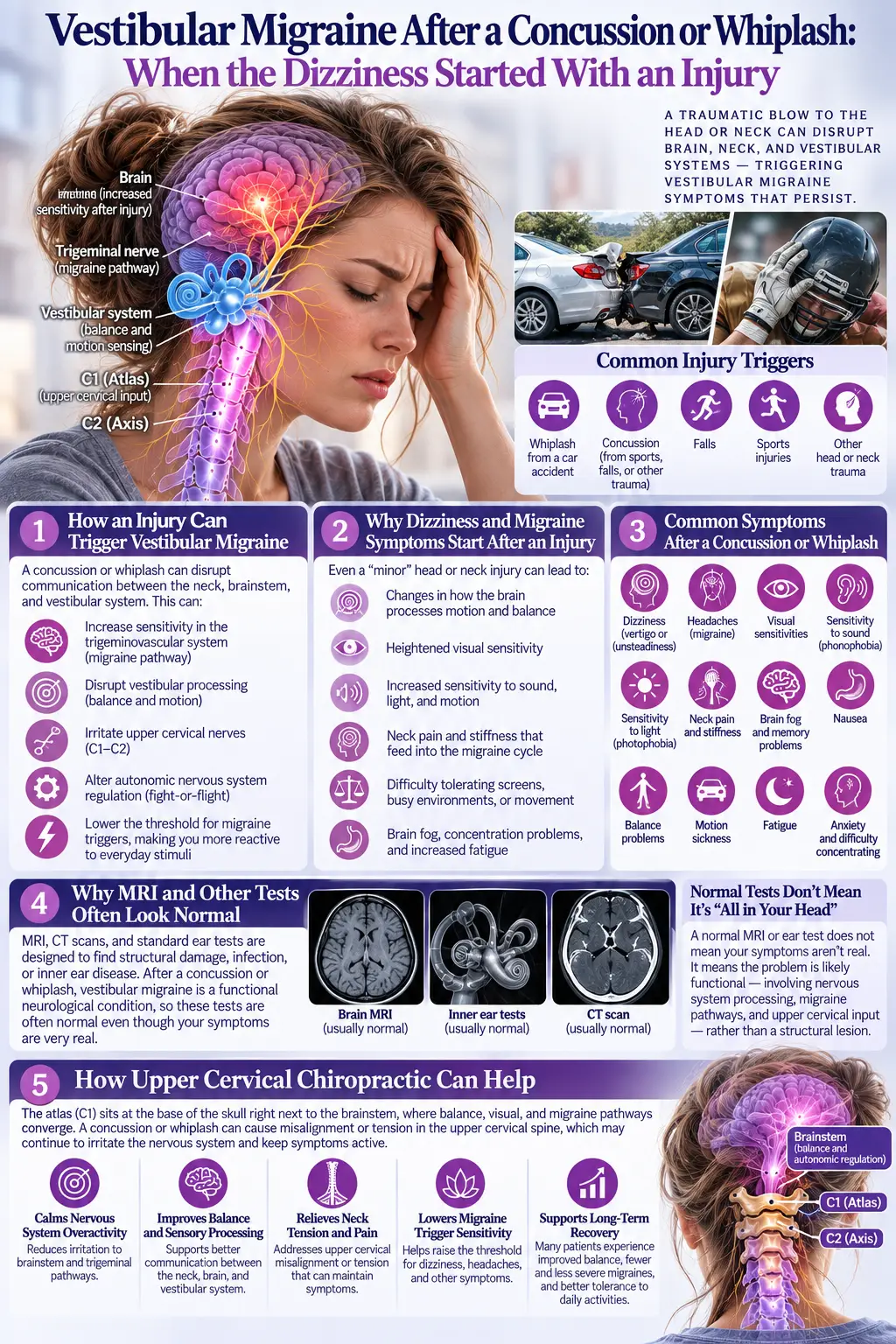
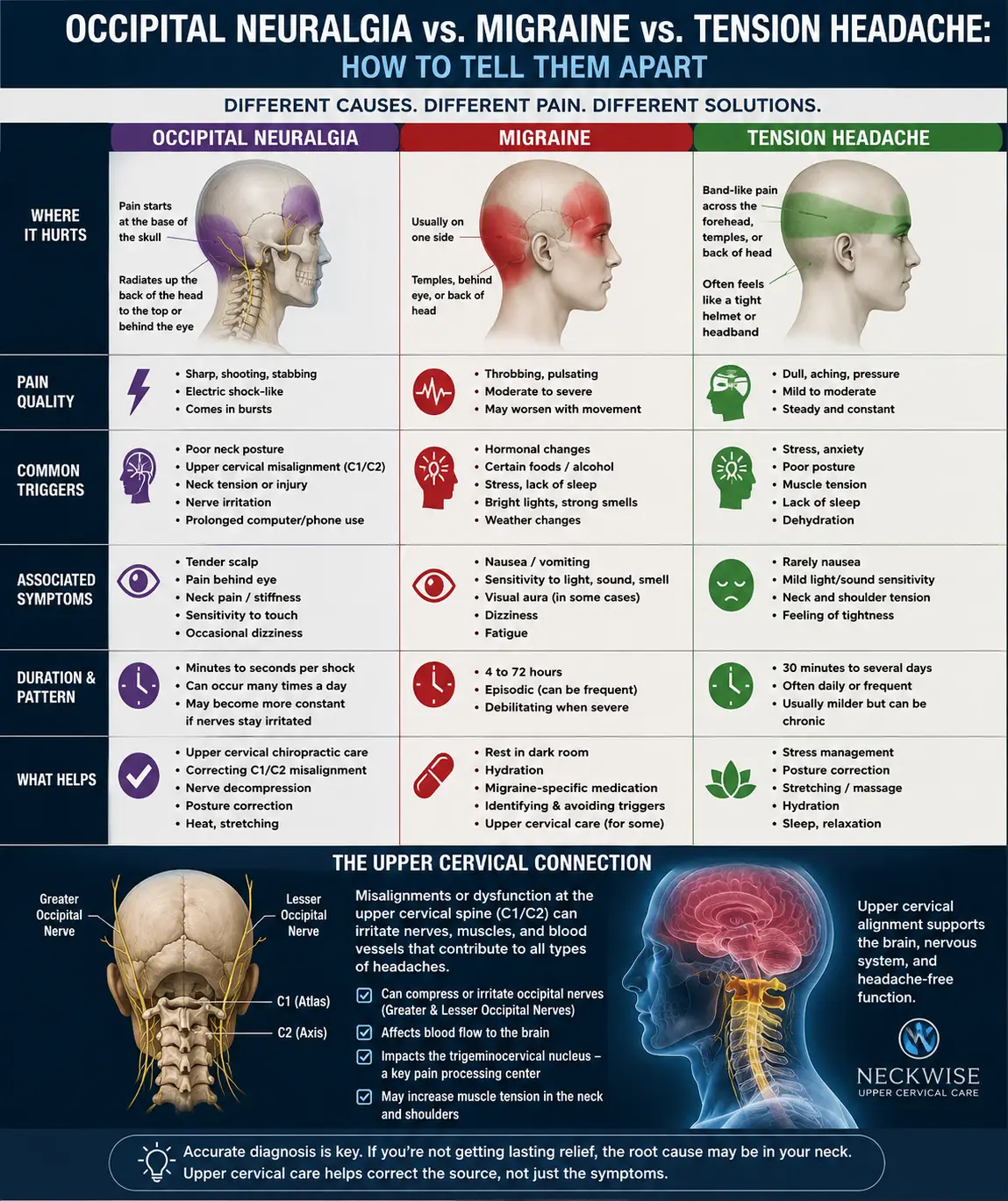
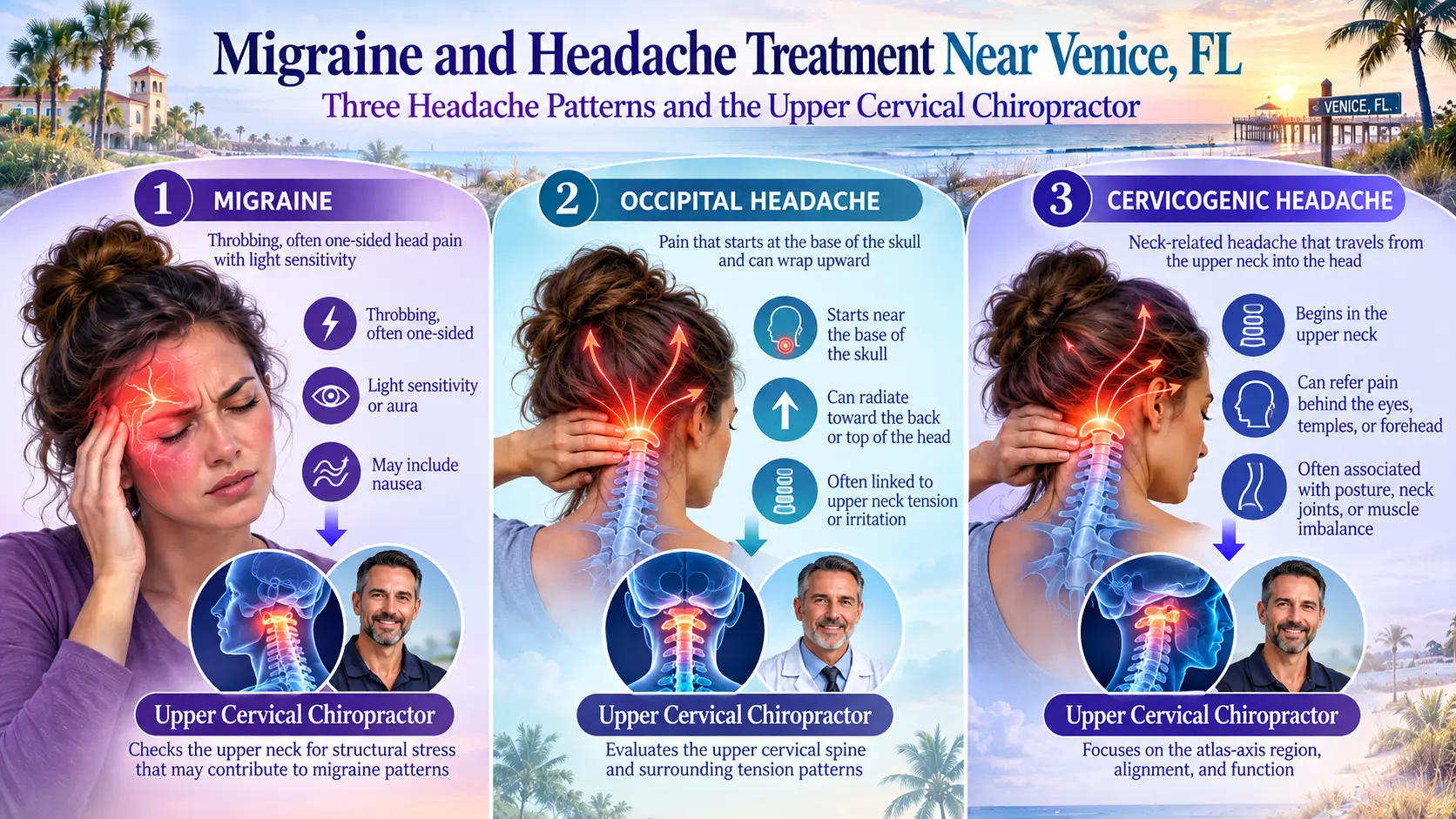
Migraine. Moderate to severe, usually one-sided, throbbing, four to seventy-two hours, with nausea or sensitivity to light and sound, sometimes a visual aura first. Migraine is a brain disorder, but the neck is wired into it: the sensory nerves of the upper three cervical segments and the trigeminal nerve that supplies the head converge on the same brainstem relay, the trigeminocervical complex (Bartsch and Goadsby, Curr Pain Headache Rep 2003). That is why so many migraine patients feel their attacks begin in the neck. If your migraines come with vertigo, see our vestibular migraine guide.
Tension-type headache. The most common headache there is: dull, pressing, band-like, both sides, mild to moderate, no nausea. Driven by muscle tenderness in the neck, shoulders and scalp. The chronic form, fifteen or more days a month, is what brings Venice patients to us after years of over-the-counter medication. The chiropractic headache guideline rates manipulation and mobilization of the cervical spine as reasonable options for it (Bryans et al., J Manipulative Physiol Ther 2011).
Cervicogenic headache. Referred from the neck: starts at the base of the skull on one side, spreads forward to the forehead or behind the eye, provoked by neck movement or sustained positions, reproducible by pressing on the upper neck. The diagnostic criteria were set out by the Cervicogenic Headache International Study Group (Sjaastad et al., Headache 1998); the anatomy is that the upper three cervical joints share nerve supply with the back of the head (Bogduk, Neurol Clin 2004). It is routinely misdiagnosed as migraine or tension headache. Our articles on pain and pressure at the base of the skull and occipital neuralgia versus cervicogenic headache go further.
The quick sort: one-sided throbbing with nausea or light sensitivity → migraine. Both sides, band-like, no nausea → tension-type. Base of the skull, one side, spreads forward, worse with neck movement → cervicogenic. Many Venice patients have migraine layered on a cervicogenic pattern, and treating the neck is what lowers the attack count.
Migraine and Headache Treatment Near Venice: Who Treats What
| If it looks like | Treatment with the best evidence | Who does it | Near Venice? |
|---|---|---|---|
| Migraine, frequent | Preventive medication (including CGRP antibodies), trigger management, acute plan | Neurologist / headache specialist | Yes, neurology in Venice and along the US-41 corridor |
| Migraine with a neck component | The above, plus care directed at the upper cervical spine | Neurologist + upper cervical chiropractor | Neurology yes; no upper cervical office south of Sarasota |
| Tension-type, chronic | Manual therapy to the neck, exercise, posture and stress management; cut analgesic days to avoid rebound | Chiropractor, physical therapist | Yes, general chiropractic and PT in Venice |
| Cervicogenic headache | Manipulation or mobilization of the upper cervical spine plus specific neck exercise | Upper cervical chiropractor | Closest is ours, 29 minutes up I-75 |
If you are having four or more migraine days a month and have never discussed prevention with a neurologist, go there first; we refer Venice patients for exactly that and work alongside. The neck-directed approach has its strongest evidence in cervicogenic headache: a randomized trial of 200 patients found manipulative therapy and a specific neck exercise program each reduced cervicogenic headache frequency and intensity compared with control, with the effect maintained at twelve months (Jull et al., Spine 2002).
What the Research Says About Chiropractic for Migraine
A randomized trial of 127 migraine patients found that chiropractic spinal manipulation reduced migraine frequency, duration, and medication use compared with a detuned-device control (Tuchin et al., J Manipulative Physiol Ther 2000). A later three-armed trial found that chiropractic manipulation reduced migraine days from baseline, with the reduction sustained through follow-up (Chaibi et al., Eur J Neurol 2017). A systematic review and meta-analysis pooling the trials concluded that spinal manipulation may reduce migraine days and pain intensity and called for larger trials (Rist et al., Headache 2019). Read together: treating the neck reduces migraine frequency, and it works best when there is a real neck component to treat, which is exactly what upper cervical imaging identifies.
Where the Upper Cervical Spine Fits
All three headache types run through the top of the neck. The upper three cervical nerves feed the trigeminocervical complex that drives migraine pain, supply the muscles that generate tension-type headache, and refer pain to the head directly in cervicogenic headache. The atlas and axis carry the densest concentration of position sensors in the spine and sit beneath the brainstem. When the atlas is shifted, the muscles at the base of the skull work constantly to keep the head level, the upper cervical joints sit under uneven load, and the nerves through the region are irritated. For a migraine patient that is a standing source of the neck input that lowers the attack threshold; for a tension or cervicogenic patient it may be the headache itself.
Upper cervical chiropractic is the most precise way to treat that target. A 3D cone-beam CT shows the actual position of the atlas and axis in three dimensions; paraspinal thermography reads the nervous system’s pattern along the spine; the correction is calculated from the imaging and delivered without rotating the neck, which matters for a seventy-five-year-old neck and for anyone whose headache is provoked by movement. And we re-measure, so you and we can see whether the structure changed.
What an Upper Cervical Evaluation for Headaches Involves
The first visit is an evaluation. A detailed headache history: where it starts, which side, how long, what accompanies it, what provokes it, what you take and how many days a week, and every collision, fall, and head injury back to childhood. An examination of the neck for the signs of cervicogenic headache and a screen for the red flags that need a physician first. Then measurement: 3D CBCT imaging of the upper cervical spine, paraspinal thermography, digital posture analysis. We review the findings with you before any care begins. Several of our Venice headache patients see us and a neurologist at the same time.
Getting Here From Venice
Our office is at 5899 Whitfield Avenue, Suite 107, at the corner of University Parkway and Whitfield Avenue, just west of I-75 by UTC. From Venice, take Venice Avenue east to I-75 North, exit at University Parkway, west to Whitfield: about 24 miles and 29 minutes outside rush hour. From Nokomis and Osprey, 20 to 25 minutes; from North Port, 36. Free parking at the door, and we keep the exam room dim for anyone who arrives mid-migraine. We book Venice patients mid-morning or early afternoon so you miss the I-75 commute. Our Venice page has the full picture.
Who Should and Shouldn’t Come
Come for an upper cervical evaluation if: your headaches start at the base of the skull or on one side of the upper neck and spread forward; they are provoked by neck movement, sustained positions, or waking; they began or worsened after a collision, fall, or concussion; you have tension-type headaches most days despite medication; or you have migraines with a neck component and your neurologist’s plan has plateaued.
See someone else first if: you have four or more migraine days a month and have never discussed prevention with a neurologist; your headache is new and severe or follows a head injury; or it comes with any neurological symptom.
Frequently Asked Questions About Migraine and Headache Treatment Near Venice
Where can I get migraine treatment in Venice, FL? Neurology practices in Venice and along US-41 handle migraine diagnosis and preventive medication. For the neck component of migraine, and for tension and cervicogenic headache, the closest upper cervical office is ours, 29 minutes up I-75.
Is there a migraine chiropractor in Venice? Several general chiropractors in Venice list headaches. The difference with an upper cervical office is that the top of the neck is imaged in 3D before anything is adjusted, the correction does not rotate the neck, and we tell you clearly whether the neck is part of your picture.
Can a chiropractor help with migraines? Trials show spinal manipulation reduces migraine frequency, with the benefit strongest when there is a real neck component, which is what upper cervical imaging identifies. We measure the neck first so you know whether you are in that group.
I take ibuprofen most days for my headaches. Is that a problem? Yes, and it is one of the most common things we find in Venice patients. More than two or three analgesic days a week can produce a daily headache of its own. Tapering that, with your physician, is often the first step.
How do I know if my headache is coming from my neck? Cervicogenic headache starts at the base of the skull, usually one side, spreads forward, gets worse with neck movement, and can be reproduced by pressing on the upper neck.
Do I need to stop seeing my neurologist? No. Many of our Venice patients see both of us, and we send your neurologist our findings if you want.
My headaches started after a car accident on US-41. Is that connected? Often. Whiplash loads the upper cervical spine, and headache is one of the most common lasting symptoms after it.
How many visits will it take? We can’t say until we have evaluated you. The first visit is history, exam, thermography, and imaging if indicated, with findings reviewed before any care begins.
Is the adjustment safe for someone in their seventies? The correction is low-force with no rotation, and many of our Venice patients are in their seventies and eighties.
Does insurance cover it? We are out of network. Many patients receive a superbill for reimbursement, and we go over costs before you commit to anything.
Lavender Family Chiropractic in Sarasota, Florida offers a thorough upper cervical evaluation to find out whether the top of your neck is part of your headaches. Call (941) 243-3729 or request an appointment. 5899 Whitfield Avenue, Suite 107, Sarasota, FL 34243, 29 minutes from Venice via I-75.
References
- Steiner TJ, et al. Migraine remains second among the world’s causes of disability, and first among young women: findings from GBD2019. J Headache Pain. 2020;21(1):137. PMID 33267788
- Bartsch T, Goadsby PJ. The trigeminocervical complex and migraine: current concepts and synthesis. Curr Pain Headache Rep. 2003;7(5):371–376. PMID 12946290
- Bryans R, et al. Evidence-based guidelines for the chiropractic treatment of adults with headache. J Manipulative Physiol Ther. 2011;34(5):274–289. PMID 21640251
- Sjaastad O, Fredriksen TA, Pfaffenrath V. Cervicogenic headache: diagnostic criteria. Headache. 1998;38(6):442–445. PMID 9664748
- Bogduk N. The neck and headaches. Neurol Clin. 2004;22(1):151–171. PMID 15062532
- Jull G, et al. A randomized controlled trial of exercise and manipulative therapy for cervicogenic headache. Spine.2002;27(17):1835–1843. PMID 12221344
- Tuchin PJ, Pollard H, Bonello R. A randomized controlled trial of chiropractic spinal manipulative therapy for migraine. J Manipulative Physiol Ther. 2000;23(2):91–95. PMID 10714533
- Chaibi A, et al. Chiropractic spinal manipulative therapy for migraine: a three-armed, single-blinded, placebo, randomized controlled trial. Eur J Neurol. 2017;24(1):143–153. PMID 27696633
- Rist PM, et al. The impact of spinal manipulation on migraine pain and disability: a systematic review and meta-analysis. Headache. 2019;59(4):532–542. PMID 30973196
Related Posts
Get our upper cervical articles first.
Patients Experience