What Triggers a Fibromyalgia Flare? The Root Cause Behind the Triggers
By Dr. Rusty Lavender, D.C. — upper cervical chiropractor, Lavender Family Chiropractic, Sarasota, FL. Reviewed and updated October 2026.
Stress, poor sleep, overexertion, weather — you have read the trigger lists a hundred times. But triggers are not the disease. A trigger is simply the last straw on a nervous system that is already overloaded, already stuck in overdrive, already running hotter than it should every single day. The real question is not “what set off this flare?” It is “why is my nervous system so easily overwhelmed in the first place?” And for a great many people across Sarasota, Lakewood Ranch, and Bradenton, the answer traces back to the one place their fibromyalgia workup never examined: the top of the neck, where the brainstem meets the spine and where a whiplash or concussion so often left its mark.
If you live with fibromyalgia, you know the pattern. Good days that feel manageable, then stretches where everything intensifies at once — the deep ache spreads, fatigue turns crushing, your mind wraps in fog, and sleep offers no rest. That intensification is a flare. Flares feel unpredictable, and that unpredictability is exhausting. The genuinely good news is that flares are not random. They follow recognizable patterns, they respond to management, and — most importantly — they point back to a nervous system whose baseline can be addressed at its source.
This article walks through what actually sets flares off, how to catch one early, and how to manage and prevent them. I will be honest where the evidence is strong and where it is genuinely mixed — including on weather, which is more complicated than most people expect. And I will make the case that most fibromyalgia care manages triggers while never asking about the driver underneath them.
This article is for general educational purposes only and is not medical advice. It is not intended to diagnose, treat, or replace the care of your physician. Fibromyalgia should be managed in partnership with your medical provider.
Understanding Fibromyalgia: The Central Sensitization Model
For a long time, fibromyalgia was dismissed as “all in your head.” We now understand it very differently. The leading scientific explanation is central sensitization.
Here is the core idea. In fibromyalgia, the central nervous system — your brain and spinal cord — processes pain signals differently than it does in people without the condition. The “volume knob” for pain and other sensations is turned up. Signals that should register as mild pressure get amplified into genuine pain. This increased pain sensitivity is a real, measurable phenomenon, not imagination. It also explains why fibromyalgia comes bundled with far more than pain: fatigue, unrefreshing sleep, fibro fog, heightened sensitivity to light, sound, and temperature, and a nervous system that seems permanently on alert.
When you understand fibromyalgia as an overly sensitive, easily overwhelmed nervous system, flares make sense. A flare is a period when that already-sensitized system gets pushed past its current capacity. The triggers we will discuss — stress, poor sleep, overexertion — are not mysterious. They are ordinary demands that tax a system already working far harder than most just to keep things regulated.
But this raises the question the trigger lists never answer. A nervous system does not decide on its own to run in permanent overdrive. Something is holding the dial up. If you only ever manage the triggers, you are bailing water without ever asking where the leak is. To find the leak, you have to look at where the nervous system’s pain-and-alarm machinery physically lives.
Where the “Volume Knob” Actually Lives — and Why the Top of the Neck Drives It
The amplification that defines fibromyalgia — the turned-up volume, the constant threat-detection, the autonomic system stuck in fight-or-flight — is orchestrated in large part by the brainstem, the stalk of neural tissue connecting your brain to your spinal cord. The brainstem houses the pathways that are supposed to turn pain down and switch the body from “fight or flight” into “rest and recover.” When those pathways malfunction, pain stays up and the body stays on alert. That is central sensitization in physical terms.
Now the anatomy that changes the whole conversation. The brainstem descends through the base of the skull and continues into the top of your spine at the craniocervical junction — where your skull, atlas (C1), and axis (C2) meet. These top two vertebrae are the most mobile and least mechanically protected bones in your spine, held largely by ligaments while balancing the full weight of your head. Nowhere else does such critical neural tissue sit in such intimate mechanical relationship with bones this mobile.
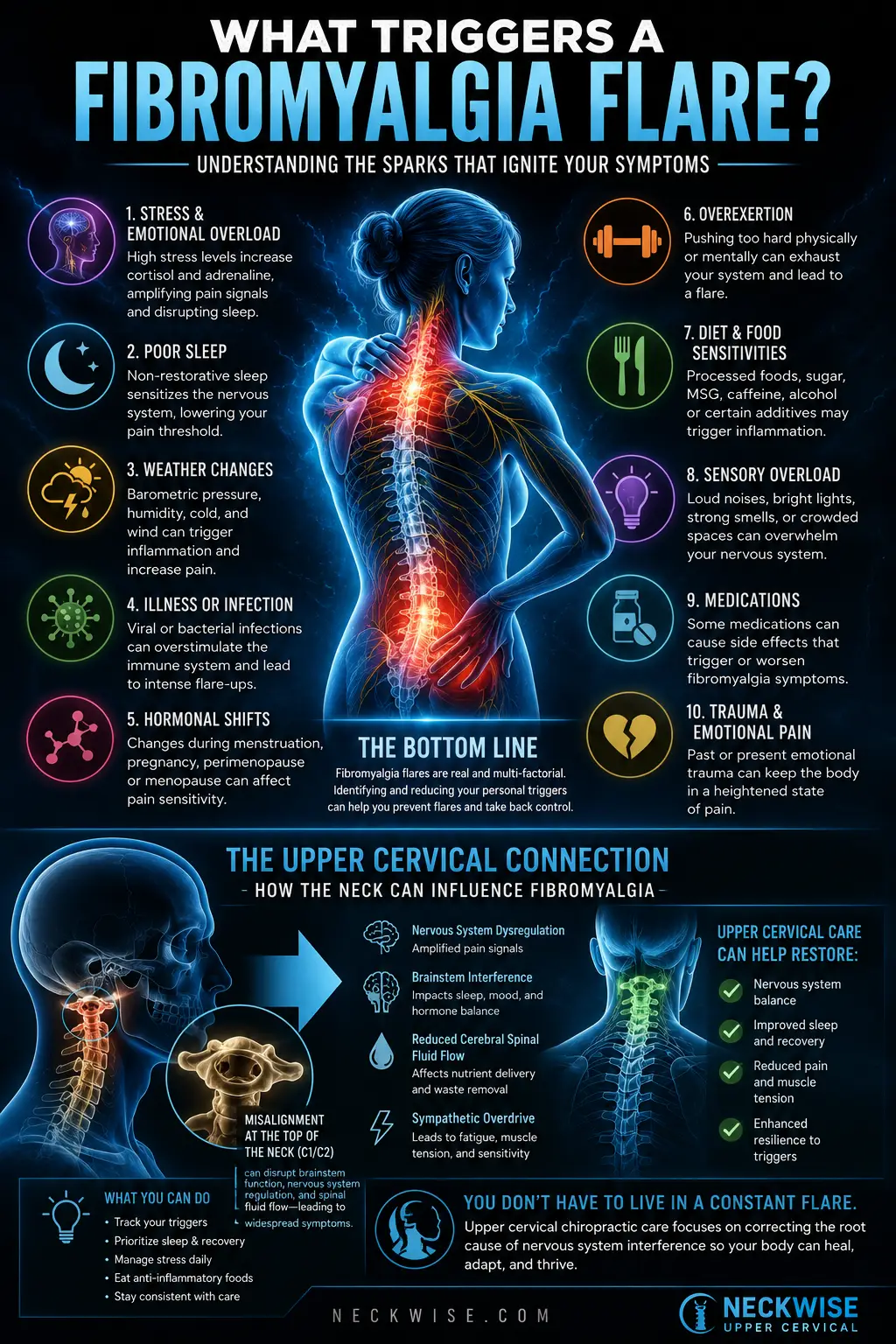
When the atlas or axis shifts out of alignment, the tissues at the skull base come under abnormal tension and stress — at the exact junction where the brainstem’s pain-modulating and autonomic pathways live. The plausible result is not a neck ache. It is a nervous system that cannot down-regulate, an autonomic system stuck in overdrive, and a pain dial that will not turn back down. That is a nervous system running near its limit every day — which is exactly why it takes so little to tip it into a flare. The upper cervical misalignment does not “cause the flare” on Tuesday. It lowers the whole threshold, so that Tuesday’s stress, or poor sleep, or a busy afternoon, is enough to push you over.
And here is the clue that ties it together: fibromyalgia so often begins after a head or neck injury — a car accident, a whiplash, a concussion, a hard fall. Patients across Sarasota, Lakewood Ranch, and Bradenton describe it the same way: “I was fine before the accident.” That same event that loaded and destabilized the craniocervical junction is, plausibly, the event that lowered your flare threshold for good. In most standard workups, no one connected that history to the region where the injury landed.
What Does a Flare Actually Feel Like?
A flare is a temporary but significant worsening of symptoms beyond your usual baseline. In a detailed qualitative study, researchers asked people with fibromyalgia to describe their flares in their own words, and the descriptions were remarkably consistent. Patients reported not just more pain, but a whole cluster of symptoms intensifying together: profound fatigue, worsening sleep, low mood and anxiety, cognitive difficulty, and a feeling of being generally “wiped out.” Many described flares as qualitatively different from everyday symptoms — not just a bad day, but a distinct state.
A more recent prospective observational study followed patients over time and helped characterize flares as identifiable episodes with a beginning, a peak, and a resolution, rather than one continuous, formless experience. That is encouraging. If flares have a shape, they also have an end. Knowing a flare will crest and subside, even in the thick of it, takes some of the fear out of the experience.
Common features during a flare include:
- Widespread pain that intensifies — the deep, aching, “flu-like” soreness spreads or sharpens.
- Crushing fatigue — a bone-deep exhaustion that rest does not fix.
- Worse sleep — more trouble falling asleep, staying asleep, or waking refreshed.
- Increased fibro fog — trouble concentrating, word-finding difficulty, forgetfulness.
- Heightened sensitivity — to light, sound, touch, or temperature.
- Mood changes — irritability, anxiety, or a dip in mood tracking with the physical symptoms.
Everyone’s flare signature is a little different. Part of managing fibromyalgia well is learning yours.
Common Flare Triggers — the Straws That Land on an Overloaded System
Triggers vary from person to person, and sometimes a flare arrives with no obvious cause. But several come up again and again. Notice, as you read, that every one of them is a load — an added demand on a system already running near its ceiling because of how it is being governed at the top of the neck.
Stress: The Most Consistently Reported Trigger
If patients name one trigger most often, it is stress — emotional, psychological, and physical. This is not just anecdote. Research comparing women in chronic pain from fibromyalgia and osteoarthritis found that those with fibromyalgia were more vulnerable to the effects of daily stress, with greater increases in pain and negative mood on stressful days. The same stressor a person without fibromyalgia would shrug off lands harder and translates more directly into symptoms.
This fits the model exactly. Stress activates the nervous system through those same brainstem-governed autonomic pathways. If your system is already sensitized and running hot from a destabilized craniocervical junction, additional stress has a shorter distance to travel before it tips you into a flare. “Stress” here is broad: emotional stress (conflict, grief, major life change), psychological load (deadlines, finances, caregiving), and physical stressors (illness, infection, injury, surgery, a poor night’s sleep). You cannot eliminate stress, and flares are never your fault for feeling it — but because stress is so consistent, buffering it is one of the highest-value things you can do.
Poor Sleep: Both a Trigger and a Symptom
Sleep and fibromyalgia have a two-way relationship. Poor sleep triggers a flare; a flare wrecks sleep, which deepens the flare. A study on sleep disturbances in fibromyalgia and their relationship to pain and depression found that disrupted, non-restorative sleep is tightly linked to symptom severity. Poor sleep is not merely a side effect — it actively feeds the pain and mood symptoms.
The mechanism makes sense. Restorative sleep is when the nervous system down-regulates and resets its sensitivity — a process orchestrated through the same brainstem circuitry sitting atop the craniocervical junction. When deep sleep is chronically shortchanged, the system never gets its reset. Pain thresholds drop. The tank starts each day closer to empty, and it takes less to trigger a flare. That is why sleep is such a leverage point: improving it raises your whole threshold.
Overexertion and the “Push-Crash” Cycle
Anyone who has lived with fibromyalgia knows the push-crash cycle. On a good day you seize the chance — clean the house, run every errand, tackle the yard — and a day or two later you crash, flat for days. Overexertion taxes a sensitized system, and the cruel twist is that a good day tempts you to overdo it. Mental and emotional overexertion count too — an intense workday, a demanding event, a stretch of caregiving.
The answer is not to stop moving. Deconditioning makes fibromyalgia worse, and gentle, regular movement genuinely helps most people. The answer is pacing — spending your energy at a steady, sustainable rate rather than in boom-and-bust cycles. More on that below.
Weather: The Honest, Complicated Answer
Now the trigger that generates the most disagreement between what patients report and what research finds. Many people with fibromyalgia are convinced weather affects them — cold snaps, damp days, dropping barometric pressure, an incoming storm. Here in the Sarasota, Lakewood Ranch, and Bradenton area, I hear about humidity, sudden swings from air conditioning to outdoor heat, and the pressure changes of our summer storm season. When someone tells me their body responds to weather, I believe that is their genuine experience.
Here honesty requires nuance. When researchers measured this rigorously, the picture was far less clear than patient conviction suggests. A notable study by Bossema and colleagues examined the influence of weather on daily symptoms of pain and fatigue in women with fibromyalgia, tracking actual weather data against actual daily symptom reports. Weather did not uniformly worsen symptoms across the group. There was no consistent, universal weather effect.
How do we reconcile that with so many patients feeling weather in their bones? A few honest possibilities:
- Weather effects may be highly individual. Some people genuinely may be weather-sensitive while others are not, and averaging everyone together washes the effect out. The research argues against a universal trigger, not against any individual’s experience.
- Memory and expectation shape perception. We notice and remember when weather and symptoms line up, and forget when they don’t. That is normal cognition, not a failing.
- Weather travels with other triggers. A stormy stretch often means worse sleep, less activity, and lower mood — all flare triggers themselves. Weather may be a marker for a bundle of changes rather than the direct cause.
Practically: do not treat weather as a proven, universal cause you must fear. If you suspect it affects you, track it (I show you how below). If your records show a reliable pattern, plan around it. If they don’t, that is freeing — you can stop bracing for every forecast and focus on the triggers evidence more consistently supports.
Other Common Triggers
Beyond the big ones, patients frequently point to hormonal changes around the menstrual cycle; illness and infection, which knock down reserves; dietary factors, which are highly individual; schedule disruption like travel or time-zone changes; and sensory overload from busy, loud, bright environments. The common thread is load — each is an added demand on a nervous system already working near its limit.
How to Recognize a Flare Early
One of the most empowering skills in living with fibromyalgia is catching a flare early. Many patients, once they pay attention, notice subtle warning signs before a full flare — a certain fatigue, a shift in mood, sleep starting to slip, a particular quality to the pain, rising sensitivity to noise and light. These early signals are your window. If you recognize a flare building, you can respond before it takes hold: dial back activity, prioritize rest and sleep, reduce stimulation, and lean on your calming strategies. You may not stop every flare, but early action can blunt severity and shorten duration.
A simple symptom-and-trigger journal becomes genuinely valuable here. For a few weeks, jot down your daily symptom level (a 1-to-10 scale is fine), your sleep quality, your stress, your activity, and anything notable — including weather, if you want to test that connection. Patterns emerge. You will find your personal early-warning signs and your personal triggers, the two most useful things you can know. Tracking turns fibromyalgia from something that happens to you into something you can anticipate.
Managing a Flare When It Hits
Sometimes a flare arrives anyway. That is not a failure — flares are part of the condition, and even excellent self-management does not eliminate them. When one hits, the goal shifts from prevention to getting through it gently.
Give yourself permission to rest. This is appropriate care for an overwhelmed nervous system, not weakness. Fighting through often prolongs a flare.
Lower the total stimulation. Dim the lights, quiet the environment, simplify your day. You are reducing demands on an overloaded system.
Protect your sleep. Sleep is where recovery happens. Guard your routine carefully, since poor sleep deepens and extends the episode.
Be gentle with movement. Complete inactivity stiffens you; a flare is not the time to push. Very gentle movement — a short slow walk, easy stretching — usually helps more than either bed rest or intense exercise.
Use your calming tools. Slow breathing, warmth, gentle relaxation — whatever reliably settles your nervous system.
Remind yourself it will pass. Flares have a shape — a rise, a peak, a resolution. The one you are in now will crest and ease.
Stay in touch with your physician about your medication plan, especially if flares are becoming more frequent, more severe, or longer.
Prevention and Pacing: Managing the Load While You Address the Driver
If flares come from a nervous system pushed past capacity, prevention is about managing your total load and addressing why the system runs so hot in the first place. Managing load is the daily work. The most important daily skill is pacing.
What Pacing Actually Means
Pacing is distributing your energy evenly over time rather than doing a lot on good days and crashing on bad ones — the deliberate alternative to push-crash. Done well, it keeps you inside your sustainable capacity, which reduces flares and, over time, may expand what you can do. Practical pacing looks like:
- Break activities into smaller chunks with rest between them. Fifteen minutes of gardening then a rest beats two hours followed by three days down.
- Rest before you are exhausted, not after. Planned rest beats emergency rest.
- Resist the “good day” trap. On good days, do a little more than a bad day but far less than you are tempted to. Save some in the tank.
- Alternate demanding and easy tasks so you are not stacking high-load activities back to back.
- Plan around your patterns. If your journal shows certain conditions are harder, lighten your schedule accordingly.
Most patients who commit to pacing get more done overall, because they lose far fewer days to flares.
Sleep as Prevention
Given how tightly sleep links to symptom severity, protecting it is one of the most valuable investments you can make. The fundamentals matter: a consistent sleep-wake schedule, a cool, dark, quiet bedroom, limited screens before bed, and caution with caffeine and alcohol. If sleep problems persist despite good habits, talk with your physician — sometimes there is an additional, treatable sleep issue at play.
Stress Reduction and Nervous-System Regulation
Because stress is so consistent a trigger, building stress-buffering habits is central. This is not about a stress-free life. It is about giving your nervous system regular chances to down-regulate: slow diaphragmatic breathing, gentle mindfulness, time in nature, gentle movement like tai chi or restorative yoga, and protecting time for what genuinely relaxes you.
Gentle, Consistent Movement
It seems paradoxical, but gentle, regular activity is one of the better-supported approaches for fibromyalgia long-term. The key words are gentle, regular, and gradual. Start small, build slowly, stay consistent. Low-impact options — walking, water exercise, stationary cycling, gentle stretching — are usually well tolerated. Pacing applies to exercise too.
Addressing the Driver: Upper Cervical Evaluation at Lavender Family Chiropractic
Everything above manages the load on your nervous system. But if the system runs hot because of a misalignment at the craniocervical junction — the region sitting directly beneath the brainstem’s pain and autonomic control — then load management is only half the picture. The other half is asking whether the driver itself can be addressed at its source.
At Lavender Family Chiropractic (NeckWise North Sarasota), we focus exclusively on the upper cervical spine — the atlas, the axis, and the junction where the skull meets the neck. We do not guess. We use 3D CBCT imaging to see your upper cervical alignment in three dimensions and tailor care to your individual anatomy, and paraspinal infrared thermography to read how your nervous system is behaving along the spine — directly relevant when the whole question is a system stuck in overdrive. When a correction is warranted, we use the Knee Chest Upper Cervical technique: precise, gentle, and low-force, with no twisting, cracking, or popping. For a sensitized, easily overwhelmed nervous system, that gentleness is the entire point.
The goal is straightforward: give an overloaded nervous system a calmer structural environment, so its baseline is not sitting at the edge of a flare every day. Keep your physician. Keep your pacing, sleep, and stress work — they matter and they work better when the structure underneath is not fighting you. But if your flares are frequent, if your fibromyalgia started after a head or neck injury, and if no one has ever evaluated the top of your neck, that is the missing evaluation — and it is the one place driving the whole picture that nobody checked.
Serving Sarasota, Lakewood Ranch & Bradenton
Lavender Family Chiropractic (NeckWise North Sarasota) is proud to serve Sarasota, Lakewood Ranch, Bradenton, and the surrounding communities of Manatee and Sarasota Counties, including University Park, Palmetto, and Ellenton. Our practice focuses on precise, gentle, low-force upper cervical care — no twisting, cracking, or popping — using 3D CBCT imaging and paraspinal infrared thermography to guide an individualized approach.
If you live with fibromyalgia flares in Sarasota, Lakewood Ranch, or Bradenton and want to know whether a destabilized craniocervical junction is lowering your flare threshold, we would be glad to talk. We offer a consultation with our doctors to listen to your story, answer your questions honestly, and coordinate with your physician. There is no pressure and no obligation.
Lavender Family Chiropractic (NeckWise North Sarasota) 5899 Whitfield Avenue, Suite 107 Sarasota, FL 34243(941) 243-3729
To schedule your consultation, give us a call. We serve families throughout Sarasota, Lakewood Ranch, and Bradenton, and we look forward to meeting you.
Red Flags: When to Seek Medical Evaluation
This is important, so I want to state it plainly. Fibromyalgia flares are real, but not every new or worsening symptom is “just a flare.” Fibromyalgia does not make you immune to other conditions, and it is a serious mistake to attribute everything to it without checking.
Contact your physician or seek appropriate medical evaluation if you experience:
- New symptoms not typical of your usual flares — anything that feels different from your known pattern.
- New or worsening neurological symptoms — significant numbness, weakness, tingling, loss of coordination, or changes in vision or speech.
- Severe or sudden headache, especially one unlike any you have had before.
- Fever, unexplained weight loss, or night sweats, which are not features of fibromyalgia and warrant investigation.
- New joint swelling, redness, or warmth, which can point to a different or additional condition.
- Chest pain, shortness of breath, or other symptoms that concern you — do not dismiss these; seek prompt care.
- Flares becoming dramatically more frequent, severe, or prolonged, which is worth discussing with your physician.
The rule of thumb: if something is new, different, or does not fit your familiar fibromyalgia picture, get it evaluated. It is always better to check and be reassured than to assume.
Top Questions
How long does a fibromyalgia flare usually last? It varies widely from person to person and flare to flare. Some last a day or two; others stretch on for a week or more. Because flares tend to have a shape — building to a peak, then resolving — they do ease, even when it is hard to believe in the moment. If your flares are consistently lasting longer than usual, mention it to your physician.
Can I prevent flares completely? Realistically, no — flares are part of the condition. But you can often meaningfully reduce how often they happen and how severe they are through pacing, protecting sleep, managing stress, gentle movement, learning your triggers, and addressing the driver at the top of your neck. The goal is fewer and milder, not perfect.
Does weather really trigger flares? It is genuinely mixed. Many patients strongly feel weather affects them, and their experience deserves respect. But when researchers measured it rigorously, weather did not uniformly worsen symptoms across groups. Effects, if they exist, appear individual rather than universal. Track your own symptoms against the weather for a few weeks and plan based on your own data.
Is stress really that important, or is that an oversimplification? Stress is one of the most consistently reported triggers, and research shows people with fibromyalgia are more vulnerable to the effects of daily stress. That does not mean flares are your fault. It means stress is a genuine physiological load on an already-sensitized nervous system — which is exactly why calming that system, at its source, matters so much.
Should I avoid exercise to prevent flares? No — while overexertion can trigger flares, avoiding movement leads to deconditioning that makes fibromyalgia worse. The answer is gentle, regular, gradually increasing activity, paced carefully. If you are unsure where to begin, your physician or a physical therapist can help.
My flares started after a car accident. Is that relevant? Very. A whiplash or concussion loads and destabilizes the craniocervical junction — the exact region beneath the brainstem’s pain and autonomic control. If your flares trace back to a head or neck injury, the upper cervical spine is a primary driver worth evaluating rather than assuming.
Can chiropractic care treat my fibromyalgia? Upper cervical care addresses the upper-neck component of fibromyalgia, and we measure that component rather than assume it. What we offer is a precise, gentle, low-force evaluation and correction of the craniocervical junction — the region that may be keeping your nervous system stuck in overdrive — coordinated with your physician as part of whole-person care. Any decision to add care should be made with your medical team.
What the Research Says
It is worth pulling the evidence together in one place.
First, flares are real, describable, and identifiable. Qualitative research capturing patients’ own words confirms that flares are a distinct, recognizable experience involving a cluster of worsening symptoms, not just “a bad day.” Prospective observational work has further helped characterize flares as episodes with a course over time — reassuring, since they rise, peak, and resolve.
Second, sleep matters enormously. Research on sleep disturbances in fibromyalgia shows a tight link between poor, non-restorative sleep and the severity of pain and depression, positioning sleep as both a trigger and a high-value target for prevention.
Third, stress is a genuine physiological factor. A study on vulnerability to stress in women with fibromyalgia found they were more reactive to daily stress than women with osteoarthritis, with greater increases in pain and negative mood on stressful days.
Fourth — and where honesty matters most — weather is not the clear-cut trigger many assume. The Bossema study on the influence of weather on daily pain and fatigue found weather did not uniformly worsen symptoms across patients. This does not dismiss anyone’s personal experience, but it argues against treating weather as a proven, universal trigger. Individual tracking is the sensible path.
The throughline is coherent: fibromyalgia is a condition of a sensitized nervous system, flares happen when that system is overloaded, and the evidence-aligned strategies — pacing, sleep, stress reduction, gentle movement — all work by reducing load. The question that completes the picture is why the system runs so hot, and that points toward the craniocervical junction where the nervous system is governed.
A Final Word
Living with fibromyalgia takes daily resilience that people without the condition rarely appreciate. Flares are discouraging, and the unpredictability wears on you. But you are not powerless. By understanding your triggers, learning your early-warning signs, pacing your energy, protecting your sleep, tending to your nervous system — and by finally evaluating the one region that may be keeping that system in overdrive — you shift the odds in your favor. Not toward a flare-free life, which no one can honestly promise, but toward fewer and gentler flares and more good days. Be patient and kind with yourself. This is a marathon, and you are allowed to go at a sustainable pace.
Lavender Family Chiropractic (NeckWise North Sarasota) 5899 Whitfield Avenue, Suite 107 Sarasota, FL 34243(941) 243-3729
This article is for general educational purposes only and is not medical advice. It is not intended to diagnose, treat, or replace the care of your physician. Fibromyalgia should be managed in partnership with your medical provider. If you experience new, severe, or unusual symptoms, seek appropriate medical evaluation.
Related Articles
Related Posts


Get our upper cervical articles first.