
Top 10 Ways to Resolve Brachioradial Pruritus — And Why the Cervical Spine Is Almost Always the Missing Piece
By Dr. Rusty Lavender, D.C. — upper cervical chiropractor, Lavender Family Chiropractic, Sarasota, FL. Reviewed and updated October 2026.
Brachioradial pruritus is one of the most misunderstood and mismanaged conditions in healthcare today. Patients often spend months—or even years—bouncing between dermatologists, primary care providers, allergists, and neurologists, only to be told that nothing is “wrong” with their skin. Meanwhile, the itching, burning, tingling, or deep crawling sensation along the arms continues to disrupt sleep, concentration, and quality of life.
For many people, brachioradial pruritus becomes emotionally exhausting. The itching feels unbearable, scratching provides no relief, and visible skin changes are often absent. When treatments fail, patients are left questioning whether answers even exist.
The truth is this: brachioradial pruritus is not a skin disorder. It is a neurological condition, and in the vast majority of chronic cases, the root cause can be traced back to irritation or dysfunction in the cervical spine—particularly the upper and mid-cervical regions.
This article will walk you through the top 10 ways brachioradial pruritus is commonly treated, explain why most approaches fail long-term, and show how a precise upper cervical chiropractic approach at Lavender Family Chiropractic – NeckWise North Sarasota addresses the problem at its source rather than masking symptoms.
Understanding Brachioradial Pruritus: More Than “Just an Itch”
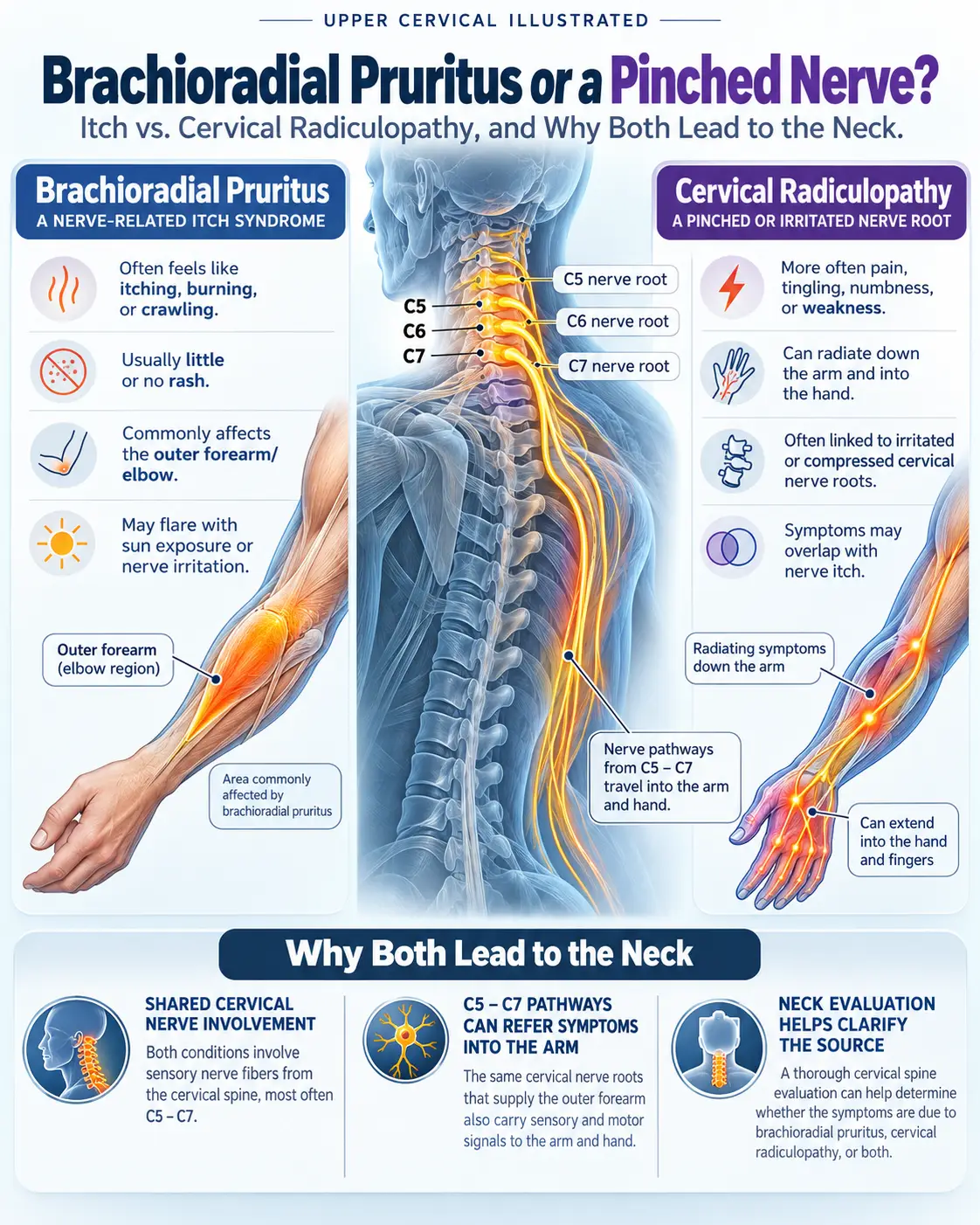
Brachioradial pruritus is characterized by intense itching, burning, tingling, or stinging sensations typically located on:
- The outer forearms
- Near the elbows
- Occasionally the upper arms, shoulders, or neck
A defining feature of this condition is that there is often no rash, or only secondary skin changes caused by scratching.
Why That Matters
If the skin looks normal, the problem is unlikely to originate in the skin itself. Instead, the sensation is coming from misfiring sensory nerves.
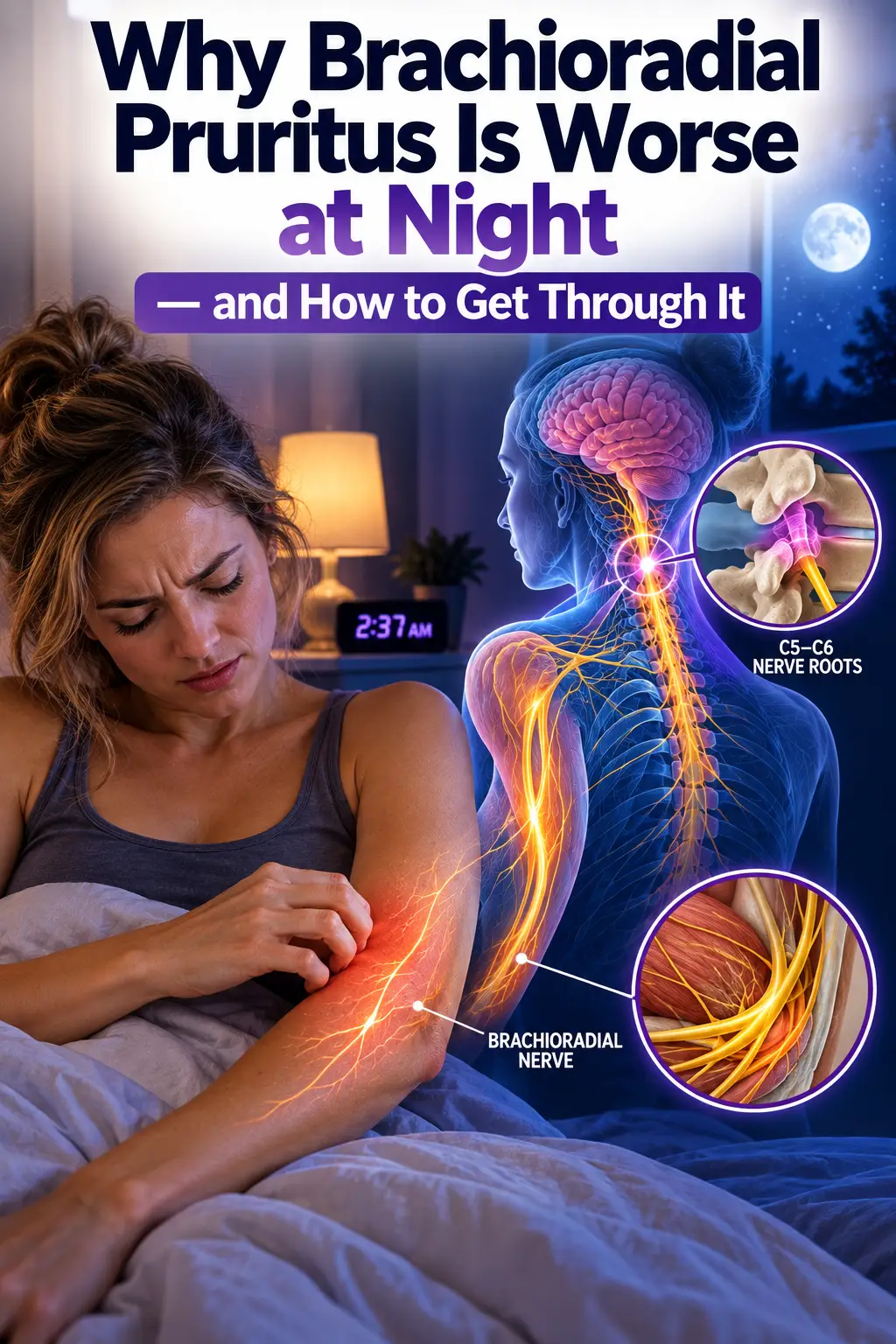
The nerves responsible for sensation in the arms originate in the cervical spine, specifically from the C5 and C6 nerve roots. When these nerves become irritated, compressed, or distorted, they can produce abnormal sensations—itching included.
The Neurological Nature of Brachioradial Pruritus
Unlike allergic itching or inflammatory skin conditions, brachioradial pruritus behaves more like:
- Neuropathic pain
- Phantom sensations
- Nerve hypersensitivity
This explains why:
- Scratching doesn’t help
- Ice often provides immediate relief
- Symptoms worsen at night
- Conventional dermatology treatments fail
Understanding this neurological component is essential before discussing solutions.
Top 10 Ways to Resolve Brachioradial Pruritus
We’ll start with the most commonly used approaches and work our way toward the methods that actually address the root cause.
1. Topical Steroid Creams
Topical corticosteroids are often the first line of treatment.
Why They’re Prescribed
Steroids reduce inflammation and suppress immune responses in the skin.
Why They Often Fail
There is usually no skin inflammation to treat. The itching is generated by nerve irritation upstream, not by a skin pathology.
Many patients report:
- No improvement
- Brief improvement followed by relapse
- Thinning of the skin with prolonged use
2. Anti-Itch Creams and Cooling Agents
Products containing menthol, camphor, or lidocaine are frequently recommended.
Why They Help Temporarily
They overwhelm sensory receptors, creating a cooling or numbing effect.
Why Relief Doesn’t Last
These products do not:
- Correct nerve irritation
- Restore normal nerve signaling
- Address spinal dysfunction
Once the sensation wears off, symptoms return.
3. Ice Therapy (A Diagnostic Clue)
Many patients discover that ice provides dramatic relief.
Why Ice Works
Cold reduces nerve conduction velocity, temporarily calming irritated sensory fibers.
What This Tells Us
If ice helps significantly, it strongly suggests:
- A neurological origin
- Nerve hypersensitivity rather than skin disease
Ice is helpful, but it is not a solution.
4. Antihistamines
Antihistamines are often prescribed under the assumption that itching equals histamine release.
Why They Rarely Work
Brachioradial pruritus is not histamine-driven. There is no allergic cascade involved.
Sedating antihistamines may help with sleep, but they do not resolve the condition.
5. Prescription Nerve Medications
Medications such as gabapentin or pregabalin are sometimes prescribed.
Why They Can Reduce Symptoms
These drugs dampen abnormal nerve firing.
Why They Are Not Ideal Long-Term
- They do not correct the cause
- Symptoms often return when medication stops
- Side effects are common
Medication management is symptom control, not resolution.
6. Sun Avoidance and UV Protection
Some theories suggest sun damage contributes to brachioradial pruritus.
The Reality
Sun exposure can aggravate irritated nerves, but it is rarely the primary cause.
Many patients develop symptoms without excessive sun exposure, further pointing toward a spinal origin.
7. Physical Therapy
Physical therapy may focus on:
- Stretching the neck and shoulders
- Improving mobility
- Reducing muscular tension
When It Helps
It can reduce secondary muscular strain.
When It Falls Short
If the cervical spine is misaligned, exercises alone cannot restore proper nerve function.
8. Postural Correction
Improving posture can reduce mechanical stress on the neck.
Why It’s Helpful
Forward head posture increases cervical nerve tension.
Why It’s Not Enough
Posture does not realign vertebrae or correct existing neurological interference.
9. General Chiropractic Care
Some patients experience partial relief with traditional chiropractic adjustments.
Limitations
- Adjustments may not be specific enough
- Upper cervical misalignments are often missed
- Rotational forces may irritate sensitive nerves
10. Upper Cervical Chiropractic Care — The Root-Cause Solution
This is where lasting resolution most often occurs.
Why Upper Cervical Care Works
The atlas and axis (C1–C2) play a critical role in:
- Neurological signaling
- Head-neck alignment
- Spinal cord tension
- Brain-body communication
Even a subtle misalignment can create widespread neurological effects, including abnormal sensory signals in the arms.
At Lavender Family Chiropractic – NeckWise North Sarasota, care is focused exclusively on:
- The upper cervical spine
- Objective diagnostics using 3D CBCT imaging
- Functional nervous system scans
- Gentle, precise corrections without twisting or cracking
This approach allows the nervous system to recalibrate naturally.
Why the Cervical Spine Is the Missing Link
The nerves that supply the arms pass through the cervical spine before traveling down the arms. When the neck is misaligned:
- Nerves become irritated
- Sensory signals become distorted
- The brain interprets normal input as itching
Correcting spinal alignment removes the interference rather than suppressing the signal.
Why Many Patients Suffer for Years Without Answers
Brachioradial pruritus falls between specialties:
- Dermatology looks at skin
- Neurology often looks at the brain
- Primary care may dismiss symptoms
Upper cervical care bridges this gap by addressing structure, neurology, and function together.
How NeckWise North Sarasota Is Different
What sets this approach apart:
- Precision imaging instead of guesswork
- Objective nerve testing
- Specific corrections tailored to the individual
- Stability-focused care, not constant adjustments
Patients are not treated based on symptoms alone, but on measurable neurological findings.
Final Thoughts: True Resolution Requires Addressing the Source
Brachioradial pruritus is not something you have to “manage forever.” When the cervical spine is corrected and nerve irritation is removed, the nervous system can finally quiet down.
If you’ve tried creams, medications, ice, and avoidance strategies without success, it may be time to stop chasing symptoms and start addressing the root cause.
For many people, that root cause is in the upper cervical spine—and correcting it can change everything.
Schedule a Consultation
If you’re searching for a chiropractor sarasota florida, chiropractor near me, upper cervical chiropractor near me, or you’ve been looking for answers to ear pressure, dizziness, vertigo, headaches, and chronic congestion, we’re here to help.
Lavender Family Chiropractic (NeckWise North Sarasota)
5899 Whitfield Ave Ste 107, Sarasota, FL 34243
www.chiropractorsarasotaflorida.com
To learn more about us go to http://www.chiropractorsarasotaflorida.com
We also service Bradenton, Parrish, Ellenton, Ruskin, Venice, Tampa, St. Pete, Osprey, Longboat, Lakewood Ranch, Myakka City.
If you are in Tampa, Land O Lakes, Fort Myers, or Salt Lake City, you can visit my other locations! NeckWise Upper Cervical. Visit, www.neckwise.com
If you are not local, visit www.uccnearme.com to find a doctor in your area
Serving Sarasota, Bradenton, Lakewood Ranch, Parrish, Ellenton, Venice, Osprey, Siesta Key, Longboat Key, Lido Key, Myakka City, Punta Gorda, and St. Petersburg.
Frequently Asked Questions
What is brachioradial pruritus and why is it called a nerve problem?
Brachioradial pruritus is an intense itch, burn, or prickling on the outer forearms and upper arms with no rash to explain it. Scratching makes it worse and creams rarely help, because the problem is in the nerves, not the skin. The sensory nerves to that region leave the spine in the lower neck, and their signals are processed through the brainstem. We assess whether the cervical spine, especially the atlas, is irritating that pathway.
Why do steroid creams and antihistamines fall short for BRP?
Those products target skin inflammation and histamine, but BRP is a signaling problem along cervical nerves, which is why so many patients cycle through creams without lasting relief. Gabapentin can quiet nerve firing but does not change the structure irritating it. Medication decisions stay with your prescribing doctor. Our role is different: identify whether neck alignment is contributing, correct it with a precise, low-force adjustment, and measure the nervous system’s response with thermography.
How does cervical imaging help with brachioradial pruritus?
Imaging shows what the itch cannot. 3D cone-beam CT of the upper cervical spine reveals the exact position of the atlas and axis, which influences the posture and nerve tension of the whole neck below. Paraspinal infrared thermography shows uneven nervous system activity along the spine before a correction and whether it evened out afterward. Together they let us calculate the correction and confirm the result instead of adjusting on a guess.
Does sun exposure really matter in BRP, and how does that fit with neck care?
Many BRP patients notice the itch flares after sun on the arms, and protecting the skin reduces that trigger. Sun sensitivity and neck involvement are often both present: ultraviolet light irritates skin nerves that are already firing abnormally because of cervical irritation. Sun protection lowers the trigger; correcting the upper cervical alignment addresses the nerve pathway itself. Many patients notice the arms calm as thermography readings become more balanced, though results vary by person.
Do you evaluate BRP patients from Bradenton and Lakewood Ranch?
Yes. Our Sarasota office at 5899 Whitfield Avenue sits at the corner of University Parkway and Whitfield, minutes from Lakewood Ranch and Bradenton. We coordinate with dermatologists and neurologists already on your case and share imaging on request. The evaluation includes a history, neurological checks, thermography, and cone-beam CT when indicated. If the neck is not involved, we tell you and refer. Call (941) 243-3729 to schedule an evaluation.
Related Posts


Get our upper cervical articles first.