
TMJ Doctor Near Me and Lavender Family Chiropractic Sarasota, Florida: Tackling Atlas Misalignments & TMJ with Upper Cervical Chiropractic Care
By Dr. Rusty Lavender, D.C. — upper cervical chiropractor, Lavender Family Chiropractic, Sarasota, FL. Reviewed and updated October 2026.
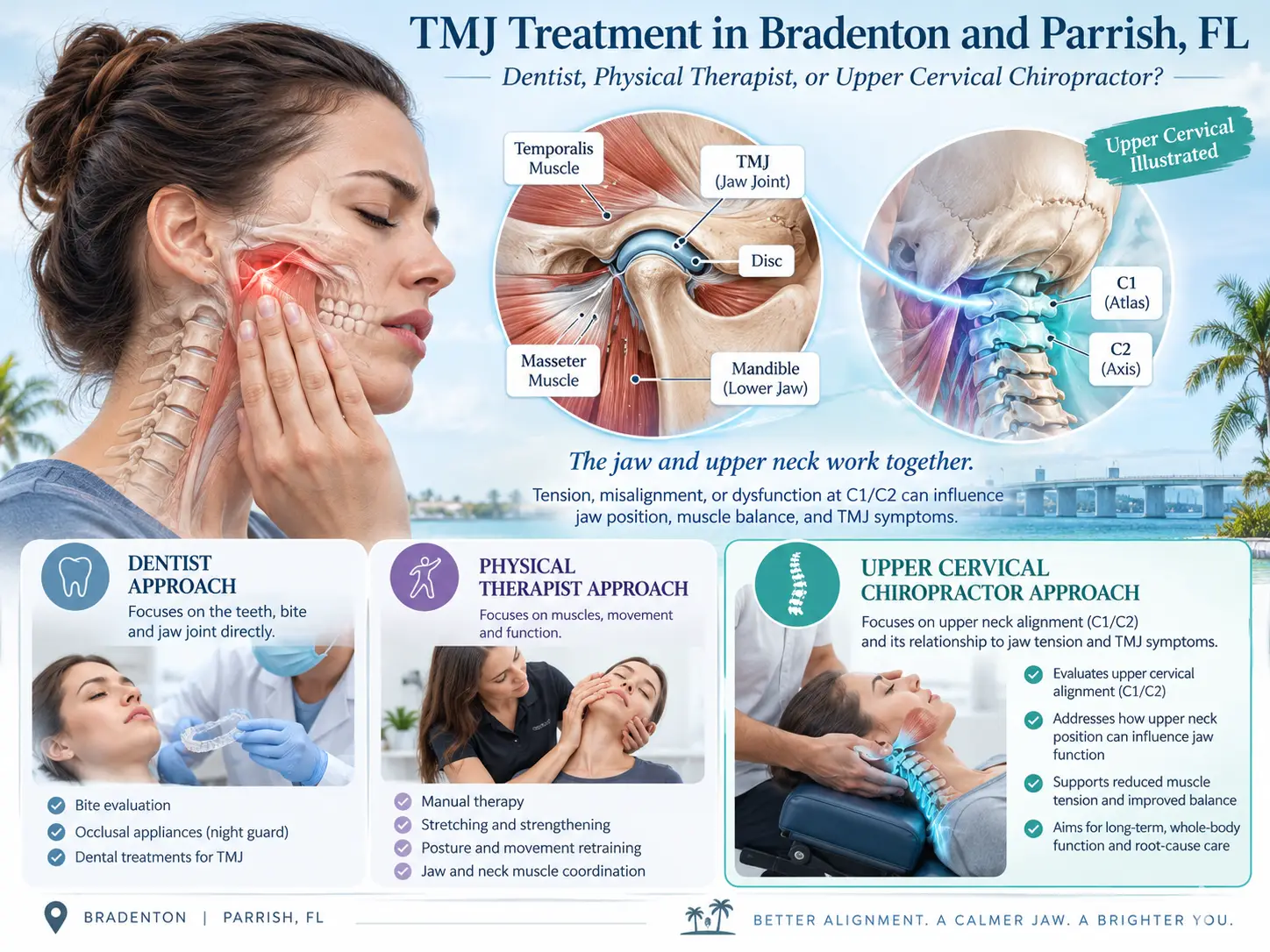
If you typed “TMJ doctor near me” from Sarasota, Lakewood Ranch, or Bradenton, you have probably already noticed that no single specialty owns TMJ. Dentists treat it. Oral surgeons treat it. Physical therapists treat it. ENTs rule out the ear. And upper cervical chiropractors, which is what we are, treat the one structure most of the others don’t examine: the top of the neck, which shares nerves, muscles, and movement patterns with the jaw. This page is a plain answer to the question you actually asked: who near you treats TMJ, how to tell which one you need, and what we do at our office at University Parkway and Whitfield Avenue. Our complete guide to TMJ treatment in Sarasota goes deeper on the jaw–neck connection; this page is the practical version.
Who Treats TMJ Near Sarasota, and When to See Each
A dentist or orofacial pain dentist is the right first call when the problem is clearly in the teeth and bite: grinding that has worn the enamel, a bite that changed after dental work, locking that started after a long dental appointment, or pain that is worst when you chew. Several Sarasota dental offices make splints and night guards, and an orofacial pain specialist can evaluate the joint itself. The formal diagnostic system most of them use, the DC/TMD, separates muscle-driven TMJ from joint-driven TMJ, and that distinction matters for who you see next (Schiffman et al., Journal of Oral & Facial Pain and Headache, 2014).
An oral and maxillofacial surgeon is for the small group whose joint has a structural problem: a disc that is displaced and will not recapture, a jaw that locks closed and cannot be opened, degenerative change on imaging, or trauma. Surgery is the last step, not the first, and most people searching “TMJ doctor near me” do not need it.
A physical therapist treats the muscles and joint mechanics with hands-on work and exercise. The evidence here is good: a 2016 systematic review and meta-analysis in Physical Therapy found that manual therapy and exercise, including work directed at the neck, reduced TMJ pain and improved mouth opening (Armijo-Olivo et al., 2016), and a 2015 review reached the same conclusion for pain and range of motion (Calixtre et al., Journal of Oral Rehabilitation, 2015).
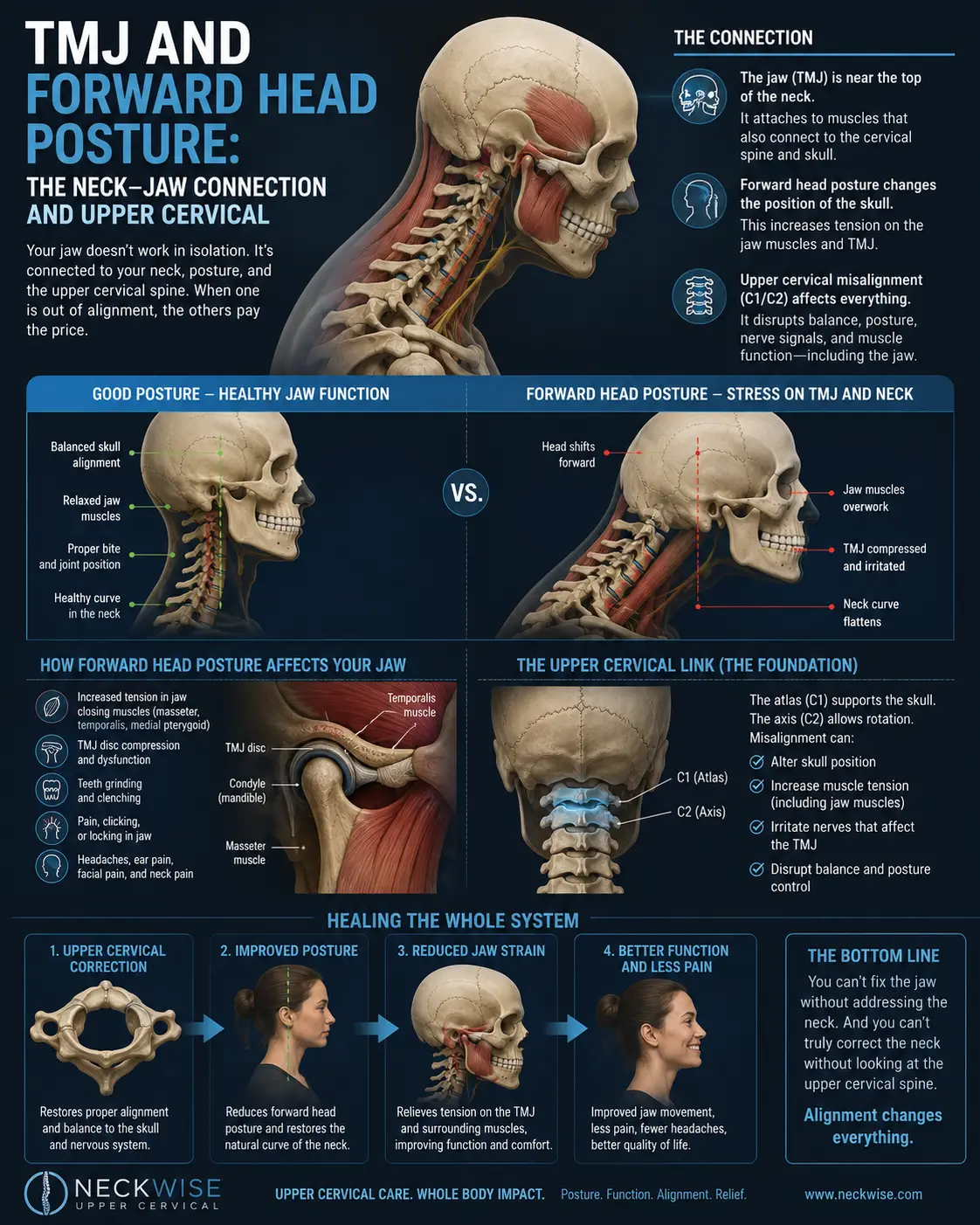
An upper cervical chiropractor is who to see when the jaw problem travels with a neck problem, or when the jaw has been treated and the pain keeps coming back. That describes a lot of TMJ patients. A 2015 study found that people with chronic TMJ had significantly more neck disability and more tender neck muscles than people without it, and that jaw dysfunction and neck disability rose together (Silveira et al., BioMed Research International, 2015). A systematic review found a consistent association between forward head posture, cervical posture, and TMJ (Olivo et al., Journal of Orofacial Pain, 2006). If your jaw hurts and your neck is also stiff, clicks, or aches at the base of the skull, the neck is part of the picture, and we are the office that measures it.
Why the Top of the Neck Matters for the Jaw
The jaw and the upper neck are not neighbors that happen to hurt at the same time. They are wired together. Every time you open your mouth, your head extends slightly on the top two vertebrae; every time you close it, your head flexes back. This was measured directly with motion recordings in healthy adults: mandibular and head–neck movements are coordinated, not independent (Eriksson et al., Journal of Dental Research, 2000; Zafar et al., Archives of Oral Biology, 2000). The muscles that position the head, the suboccipitals and upper trapezius, co-contract with the muscles that close the jaw. And the sensory nerves from the jaw (the trigeminal nerve) and from the upper neck (C1 to C3) converge on the same relay in the brainstem, the trigeminocervical nucleus, which is why pain from one so often shows up in the other.
The upper neck is also where TMJ patients are measurably different. A 2017 study found that people with myogenic TMJ had significantly reduced rotation at the C1–C2 joint on the cervical flexion-rotation test compared with controls (Greenbaum et al., Musculoskeletal Science and Practice, 2017). That is the exact joint upper cervical chiropractic is built to evaluate and correct.
What the Research Says About Treating the Neck for TMJ
Treating the upper neck changes the jaw. That is not a theory; it has been tested.
- In a randomized trial, a single manipulation of the atlanto-occipital joint, the joint between the skull and the atlas, immediately increased active mouth opening and raised pressure pain thresholds over the trigeminal nerve in women with neck pain (Mansilla-Ferragut et al., Journal of Manipulative and Physiological Therapeutics, 2009).
- A second randomized trial reproduced the finding in a different group: atlanto-occipital manipulation and suboccipital muscle release both increased mouth opening and reduced tenderness in the masseter and temporalis, the two main chewing muscles (Oliveira-Campelo et al., Journal of Orthopaedic & Sports Physical Therapy, 2010).
- Manual therapy and exercise aimed only at the cervical spine, with no treatment to the jaw at all, reduced orofacial pain and raised pain thresholds over the masticatory muscles in patients with myofascial TMJ (La Touche et al., Journal of Oral Rehabilitation, 2009).
- A 2019 randomized trial found that mobilizing the upper cervical region and training the deep neck flexors reduced orofacial pain and improved mandibular function and headache impact in women with TMJ (Calixtre et al., Journal of Oral Rehabilitation, 2019).
- The relationship runs both ways: in a randomized trial, treating the jaw improved cervical movement impairment in patients with headache and TMJ features (von Piekartz and Hall, Manual Therapy, 2013).
Upper cervical chiropractic is the most precise way to treat that target. Those trials used hands-on techniques applied by feel; our correction is calculated from 3D cone-beam imaging of your atlas and axis, delivered without rotating or twisting the neck, and re-measured afterward with infrared thermography so we know the change held. The target is the same joint the trials treated; the difference is how exactly we can find it and how we verify the result.
Why TMJ Keeps Coming Back After a Splint
A night guard protects teeth and can unload the joint. What it cannot do is change the position of the head on the neck, or the resting tone of the muscles that hold it there. If the atlas is rotated or tilted, the muscles on one side of the neck and jaw work harder around the clock to keep the eyes level. The chewing muscles are part of that system. People in this situation often describe the same story: the guard helps at night, the jaw is tight again by mid-morning, and the neck is sore too. Large epidemiological work from the OPPERA study found that chronic TMJ is strongly associated with pain amplification and with other painful conditions, including headache and neck pain, rather than being an isolated joint problem (Slade et al., Journal of Dental Research, 2016; Harper et al., Journal of Dental Research, 2016). The neck is one of the few parts of that picture that can be measured and corrected.
What a TMJ Evaluation at Our Office Looks Like
We do not treat your jaw directly, and we will tell you on the first visit if the jaw is the whole problem and a dentist is the right call. What we do is determine whether the top of your neck is contributing, and by how much.
- History. When the jaw pain started, what else started around then (neck pain, headaches, ear fullness, dizziness, a car accident, a fall, a long dental procedure), what has helped, what has not.
- Neurological and postural exam. Head tilt, shoulder height, leg length, range of motion at the upper neck, and tenderness in the suboccipital and chewing muscles.
- Paraspinal infrared thermography. A heat scan down both sides of the neck that shows asymmetric nerve activity, which we repeat after the correction.
- 3D cone-beam CT of the upper neck. This is the part no one else in the TMJ pathway does. It shows the exact three-dimensional position of the atlas and axis relative to the skull, which is what we correct.
- A specific correction, calculated from the imaging and delivered to the atlas with no twisting, cracking, or rotation of the neck. Most patients feel a light pressure and nothing else.
Many of our TMJ patients keep seeing their dentist at the same time; that is the right arrangement. A splint protects the joint from the top while we work on the position of the head from below.
Symptoms That Point to the Neck as Part of Your TMJ
- Jaw pain on the same side as neck pain or a stiff upper neck
- Headaches at the base of the skull or behind one eye alongside the jaw pain
- Clicking or popping that started after a car accident, fall, or concussion
- Ear ringing or ear fullness with no ear infection
- Jaw tightness that returns within hours of taking out a night guard
- Forward head posture from desk work, with the jaw worst at the end of the workday
- Dizziness or a floaty feeling along with jaw and neck tension
Where We Are, From Wherever You’re Searching
Lavender Family Chiropractic is at 5899 Whitfield Avenue, Suite 107, at the corner of University Parkway and Whitfield Avenue, just west of I-75 by University Town Center. From downtown Sarasota it is about 15 minutes up US-41 or I-75. From Lakewood Ranch Main Street, under 10 minutes along University Parkway. From Siesta Key, about 25. From Bradenton, Parrish, Palmetto, or Ellenton, 20 to 25 minutes via I-75 or US-301; our TMJ guide for Bradenton and Parrishcovers the dental and physical therapy options on that side of the river too. From Venice or North Port, 30 to 40 minutes on I-75. Call (941) 243-3729 or request an appointment online.
Frequently Asked Questions
1. What kind of doctor should I see for TMJ near Sarasota?
Start with a dentist if the problem is clearly dental: worn teeth, a changed bite, locking after dental work. See a physical therapist or an upper cervical chiropractor if the jaw pain comes with neck pain, headaches, or ear symptoms, or if a splint has not held. See an oral surgeon only if imaging shows a structural joint problem or the jaw locks and will not open. Many patients see two of these at once, and that is appropriate.
2. Can a chiropractor treat TMJ?
An upper cervical chiropractor treats the neck component of TMJ, which research shows is present in a large share of chronic cases. Randomized trials have found that correcting the joint between the skull and the atlas immediately increases mouth opening and reduces tenderness in the chewing muscles. We do not adjust the jaw itself; we correct the position of the head on the neck, which changes the resting tension on the jaw.
3. How do I know if my TMJ is coming from my neck?
Clues: the jaw and neck hurt on the same side, the pain started after a car accident or fall, you have headaches at the base of the skull, your neck is stiff turning one direction, or a night guard helps at night but the jaw is tight again by morning. The only way to know for certain is to measure the upper neck, which is what our evaluation does.
4. Do I need to stop seeing my dentist?
No. Keep your splint, keep your dentist. We work alongside dental care, not instead of it. If your dentist wants our imaging or exam findings, we send them.
5. Is the upper cervical adjustment safe for someone with a clicking or locking jaw?
Yes. The correction is delivered to the top of the neck with no rotation, twisting, or cracking, and your mouth stays closed throughout. It does not load the jaw joint. If your jaw is locked closed, we will refer you to an oral surgeon first.
6. Does insurance cover TMJ treatment at a chiropractor?
Coverage varies by plan and by whether the diagnosis is coded as a neck condition or a jaw condition. Call us with your plan name and we will tell you what we can verify before your first visit.
7. How many visits does TMJ care take?
It depends on how long the problem has been there and whether an injury started it. Changes in mouth opening and muscle tenderness are often measurable after the first correction, which matches what the trials found. Holding the correction so the jaw muscles reset takes longer, and we re-measure at each visit rather than working from a fixed schedule.
8. Can TMJ cause ear fullness, ringing, or dizziness?
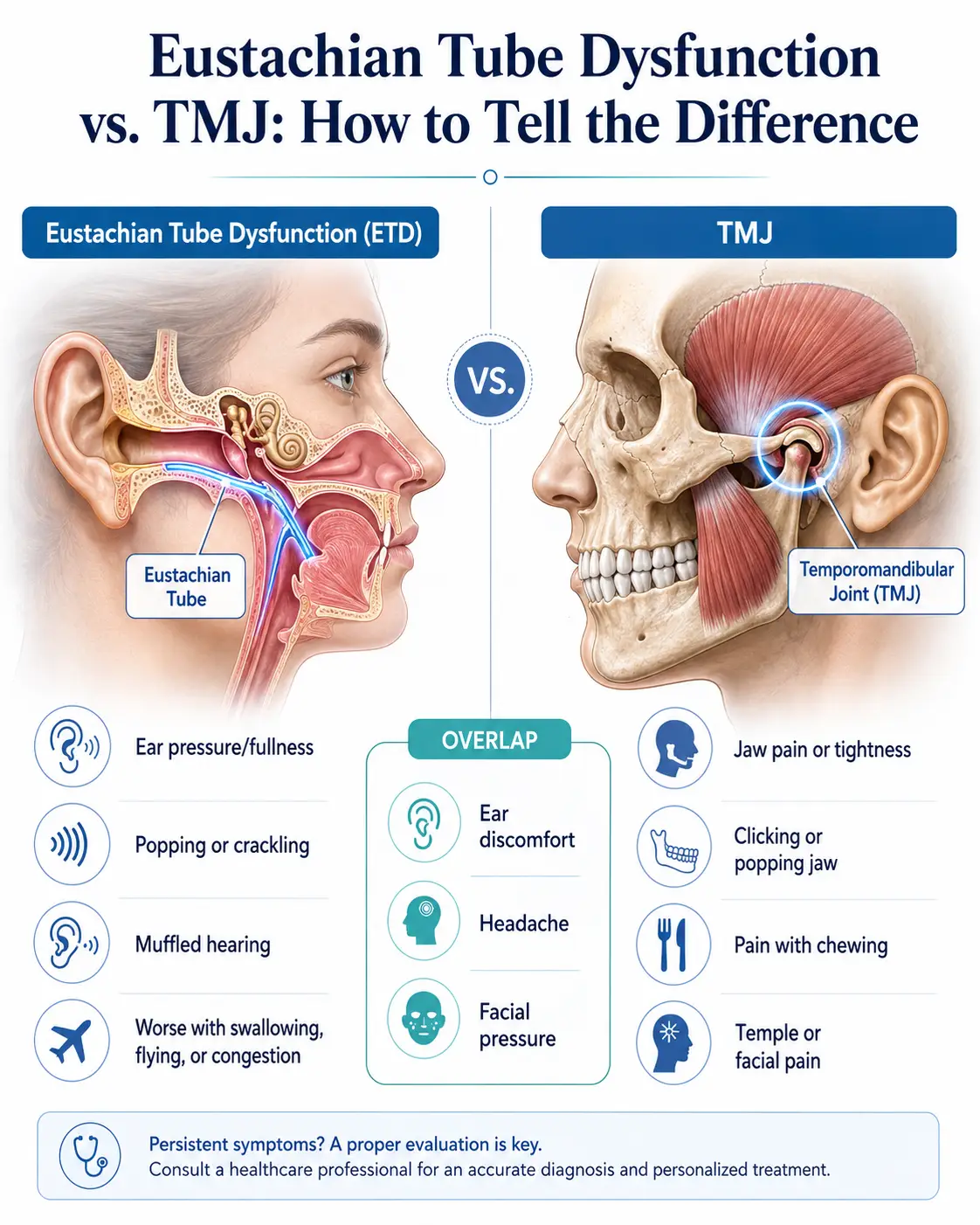
Yes, and so can the upper neck, which is one reason the two are so often confused. The jaw joint sits directly in front of the ear canal, and the upper neck shares nerve pathways with the ear and the balance system. Our guides on eustachian tube dysfunction vs. TMJ and TMJ and tinnitus explain how to tell them apart.
9. Do you see TMJ patients from Bradenton, Lakewood Ranch, and Venice?
Yes. We are at University Parkway and Whitfield Avenue by UTC, which puts Lakewood Ranch under 10 minutes away, Bradenton and Parrish 20 to 25, and Venice about 30 via I-75.
10. What should I bring to a TMJ evaluation?
Your night guard if you have one, any dental or jaw imaging reports, a list of what has been tried, and a note of when the jaw pain started and what else changed around that time. If you have had a car accident or concussion, even years ago, tell us.
Next Step
If your jaw pain has outlasted the splint, or it came with neck pain, headaches, or ear symptoms, the top of your neck should be measured. Lavender Family Chiropractic in Sarasota offers a thorough upper cervical evaluation, including 3D imaging, to find out whether the atlas is part of your TMJ. Call (941) 243-3729 or schedule online.
References
- Schiffman E, et al. Diagnostic Criteria for Temporomandibular Disorders (DC/TMD) for Clinical and Research Applications. J Oral Facial Pain Headache. 2014;28(1):6–27. PMID 24482784
- Armijo-Olivo S, et al. Effectiveness of Manual Therapy and Therapeutic Exercise for Temporomandibular Disorders: Systematic Review and Meta-Analysis. Phys Ther. 2016;96(1):9–25. PMID 26294683
- Calixtre LB, et al. Manual therapy for the management of pain and limited range of motion in subjects with signs and symptoms of temporomandibular disorder: a systematic review. J Oral Rehabil. 2015;42(11):847–861. PMID 26059857
- Silveira A, et al. Jaw dysfunction is associated with neck disability and muscle tenderness in subjects with and without chronic temporomandibular disorders. Biomed Res Int. 2015;2015:512792. PMID 25883963
- Olivo SA, et al. The association between head and cervical posture and temporomandibular disorders: a systematic review. J Orofac Pain. 2006;20(1):9–23. PMID 16483016
- Eriksson PO, et al. Co-ordinated mandibular and head-neck movements during rhythmic jaw activities in man. J Dent Res. 2000;79(6):1378–1384. PMID 10890716
- Zafar H, et al. Temporal coordination between mandibular and head-neck movements during jaw opening-closing tasks in man. Arch Oral Biol. 2000;45(8):675–682. PMID 10869479
- Greenbaum T, et al. Cervical flexion-rotation test and physiological range of motion: a comparative study of patients with myogenic temporomandibular disorder versus healthy subjects. Musculoskelet Sci Pract. 2017;27:7–13. PMID 28637604
- Mansilla-Ferragut P, et al. Immediate effects of atlanto-occipital joint manipulation on active mouth opening and pressure pain sensitivity in women with mechanical neck pain. J Manipulative Physiol Ther. 2009;32(2):101–106. PMID 19243721
- Oliveira-Campelo NM, et al. The immediate effects of atlanto-occipital joint manipulation and suboccipital muscle inhibition technique on active mouth opening and pressure pain sensitivity over latent myofascial trigger points in the masticatory muscles. J Orthop Sports Phys Ther. 2010;40(5):310–317. PMID 20436241
- La Touche R, et al. The effects of manual therapy and exercise directed at the cervical spine on pain and pressure pain sensitivity in patients with myofascial temporomandibular disorders. J Oral Rehabil. 2009;36(9):644–652. PMID 19627454
- Calixtre LB, et al. Effectiveness of mobilisation of the upper cervical region and craniocervical flexor training on orofacial pain, mandibular function and headache in women with TMD: a randomised, controlled trial. J Oral Rehabil. 2019;46(2):109–119. PMID 30307636
- von Piekartz H, Hall T. Orofacial manual therapy improves cervical movement impairment associated with headache and features of temporomandibular dysfunction: a randomized controlled trial. Man Ther.2013;18(4):345–350. PMID 23415640
- Slade GD, et al. Painful Temporomandibular Disorder: Decade of Discovery from OPPERA Studies. J Dent Res.2016;95(10):1084–1092. PMID 27339423
- Harper DE, et al. Pain Mechanisms and Centralized Pain in Temporomandibular Disorders. J Dent Res.2016;95(10):1102–1108. PMID 27422858
This article is for general information and is not a substitute for an individual evaluation. Upper cervical chiropractic care addresses the position and function of the upper neck; results vary, and we will refer you to a dentist, oral surgeon, or physician when your findings call for it.
Related Posts


Get our upper cervical articles first.