
Chiari Malformation and Upper Cervical Chiropractic: Sarasota’s Natural Relief at Lavender Family Chiropractic
By Dr. Rusty Lavender, D.C. — upper cervical chiropractor, Lavender Family Chiropractic, Sarasota, FL. Reviewed and updated October 2026.
Our complete guide to upper cervical chiropractic care in Sarasota covers the causes we see, the imaging we use, and what to expect at an evaluation.
Understanding Chiari Malformation: When the Brain Pushes Where It Shouldn’t
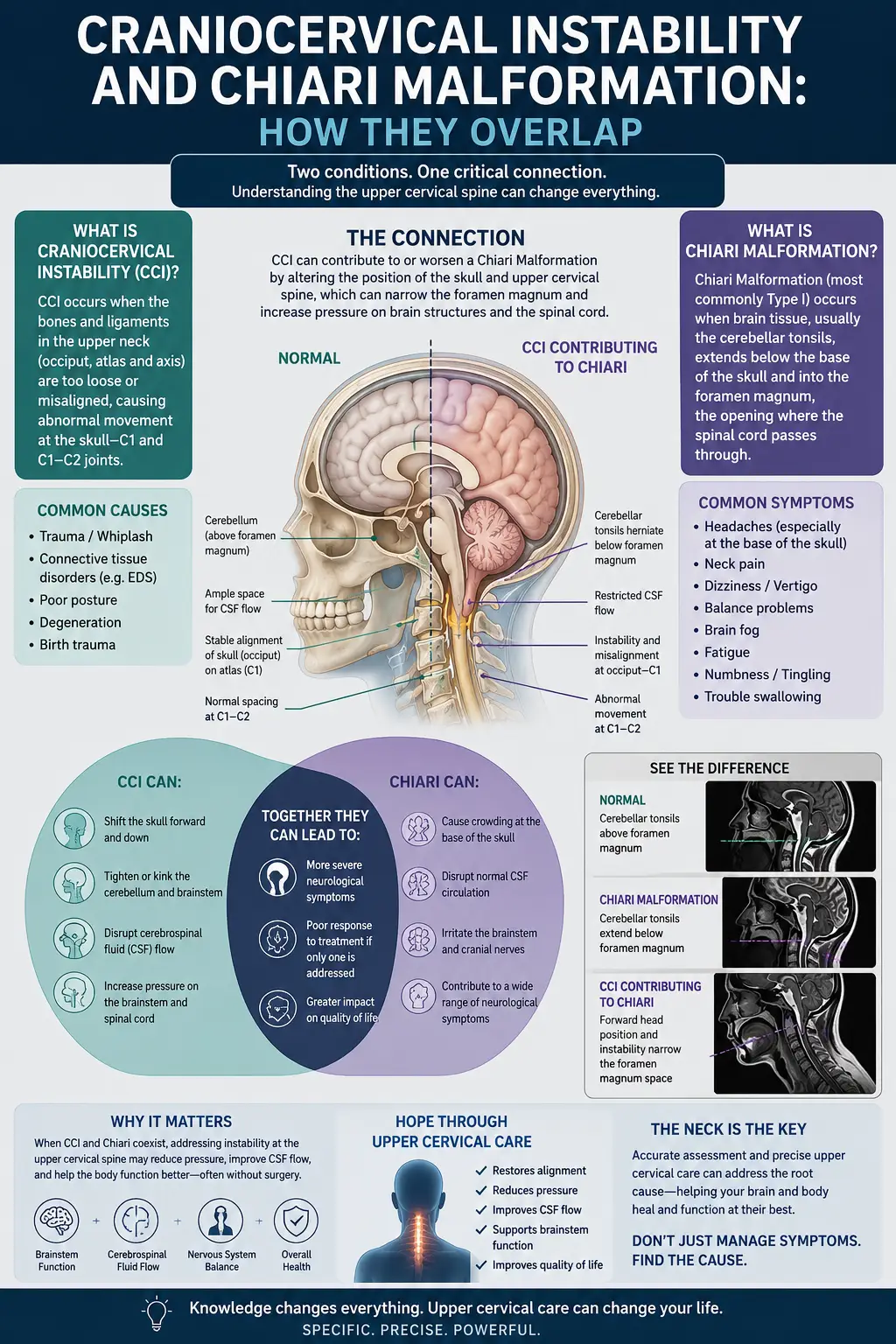
Chiari Malformation: If you’ve been diagnosed with Chiari malformation—or suspect something deeper is behind your chronic dizziness, neck pain, brain fog, or headaches—you’re not alone. Chiari malformation is a neurological condition where part of the brain (the cerebellar tonsils) descends below the skull and puts pressure on the spinal cord and brainstem. This pressure can disrupt the flow of cerebrospinal fluid and affect everything from balance to vision to digestion.
Unfortunately, many Chiari patients are offered only two paths: “watch and wait” with symptom-suppressing medications or invasive brain surgery (posterior fossa decompression). But what if there’s a more natural, non-invasive way to help your body function better?
At Lavender Family Chiropractic in Sarasota, Florida, we specialize in upper cervical chiropractic care—a unique, precise approach to spinal correction that focuses on the upper neck and brainstem. We’ve helped patients with Chiari find real relief by gently correcting misalignments that exacerbate brainstem pressure and neurological dysfunction.
Let’s explore what Chiari malformation is, what symptoms it causes, and how our specialized care could help restore balance to your life—without cracking, popping, or surgery.
What Is Chiari Malformation?
Chiari malformation occurs when the lower part of the cerebellum (the cerebellar tonsils) herniates downward into the spinal canal through the opening at the base of the skull (foramen magnum). This can crowd the brainstem and upper spinal cord, disrupting essential nerve communication between the brain and body.
There are four main types of Chiari malformation, with Type I being the most common and often diagnosed in teens or adults. It is typically congenital (you are born with it) but may not cause symptoms until later in life—often after a physical trauma such as a car accident or sports injury that destabilizes the upper cervical spine.
Common and Lesser-Known Symptoms of Chiari Malformation
Chiari symptoms can vary widely based on the degree of herniation and the person’s anatomy. Some people have dramatic symptoms with a small descent; others have little to no symptoms with a larger one. This makes it difficult to diagnose, and many patients are misdiagnosed for years.
Common symptoms of Chiari malformation include:
- Occipital headaches (worsened by coughing, sneezing, straining)
- Neck pain or stiffness
- Dizziness and balance issues
- Vertigo
- Tinnitus (ringing in the ears)
- Difficulty swallowing
- Nausea or vomiting
- Sleep apnea
- Numbness or tingling in hands or feet
- Muscle weakness
- Brain fog or difficulty concentrating
- Fatigue
- Sensitivity to light or sound
- Double vision or other visual disturbances
- Poor coordination
Lesser-known symptoms can include:
- Pressure behind the eyes or ears
- “Full head” sensation
- Postural tachycardia (POTS)
- Gastrointestinal distress
- Anxiety or depression caused by neurological dysfunction
The Neurological Link Between Chiari and the Upper Cervical Spine
Why does the top of your spine matter so much when it comes to your brainstem and Chiari symptoms?
The atlas (C1) and axis (C2) vertebrae form the top of your spine and cradle the brainstem. When these bones misalign—due to birth trauma, car accidents, falls, or even repetitive posture stress—they can compress or twist the brainstem, exacerbate the effects of Chiari, and worsen neurological symptoms.
Misalignments in this area also affect:
- Cerebrospinal fluid (CSF) flow
- Blood flow between the brain and body
- The vagus nerve and autonomic nervous system
This creates a vicious cycle of inflammation, nerve pressure, and poor brain-body communication—often mimicking or intensifying Chiari symptoms. That’s why correcting upper cervical misalignments can relieve pressure, restore function, and help the body adapt better to structural abnormalities like Chiari malformation.
What Is Upper Cervical Chiropractic Care? A Gentle, Brain-Focused Approach to Natural Healing
When most people think of chiropractic care, they imagine loud cracks, twisting motions, or full-spine adjustments. But upper cervical chiropractic care is something entirely different—a precise, gentle, and neurologically focused technique that targets the top two bones in the spine: the atlas (C1) and the axis (C2). This uppermost region of the spine plays a vital role in supporting your head, protecting the brainstem, and allowing critical communication between the brain and body.
At Lavender Family Chiropractic in Sarasota and Lakewood Ranch, Florida, we specialize exclusively in upper cervical chiropractic care to help patients find lasting relief from complex health issues—without forceful adjustments or medications. Our approach uses state-of-the-art imaging and nerve system testing to locate subtle misalignments at the top of the spine, and we correct them with gentle, customized techniques that restore balance from the inside out.
Why the Upper Cervical Spine Is So Important
The upper cervical spine is unlike any other part of the body. The atlas (C1) and axis (C2) vertebrae sit at the base of the skull and are responsible for supporting the head’s weight (about 10–12 pounds), allowing head and neck movement, and protecting the brainstem—the part of the nervous system that controls breathing, heart rate, digestion, blood pressure, and sensory integration.
Because this area is so mobile and lacks the interlocking joints that exist further down the spine, it is highly vulnerable to misalignment. Even a minor injury, like a car accident, sports trauma, or birth injury, can shift these vertebrae out of alignment, which can:
- Compress or irritate the brainstem
- Interfere with cerebrospinal fluid (CSF) flow
- Reduce blood flow between the brain and body
- Create muscle tension and postural distortions throughout the spine
- Disrupt signals from the brain to the rest of the body
This kind of interference is called a subluxation, and when it occurs in the upper cervical region, the effects can ripple through the entire nervous system.
Signs You May Have an Upper Cervical Misalignment
Because the upper cervical spine affects every system of the body, misalignments in this area can lead to a wide variety of symptoms. Some of the most common include:
- Chronic headaches and migraines
- Dizziness or vertigo
- TMJ and jaw pain
- Tinnitus (ringing in the ears)
- Brain fog and memory problems
- Neck pain and stiffness
- Fatigue and poor sleep
- POTS (Postural Orthostatic Tachycardia Syndrome)
- Fibromyalgia
- Numbness, tingling, or weakness in the arms or legs
- Trigeminal neuralgia and facial pain
- Pressure in the head or ears
- Poor posture or uneven shoulders/hips
Many people suffering from these issues have tried various specialists, medications, and therapies—only to find temporary relief or no answers at all. That’s often because the root of the problem isn’t being addressed.
How Upper Cervical Chiropractic Works
At Lavender Family Chiropractic, we don’t guess—we use precision diagnostics to identify exactly how the upper cervical vertebrae are misaligned and how that misalignment is affecting your nervous system.
Step 1: Comprehensive Consultation and Examination
We begin by listening to your story. We ask detailed questions about your health history, symptoms, lifestyle, and past injuries. Then we perform a neurological exam to assess posture, balance, nerve function, and overall body symmetry.
Step 2: 3D CBCT Imaging
Unlike standard X-rays, we use Cone Beam Computed Tomography (CBCT)—a state-of-the-art 3D scan that provides incredibly detailed views of the atlas and axis. This allows us to measure your misalignment in three dimensions: how far the bones have shifted, in which direction, and at what angle. This is essential for making a correction that is both gentle and highly specific.
Step 3: Functional Nervous System Scanning
We use Tytron Infrared Paraspinal Thermography, a non-invasive tool that measures heat distribution along the spine. This allows us to detect areas of nervous system imbalance and inflammation in real time. We repeat this scan before and after each adjustment to ensure you’re moving in the right direction.
Step 4: Personalized, Gentle Corrections
Once we know exactly what your misalignment is, we perform a precise, customized correction using a gentle adjustment technique. There’s no twisting, cracking, or popping. In fact, many patients are surprised by how light the correction feels—but are amazed at how deeply it affects their body.
Step 5: Monitoring and Long-Term Correction
We track your progress over time using repeat scans, clinical exams, and patient feedback. The goal isn’t just symptom relief—it’s long-term correction of spinal and neurological imbalance so your body can heal and function properly.
What Makes Upper Cervical Chiropractic Different
Traditional chiropractic often focuses on full-spine adjustments with manual force. While this can be helpful in many cases, it does not address the neurological significance of the upper cervical spine, and it may lack the precision needed for people with serious health challenges.
Here’s how upper cervical care stands apart:
- Focuses solely on the most neurologically important part of the spine
- Uses advanced imaging and scanning technology
- Gentle and non-invasive (safe for all ages, including children and seniors)
- Highly individualized to each patient’s anatomy and condition
- Improves brain-body communication, not just structural alignment
At Lavender Family Chiropractic, we’ve seen dramatic transformations in patients who had “tried everything” before finally finding answers through upper cervical care.
Why Choose Upper Cervical Chiropractic at Lavender Family Chiropractic?
Located in Sarasota, Florida, and serving Lakewood Ranch, Bradenton, Parrish, Venice, Ellenton, and surrounding areas, Lavender Family Chiropractic has built a reputation as one of the leading upper cervical chiropractic offices in the state. Our doctors are extensively trained, our technology is cutting-edge, and our results speak for themselves.
If you’ve been searching for the best chiropractor in Sarasota or Lakewood Ranch, or wondering whether your symptoms could be related to upper neck misalignment, we invite you to discover a different kind of chiropractic care—one that goes beyond symptom management and works to restore true health and function.
About Lavender Family Chiropractic in Sarasota and Lakewood Ranch, Florida
Lavender Family Chiropractic is a specialized upper cervical chiropractic office serving patients in Sarasota, Lakewood Ranch, Bradenton, and surrounding Florida communities. The clinic focuses exclusively on gentle, precise corrections to the upper cervical spine—specifically the atlas (C1) and axis (C2)—which are crucial to brain-body communication. This region of the spine plays a key role in regulating nervous system function, blood flow to the brain, and cerebrospinal fluid drainage. Misalignments in this area can contribute to a wide range of chronic and complex health conditions.
The practice is led by Dr. Rusty Lavender, Dr. Jacob Temple, and Dr. Will Guzinski—a team of highly trained upper cervical chiropractors with extensive experience in helping patients suffering from symptoms like vertigo, migraines, TMJ dysfunction, POTS, tinnitus, neck pain, brain fog, fibromyalgia, post-concussion syndrome, and balance issues. They are widely recognized as some of the most trusted upper cervical chiropractors in Sarasota and Lakewood Ranch, Florida.
What Makes Lavender Family Chiropractic Unique
Unlike traditional chiropractic offices that often use high-force spinal manipulation techniques, Lavender Family Chiropractic uses a more refined approach known as upper cervical chiropractic care. This technique emphasizes specificity and precision and is performed without any popping, cracking, or twisting of the spine.
Every patient at Lavender Family Chiropractic undergoes an in-depth diagnostic process that includes:
- 3D CBCT Imaging – Cone Beam Computed Tomography (CBCT) provides highly detailed, three-dimensional views of the upper cervical spine. This allows the doctors to analyze the exact degree, direction, and location of any misalignment—something that standard X-rays or MRIs may miss.
- Tytron Infrared Paraspinal Thermography – This technology measures heat distribution along the spine, which is an indicator of nervous system stress and inflammation. It allows the doctors to assess the effectiveness of care and determine when and where an adjustment is needed.
- Neurological Testing and Postural Analysis – Objective evaluations of balance, posture, and neurological tone help the doctors develop a personalized care plan tailored to the patient’s needs and health goals.
Because the upper cervical spine affects the brainstem, vagus nerve, and autonomic nervous system, correcting misalignments in this area often leads to improvements in a wide range of symptoms—especially those that haven’t responded to medication or traditional chiropractic care.
Conditions Commonly Treated at Lavender Family Chiropractic
Patients seek out Lavender Family Chiropractic from across Florida for help with a variety of health issues, particularly those related to neurological, vestibular, and structural dysfunctions. These include:
- Vertigo and Dizziness
- Migraines and Chronic Headaches
- Post-Concussion Syndrome
- TMJ and Jaw Pain
- Trigeminal and Occipital Neuralgia
- Fibromyalgia
- POTS (Postural Orthostatic Tachycardia Syndrome)
- Brachioradial Pruritus (itchy arms)
- Neck and Upper Back Pain
- Tinnitus (Ringing in the Ears)
- Balance and Coordination Problems
- Fatigue and Brain Fog
Each care plan is customized to the patient and focused on correcting the underlying spinal misalignment rather than chasing individual symptoms. For the full evaluation-and-care picture, see our main page on craniocervical instability treatment in Sarasota.
What to Expect During Care at Lavender Family Chiropractic
When you arrive, we’ll sit down together and talk. We want to hear your story, your struggles, and your goals.
Here’s what you can expect:
- A peaceful, healing environment
- Doctors who listen and explain everything
- Non-invasive testing and imaging
- No twisting or forceful adjustments
- Reassessments along the way to measure progress
- A plan tailored just for you
Top 15 FAQs About Chiari Malformation and Chiropractic Care
- What is Chiari malformation?
It’s when brain tissue descends into the spinal canal, putting pressure on the brainstem and spinal cord. - Can upper cervical chiropractic cure Chiari?
No, but it can dramatically reduce symptoms by restoring alignment and neurological balance. - Is this safe for Chiari patients?
Yes. Our care is gentle and customized using advanced imaging—no cracking or twisting involved. - How do you diagnose spinal misalignment?
We use 3D CBCT imaging and functional nervous system scans. - What symptoms improve with upper cervical care?
Headaches, neck pain, dizziness, brain fog, visual disturbances, and more. - Do you treat children with Chiari?
Yes, we care for patients of all ages. - How soon will I feel better?
Some notice relief quickly, while others improve gradually over weeks or months. - Do you work with neurologists or neurosurgeons?
Yes, we often collaborate and refer as needed. - Will I need lifelong care?
No, our goal is long-term correction. Frequency tapers as your body stabilizes. - Is this covered by insurance?
Our office is out of network, but we provide superbills for reimbursement. We also offer flexible payment plans. - What areas do you serve?
Sarasota, Lakewood Ranch, Bradenton, Venice, Parrish, Ellenton, Punta Gorda, and more. - What makes you different from a regular chiropractor?
We specialize in upper cervical care with precision imaging and no twisting. - How long are appointments?
Initial visits take 60–90 minutes; regular adjustments are shorter. - Can this help if I’ve already had Chiari surgery?
Yes. Many post-surgical patients benefit from care to relieve lingering symptoms. - How do I get started?
Call (941) 243-3729 or visit www.chiropractorsarasotaflorida.com to schedule your consultation.
Areas We Proudly Serve
We’re honored to help patients across:
- Sarasota
- Lakewood Ranch
- Bradenton
- Parrish
- Venice
- Osprey
- Ellenton
- Punta Gorda
- St. Petersburg
- Siesta Key
- Longboat Key
- Lido Key
- Myakka City
If you’ve been searching for a “Chiari specialist chiropractor near me” or “best chiropractor Sarasota Florida,” you’ve found the right place.
Conclusion: You Deserve Answers—And Hope
Living with Chiari malformation can feel overwhelming. But it doesn’t have to be hopeless. At Lavender Family Chiropractic, we don’t just chase symptoms—we help you get to the root of the issue with precise, non-invasive care focused on your nervous system and brainstem.
Whether you’ve been struggling for years or just received a diagnosis, we’re here to help guide your body toward better function and lasting relief.
Call to Action: Begin Your Journey to Healing Today
Lavender Family Chiropractic in Sarasota Florida offers consultations to learn more about you. Click the link below!
https://intake.chirohd.com/new-patient-scheduling/724/lavender-family-chiropractic
Visit our Website!
To learn more about us go to http://www.chiropractorsarasotaflorida.com
We also service Bradenton, Parrish, Ellenton, Ruskin, Venice, Tampa, St. Pete, Osprey, Longboat, Lakewood Ranch, Myakka City.
If you are not local, visit www.uccnearme.com to find a doctor in your area.
📞 Call us today at (941) 243-3729
🌐 Visit www.chiropractorsarasotaflorida.com
📍 Find us at: 5899 Whitfield Ave Ste 107, Sarasota, FL 34243
📱 Follow us on Instagram: @lavenderfamilysrq
📱 TikTok: @drrustylavender
Let’s help you feel like YOU again—with care as unique as your nervous system.
What the Research Says About Chiari Malformation and the Neck
Chiari I malformation is a structural condition in which the cerebellar tonsils extend below the skull base into the top of the spinal canal. In a series of 364 symptomatic patients, the most common symptom was headache made worse by straining or coughing, tonsillar herniation was measured on MRI, and symptoms were attributed to crowding at the foramen magnum (Milhorat et al., Neurosurgery 1999). Because this is an anatomical finding, it needs a neurosurgeon’s evaluation, and decisions about decompression surgery belong there. Research on upper cervical chiropractic for Chiari malformation is limited to case reports, and no controlled study shows that atlas correction changes tonsillar position or cerebrospinal fluid flow, so we do not make that claim.
The upper neck is nonetheless part of the picture for many people with Chiari, because the foramen magnum sits directly above the atlas and the suboccipital region is a frequent source of pain. Upper cervical structures from C1 to C3 converge on the trigeminocervical complex, so irritation at the top of the neck can refer pain into the back of the head (Bogduk & Govind, Lancet Neurol 2009). Disturbed input from the upper cervical joints alters head and eye movement control and produces unsteadiness (Kristjansson & Treleaven, J Orthop Sports Phys Ther 2009). Any upper cervical care in Chiari must be gentle and guided by imaging, which is why we never adjust without 3D imaging of the atlas, a correction matched to that imaging, and re-measurement, alongside your neurosurgeon’s clearance.
Frequently Asked Questions
What is Chiari malformation?
Chiari malformation is a structural condition in which the lower part of the cerebellum, the tonsils, extends below the opening at the base of the skull into the upper spinal canal. That crowds the craniocervical junction, where the brainstem, cerebrospinal fluid, and major vessels already compete for space. Because the atlas forms the floor of that region, its alignment affects how much room remains. We image that relationship with 3D cone-beam CT.
What symptoms are common and less known in Chiari?
Common symptoms include pressure headaches at the back of the head that worsen with coughing or straining, neck pain, dizziness, and balance problems. Less recognized ones include swallowing difficulty, ringing in the ears, visual disturbance, tingling in the hands, heart rate changes, and fatigue, all of which trace back to a stressed brainstem. Paraspinal thermography lets us see how that brainstem is regulating the body, before and after a correction.
Is upper cervical care safe for someone with Chiari?
The Knee Chest technique is precise and low force, with no twisting, cracking, or rotation of the neck, which is why it is suited to a crowded craniocervical junction. We never adjust without 3D imaging, and we review your existing MRI and coordinate with your neurologist or neurosurgeon before beginning. Chiari with significant compression or syrinx formation requires medical oversight, and we respect that. Our goal is to reduce mechanical stress at the atlas, measured by thermography.
How can correcting the atlas help with Chiari symptoms?
Chiari crowds the junction from above; a misaligned atlas can crowd it from below, narrowing the space for cerebrospinal fluid and the brainstem even further. Correcting the atlas position is aimed at giving that region back whatever room the alignment was taking. Many patients notice changes in head pressure, neck tension, and balance, though results vary by person. We confirm the nervous system’s response with thermography before and after each correction rather than assume it.
Do you see Chiari patients from Lakewood Ranch, Bradenton, and Venice?
Yes. Our Sarasota office at 5899 Whitfield Avenue, Suite 107, is at the corner of University Parkway and Whitfield, minutes from Lakewood Ranch and Bradenton and about thirty minutes from Venice. Bring your MRI reports; we share our imaging with your medical team on request. The evaluation includes a thorough history, neurological checks, thermography, and cone-beam CT. Care plans are individual and reassessed each visit. Call (941) 243-3729 to schedule an evaluation.
Related Posts


Get our upper cervical articles first.