Why Do I Get Dizzy When I Look Up? Neck Extension, the Suboccipital Muscles, and How Upper Cervical Care at Lavender Family Chiropractic May Help in Sarasota, Florida
By Dr. Rusty Lavender, D.C. — upper cervical chiropractor, Lavender Family Chiropractic, Sarasota, FL. Reviewed and updated October 2026.
I get dizzy when I look up: You reach for a plate on the top shelf, tip your head back to check a smoke detector, or lean back at the salon sink — and the room lurches. A wave of spinning or swaying takes hold the moment you look up, and you grab for something solid until it passes. If tilting your head back reliably makes you dizzy, you are describing one of the most specific and telling patterns in all of balance medicine, and it points directly at the upper neck and the inner ear.
At Lavender Family Chiropractic in Sarasota, “I get dizzy when I look up” is a description we hear often from people seeking natural vertigo relief. The good news is that this pattern is meaningful: the position of your head when symptoms strike gives real clues about what is driving them. This guide explains what actually happens in your neck and inner ear when you extend your head backward, how the suboccipital muscles and their proprioceptors fit in, when looking-up dizziness signals something that needs medical attention, and how upper cervical chiropractic care may fit into a comprehensive plan.
Dizzy when I Look Up: First, the Important Part: Looking-Up Dizziness Has Several Causes
Before we get to the neck, it is worth being clear and honest: dizziness when you look up can come from more than one source, and some deserve prompt medical evaluation. Sorting out which cause is behind your symptoms matters, because the right answer determines the right approach.
Benign paroxysmal positional vertigo (BPPV) is the single most common cause of position-triggered vertigo, and looking up is a classic trigger. In BPPV, tiny calcium-carbonate crystals in the inner ear become dislodged and drift into a semicircular canal. When you tip your head back, those crystals shift and send a false, intense spinning signal to the brain. The vertigo is brief — usually seconds to under a minute — and often violent, and it is diagnosed with a specific positional test and typically addressed with a repositioning maneuver. If your looking-up vertigo is short, spinning, and reproducible, BPPV should be evaluated first.
Vertebrobasilar circulation concerns. Less commonly, extending and rotating the neck can affect blood flow through the vertebral arteries that travel up through the neck to the back of the brain. Dizziness on looking up that comes with slurred speech, double vision, weakness, numbness, difficulty swallowing, a severe or unusual headache, or fainting is a medical red flag and warrants urgent evaluation — not a chiropractic appointment. We take this seriously and screen for it.
Cervicogenic (neck-related) dizziness is the third major cause, and it is where the suboccipital muscles and upper cervical joints come in. Here, the dizziness arises because the neck itself is sending faulty position information to the brain’s balance centers, particularly during head extension. This is the cause upper cervical care is most relevant to, and the focus of the rest of this article.
Because these causes can overlap and sometimes coexist, a careful evaluation is essential. Our guide on when to get an MRI for dizziness can help you think through when imaging and medical workup are appropriate.
What Happens in Your Neck When You Look Up
To understand cervicogenic looking-up dizziness, it helps to picture what extending your head actually does mechanically.
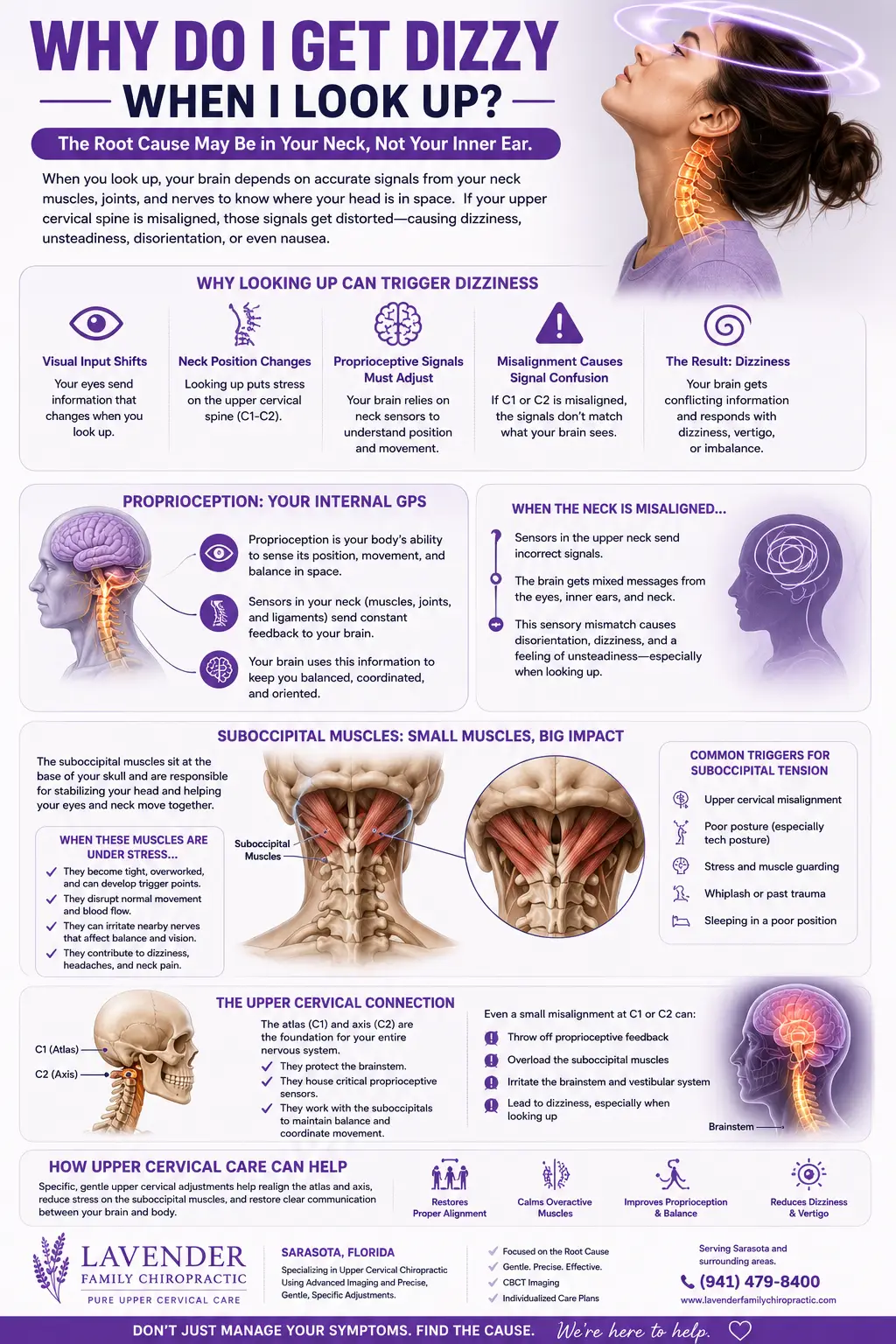
When you tip your head back to look up, most of that motion happens at the very top of your neck — the atlanto-occipital joint between your skull and the atlas (C1), and the atlanto-axial joint between the atlas and axis (C2). This upper cervical region is where a large share of your neck’s extension and rotation occurs. It is also where the suboccipital muscles live: four small paired muscles that connect the base of the skull to the top two vertebrae.
These suboccipital muscles do something remarkable. They are not big movers like the muscles that turn your whole head; they are fine-tuning muscles, packed with an extraordinary density of proprioceptors — sensory receptors that continuously report the exact position and motion of your head relative to your body. Gram for gram, the suboccipital and deep upper-neck muscles carry one of the highest concentrations of muscle spindles anywhere in the body. Roughly half of all the position-sensing receptors for head and neck orientation are clustered in the joints and muscles of the upper cervical spine.
When you look up, these muscles stretch and contract, and their proprioceptors fire a stream of position data to the brainstem. Your brain fuses that neck data with input from your inner ear and your eyes to keep a single, stable sense of where your head is in space. In a well-aligned, relaxed neck, the signal is clean and the transition is seamless. But when the upper neck is misaligned, restricted, or chronically tense, extending your head can pull on guarded suboccipital muscles and irritated joints — and the position signal they send becomes distorted.
How Misalignment Turns “Looking Up” Into Vertigo
Here is the core mechanism behind cervicogenic looking-up dizziness.
Your balance depends on three information streams agreeing: the inner ear (which senses head motion and gravity), the eyes (which report what is moving around you), and the neck and body (which report head position). The brain constantly compares these three. When they agree, you feel steady. When they disagree, the brain interprets the conflict as motion — and you feel dizzy.
When the upper cervical spine is misaligned, the suboccipital proprioceptors send inaccurate information about where your head is. This is especially pronounced during extension, because looking up loads exactly the joints and muscles most affected by an upper cervical misalignment. As you tip your head back, the neck reports one thing while the inner ear and eyes report another. The brain receives a mismatch, and the result is a wave of dizziness, unsteadiness, or a spinning sensation tied specifically to the movement.
Chronically tense or guarded suboccipital muscles make this worse in two ways. First, taut muscles alter the stretch signals their spindles produce, feeding the brain “noisy” data even at rest. Second, that tension often accompanies the tension headaches at the base of the skull, neck stiffness, and reduced range of motion that so many people with looking-up dizziness also report. These are not separate problems; they are different expressions of the same upper cervical picture. Our article on whether neck pain can cause dizziness explores this connection in more depth.
Why the Suboccipital Muscles Matter So Much
It is worth dwelling on the suboccipital region, because it is the heart of this story.
These four small muscles — the rectus capitis posterior major and minor, and the obliquus capitis superior and inferior — sit deep at the base of the skull. Their job is not brute movement but precise, moment-to-moment calibration of head position. Their exceptional proprioceptor density means the brain trusts them heavily for balance and spatial orientation. That trust is a strength when the signal is accurate and a liability when it is not.
There is also a direct anatomical link between these muscles and the visual and vestibular systems. The suboccipital proprioceptors have neurological connections to the reflexes that stabilize your gaze and your posture. This is part of why a neck problem can produce not only dizziness but also visual disturbances, a sense of unsteadiness on your feet, and difficulty keeping your eyes settled when you move your head. When you look up and the suboccipital signal is faulty, that error propagates into the very systems that are supposed to keep the world from spinning.
Modern life does the suboccipitals no favors. Long hours with the head tilted forward over a phone or screen keep these muscles in a shortened, strained state, degrading the quality of their proprioceptive feedback over time. When a neck conditioned by forward head posture is then asked to extend and look up, the mismatch can be pronounced.
Everyday Situations That Trigger Looking-Up Dizziness
Because the trigger is head extension, the same wave of unsteadiness tends to show up across a recognizable set of daily moments. Seeing your own pattern in this list can help you make sense of the experience and describe it clearly when you seek care.
Reaching for a high shelf. Grabbing a plate from the top cabinet or a box from the closet’s upper shelf is one of the most commonly reported triggers — so much so that clinicians sometimes call it “top shelf vertigo.” The combination of tipping the head back and reaching often provokes symptoms at once.
The salon or barber sink. Leaning back into a shampoo bowl holds the neck in sustained extension, sometimes for several minutes. This position is a classic trigger, occasionally described as “beauty parlor syndrome,” and can affect both the inner ear and the neck.
The dentist’s chair. Reclining with the head tipped back for an extended dental visit combines prolonged extension with stillness, a setup that frequently brings on dizziness in sensitive people.
Household tasks overhead. Painting a ceiling, hanging curtains, changing a lightbulb or smoke-detector battery, and similar chores all ask the neck to hold an extended position while you focus upward.
Looking up outdoors. Watching fireworks, stargazing, following a plane, or gazing up at tall buildings and trees can each provoke a wave of unsteadiness when the head tips back.
Backing up the car. Turning and extending the neck to reverse into a parking spot briefly loads the upper cervical joints in both rotation and extension, a combination that can be particularly provocative.
Across all of these, the common thread is the same: extension loads the upper cervical joints and the suboccipital muscles, and in a misaligned or guarded neck, that loading produces the sensory mismatch behind the dizziness.
Upper Cervical Care at Lavender Family Chiropractic
At Lavender Family Chiropractic in Sarasota, we take a root-cause approach to dizziness rather than simply chasing the symptom. When looking up reliably triggers your vertigo and a cervical cause is involved, our focus is on the physical contributors we can objectively measure and address — the alignment and function of the upper cervical spine and the suboccipital region.
Our evaluation is detailed and individualized, and it begins with careful screening to help distinguish a neck-related cause from BPPV or a circulatory red flag that belongs in a medical setting. We use 3D CBCT imaging to precisely assess the position of your atlas and axis, and paraspinal infrared thermography to evaluate how your nervous system is functioning. Because looking-up dizziness so often traces to the upper cervical joints and the suboccipital proprioceptors, this objective look at alignment and nervous-system function is especially valuable.
When a correction is indicated, we use the Knee Chest Upper Cervical technique to restore upper cervical alignment gently and precisely, without forceful twisting or cracking. The aim is to help the upper neck send accurate position signals to the balance centers so that extending your head no longer produces a sensory mismatch. From there we develop customized treatment plans built around your specific goals.
We are also clear about scope. Upper cervical care addresses the cervical contributors to dizziness; it is not a treatment for BPPV crystals, which are addressed with repositioning maneuvers, nor a substitute for medical evaluation when red-flag symptoms are present. For many people, the most effective path is a coordinated one, and we are glad to work alongside your other providers.
Take the First Step Toward Steadier Days
If tilting your head back has become something you dread, we would like to help you understand the physical side of the picture. Call Lavender Family Chiropractic at (941) 243-3729 to schedule a consultation, or book online here: https://intake.chirohd.com/new-patient-scheduling/724/lavender-family-chiropractic. We will examine your upper cervical spine and help determine whether it may be contributing to your symptoms.
What the Research Says About Neck-Related Looking-Up Dizziness
The role of the neck and its proprioceptors in balance is a well-studied area. Here are five studies that illuminate the mechanisms behind looking-up dizziness.
A comprehensive review of cervicogenic dizziness explains how dysfunction in the cervical spine — particularly the upper cervical joints — can generate dizziness through faulty proprioceptive input to the balance centers. It notes that changes in the upper cervical spine tend to be more strongly associated with dizziness than changes lower in the neck, which fits the pattern of symptoms provoked by head extension.
Research specifically on suboccipital muscles, forward head posture, and cervicogenic dizziness connects the deep upper-neck muscles and everyday posture to dizziness symptoms. It underscores how the proprioceptor-rich suboccipital region contributes to balance and how postural strain on these muscles can degrade the position information they provide.
A study on the sensorimotor function of the cervical spine in healthy volunteers documents just how central neck proprioception is to head-position sense, reflecting the high density of muscle spindles in the deep neck muscles. This establishes the physiological basis for why an inaccurate neck signal — such as during extension in a misaligned neck — can disturb balance.
A scoping review of proprioceptive cervicogenic dizziness care examined how this proprioceptively driven form of dizziness is understood and managed across patient groups. It reinforces that a disturbance in cervical proprioception is a recognized, treatable contributor to dizziness rather than a fringe idea.
Finally, addressing the most common non-cervical cause, research on vertical position tests for posterior canal BPPVillustrates how tipping the head back is used clinically to provoke and diagnose positional vertigo of inner-ear origin. This is a valuable reminder that looking-up dizziness can stem from the inner ear as well as the neck, which is why careful evaluation matters.
Lifestyle Strategies to Ease Looking-Up Dizziness
Alongside professional care, daily habits can help settle both the neck and the balance system.
Move into extension slowly. When you need to look up, do it deliberately rather than snapping your head back. A slow, controlled motion gives the balance system time to update and reduces the intensity of a mismatch.
Bring objects to you. For frequent overhead tasks, use a step stool or reacher so you can keep your head closer to neutral instead of holding a prolonged backward tilt.
Address forward head posture. Because hours of looking down at screens strain the suboccipital muscles, taking regular breaks, raising your monitor to eye level, and being mindful of head position throughout the day can improve the quality of your neck’s proprioceptive feedback over time.
Release suboccipital tension gently. Warm compresses at the base of the skull, gentle upper-neck mobility within a comfortable range, and awareness of jaw and neck clenching can reduce the muscle guarding that distorts position signals.
Mind your sleep setup. A pillow that is too tall props the neck into extension all night. Choosing support that keeps the neck closer to neutral can help; our guide on the best pillow for vertigo covers this in detail.
Support the basics. Adequate sleep, steady hydration — which matters year-round in Florida’s heat — and managing stress all raise your threshold for dizziness and help the nervous system stay calmer.
What to Expect at Your First Visit
If looking-up dizziness has made you cautious, it helps to know exactly what your first visit involves so there are no surprises.
We start with an unhurried conversation about your history. We want to understand exactly when your dizziness strikes, how long it lasts, whether it spins or sways, and what other symptoms accompany it. These details help us distinguish a cervical cause from BPPV or a red-flag pattern that belongs in a medical setting — an important first step, because the right answer guides everything that follows.
Next, we gather objective data. The 3D CBCT imaging shows us the precise position of your atlas and axis, while paraspinal infrared thermography helps us evaluate nervous-system function. These findings guide whether an upper cervical correction is appropriate for you, or whether we should refer you for further workup first.
If care is indicated, we explain what we found in clear terms and outline a customized treatment plan built around your goals. We practice on a cash-pay basis and review the details with you in advance. We will always be candid about where upper cervical care fits and where inner-ear repositioning or medical evaluation belongs. If you would like to talk through anything before scheduling, call us any time at (941) 243-3729.
Areas We Serve Around Sarasota
Lavender Family Chiropractic is located at 5899 Whitfield Avenue, Suite 107, in Sarasota, at the corner of University and Whitfield. We care for patients seeking natural vertigo relief from throughout the region, including Bradenton, Lakewood Ranch, Palmetto, Ellenton, Ruskin, Venice, Osprey, Myakka, Tampa, and St. Pete. If looking up or moving your head makes travel uncomfortable, tell us when you call and we will help you plan a comfortable first visit.
Our complete guide to dizziness treatment in Sarasota covers the difference between dizziness and vertigo, the upper neck’s role in balance, and how we evaluate it.
Top 15 Frequently Asked Questions About Getting Dizzy When You Look Up
1. Why do I get dizzy specifically when I look up? Tipping your head back loads the upper cervical joints and stretches the proprioceptor-rich suboccipital muscles. If your neck is misaligned, the position signal it sends during extension conflicts with your inner ear and eyes, and the brain reads that mismatch as dizziness. Looking up can also trigger inner-ear BPPV.
2. Is it my neck or my inner ear? It can be either, and sometimes both. Neck-related dizziness tends to accompany neck stiffness and headaches and follows head position; inner-ear BPPV usually produces brief, intense spinning right after a position change. A careful evaluation sorts this out.
3. What are the suboccipital muscles? They are four small, deep muscles connecting your skull to the top two neck vertebrae. They fine-tune head position and are packed with sensory receptors, so the brain relies on them heavily for balance.
4. How does neck misalignment cause dizziness? A misaligned upper neck sends inaccurate position information to the brain’s balance centers, especially during extension. That faulty signal conflicts with the inner ear and eyes, producing a sensory mismatch the brain interprets as dizziness.
5. Could looking-up dizziness be something serious? Yes. Dizziness on looking up that comes with slurred speech, double vision, weakness, numbness, trouble swallowing, fainting, or a severe unusual headache is a medical red flag that warrants urgent evaluation, not a chiropractic visit.
6. What is BPPV, and how is it different? BPPV is caused by dislodged inner-ear crystals that produce brief, intense spinning with position changes like looking up. It is diagnosed with a positional test and typically addressed with a repositioning maneuver, which is different from cervical care.
7. Can upper cervical chiropractic care help looking-up dizziness? When a cervical cause is involved, it can address the upper cervical alignment and suboccipital function contributing to the faulty position signal. It is not a treatment for BPPV crystals or a substitute for medical evaluation of red flags.
8. Why does my neck feel tight along with the dizziness? Chronic suboccipital tension often accompanies upper cervical misalignment. Because these muscles are so rich in position sensors, their tightness both distorts balance signals and produces the stiffness and base-of-skull headaches many people notice.
9. Does looking down cause it too? It can. Both extension and flexion move the upper cervical joints, though looking up is the more common trigger. Rapid or sustained positions in either direction can provoke a mismatch in a sensitive neck.
10. Is forward head posture from screens making this worse? It can contribute. Prolonged forward head posture strains the suboccipital muscles and degrades their proprioceptive feedback over time, which can make head extension more provocative.
11. What testing do you perform? We use 3D CBCT imaging to assess upper cervical alignment and paraspinal infrared thermography to evaluate nervous-system function, alongside a history and screening to help distinguish cervical from inner-ear and vascular causes.
12. Will changing my pillow help? It may. A pillow that is too tall holds the neck in extension overnight, which can aggravate symptoms. Support that keeps the neck closer to neutral is generally preferable for people with looking-up dizziness.
13. How long does it take to see change? It varies with the person and the underlying cause. Progress typically comes gradually as upper cervical alignment and suboccipital function are supported over time, rather than all at once.
14. Should I avoid looking up entirely? No — long-term avoidance is not the goal. Moving into extension slowly and using tools like step stools for overhead tasks can reduce provocation while the underlying contributors are addressed.
15. Where are you located and who do you serve? We are at 5899 Whitfield Avenue, Suite 107, in Sarasota, serving patients from Bradenton, Lakewood Ranch, Venice, Palmetto, Ellenton, and the surrounding area.
Ready to Look Up Without the Spin?
When tilting your head back triggers your vertigo, understanding whether your upper neck and suboccipital muscles are contributing is a meaningful step toward steadier days. If you are ready to find out, call Lavender Family Chiropractic at (941) 243-3729 or book your consultation online at https://intake.chirohd.com/new-patient-scheduling/724/lavender-family-chiropractic. Our Sarasota team is here to help you pursue natural vertigo relief as part of a comprehensive plan.
Related Articles
Related Posts


Get our upper cervical articles first.
Patients Experience