Atypical (Type 2) Trigeminal Neuralgia: When Facial Pain Is Constant Rather Than Just Shock-Like
By Dr. Rusty Lavender — Lavender Family Chiropractic, Sarasota, FL
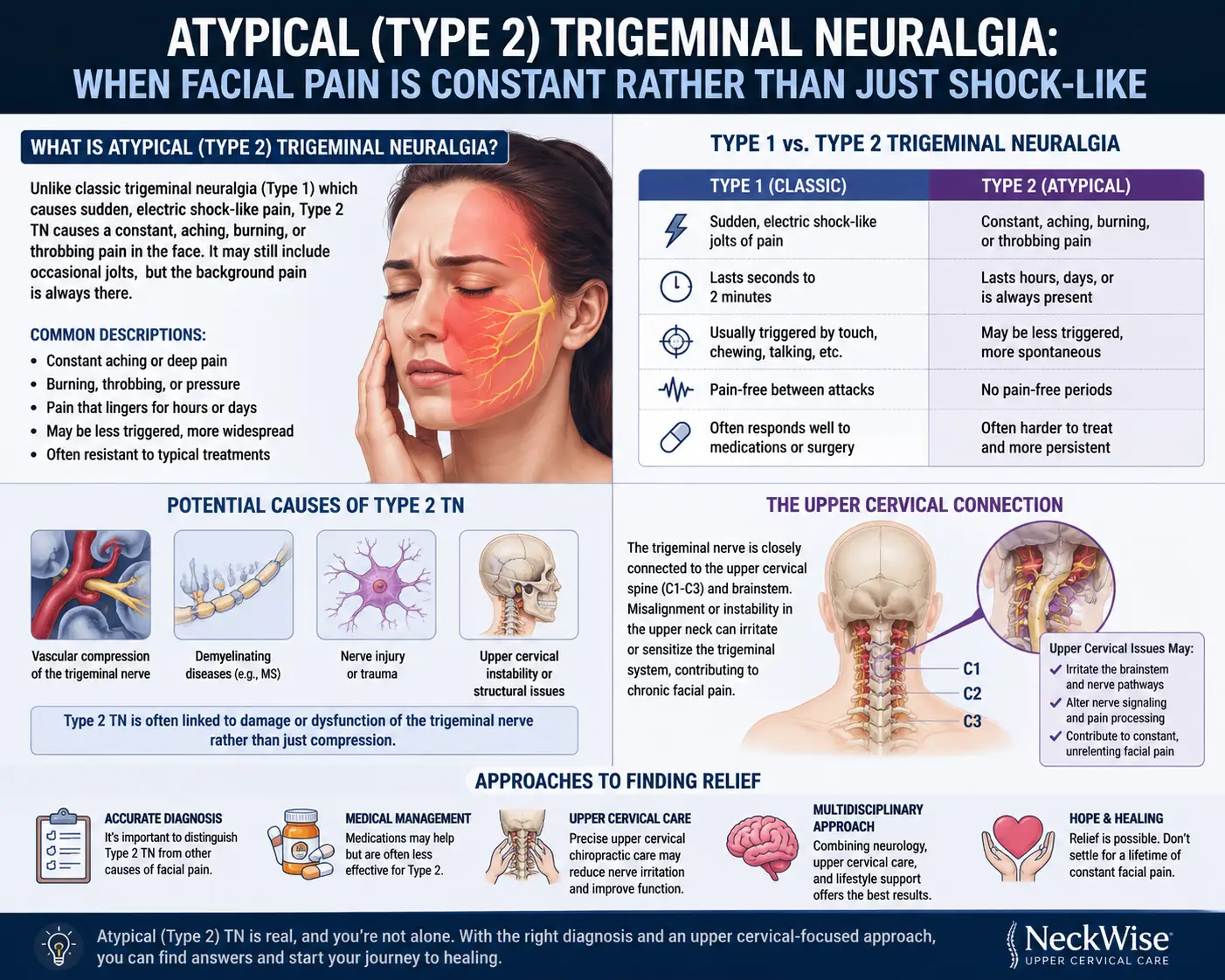
Atypical (Type 2) Trigeminal Neuralgia: Most people picture trigeminal neuralgia as sudden, electric, stabbing jolts across the cheek or jaw — pain that arrives in a flash, lasts a few seconds, and then disappears until the next attack. That description fits many people well. But it does not fit everyone. A significant number of people living with trigeminal neuralgia experience something different and, in some ways, more wearing: a constant, aching, burning, or throbbing background pain that never fully lets go, sometimes with sharp electric attacks layered on top. This form is often called atypical trigeminal neuralgia, or Type 2 trigeminal neuralgia, and it is defined by that concomitant continuous pain component.
If you have been told your facial pain “does not sound like classic trigeminal neuralgia” because it does not switch off between attacks, you are not imagining things, and you are not alone. The presence of a persistent, ever-present ache alongside the shock-like episodes is a recognized clinical pattern. It matters because it can change how the condition is diagnosed, how it responds to medication, and how a coordinated care plan is built. It also overlaps with several other facial pain conditions, which is exactly why an accurate diagnosis from the right medical professionals is so important.
At Lavender Family Chiropractic in Sarasota, Florida, Dr. Rusty Lavender and Dr. Jacob Temple work with people carrying complex, frustrating facial pain — including those with an atypical, constant-pain presentation. We want to be honest and clear from the very first paragraph: trigeminal neuralgia is a serious neurological condition, proper diagnosis and classification is a medical process, and our precise, low-force upper cervical care is supportive and coordinated — never a replacement for neurological evaluation and medical management. This article is written to help you understand the difference between the two main types of trigeminal neuralgia, why the atypical form can be harder to sort out, what mechanisms may be involved, and where gentle upper cervical care may fit within a broader, medically guided plan.
Type 1 vs. Type 2 (Atypical) Trigeminal Neuralgia: The Key Difference
Trigeminal neuralgia is pain arising from the trigeminal nerve, the fifth cranial nerve, which carries sensation from the face — the forehead and eye region (ophthalmic branch), the cheek and upper jaw (maxillary branch), and the lower jaw (mandibular branch). When this nerve misfires, it can produce some of the most intense pain the human body is capable of generating. But the character of that pain is not identical from person to person, and clinicians have long recognized two broad patterns.
Type 1 trigeminal neuralgia, sometimes called classical or typical trigeminal neuralgia, is dominated by paroxysmal pain. “Paroxysmal” simply means it comes in sudden, discrete bursts. These are the textbook attacks: sharp, stabbing, electric-shock-like jolts that last from a fraction of a second to about two minutes, often triggered by everyday activities such as chewing, talking, brushing the teeth, shaving, a cool breeze on the cheek, or even a light touch. Between attacks, people with predominantly Type 1 patterns are frequently pain-free. The nerve settles, the face feels normal, and then a trigger sets off the next volley. This paroxysmal-only pattern is the version most people have heard about.
Type 2 trigeminal neuralgia — the atypical form — is different in one defining way: the paroxysmal attacks are accompanied by concomitant continuous pain. In other words, it is paroxysmal-plus-constant. On top of (or between) the electric jolts, there is an ongoing background sensation that is often described as aching, burning, throbbing, gnawing, pressing, or a dull deep soreness. This continuous component does not switch off between the sharp attacks. Some people describe it as if the sharp jolts are the “spikes” and the constant ache is the “floor” that never goes away. The pain may cover the same facial territory as the attacks, or it may feel more diffuse.
The distinction is not just academic. Research using structured, prospective evaluation of consecutive trigeminal neuralgia patients has found that concomitant persistent pain is remarkably common and appears to represent a distinct subtype rather than simply being a byproduct of severe attacks. In that body of work, patients with the concomitant continuous pain pattern tended to be younger at onset, showed sensory abnormalities more often, and were less likely to respond well to the sodium-channel-blocking medications that are a mainstay of trigeminal neuralgia treatment. That last point is clinically important: the constant-pain form can behave differently under medical management, which is one reason accurate classification matters so much.
It is also worth noting that these “types” exist on a spectrum and that classification systems have evolved. Modern diagnostic frameworks increasingly describe trigeminal neuralgia as “purely paroxysmal” versus “with concomitant continuous pain,” language that maps closely onto the older Type 1 and Type 2 labels. Whatever terminology your neurologist uses, the practical question is the same: is your pain only the sharp, on-and-off attacks, or is there also a persistent background pain that never quite leaves? To learn more about how the condition is understood as a whole, our overview of trigeminal neuralgia is a helpful companion to this article.
Why Atypical TN Is Harder to Diagnose and Treat
When facial pain is purely paroxysmal — brief electric jolts triggered by touch — it often points clinicians fairly quickly toward classical trigeminal neuralgia. But when a constant, aching, or burning component is layered in, the diagnostic picture becomes considerably more crowded. Several other facial pain conditions can produce persistent pain in the same region, and distinguishing among them is a genuinely difficult medical task that belongs in the hands of neurologists, oral medicine specialists, and other qualified physicians.
One of the most important entities to differentiate is persistent idiopathic facial pain, or PIFP, which was historically called “atypical facial pain.” PIFP is a related but distinct diagnosis: it is a chronic facial pain that recurs on most days for months, is often described as a dull, nagging, or deep ache, and — crucially — cannot be attributed to another identifiable disorder after appropriate evaluation. Unlike classic trigeminal neuralgia, PIFP typically lacks the clear-cut, trigger-evoked electric attacks, and clinical examination usually shows no neurological deficit. Because atypical (Type 2) trigeminal neuralgia also features constant pain, the two can look similar on the surface, and careful medical assessment is required to tell them apart. PIFP is considered an important differential diagnosis precisely because it is so easy to confuse with other chronic facial pain syndromes.
The overlaps do not stop there. Constant facial pain can also arise from temporomandibular joint disorders (TMJ/TMD), where the jaw joint and surrounding muscles generate pain that can radiate across the cheek and temple. It can come from dental sources — a cracked tooth, an abscess, or referred pain from the teeth and gums. There is even a specific entity called atypical odontalgia (also discussed within the persistent idiopathic facial pain family), in which a tooth or the area where a tooth used to be aches persistently despite no clear dental pathology on examination and imaging. Migraine and other headache disorders, cluster-type facial pains, and post-traumatic trigeminal neuropathies can all contribute persistent facial pain as well. If you suspect your pain has a significant jaw component, our resource on TMJ and TMD upper cervical care offers additional context, and any of these possibilities deserves proper medical and, where relevant, dental evaluation.
Why does accurate diagnosis matter so much? Because the treatment paths diverge. The first-line medical management of classical trigeminal neuralgia is anticonvulsant medication — carbamazepine and oxcarbazepine are the usual first choices — and for people whose pain is not controlled medically or who cannot tolerate the medications, surgical options such as microvascular decompression may be considered. Persistent idiopathic facial pain, by contrast, is generally managed with different strategies and often requires interdisciplinary collaboration, including screening for psychiatric comorbidity and other pain syndromes. A cracked tooth needs a dentist. A jaw-joint problem needs a jaw-focused approach. Chasing the wrong diagnosis wastes time, delays relief, and can lead to unnecessary procedures. This is why we say plainly: the classification of your facial pain is a medical decision, and it should be made — or confirmed — by physicians equipped to do it. Our role is to support that process, not to substitute for it.
The Mechanisms
Understanding why atypical trigeminal neuralgia produces both sharp attacks and constant pain requires looking at two overlapping mechanisms: what is happening at the nerve itself, and what is happening in the central nervous system that processes the nerve’s signals.
At the level of the nerve, the most widely discussed mechanism in classical trigeminal neuralgia is neurovascular compression. Near the point where the trigeminal nerve enters the brainstem — the root entry zone — a nearby blood vessel, often an artery, can press against the nerve. Over time, this pulsatile contact is thought to injure the protective myelin coating of the nerve fibers, a process called focal demyelination. Demyelinated fibers can become hyperexcitable and can “cross-talk,” so that a light, non-painful touch signal gets amplified into a burst of pain signaling. This helps explain the trigger-evoked, electric-shock character of the paroxysmal attacks. Importantly, the presence of a neurovascular contact on imaging does not by itself confirm the diagnosis, and not everyone with trigeminal neuralgia has a demonstrable compression — which is another reason expert imaging and interpretation matter.
But neurovascular compression alone does not fully explain the constant, burning background pain of the atypical form. Here, a second mechanism enters the picture: central sensitization. When pain signaling from the trigeminal system is intense or prolonged, the neurons in the central pain-processing pathways — particularly in the brainstem and upper spinal cord — can become sensitized. Sensitized neurons fire more easily, respond more strongly, and can continue signaling pain even in the absence of a fresh peripheral trigger. This heightened, self-sustaining state of the central nervous system is a leading candidate for the ongoing, ever-present ache that defines Type 2 trigeminal neuralgia. It also helps explain why the constant component may respond less predictably to medications that primarily calm the peripheral nerve, and why it can share features with other centralized facial pain conditions.
In practical terms, atypical trigeminal neuralgia may involve both an irritated or compressed peripheral nerve driving the sharp attacks and a sensitized central system maintaining the constant pain. The two mechanisms can feed one another — peripheral bombardment promoting central sensitization, and central sensitization lowering the threshold for the next attack. This dual picture is part of why the constant-pain form can be more stubborn and why a thoughtful, multi-angle approach, coordinated with your medical team, often makes sense.
The Trigeminocervical Connection and the Upper Neck
One of the more interesting and clinically relevant pieces of neuroanatomy in facial pain is the relationship between the trigeminal nerve and the upper cervical spine — the top of the neck. Signals from the trigeminal nerve and signals from the upper cervical nerves (roughly C1 through C3) converge onto a shared pool of neurons in the brainstem and upper spinal cord known as the trigeminocervical complex. In this shared “switchboard,” sensory input from the face and from the upper neck are processed together and can influence one another.
This convergence is well documented in the pain-science literature and is a central reason why upper neck problems and head or face pain are so often intertwined. When sensory afferents from the trigeminal region and the occipital/upper cervical region meet in the trigeminocervical complex, that convergence is understood to be a key substrate for input-induced central sensitization — the very process implicated in the constant component of atypical trigeminal neuralgia. In experimental models, stimulating upper cervical and occipital nerve pathways changes how neurons in the trigeminocervical complex respond to facial input, demonstrating that the upper neck is not a bystander in facial pain processing but an active participant in it.
Where might a gentle upper cervical component fit into this? The reasoning is grounded in that shared neurology. The uppermost cervical vertebrae — the atlas (C1) and axis (C2) — sit at the junction where cervical and trigeminal processing overlap. The hypothesis explored in upper cervical care is that when the alignment and neurological function of this region are not optimal, the associated input into the trigeminocervical complex may contribute to the overall load of sensory signaling that a sensitized system has to manage. By carefully assessing and, where appropriate, gently correcting the position of the upper cervical vertebrae, the goal is to support more normal neurological input from this region — potentially reducing one contributor to an already-irritated system.
We want to be precise about what this does and does not mean. Addressing the upper neck does not remove a blood vessel compressing the trigeminal nerve, and it does not replace the medical mechanisms that anticonvulsant medications target. It is a supportive, complementary consideration built on genuine anatomy — the trigeminocervical convergence — not a claim to reverse the underlying neurological condition. This distinction is essential to honest, trustworthy care.
How Precise Upper Cervical Care Fits at Lavender
At Lavender Family Chiropractic, our approach to the upper neck is deliberately precise and low-force. We practice the Knee Chest Upper Cervical technique, a method focused on a specific, gentle correction of the upper cervical spine. This is not high-velocity twisting or forceful “cracking” of the neck. It is a careful, measured, low-force correction designed to respect the delicate neurology of the region. For someone already dealing with facial pain and a sensitized nervous system, the gentleness of the approach is not incidental — it is central to how we work.
Precision starts with measurement, not guesswork. Before any correction, we use advanced imaging and objective monitoring so that decisions are based on data specific to your spine. Our 3D CBCT imaging — cone beam computed tomography — provides a detailed, three-dimensional view of the upper cervical anatomy, allowing us to understand your unique structure rather than relying on generic assumptions. We also use Tytron paraspinal infrared thermography, a non-contact scan that reads patterns of heat along the spine as an indirect window into autonomic nervous system function. Together, these tools help us decide whether an upper cervical correction is appropriate for you, precisely where and how to deliver it, and how your system is responding over time.
From there, care is individualized. We build customized care plans rather than one-size-fits-all schedules, because a person with constant, atypical facial pain has different needs than someone with a purely paroxysmal pattern or an unrelated neck complaint. Our broader philosophy of upper cervical chiropractic care is oriented around doing less, more precisely, and letting objective findings guide the pace.
Just as important as what we do is what we openly acknowledge we cannot do. Upper cervical care does not cure trigeminal neuralgia. It is not a substitute for a neurologist’s evaluation, for appropriate imaging of the trigeminal nerve, or for medical treatments such as anticonvulsant medications and, in refractory cases, surgery. What our care can aim to do is support the health and function of the upper cervical region — one input into the trigeminocervical system — as part of a coordinated plan that keeps your physicians fully in the loop. We are glad to work alongside your medical team, and we encourage you to keep them central to your care. If a person’s presentation suggests their pain is being driven by something we cannot help, our job is to say so and point them toward the right professional.
Ready to Talk With Us?
If you are living with constant facial pain layered with sharp attacks and you want to understand whether precise, low-force upper cervical care might have a supportive role in your broader plan, we would be glad to talk with you. Call Lavender Family Chiropractic at (941) 243-3729, or book a new-patient visit online. Our office is located at 5899 Whitfield Avenue, Suite 107, Sarasota, FL 34243 — at the corner of University and Whitfield. You can also reach us anytime through our contact page.
What the Research Says
The points made throughout this article are grounded in the peer-reviewed literature. Below are five studies and clinical resources that inform how trigeminal neuralgia — including the atypical, constant-pain form — is classified, diagnosed, and understood. These are provided for education and are not a substitute for personalized medical advice.
- European Academy of Neurology guideline on trigeminal neuralgia (Bendtsen et al., European Journal of Neurology, 2019; PMID 30860637). This expert-panel guideline sets out the recommended classification of trigeminal neuralgia (primary — classical or idiopathic — versus secondary), emphasizes MRI in the diagnostic work-up, and outlines that carbamazepine or oxcarbazepine are first-choice medications, with surgery such as microvascular decompression reserved for cases not sufficiently controlled medically.
- Concomitant persistent pain in classical trigeminal neuralgia — evidence for different subtypes (Maarbjerg et al., Headache, 2014; PMID 24842632). In a prospective study of 158 consecutive patients, concomitant persistent pain was present in about half, was not simply a consequence of the paroxysmal attacks, and was associated with more sensory abnormalities and a poorer response to sodium-channel-blocking medication — supporting the distinction between purely paroxysmal and constant-pain subtypes.
- Persistent idiopathic facial pain (Benoliel and Gaul, Cephalalgia, 2017; PMID 28425324). This review describes PIFP (formerly “atypical facial pain”) as a chronic, near-daily facial pain occurring in the absence of a clinical neurological deficit, and stresses that it is an important and often difficult differential diagnosis among chronic facial pain syndromes — including trigeminal neuralgia — requiring interdisciplinary evaluation.
- Modulation of responses in the trigeminocervical complex by stimulation of the greater occipital nerve in a model of trigeminal neuropathic pain (García-Magro et al., The Journal of Headache and Pain, 2020; PMID 32762640). This study documents the convergence of trigeminal and occipital/upper-cervical sensory input in the trigeminocervical complex as a key mechanism for input-induced central sensitization, and shows that stimulating upper cervical/occipital pathways changes how these neurons respond to facial input.
- Global incidence and prevalence of trigeminal neuralgia, 1945–2024: a systematic review and meta-regression (Jeong et al., Journal of Clinical Neurology, 2026; PMCID PMC12802065). Pooling data across more than 170 million people, this meta-analysis estimates a global annual prevalence of about 45 cases per 100,000 people and a lifetime prevalence of about 108 per 100,000, confirming that trigeminal neuralgia is uncommon and underscoring the value of careful, imaging-informed diagnosis.
Self-Care for Constant Facial Pain
While diagnosis and treatment of atypical trigeminal neuralgia belong with your medical team, there are supportive self-care habits that many people with constant facial pain find helpful for day-to-day living. None of these are treatments for the underlying condition, and none should replace prescribed medication or medical follow-up — think of them as ways to reduce added strain on an already-sensitized system.
Protect against known triggers. If cold air, wind, chewing tough foods, or touching a specific facial “trigger zone” tends to set off attacks, small adaptations — a scarf outdoors, softer foods during flare periods, gentle oral care routines — can reduce provocation. Keep a simple pain diary noting what preceded flares; over weeks, patterns often emerge that help both you and your clinicians.
Support your nervous system’s baseline. Constant pain is exhausting, and poor sleep, dehydration, skipped meals, and unmanaged stress all tend to amplify centralized pain. Prioritizing consistent sleep, steady hydration and nutrition, and stress-reducing practices such as paced breathing or gentle movement will not remove the condition, but they can help keep your system from being pushed further into a sensitized state. Be mindful of posture and upper-neck strain from prolonged phone or screen use, given the trigeminocervical relationship discussed earlier — frequent position changes and a neutral head posture are reasonable, low-risk habits.
Coordinate, do not self-experiment. Resist the urge to repeatedly change medication doses on your own or to abandon a medical plan during a bad week; talk with your prescriber instead. For more on gentle, everyday strategies and how upper cervical care approaches head and face symptoms, see our related reading on facial pain and trigeminal neuralgia. And if any new or alarming symptom appears, treat it as a reason to check in promptly with a physician rather than to wait.
Serving Sarasota and Surrounding Communities
Lavender Family Chiropractic is proud to serve people across Southwest Florida who are searching for thoughtful, precise, coordinated support for complex facial pain. Our Sarasota office at the corner of University and Whitfield is convenient to a wide surrounding area, and we welcome patients traveling from throughout the region.
We regularly care for people from Sarasota, Bradenton, Lakewood Ranch, Venice, Palmer Ranch, Osprey, Siesta Key, Longboat Key, Lido Key, University Park, Parrish, Ellenton, Myakka City, Punta Gorda, and St. Petersburg. Whether you are just north in Manatee County, out toward the eastern communities, or down the coast, our team is happy to discuss whether a visit makes sense for your situation. Because we are a cash-pay, out-of-network practice, patients often find that traveling a bit farther for a specialized upper cervical approach fits well into a broader, physician-guided plan.
Top 15 Questions
1. What is the difference between Type 1 and Type 2 trigeminal neuralgia? Type 1 (classical/typical) trigeminal neuralgia is dominated by paroxysmal pain — sudden, brief, electric-shock-like attacks with pain-free periods in between. Type 2 (atypical) trigeminal neuralgia includes those attacks but adds a concomitant continuous pain: a constant aching, burning, or throbbing background that does not switch off between the sharp episodes.
2. How do I know if my facial pain is Type 1 or Type 2? The practical clue is whether you have a constant background pain in addition to the sharp attacks. If you are essentially pain-free between jolts, that leans toward Type 1; if there is an ever-present ache layered under or between the attacks, that suggests the atypical, Type 2 pattern. That said, this is a medical determination. A neurologist, supported by appropriate imaging and examination, is the right person to classify your pain accurately, because several other conditions can mimic it.
3. Can you cure my trigeminal neuralgia? No. We want to be completely honest: upper cervical chiropractic care does not cure trigeminal neuralgia, and no responsible provider should promise that it will. Trigeminal neuralgia is a serious neurological condition whose first-line management is medical. Our care is supportive and coordinated — aimed at helping the upper cervical region function well as one part of a broader plan led by your physicians.
4. Is atypical (Type 2) trigeminal neuralgia harder to treat? It can be. Research suggests the constant-pain form is associated with more sensory abnormalities and a less predictable response to the sodium-channel-blocking medications used for classical trigeminal neuralgia. This is one reason accurate diagnosis and a coordinated, multi-angle plan are so important.
5. What is persistent idiopathic facial pain, and how is it different? Persistent idiopathic facial pain (PIFP), once called “atypical facial pain,” is a chronic, near-daily facial pain that cannot be attributed to another identifiable disorder after proper evaluation, and it typically lacks the clear trigger-evoked electric attacks of trigeminal neuralgia. Because both PIFP and atypical trigeminal neuralgia involve constant pain, they can be confused, and careful medical differentiation is essential.
6. Could my facial pain actually be a jaw or dental problem? It is possible. TMJ/TMD and dental issues such as a cracked tooth or an abscess can produce persistent facial pain, and there is a specific entity called atypical odontalgia. This is exactly why an accurate diagnosis — including dental evaluation where appropriate — matters before assuming any single cause.
7. When should I see a neurologist or go to the doctor right away? See a physician promptly for any new, severe, or changing facial pain, and treat certain features as red flags warranting urgent medical evaluation: pain accompanied by weakness or numbness of the face, vision changes, hearing loss, a new persistent headache, fever, a rash, difficulty with balance or speech, or pain that began after a head injury. New facial pain in a younger person, or pain with neurological signs, especially warrants specialist assessment to rule out secondary causes.
8. What causes trigeminal neuralgia in the first place? In classical cases, a common contributor is neurovascular compression — a blood vessel pressing on the trigeminal nerve near where it enters the brainstem, which can injure the nerve’s myelin and make it hyperexcitable. The constant component of the atypical form is also thought to involve central sensitization, a heightened, self-sustaining state in the central pain-processing pathways. Secondary trigeminal neuralgia can result from other conditions, which is why imaging is important.
9. What does the upper neck have to do with facial pain? The trigeminal nerve and the upper cervical nerves share a processing hub called the trigeminocervical complex, where facial and upper-neck sensory signals converge and influence one another. This genuine neuroanatomy is why upper-neck function is relevant to facial pain — and why a gentle upper cervical approach may have a supportive role.
10. Is your correction the same as forceful neck cracking? No. We use the Knee Chest Upper Cervical technique, a precise, low-force correction of the upper cervical spine. It is not high-velocity twisting manipulation. For someone with a sensitized nervous system and facial pain, that gentleness and precision are central to how we work.
11. What imaging and testing do you use? We use 3D CBCT (cone beam computed tomography) imaging to see your upper cervical anatomy in three dimensions, and Tytron paraspinal infrared thermography, a non-contact scan that reads heat patterns along the spine as an indirect measure of nervous system function. These tools let us base decisions on your specific data.
12. Do you take my insurance? How does payment work? We are a cash-pay, out-of-network practice. That means payment is handled directly with our office rather than billed through insurance networks. This model lets us spend the time and precision that complex cases deserve.
13. Can I still get reimbursed if you are out-of-network? Often, yes, depending on your specific plan. We provide superbills — detailed receipts you can submit to your insurance company for potential out-of-network reimbursement. Because plans vary widely, we recommend checking directly with your insurer about your out-of-network benefits.
14. Will I be locked into a rigid, one-size-fits-all schedule? No. We build customized care plans tailored to your presentation and monitored with objective findings over time. A person with constant, atypical facial pain has different needs than someone with a purely paroxysmal pattern, and your plan should reflect that.
15. Do you work with my medical team? Yes, and we prefer it. We view upper cervical care as one supportive piece of a coordinated plan. We encourage you to keep your neurologist and other physicians central to your care, and we are glad to communicate and collaborate so everyone is working from the same page.
Closing CTA
Constant facial pain — the kind that never fully lets go, punctuated by sharp electric attacks — is genuinely wearing, and it deserves careful, honest, coordinated attention. Atypical (Type 2) trigeminal neuralgia is a real and recognized pattern, and getting the diagnosis right is the foundation of getting the care right. If you would like to explore whether precise, low-force upper cervical care could play a supportive role alongside your medical treatment, we are here to talk it through with you.
Call Lavender Family Chiropractic at (941) 243-3729, book your new-patient visit online, or visit us at 5899 Whitfield Avenue, Suite 107, Sarasota, FL 34243 — at the corner of University and Whitfield. To reach Dr. Rusty Lavender and Dr. Jacob Temple with any question, you can also call (941) 243-3729 and our team will be glad to help.