Hemifacial Spasm vs. Trigeminal Neuralgia: How to Tell Them Apart
By Dr. Rusty Lavender — Lavender Family Chiropractic, Sarasota, FL
Hemifacial Spasm: When something goes wrong on one side of your face, it can be frightening and confusing. One person feels sudden, electric, stabbing pain that arrives in seconds and vanishes just as fast. Another notices a small, involuntary flicker near the eye that will not stop, and that slowly spreads across the cheek and down toward the mouth over months. These two experiences are often lumped together in the same online searches, in the same worried conversations with family, and sometimes even in the same early doctor’s visits. Yet they are genuinely different conditions with different nerves, different mechanisms, and different treatments.
At Lavender Family Chiropractic in Sarasota, Florida, we talk with patients every week who are trying to make sense of one-sided facial symptoms. Some arrive certain they have trigeminal neuralgia. Others have been told they might have hemifacial spasm. Many simply know that something on one side of the face is not right, and they want a clear, honest explanation of the possibilities. We believe the most helpful thing we can offer is clarity paired with honesty. That is why we want to be direct from the very first paragraph: hemifacial spasm and trigeminal neuralgia are both neurological conditions, they are frequently linked to the same underlying idea of neurovascular compression, and they are still two distinct problems that require proper medical diagnosis, usually including an MRI.
This article is written to help you tell them apart. We will walk through the core difference between them, explain what each condition actually is, describe how physicians and neurologists diagnose and treat each one, and explore the relationship between the upper neck and the nerves of the face. We will also explain exactly how precise, low-force upper cervical chiropractic care fits into the picture at our Sarasota office, and just as importantly, what that care can and cannot do. Our goal is not to convince you that chiropractic is the answer to a neurological condition. Our goal is to give you accurate information so you can pursue the right evaluation and build a care team that truly serves you.
Hemifacial Spasm- The Core Difference: Pain vs. Twitching
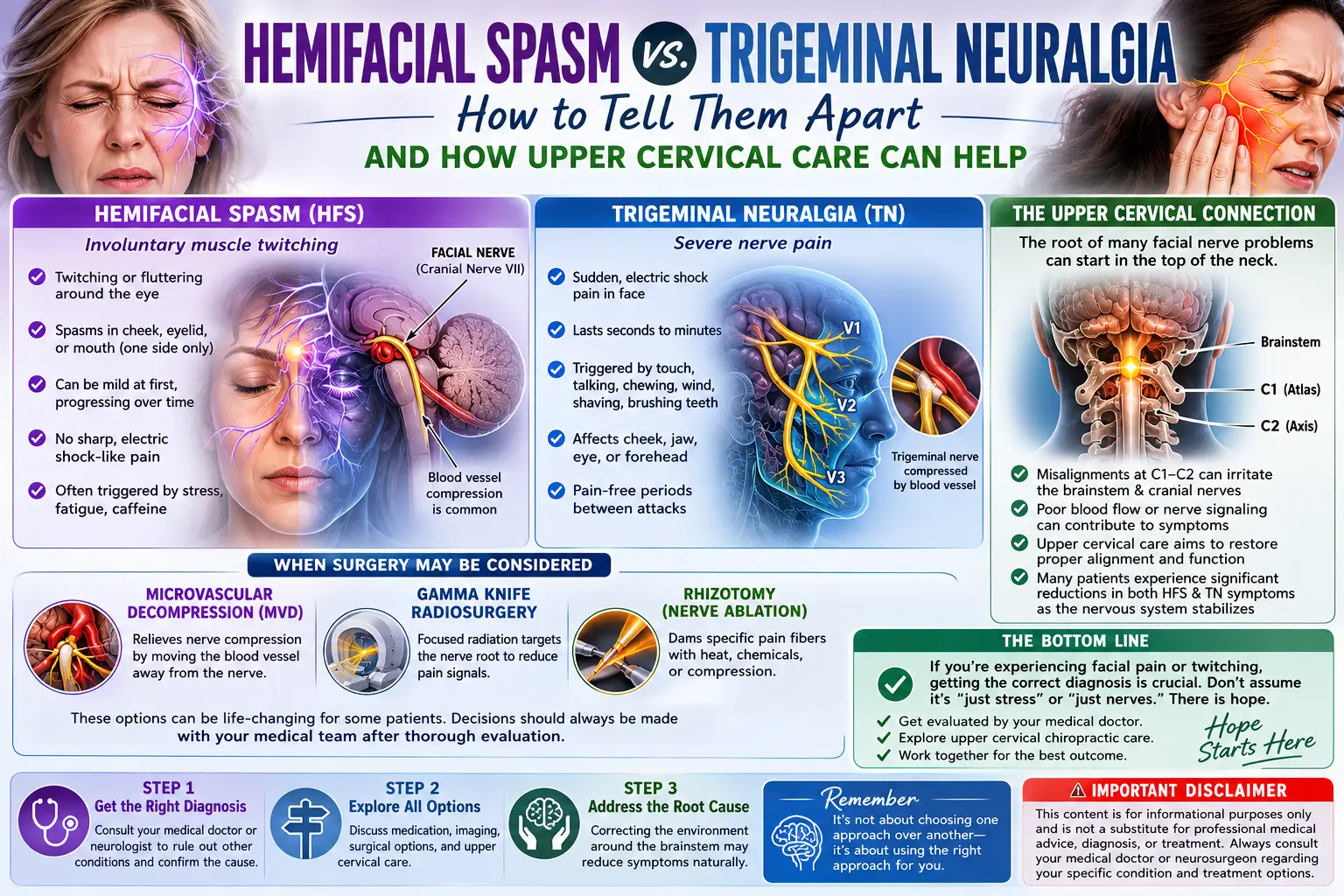
If you remember only one thing from this entire article, let it be this simple contrast. Trigeminal neuralgia is a paincondition. Hemifacial spasm is a movement condition. That single distinction is the simplest and most reliable way to begin separating the two in your mind.
Trigeminal neuralgia involves the trigeminal nerve, also called cranial nerve V. The trigeminal nerve is the primary sensory nerve of the face. It carries sensation from your forehead, cheek, jaw, teeth, and gums to your brain. When the trigeminal nerve is irritated or compressed in a way that produces trigeminal neuralgia, the hallmark symptom is sudden, severe, shock-like or stabbing facial pain. People often describe it as an electric jolt, a lightning strike, or a searing burn that lasts anywhere from a fraction of a second to a couple of minutes. It can be triggered by light touch, chewing, talking, brushing the teeth, a breeze on the face, or even a smile. The key word is pain.
Hemifacial spasm involves a completely different nerve: the facial nerve, also called cranial nerve VII. The facial nerve is a motor nerve. Instead of carrying sensation, it controls the muscles of facial expression. It is the nerve that lets you blink, wink, smile, frown, and close your eyelid. When the facial nerve is irritated or compressed in a way that produces hemifacial spasm, the hallmark symptom is involuntary muscle twitching or contraction on one side of the face. There is typically no pain at all. Instead there is movement the person cannot control: an eyelid that flutters and squeezes shut, a cheek that pulls, a corner of the mouth that jumps. The key word is twitching.
So the two conditions live on opposite sides of the same anatomical neighborhood. One is a sensory nerve producing abnormal sensation in the form of pain. The other is a motor nerve producing abnormal movement in the form of spasm. Both nerves exit the brainstem in close quarters, both can be compressed by a nearby blood vessel, and both can affect one side of the face. But a patient with trigeminal neuralgia hurts, and a patient with hemifacial spasm twitches. Understanding this pain-versus-twitching split is the foundation for everything else in this article.
There is one more practical layer worth mentioning. Because both conditions are one-sided and both involve the face, patients sometimes worry they have a stroke, a tumor, or Bell’s palsy. Hemifacial spasm is not facial paralysis; in Bell’s palsy the muscles go weak or limp, while in hemifacial spasm the muscles contract too much. Trigeminal neuralgia is not a dental infection, even though the pain can feel like it is coming from the teeth. This is exactly why proper neurological evaluation matters so much. The symptoms overlap enough in a person’s mind that self-diagnosis is unreliable, and the correct diagnosis changes the entire treatment path.
What Is Hemifacial Spasm?
Hemifacial spasm is a chronic neuromuscular disorder characterized by involuntary, intermittent contractions of the muscles supplied by the facial nerve on one side of the face. The word “hemifacial” means half the face, and “spasm” means involuntary muscle contraction. Put together, it describes exactly what patients experience: uncontrolled muscle activity confined to one side.
The condition usually follows a recognizable pattern as it develops. In the earliest stage, most people notice a subtle twitching around one eye, specifically in the orbicularis oculi muscle, which is the ring of muscle that closes the eyelid. At first these little flickers may seem trivial, similar to the harmless eyelid twitches nearly everyone gets when tired or stressed. The difference is that hemifacial spasm does not go away with rest, sleep, or reduced caffeine. Over months to years, the twitching tends to become more frequent, more forceful, and more widespread. The contractions gradually spread downward from the eye to involve the cheek, the muscles around the mouth, and sometimes the platysma muscle of the neck. In advanced cases, a strong spasm can force the eye to close and the mouth to pull to one side at the same time, which can interfere with vision, eating, and speaking.
A distinctive feature of hemifacial spasm is that the twitching often continues even during sleep, which helps distinguish it from ordinary benign eyelid twitching and from tics that a person can suppress. The spasms may worsen with stress, fatigue, anxiety, or specific facial movements, and many patients report that the condition affects their confidence and social comfort because the movements are visible to others.
What causes hemifacial spasm? In the large majority of cases, the underlying mechanism is neurovascular compression. This means a blood vessel, most commonly a small artery, lies against the facial nerve near the point where the nerve exits the brainstem, an area called the root exit zone. With every pulse of the artery, the nerve is gently but repeatedly irritated. Over time this pulsatile contact is thought to cause changes in the nerve’s insulating myelin and abnormal, hyperactive electrical firing, which the body translates into involuntary muscle contraction. Detailed imaging research on neurovascular compression syndromes has described how this vulnerable transition zone between different types of nerve myelin makes the facial nerve susceptible to symptomatic compression, and it explains why hemifacial spasm and trigeminal neuralgia share a common conceptual root even though they affect different nerves.
Less commonly, hemifacial spasm can be caused by other structures pressing on the facial nerve, such as a tumor, a cyst, or a vascular malformation, or it can follow damage to the facial nerve from a prior Bell’s palsy. These secondary causes are one of the main reasons an MRI is such an important part of the workup: imaging helps confirm the likely neurovascular compression and, just as importantly, rules out the less common but more serious causes that would change the treatment plan entirely.
Hemifacial spasm is relatively uncommon, with an estimated incidence of roughly one person per 100,000, and it tends to appear in middle-aged and older adults, somewhat more often in women. While it is not life-threatening, it is persistent and progressive, and it can meaningfully affect quality of life. That combination of persistence and visibility is what drives most patients to finally seek answers.
What Is Trigeminal Neuralgia?
We have written extensively about trigeminal neuralgia elsewhere, and you can explore our in-depth trigeminal neuralgia resource for a fuller discussion. Here we will offer a focused recap so you can hold the two conditions side by side.
Trigeminal neuralgia is a chronic pain condition affecting the trigeminal nerve, cranial nerve V. Its signature is sudden, intense, one-sided facial pain that is commonly described as electric, shock-like, stabbing, or shooting. The pain typically arrives in brief bursts, or paroxysms, that can last from a second or two up to a couple of minutes, and it can occur many times a day. Between attacks a person may feel completely normal, or may have a duller background ache in some forms of the condition. The pain most often affects the cheek and jaw regions served by the second and third divisions of the trigeminal nerve, though it can involve the forehead and eye area as well.
One of the most striking characteristics of trigeminal neuralgia is that ordinary, harmless activities can trigger an attack. Touching the face, washing, shaving, applying makeup, brushing the teeth, eating, drinking, talking, or even a light gust of wind can set off a jolt of pain. Certain spots on the face may act as trigger zones where the lightest contact provokes an episode. Because the pain can radiate into the teeth and jaw, many patients first visit a dentist and may even undergo dental procedures before the true neurological cause is identified.
Like hemifacial spasm, classic trigeminal neuralgia is most often attributed to neurovascular compression, but with a crucial difference in location and nerve. In trigeminal neuralgia, a blood vessel, frequently the superior cerebellar artery, presses on the trigeminal nerve near its root entry zone where it joins the brainstem. This pulsatile contact irritates the sensory nerve and is thought to cause demyelination and abnormal pain signaling. The same body of imaging research that describes neurovascular compression of the facial nerve in hemifacial spasm also describes this compression of the trigeminal nerve in trigeminal neuralgia, which is why the two conditions are so often discussed together despite being distinct.
The essential contrast, once again, is the output. Trigeminal neuralgia produces pain because the trigeminal nerve is sensory. Hemifacial spasm produces movement because the facial nerve is motor. Same neighborhood, same general mechanism of a vessel touching a nerve, entirely different symptom.
How Doctors Tell Them Apart and Diagnose Each
Because the two conditions can both start with vague, one-sided facial symptoms, physicians rely on a combination of careful history, clinical examination, and imaging to reach an accurate diagnosis. This is medical work that belongs to physicians and neurologists, and we encourage every patient with new facial pain or facial twitching to seek that evaluation.
The clinical history is often the single most useful tool. A doctor will ask what the symptom actually is. Is it pain, or is it movement? Pain that is sharp, electric, and triggered by touch or chewing points strongly toward trigeminal neuralgia. Involuntary twitching that started around the eye and spread down the face, and that continues during sleep, points strongly toward hemifacial spasm. The doctor will also ask about timing, triggers, progression, and any associated symptoms such as hearing changes, numbness, or weakness, which can suggest a secondary cause that needs closer attention.
The neurological examination adds more information. In trigeminal neuralgia, the sensory and motor exam of the face is usually normal between attacks; obvious sensory loss can be a clue that something other than classic trigeminal neuralgia is present. In hemifacial spasm, the physician may directly observe the involuntary contractions and may look for specific signs such as the simultaneous eyebrow raise and eye closure that can occur with facial nerve overactivity.
Imaging is where the two workups converge on a common tool: high-resolution MRI of the brain. For both conditions, MRI is used to look for a blood vessel in contact with the affected nerve at its vulnerable zone near the brainstem, and, critically, to rule out other causes such as a tumor, multiple sclerosis plaque, cyst, or vascular malformation. Specialized MRI sequences, including thin-slice T2-weighted imaging combined with vascular imaging, are considered the reference standard for detecting neurovascular compression. This is a key reason we so consistently encourage patients to obtain proper neurological evaluation and imaging: the MRI does not just support the diagnosis, it protects the patient by screening for the serious conditions that mimic these syndromes.
Once a diagnosis is established, the treatments diverge because the conditions are different.
For trigeminal neuralgia, first-line medical management is typically an anticonvulsant medication such as carbamazepine or oxcarbazepine, which calm the abnormal firing of the sensory nerve and can substantially reduce the frequency and intensity of pain attacks for many patients. When medications become inadequate or produce intolerable side effects, procedural and surgical options are considered. These include microvascular decompression, a neurosurgical operation that places a small cushion between the offending vessel and the trigeminal nerve, as well as ablative procedures such as radiofrequency rhizotomy, glycerol injection, balloon compression, and stereotactic radiosurgery. The European Academy of Neurology guideline on trigeminal neuralgia lays out this evidence-based framework in detail, describing carbamazepine and oxcarbazepine as first-line drugs and microvascular decompression as the surgical option with the most durable long-term results for classic trigeminal neuralgia.
For hemifacial spasm, the treatment landscape looks quite different because the problem is abnormal muscle contraction, not pain. The most common first-line treatment is botulinum toxin injection. Small, targeted injections of botulinum toxin type A into the overactive facial muscles reduce the involuntary contractions by temporarily limiting the nerve-to-muscle signaling in those muscles. The effect is not immediate and not lasting; it typically begins within a few days and wears off over roughly three months, so injections are repeated periodically. Botulinum toxin is widely regarded as an effective and generally well-tolerated symptomatic treatment for hemifacial spasm, though it manages the symptom rather than addressing the underlying vascular compression. Oral medications are sometimes tried but are usually less helpful for hemifacial spasm than they are for trigeminal neuralgia.
Both conditions share one important surgical option: microvascular decompression. Because both are frequently caused by a vessel pressing on a nerve, a neurosurgeon can, in appropriate candidates, relocate or cushion that vessel to relieve the compression. For hemifacial spasm, microvascular decompression is the procedure that directly targets the presumed cause rather than only the symptom, and systematic reviews report high rates of long-term relief from spasms, with the usual and important caveat that any brain surgery carries risks and requires careful patient selection and an experienced surgical team. The decision between ongoing botulinum toxin injections and microvascular decompression is a highly individual one that a patient makes together with their neurologist and neurosurgeon.
The takeaway from the diagnostic and treatment picture is straightforward. These are medical and, in some cases, surgical conditions. Anticonvulsants, botulinum toxin, and microvascular decompression are the tools of neurology and neurosurgery. That is precisely why our role at Lavender Family Chiropractic is a supportive and coordinated one, never a replacement for that care.
The Trigeminocervical Connection and the Upper Neck
If these conditions are driven by compression near the brainstem and treated by neurologists and neurosurgeons, where could the upper neck possibly fit? The answer lies in an area of neuroanatomy called the trigeminocervical complex, and it is a mechanism worth understanding in plain language.
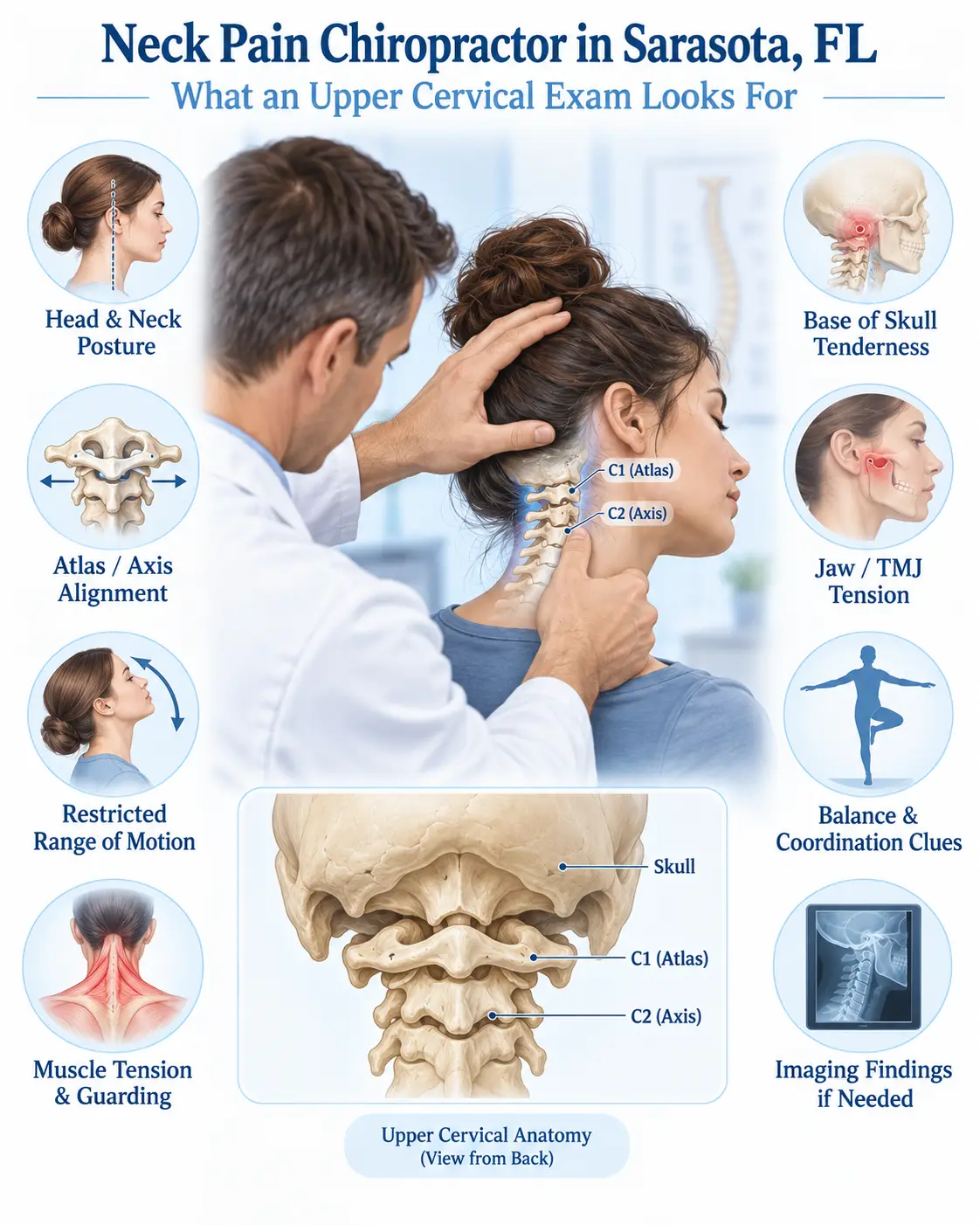
Deep in the upper spinal cord and lower brainstem, the sensory fibers of the trigeminal nerve descend and functionally overlap with the sensory nerves coming from the upper cervical spine, specifically the first three cervical nerve roots. This shared pool of nerve tissue is known as the trigeminocervical nucleus, or trigeminocervical complex. Because signals from the face and signals from the upper neck feed into the same processing region, the nervous system can, in effect, blur the lines between them. This is the well-documented mechanism behind cervicogenic headache, in which a problem in the upper neck is perceived as pain in the head and face. It is also the reason that upper neck dysfunction and facial symptoms can be intertwined in a person’s overall nervous system experience.
It is important to be precise and honest here about what this does and does not mean. The trigeminocervical connection does not mean that a misalignment in the neck causes hemifacial spasm or trigeminal neuralgia, and it does not mean that adjusting the neck removes a blood vessel from a cranial nerve. The vascular compression at the brainstem is a real, structural, medical issue, and no chiropractic technique changes that anatomy. What the trigeminocervical connection does suggest is that the upper cervical spine is part of the same neurological input environment that the face and head draw on. When the upper neck is functioning poorly, it contributes additional nociceptive and mechanical input into a system that, in these patients, is already sensitized and irritable.
This is where a gentle upper cervical component may fit as a supportive measure. The goal is not to treat the cranial nerve compression directly. The goal is to reduce unnecessary irritation and mechanical stress in the upper cervical spine so that the broader nervous system has less total load to manage. For some patients, addressing upper neck function, posture, and muscle tension is one modifiable piece of a larger picture that also includes their neurologist’s care. We frame this carefully and modestly: it is a supportive, quality-of-life-oriented role that works alongside proper medical treatment, not a stand-alone solution and not a substitute for neurological evaluation. Our related discussion of facial pain and trigeminal neuralgia goes deeper into how this input model works for facial symptoms.
Because the muscles of the jaw and upper neck are also part of this shared neighborhood, jaw mechanics can play a role in the overall symptom experience for some patients as well. If you grind your teeth, clench, or have jaw joint issues, our overview of TMJ and TMD upper cervical care explains how those factors interact with the same regional nervous system.
How Precise Upper Cervical Care Fits at Lavender
At Lavender Family Chiropractic, our entire practice is built around one specialized area: the upper cervical spine, the topmost region of the neck where the head balances on the spine. We are not a general, everything-cracks-and-twists chiropractic office. We practice a focused, measurement-driven form of upper cervical chiropractic care that emphasizes precision and gentleness above all else.
The technique we use is called the Knee Chest Upper Cervical technique. This is a precise, low-force method of correcting upper cervical misalignment. It is specifically not a high-velocity, twisting, popping manipulation of the neck. There is no forceful cranking or rotation. Instead, the correction is a carefully directed, low-force contact designed to encourage the upper cervical vertebrae toward a more neutral, well-aligned position with as little mechanical stress as possible. For patients dealing with a sensitized nervous system and one-sided facial symptoms, that gentleness matters enormously, and it is central to how we work.
Precision requires measurement, and we do not guess. Before any correction, we use 3D CBCT imaging, a cone-beam computed tomography scan that produces a detailed three-dimensional picture of your unique upper cervical anatomy. Every person’s spine is different, and this imaging lets us understand exactly how your vertebrae are oriented so that any correction is tailored specifically to you rather than to a generic template. We pair that structural information with Tytron paraspinal infrared thermography, a non-contact scan that reads patterns of heat along the spine as an objective, repeatable window into how your nervous system is functioning over time. Together, these tools let us make decisions based on data and track how your body is responding.
From that objective picture, we build customized care plans. We do not sell one-size-fits-all programs, and we do not believe in a random, unmeasured approach. Your plan reflects your imaging, your thermography, your symptoms, your goals, and your medical situation, and it is designed to evolve as we gather more information about how you respond.
Now for the honest part, which is the part that matters most. Upper cervical care at our office does not cure hemifacial spasm, and it does not cure trigeminal neuralgia. It does not remove a blood vessel from a cranial nerve, and it is not a replacement for the MRI, the neurologist, the botulinum toxin injections, the anticonvulsant medication, or the microvascular decompression surgery that these conditions may require. Anyone who promises otherwise is not being straight with you. What precise upper cervical care can do is address the function of your upper neck, reduce mechanical irritation in a region that feeds the same nervous system pathways involved in your facial symptoms, and serve as a supportive, coordinated part of a care team you build with your medical providers. We are enthusiastic about that supportive role, and we are equally committed to being clear about its limits. Coordinating with your neurologist, not competing with them, is how we believe this should work.
Ready to Talk With Us?
If you are dealing with one-sided facial pain or facial twitching and you want a careful, honest conversation about how precise upper cervical care might support your overall plan, we would be glad to help. Call Lavender Family Chiropractic at (941) 243-3729, or request a visit through our new patient scheduling page. Our office is located at 5899 Whitfield Avenue, Suite 107, Sarasota, FL 34243, right at the corner of University and Whitfield, and we welcome patients from across the Sarasota and Bradenton area. If you have not yet had a neurological evaluation for your symptoms, we will encourage you to get one, and we are happy to work alongside that care.
What the Research Says
We believe patients deserve to see the actual evidence base rather than vague claims. Here are five real, peer-reviewed sources that inform how these conditions are understood and treated. We encourage you to read them and to discuss them with your own physicians.
- Imaging of Neurovascular Compression Syndromes: Trigeminal Neuralgia, Hemifacial Spasm, Vestibular Paroxysmia, and Glossopharyngeal Neuralgia (PMC7960264) — This American Journal of Neuroradiology review explains how both trigeminal neuralgia and hemifacial spasm arise from a blood vessel compressing a cranial nerve at a vulnerable transition zone near the brainstem, and it describes the high-resolution MRI sequences considered the reference standard for detecting that compression.
- European Academy of Neurology Guideline on Trigeminal Neuralgia (PMID 30860637) — This evidence-based European guideline recommends carbamazepine and oxcarbazepine as first-line medications for trigeminal neuralgia and identifies microvascular decompression as the surgical option with the most durable long-term outcomes for classic cases.
- Botulinum Toxin Type A Therapy for Hemifacial Spasm (PMC6823221) — This review examines botulinum toxin type A as a widely used, effective, and generally well-tolerated symptomatic treatment for hemifacial spasm, detailing how the injections reduce involuntary facial muscle contractions on a temporary, repeatable basis.
- Efficacy and Safety of Botulinum Neurotoxin in the Treatment of Hemifacial Spasm: A Systematic Review and Meta-Analysis (PMC11520904) — This systematic review and meta-analysis pools multiple studies to evaluate how well botulinum neurotoxin controls hemifacial spasm symptoms and characterizes its safety profile, supporting its role as a mainstay symptomatic therapy.
- Spasm Freedom Following Microvascular Decompression for Hemifacial Spasm: Systematic Review and Meta-Analysis (PMC7899163) — This meta-analysis of thousands of patients across many studies reports high long-term rates of freedom from spasm after microvascular decompression for hemifacial spasm, while also documenting the surgical risks that make careful patient selection essential.
Self-Care and Next Steps
While hemifacial spasm and trigeminal neuralgia are medical conditions that require professional diagnosis and treatment, there are sensible steps you can take to support yourself and to give your care team the best information to work with.
First, keep a simple symptom journal. Write down when your symptoms occur, how long they last, what seems to trigger them, and whether the sensation is pain or movement. This distinction between pain and twitching is exactly what your neurologist will want to understand, and a clear record will make your appointments more productive.
Second, pursue proper evaluation early rather than waiting. If you have new one-sided facial pain or new involuntary facial twitching, ask your physician about a neurological evaluation and MRI. Early, accurate diagnosis both directs you to the right treatment and screens for the less common serious causes that can mimic these syndromes.
Third, attend to the general factors that can amplify a sensitized nervous system. Adequate sleep, stress management, hydration, and attention to posture and upper neck tension will not remove a vascular compression, but they can influence how heavily your overall system is loaded. Many patients notice their symptoms feel worse when they are exhausted or under stress, which is consistent with what we see clinically.
Fourth, be cautious about triggers if you have trigeminal neuralgia. Because light touch, wind, chewing, and oral hygiene can set off attacks, some patients find gentle adaptations to daily routines helpful while their medical treatment takes effect. Your neurologist can guide this.
Finally, if you would like to understand more about how facial symptoms and the upper neck relate, read our companion article on facial pain and trigeminal neuralgia, which explores the input model in greater depth and describes how supportive care can fit alongside medical treatment.
Serving Sarasota and Surrounding Communities
Lavender Family Chiropractic is proud to serve patients throughout Southwest Florida from our office at the corner of University and Whitfield. Whether you are searching for answers about facial pain, facial twitching, or upper cervical care in general, we welcome patients from Sarasota, Bradenton, Lakewood Ranch, Venice, Palmer Ranch, Osprey, Siesta Key, Longboat Key, Lido Key, University Park, Parrish, Ellenton, Myakka City, Punta Gorda, and St. Petersburg. Many of our patients travel to us specifically because focused, measurement-driven upper cervical care is not available on every corner, and we are glad to be a resource for the region. If you live in or near any of these communities and want a careful, honest conversation about your one-sided facial symptoms, we would be happy to meet you.
Top 15 Questions
1. What is the single biggest difference between hemifacial spasm and trigeminal neuralgia? Trigeminal neuralgia causes pain because it involves the trigeminal nerve, a sensory nerve. Hemifacial spasm causes involuntary muscle twitching because it involves the facial nerve, a motor nerve. In short: pain versus movement.
2. Can I have both conditions at the same time? It is uncommon but possible for a person to have compression affecting more than one cranial nerve. Because the nerves are close together, a thorough neurological evaluation and MRI are the right way to sort out exactly what is happening in your case.
3. Should I see a neurologist? Yes. Both hemifacial spasm and trigeminal neuralgia are neurological conditions that require proper medical diagnosis, usually including an MRI to identify the cause and to rule out more serious problems. We strongly encourage a neurological evaluation, and we are glad to coordinate our supportive care with your neurologist.
4. Can upper cervical chiropractic care cure my hemifacial spasm or trigeminal neuralgia? No. To be completely honest with you, our care does not cure either condition. Neither one is caused by a neck misalignment, and no chiropractic technique removes a blood vessel from a cranial nerve. Our role is supportive and coordinated, focused on upper neck function alongside your medical treatment, not a replacement for it.
5. Is hemifacial spasm painful? Usually not. The defining feature of hemifacial spasm is involuntary muscle contraction, not pain. If you are experiencing significant facial pain, that points more toward trigeminal neuralgia or another condition, which is one more reason to get an accurate diagnosis.
6. Why does trigeminal neuralgia sometimes feel like a tooth problem? Because the trigeminal nerve carries sensation from the teeth and jaw, the pain can be perceived as originating in the teeth. Many patients see a dentist first. If dental treatment does not explain or relieve the pain, a neurological cause should be considered.
7. How are the two conditions diagnosed? Through clinical history, neurological examination, and high-resolution MRI. Imaging looks for a vessel compressing the affected nerve and rules out other causes such as tumors or multiple sclerosis. Diagnosis is medical work performed by physicians.
8. What are the standard medical treatments? Trigeminal neuralgia is often treated first with anticonvulsant medications such as carbamazepine or oxcarbazepine, with surgical options including microvascular decompression when needed. Hemifacial spasm is often treated with botulinum toxin injections, with microvascular decompression as a surgical option that targets the underlying compression.
9. What technique does Lavender Family Chiropractic use? We use the Knee Chest Upper Cervical technique, a precise, low-force method of correcting upper cervical misalignment. It is not a high-velocity, twisting, or popping manipulation. Gentleness and precision are central to how we work.
10. What imaging and technology do you use? We use 3D CBCT imaging to map your individual upper cervical anatomy in three dimensions, and Tytron paraspinal infrared thermography to objectively assess nervous system function over time. These tools guide precise, individualized care.
11. Do you accept insurance? We are a cash-pay, out-of-network practice. This means we are not in network with insurance plans, which allows us to focus fully on individualized care rather than insurance restrictions.
12. Can I get reimbursed by my insurance if you are out-of-network? We provide superbills, which are detailed receipts you can submit to your insurance company for potential out-of-network reimbursement. Whether and how much you are reimbursed depends on your specific plan, so we recommend checking your out-of-network benefits directly with your insurer.
13. How do your care plans work? We build customized care plans based on your imaging, thermography, symptoms, and goals. Every plan is individualized and designed to adjust over time as we learn how your body responds. We do not use generic, one-size-fits-all programs.
14. Will chiropractic care interfere with my medical treatment? Our precise, low-force care is designed to work alongside your medical treatment, not against it. We view ourselves as a supportive, coordinated member of your care team. We encourage you to keep your neurologist informed and to continue any prescribed medical treatment.
15. What if I am not sure which condition I have? That is completely understandable, and it is exactly why proper evaluation matters. Start by noting whether your main symptom is pain or twitching, then seek a neurological evaluation and MRI. We are also glad to talk with you about how supportive upper cervical care might fit once you have a clear diagnosis — you can reach us at (941) 243-3729.
Closing CTA
One-sided facial pain and one-sided facial twitching can be unsettling, but you do not have to sort it out alone. The most important step is getting an accurate diagnosis from a neurologist, and from there, building a care team that supports you fully. At Lavender Family Chiropractic in Sarasota, we offer precise, low-force upper cervical care as an honest, supportive, and coordinated part of that team, guided by 3D CBCT imaging, Tytron thermography, and customized care plans. We will always be straightforward with you about what our care can and cannot do.
To talk with us, call (941) 243-3729, or book online through our new patient scheduling page. You can also reach us through our contact page. Our office is at 5899 Whitfield Avenue, Suite 107, Sarasota, FL 34243, at the corner of University and Whitfield. We look forward to helping you find clarity and support.