Brachioradial Pruritus Treatment Options Explained: Capsaicin, Gabapentin, Nerve Blocks, and Addressing the Source
By Dr. Rusty Lavender — Lavender Family Chiropractic, Sarasota, FL
Treatment Options: If you have brachioradial pruritus, you have probably already assembled a small pharmacy on your bathroom counter. There is the antihistamine that did nothing. The steroid cream that did nothing. The eczema ointment a well-meaning relative recommended, which also did nothing. Somewhere in there is a bag of frozen peas that works better than all of them combined — and that fact, strange as it sounds, is one of the most useful diagnostic clues you have.
Brachioradial pruritus (BP) is an intense, maddening itch that typically settles over the outer forearm near the brachioradialis muscle, though it can extend to the upper arm, the shoulder, and occasionally the upper back. It burns. It stings. It sometimes feels electric or crawling. And it very often does not respond to the things that normally quiet an itch, because it is not the kind of itch those things were designed to quiet. BP is widely described in the dermatologic and neurologic literature as a neuropathic itch — an itch generated by irritated or compressed nerve tissue rather than by an inflammatory reaction in the skin itself. Two contributing factors show up again and again in the literature: chronic ultraviolet exposure and cervical spine pathology.
This article walks through the treatment landscape honestly. We will cover topical capsaicin and how it actually works, the compounded creams some dermatologists prescribe, oral nerve-active medications like gabapentin and pregabalin, and procedural options including cervical nerve root blocks and epidural steroid injections. All of these have a legitimate place, and decisions about any of them belong to you and your physician. But we are also going to draw a distinction that we think matters more than any single product on the list: most of these approaches are designed to manage the signal. Comparatively few of them ask where the signal is coming from. At Lavender Family Chiropractic in Sarasota, our entire focus is the second question — and specifically the upper cervical spine, which is where the nervous system’s own volume control over itch physically lives.
Why Skin-Directed Treatment Options Usually Disappoint
Almost everyone with BP starts in the same place: the skin. That makes sense. The symptom is on the skin. You can see the scratch marks. So you try hydrocortisone, then a stronger prescription steroid, then oral antihistamines, then colloidal oatmeal baths and ceramide creams and whatever the pharmacist suggests. And typically, very little changes.
The reason is mechanistic. Most common itches — hives, allergic reactions, bug bites, contact dermatitis — are histaminergic. Mast cells in the skin release histamine, histamine binds receptors on nearby nerve endings, those endings fire, and your brain interprets the firing as itch. Antihistamines work in that setting because they interrupt the chain at the receptor. Topical steroids work because they suppress the inflammation that is driving mast cell activity in the first place.
Neuropathic itch does not follow that chain. In BP, the sensory nerve fibers serving the forearm are firing abnormally without a corresponding inflammatory event in the skin. The skin is, in most cases, completely normal on examination — no rash, no scale, no hive, nothing except secondary changes from scratching. There is no histamine release to block, so blocking histamine accomplishes nothing. This is not a subtle clinical impression; it is stated plainly in the reference literature. The StatPearls review of brachioradial pruritus notes that antihistamines are generally not beneficial in BP and lists nerve-active agents such as gabapentin and pregabalin among the more effective options.
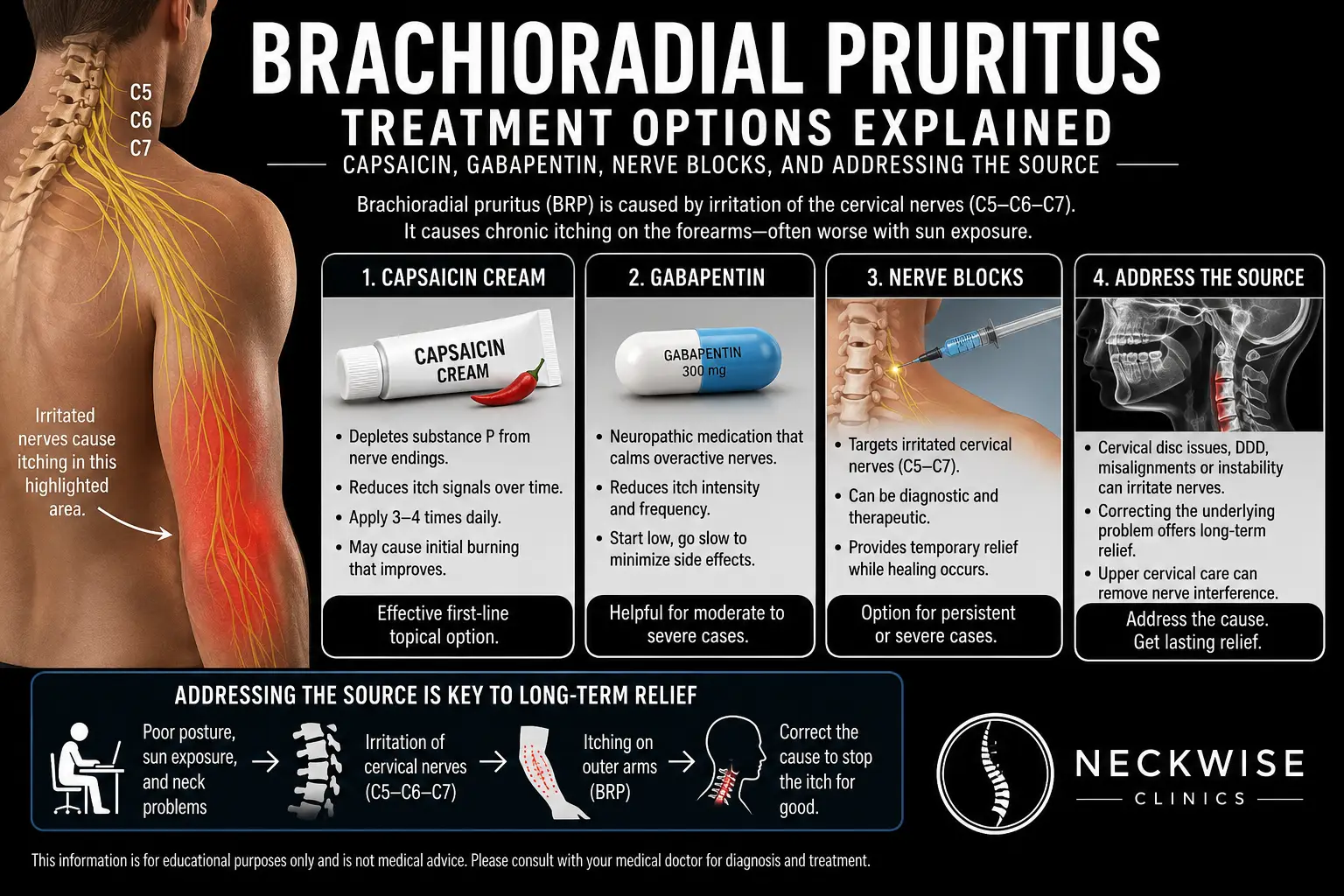
That single distinction reorganizes the entire treatment conversation. Once you accept that the problem is a signaling problem rather than a skin problem, the useful interventions fall into three broad buckets:
- Quiet the peripheral nerve endings in the skin (capsaicin, topical anesthetics, compounded neuromodulator creams, cold).
- Quiet the nerve signaling centrally or along the nerve (gabapentin, pregabalin, other nerve-active oral medications).
- Address the anatomy that may be irritating the nerve in the first place (procedural spinal interventions, and structural correction of the cervical spine).
Nearly everything offered for BP fits into one of those three buckets. Understanding which bucket a given treatment belongs to tells you a great deal about what it can reasonably be expected to accomplish — and what it cannot.
A second point deserves emphasis before we go further. The failure of skin-directed treatment is not a failure of your dermatologist. It is diagnostic information. When an itch does not respond to antihistamines and steroids, that pattern is itself pointing toward a neuropathic origin. Many patients spend two or three years cycling through skin products before anyone reframes the problem. If you are early in that cycle, you can save yourself considerable time by taking the non-response seriously rather than assuming you simply have not found the right cream yet.
Topical Options
Topical treatment for BP is not about moisturizing or anti-inflammatory action. It is about acting on the nerve endings in the skin directly. Several approaches are used.
Capsaicin
Capsaicin is the compound that makes chili peppers hot, and it is one of the more commonly discussed topical options for neuropathic itch. Its mechanism is genuinely interesting and worth understanding, because it explains both why it can help and why so many people quit before it does.
Capsaicin binds to the TRPV1 receptor on small-diameter sensory nerve fibers — the same C-fibers implicated in itch and burning pain transmission. Initially, this binding activates those fibers. That is why the first several applications commonly produce a burning, stinging, warm sensation that can be genuinely unpleasant, sometimes more unpleasant than the itch itself. This initial burning phase is expected, not a sign that something has gone wrong.
With repeated, consistent application, the picture changes. Sustained TRPV1 activation leads to depletion of substance P, a neuropeptide these fibers use to transmit itch and pain signals, and to a broader functional desensitization of the nerve endings. Once the fibers are depleted and desensitized, their capacity to signal itch is reduced. The catch is that this requires consistent use over a period of days to weeks, and if you stop, the effect fades as the nerve endings recover.
Practical realities patients should discuss with their prescriber include: application frequency (often several times daily for lower-concentration preparations), the availability of high-concentration patch formulations applied in a clinical setting, the need to avoid eyes, mucous membranes, and broken skin, and hand-washing after application. Some people find the initial burning phase tolerable when they know what to expect and when they are told explicitly that it typically diminishes. Others find it intolerable. Both are legitimate.
It is worth naming the conceptual limitation clearly: capsaicin does not address why the nerve is misbehaving. It reduces the terminal’s ability to transmit the message. That can be a meaningful improvement in day-to-day life, and for some people it is enough. But it is signal management by design.
Menthol and Camphor Preparations
Menthol acts on TRPM8, the cold receptor, producing a cooling sensation that can transiently override itch through a counter-stimulation effect. Camphor works similarly. Many over-the-counter anti-itch preparations combine them. Pramoxine, a topical anesthetic, is often included as well.
These preparations are inexpensive, widely available, and low-risk for most people, and many BP patients report short-lived relief from them. The relief is usually measured in minutes to a couple of hours. Think of them as portable, socially acceptable versions of the ice pack — useful for getting through a meeting or a dinner, not a treatment strategy. Some patients find that menthol preparations sting on skin that has been scratched raw, so application to intact skin matters.
Compounded Ketamine-Amitriptyline-Lidocaine
Some dermatologists and compounding pharmacies prepare a topical combination of ketamine, amitriptyline, and lidocaine — sometimes abbreviated KAL — for neuropathic itch and neuropathic pain conditions. The reasoning behind the combination is that each ingredient works on a different aspect of abnormal nerve signaling: ketamine acts at NMDA receptors involved in central and peripheral sensitization, amitriptyline has effects on sodium channels and other targets relevant to neuropathic transmission, and lidocaine blocks sodium channels to reduce nerve firing directly.
Because these are compounded preparations rather than mass-manufactured products, concentrations vary between pharmacies and prescribers, insurance coverage is inconsistent, and the evidence base is smaller and more heterogeneous than for oral agents. Whether a compounded topical is appropriate is a conversation for you and your prescribing physician. It is mentioned here because many BP patients encounter it and wonder what it is.
Topical Anesthetics
Lidocaine in cream, ointment, or patch form is sometimes used for localized neuropathic itch. The mechanism is straightforward — sodium channel blockade reduces the ability of nerve fibers to generate and propagate signals. Patches can be convenient for a discrete, consistently affected patch of forearm. Duration of effect is limited, and there are limits on how much surface area can be treated at once, which your physician or pharmacist can advise on.
Across all topical options, the honest summary is this: they can reduce the intensity or frequency of symptoms, sometimes substantially, and they carry relatively contained risk profiles. None of them changes what is happening upstream in the nerve.
Oral Nerve-Active Medications
When topical measures are insufficient, oral nerve-active medications are frequently the next step, and they are among the more commonly reported effective options in the BP literature.
Gabapentin and Pregabalin
Gabapentin and pregabalin are often described as anticonvulsants, which can be confusing to patients who do not have seizures. Their relevance to BP has nothing to do with seizure control per se and everything to do with how they modulate excitable nerve tissue.
Both bind the alpha-2-delta subunit of voltage-gated calcium channels on nerve terminals. By reducing calcium influx when a nerve fires, they reduce the release of excitatory neurotransmitters. Functionally, this dampens the amplified, self-sustaining signaling that characterizes neuropathic conditions. In an oversimplified but useful framing: these medications turn down the gain on a nerve pathway that has become too loud.
That framing is exactly why they are relevant to BP. If BP involves hyperexcitable signaling in a sensory pathway, a drug that reduces excitability in that pathway is a rational choice, and clinical reports support it. In the Cureus 2022 case series by Shields and colleagues, which examined clinical features, electromyography, and cervical MRI in nine BP patients, gabapentin provided the most relief among the treatments used.
Dosing, titration schedules, duration, tapering, and management of side effects are decisions for you and your physician — full stop. These medications are typically started low and increased gradually. Commonly discussed side effects include drowsiness, dizziness, unsteadiness, cognitive fog, peripheral swelling, and weight gain, and they can vary considerably between individuals and doses. Dose adjustment is needed in reduced kidney function. Stopping abruptly is generally not advised. None of that is advice we are qualified to give, and nothing in this article should be read as a suggestion to start, change, or stop any medication. We mention side effects only because patients ask what the trade-offs are, and it would be dishonest to describe the benefits without acknowledging that trade-offs exist.
Other Oral Agents
Depending on the clinical picture, physicians sometimes consider other agents with neuropathic activity, including certain antidepressants used at neuropathic doses. Again, these are prescriber decisions. Our purpose here is orientation, not recommendation.
The same conceptual observation applies to oral agents as to topicals: they reduce the transmission and perception of an abnormal signal. They do not evaluate or alter whatever anatomical or biomechanical situation may be generating it. That is not a criticism — reducing a debilitating symptom has real value, and for some people these medications are the difference between functioning and not functioning. It is simply an accurate description of the category.
Procedural Options
For patients whose symptoms persist despite topical and oral management, physicians sometimes consider procedural interventions. And here the story takes a turn that we think deserves far more attention than it usually gets.
Cervical Nerve Root Blocks
A cervical nerve root block involves the image-guided injection of anesthetic, often with a corticosteroid, around a specific cervical nerve root. The goal is to interrupt signaling and reduce inflammation at the level of the nerve root itself.
Weinberg and colleagues published a case in JAAD Case Reports in 2018 describing CT-guided cervical nerve root block used in the treatment of brachioradial pruritus. It is a single case report, and single case reports do not establish general efficacy — that limitation should be stated plainly. But the report is instructive for a reason beyond its outcome.
Consider what the procedure actually is. A patient presents with an itch on the forearm. The intervention performed is an injection into the neck. Nobody would do that unless the clinical reasoning held that the neck is where the relevant nerve irritation lives.
Cervical Epidural Steroid Injections
Similarly, cervical epidural steroid injections deliver corticosteroid into the epidural space of the cervical spine to reduce inflammation around irritated nerve roots. They are used in a range of cervical radicular conditions, and they appear in discussions of refractory BP for the same reason nerve root blocks do.
Both procedures carry the risk profiles inherent to spinal injections, which the performing physician will review in detail. Effects are frequently temporary, and repeat procedures are sometimes required. Those are considerations to weigh with your physician, not with a blog post.
The Point Worth Sitting With
Here is the observation we want to leave you with before the pivot section. When mainstream medicine escalates BP treatment to its more definitive interventions, those interventions target the cervical spine. Not the forearm. The neck.
That is not a fringe idea. That is the standard escalation pathway, and it encodes a clinical judgment: in many cases of BP, the cervical spine is part of the causal chain. The imaging literature supports the same conclusion. Marziniak and colleagues, publishing in the Journal of the American Academy of Dermatology in 2011, obtained cervical MRI in 41 patients with BP and found evidence of nerve compression corresponding to the affected dermatomes in 80.5% of cases.
So the question is not whether the neck matters in BP. Injection-based treatment and imaging studies both point that direction. The question is what you do about a neck that appears to be part of the problem.
Non-Drug Measures
Before we get to that, a few practical measures worth knowing.
Cold and the Ice-Pack Sign
The “ice-pack sign” is one of the most characteristic features of BP. Patients find that applying ice or cold packs to the affected area produces relief that is faster and more complete than anything a topical steroid or antihistamine delivers. The sign is considered so typical of BP that it functions as a clinical clue supporting the diagnosis.
Why does cold work when antihistamines do not? Cold reduces the conduction velocity and excitability of peripheral nerve fibers and engages cold-sensing pathways that compete with itch signaling for attention in the spinal cord. It acts on nerve behavior, which is precisely the domain of the problem.
Practical notes: use a cloth barrier rather than applying ice directly to skin, limit application time to avoid cold injury, and pay attention to sensation — if the area is numb from medication or nerve involvement, you may not get accurate feedback about skin damage. Many patients keep gel packs in a cooler or a small freezer pack in a bag when traveling.
Sun Protection
Chronic ultraviolet exposure is one of the two most consistently cited contributing factors in BP, and it explains the classic epidemiology: sun-exposed forearms, warmer climates, more cases, and symptoms that often worsen in summer. In a place like Sarasota, this is not an abstraction. Between year-round sun, driving with a bare left arm on the window ledge, boating, golf, tennis, pickleball, and gardening, our forearms take a beating.
Reasonable measures include broad-spectrum sunscreen applied to the forearms as routinely as the face, UV-protective long-sleeve shirts and sleeves, window film or a UV-blocking sleeve for driving, and shade during peak hours. Patients often notice that symptoms track with sun exposure, and reducing that exposure can be one of the more accessible levers available.
Scratch Avoidance and Skin Protection
Scratching a neuropathic itch offers little satisfaction and creates real problems. The itch-scratch cycle sensitizes tissue, damages the skin barrier, and can produce excoriations, secondary infection, lichenified plaques, and scarring. Because the fingernails cannot reach the source of the signal, the scratching is essentially self-harm without payoff.
Substitution tends to work better than willpower. Keeping nails trimmed short, applying cold instead of scratching, wearing long sleeves as a physical barrier, and firm pressure or gentle rubbing rather than nail scratching all reduce damage. Nighttime scratching, which many patients do unconsciously, may warrant soft gloves or covered sleeves.
Managing the Signal vs. Addressing the Source
Line up everything covered so far.
Capsaicin depletes substance P at the nerve endings so they transmit less itch. Menthol overrides the sensation temporarily. Compounded creams block sodium channels and NMDA receptors locally. Lidocaine numbs. Gabapentin and pregabalin reduce excitability in the pathway. Ice slows nerve conduction. Sun protection reduces one source of cumulative nerve insult. Nerve root blocks and epidural injections chemically interrupt or reduce inflammation around a nerve root — the most upstream of the conventional options, and notably the one aimed at the neck.
Almost all of it is signal management. That is not a knock. When an itch is severe enough to keep you awake, to make you scratch until you bleed, to consume your attention through every workday, turning the signal down is a genuine mercy and a completely rational goal. Anyone who tells you otherwise has never had a neuropathic itch.
But signal management has a built-in ceiling: relief generally persists as long as the intervention persists. Stop the capsaicin and the nerve endings repopulate. Stop the gabapentin and excitability returns. The injection wears off. If the underlying situation that is irritating the nerve remains unchanged, the symptom has a reason to come back.
Which raises the obvious question: what changes the underlying situation?
For BP, the two most cited contributors are UV exposure and cervical spine pathology. UV exposure you can address behaviorally, starting today. The cervical spine is harder — and it is where our attention goes.
Here we want to be careful. We are not claiming that chiropractic care is a treatment for brachioradial pruritus, that it works where medications fail, or that it lets anyone avoid a procedure. We do not know that, and no honest practitioner would claim it. What we are saying is narrower and, we think, more defensible: if the cervical spine is implicated in BP — and the injection literature and the imaging literature both suggest it frequently is — then the structural integrity and function of the cervical spine is a legitimate thing to evaluate. It is a variable almost nobody in the standard pathway examines from a structural, biomechanical standpoint.
Why the Upper Cervical Spine Is Central
Two mechanisms drive our focus on the upper cervical spine specifically. Both are mechanistic reasoning — they are grounded in established neuroanatomy and biomechanics, but we want to label them clearly as reasoning rather than as findings from BP-specific trials. No study has tested upper cervical correction for brachioradial pruritus.
Mechanism One: Descending Inhibitory Control and Spinal Hyperexcitability
This is the more important of the two, and it is not well known outside pain neuroscience.
Itch is not simply transmitted from skin to brain like a phone call. It is gated. When itch fibers arrive at the dorsal horn of the spinal cord — the sensory processing station where peripheral input first synapses — the signal is subject to substantial modulation before anything reaches conscious awareness. Inhibitory interneurons in the dorsal horn suppress itch transmission continuously, and this local inhibitory network is itself regulated by descending pathways originating in the brainstem. The brainstem sends fibers down the spinal cord that actively hold the itch and pain gate partly closed, moment to moment, as a matter of ongoing background function.
Hachisuka, Chiang, and Ross reviewed this circuitry in Pain in 2018 in their paper “Itch and neuropathic itch,” describing dorsal horn inhibitory gating and the role of descending inhibitory control in itch processing. The key concept from that literature is that when inhibitory control is lost or diminished, the dorsal horn becomes hyperexcitable — and a hyperexcitable dorsal horn can generate the perception of intense itch from input that would otherwise be entirely unremarkable, or from no meaningful peripheral input at all.
That framework maps onto BP with uncomfortable precision. It explains why the skin looks normal. It explains why antihistamines fail. It explains the burning, electric quality patients describe. It explains why drugs that reduce neural excitability help. And it reframes the disorder: BP behaves less like an itch that is too loud at the skin and more like an itch whose brake has partially released at the spinal cord.
Now follow the anatomy of that brake.
Descending inhibitory pathways originate in brainstem structures and travel caudally through the spinal cord to reach dorsal horn segments — including the cervical segments serving the forearm. To get from the brainstem to anywhere below, every one of those fibers must pass through the uppermost segment of the spinal cord. And that segment is enclosed by the atlas (C1) and the axis (C2).
The upper cervical spine is the anatomical corridor through which the body’s own brake on the itch signal descends.
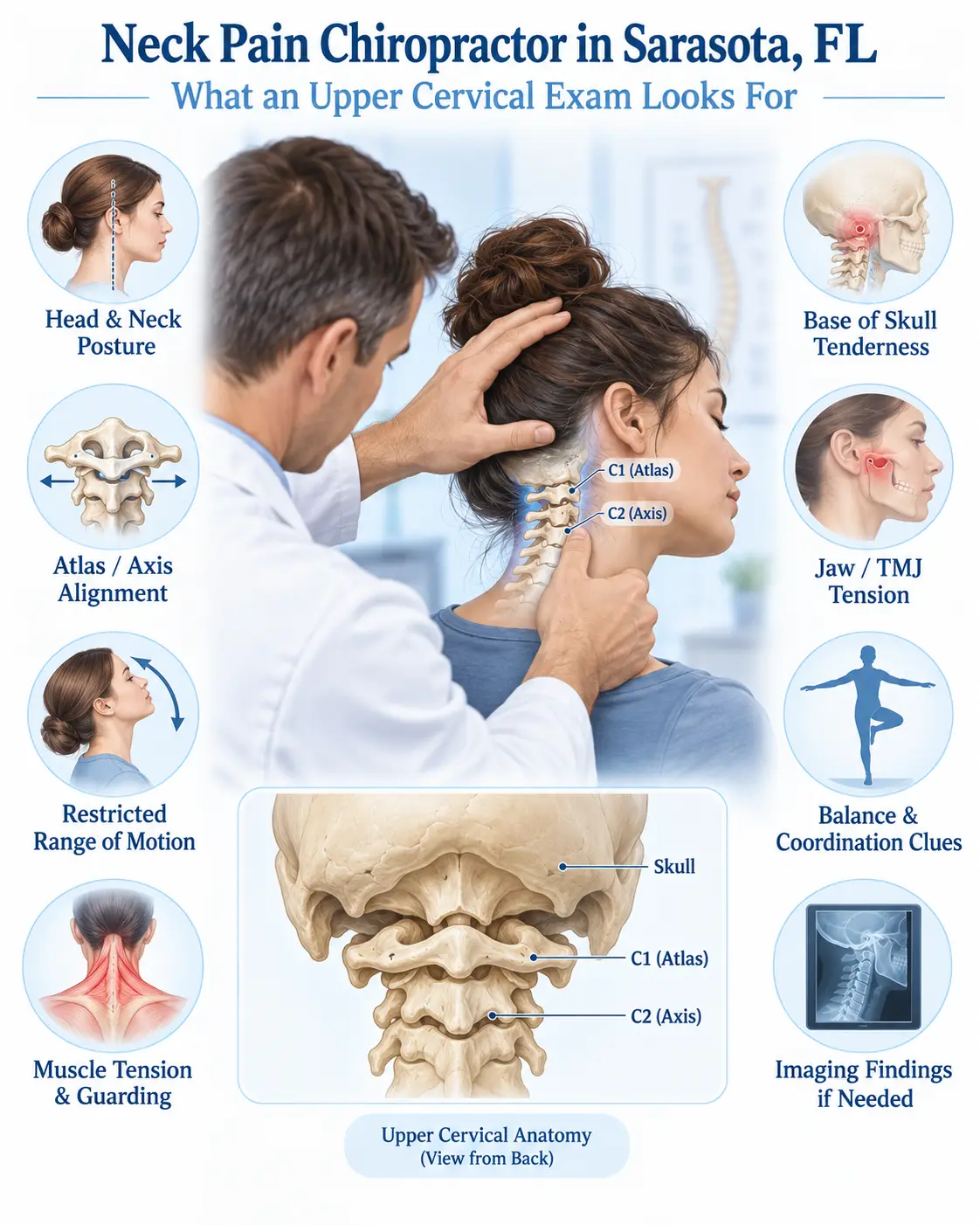
The atlas is a structurally unusual bone. It has no vertebral body and no intervertebral disc above or below it, which means it lacks the passive stabilization that the rest of the spine relies on. It supports the entire weight of the skull on two small articular surfaces. It surrounds the junction where brainstem becomes spinal cord, in a region where the spinal canal’s relationship to its contents is unusually consequential. Positional relationships in this region matter to neural function in ways they do not lower down.
The mechanistic proposition is straightforward: if descending inhibitory tone is central to keeping itch signaling in check, and if those descending fibers traverse the upper cervical cord, then the structural condition of the upper cervical spine is at minimum a relevant variable in a condition characterized by loss of inhibitory control. We are not claiming this has been demonstrated for BP. We are claiming it is a coherent question that essentially nobody in the standard treatment pathway is asking.
Mechanism Two: Upstream Biomechanics and the Downstream Cervical Chain
The second mechanism connects the upper cervical spine to the lower cervical findings that BP imaging studies actually report.
Be precise about what the imaging literature shows. Marziniak and colleagues found nerve compression corresponding to affected dermatomes in 80.5% of 41 BP patients on cervical MRI. Shields and colleagues found cervical MRI abnormalities in their nine-patient series. The changes described in this body of work — degenerative disc disease, foraminal narrowing, spondylosis — are predominantly at the lower cervical levels, in the C5 through C7 region that supplies the lateral forearm. Those studies imaged the lower cervical spine and reported lower cervical findings. It would be a misrepresentation to cite them as evidence of upper cervical involvement, and we will not do that.
The question we would raise is a different one: why does the lower cervical spine degenerate asymmetrically in the first place?
Degeneration is not uniformly random. It concentrates where mechanical load concentrates. Load concentrates where alignment deviates. And the cervical spine is a linked chain in which the position of the head atop the atlas sets the terms for everything below it.
When the upper cervical spine loses its normal alignment relationship, the head is no longer neutrally balanced over the neck. Because the visual and vestibular systems demand that the eyes stay level with the horizon, the body compensates automatically — and it does so through the segments below. Postural muscles adapt asymmetrically. The lower cervical segments accept altered loading patterns to hold the head level. Sustained over years and decades, asymmetric loading is exactly the mechanical environment in which discs thin unevenly, uncovertebral and facet joints hypertrophy, and neural foramina narrow on one side more than the other.
Which would mean that the C5-C7 findings the BP literature reports may in some cases be the visible downstream consequence of an uncorrected upper cervical problem — the place where a compensation pattern that started at the top finally accumulated enough mileage to show up on an MRI. This would also help explain a detail patients frequently notice: BP is often unilateral, or clearly worse on one side. A symmetric systemic process would not produce that. An asymmetric mechanical compensation pattern would.
Again, this is mechanistic reasoning, offered as such. It is not a claim that a specific study has demonstrated. But it is why our attention goes to the top of the neck even in a condition whose imaging findings sit lower.
Both mechanisms converge on the same conclusion. Whether you approach BP through the neurophysiology of descending inhibition or through the biomechanics of the cervical chain, the upper cervical spine is a structure worth evaluating carefully. You can learn more about our approach on our upper cervical chiropractic care page.
How Precise Upper Cervical Care Fits at Lavender Family Chiropractic
Here is what evaluating that question actually looks like in our Sarasota office.
The consultation. We begin with a conversation. When did the itch start? Which arm, or both? Is one side worse? What makes it better or worse? Does cold help? What is your sun history? What have you tried, and what happened? And critically — is there any history of head or neck trauma? Car accidents, falls, sports injuries, a hard hit years ago that seemed minor at the time. Patients are often surprised how far back we go, because upper cervical misalignments frequently trace to an event long before symptoms appeared. We also want a complete picture of your current medications and the physicians managing your care.
3D CBCT imaging. If examination findings suggest an upper cervical evaluation is warranted, we use 3D cone beam CT imaging. Standard two-dimensional films flatten a three-dimensional structure and hide a great deal in the upper cervical region, where the anatomy is complex and the relationships that matter are subtle. CBCT lets us see the atlas, the axis, and the occiput in three dimensions and measure their relationships specifically for your anatomy. That measurement is not academic — it determines whether a correction is indicated at all, and if so, precisely how it must be delivered. We do not adjust based on assumption.
Tytron paraspinal infrared thermography. Structure is only half the picture. Paraspinal infrared thermographymeasures skin temperature patterns along the spine, reflecting autonomic nervous system regulation of blood flow. Because that regulation is neurologically controlled, thermal patterns provide an objective, non-invasive window into nervous system function. We use serial scans to establish your baseline pattern, help determine whether a correction is indicated on a given visit, and track how your system responds over time. It is one of the main reasons we do not simply adjust at every appointment.
Precise, low-force Knee Chest Upper Cervical correction. Our correction is delivered using the Knee Chest Upper Cervical technique. This is not the high-velocity twisting manipulation most people picture when they hear the word “chiropractor.” There is no forceful rotation of the neck and no popping or cracking. You are positioned in a specific knee-chest posture that stabilizes the spine and gives clean access to the upper cervical segments, and the correction is a precise, low-force contact calculated from your imaging — specific vector, specific depth, specific segment. Most patients describe it as gentle and are surprised by how little there is to it. Precision, not force, is the operating principle.
Customized care plans. Every plan is built around the individual, because the imaging findings, thermographic patterns, history, age, and overall health that shape a plan are different for everyone. Our customized treatment plans page explains our approach, and we walk you through the recommended plan and all associated fees before you commit to anything. Once a correction is made, a substantial portion of the work is holding it — which is why follow-up visits often involve checking whether the correction is holding rather than adjusting again.
Coordination with your physician. We do not prescribe, we do not adjust medications, and we do not tell patients to change what their physician has prescribed. If you are taking gabapentin, using capsaicin, or considering a nerve block, those remain conversations between you and your physician. We are glad to communicate with your dermatologist, neurologist, or primary care physician, and we think concurrent care is usually the right model for a condition like this.
What this care can and cannot do. It can evaluate whether an upper cervical misalignment is present, using objective imaging and thermography. If one is present, it can deliver a precise correction and monitor whether it holds. What it cannot do is guarantee any particular outcome for your itch. Brachioradial pruritus is multifactorial. Sun exposure, degenerative change, individual neurophysiology, and other variables all contribute, and correcting a cervical misalignment does not undo years of ultraviolet damage or reverse established degeneration. Some patients report meaningful improvement. Some report partial change. Some report none. We will tell you honestly what we find and whether we believe we can help. If we do not think we can, we will say so.
Ready to Have Your Upper Cervical Spine Evaluated?
If you have BP and nobody has looked at the structural condition of your upper cervical spine, that gap may be worth closing.
Call (941) 243-3729 to schedule a consultation, or book online here.
Lavender Family Chiropractic 5899 Whitfield Avenue, Suite 107 Sarasota, FL 34243 (corner of University and Whitfield)
We are a cash-pay, out-of-network practice. We provide superbills you can submit to your insurance for potential reimbursement, and we explain all fees up front before you commit to anything.
What the Research Says
Five sources inform the discussion above. Each is described for exactly what it reports.
1. StatPearls — Brachioradial Pruritus (PMID 29083620) https://www.ncbi.nlm.nih.gov/books/NBK459321/ A reference overview of BP covering presentation, etiology, evaluation, and management. It describes BP as a neuropathic itch most commonly affecting the dorsolateral forearm, discusses ultraviolet exposure and cervical spine pathology as contributing factors, and notes that antihistamines are generally not beneficial. Gabapentin and pregabalin are listed among the more effective treatment options. This is a review resource rather than original research.
2. Weinberg BD, et al. — CT-guided cervical nerve root block for brachioradial pruritus. JAAD Case Reports, 2018 (PMID 30094306) https://pubmed.ncbi.nlm.nih.gov/30094306/ A case report describing the use of CT-guided cervical nerve root block in the management of brachioradial pruritus. As a single case report, it cannot establish general efficacy. Its conceptual significance is that the intervention targets the cervical spine for a symptom experienced in the forearm, reflecting clinical reasoning that the neck is part of the causal chain.
3. Shields LB, et al. — Cureus, 2022 (PMID 35291549) https://www.ncbi.nlm.nih.gov/pmc/articles/PMC8896843/ A case series describing clinical features, electromyography, and cervical MRI findings in nine patients with brachioradial pruritus. Among the treatments used in this series, gabapentin provided the most relief. The sample is small, and findings from nine patients should be interpreted with appropriate caution.
4. Marziniak M, et al. — Journal of the American Academy of Dermatology, 2011 (PMID 21641675)https://pubmed.ncbi.nlm.nih.gov/21641675/ Cervical MRI was obtained in 41 patients with brachioradial pruritus. Nerve compression corresponding to the affected dermatomes was identified in 80.5% of cases. This is one of the more substantial imaging datasets supporting cervical involvement in BP. The findings describe cervical nerve compression at levels corresponding to the symptomatic dermatomes; they should not be read as evidence about the upper cervical spine specifically.
5. Hachisuka J, Chiang MC, Ross SE — “Itch and neuropathic itch.” Pain, 2018 (PMID 29389746)https://pmc.ncbi.nlm.nih.gov/articles/PMC6106783/ A review of itch neurophysiology with emphasis on neuropathic itch. It describes inhibitory gating of itch transmission in the spinal cord dorsal horn and the role of descending inhibitory control from the brainstem, and discusses how loss of inhibition contributes to spinal hyperexcitability and pathological itch. This paper addresses itch circuitry generally; it is not a study of brachioradial pruritus or of chiropractic care. It is cited here for the neurophysiological framework of descending inhibition, which underpins the mechanistic reasoning in this article.
A necessary caveat: none of these studies evaluated upper cervical chiropractic care for brachioradial pruritus. No such study exists. The upper cervical mechanisms described in this article are mechanistic reasoning built on established neuroanatomy and biomechanics, presented as reasoning rather than as demonstrated fact.
Building Your Plan
A sensible approach to BP usually layers several things rather than betting on one.
Get an accurate diagnosis. If you have not seen a dermatologist, start there. BP is a clinical diagnosis, and other conditions can mimic it. Knowing what you are treating matters.
Address ultraviolet exposure now. It costs nothing, it is entirely within your control, and it is one of the two most consistently cited contributors. Sunscreen on the forearms daily, UV sleeves for driving and outdoor activity, and shade during peak hours. In Sarasota this is a year-round matter, not a summer one.
Use symptomatic relief without guilt. Cold packs, menthol preparations, capsaicin if your physician recommends it. Getting through the day is a legitimate goal, and there is no virtue in suffering while you sort out longer-term strategy.
Have the medication conversation with your physician. If topicals are not enough, gabapentin or pregabalin may be worth discussing. That conversation belongs to the two of you, and you should be able to ask openly about expected benefit, side effects, and duration.
Ask about cervical imaging. Given the imaging literature, asking your physician whether cervical imaging is appropriate in your case is reasonable. Understanding what your neck looks like is useful information regardless of what you decide to do with it.
Have your upper cervical spine evaluated structurally. This is the piece the standard pathway consistently omits. An MRI report describing degenerative change at C6-C7 tells you about tissue. It does not tell you whether the head is balanced on the atlas, whether alignment is driving compensatory loading down the chain, or whether the region housing your descending inhibitory pathways is structurally sound. That requires a different kind of evaluation.
Protect your skin from scratching. Nails short, cold instead of scratching, sleeves as a barrier, attention to nighttime habits.
If you want to understand the underlying condition in more depth, our complete guide to brachioradial pruritus is the best starting point, and Why Won’t My Elbow Stop Itching? covers the symptom presentation many patients recognize first. If your symptoms extend beyond itch into numbness, tingling, or burning, our neuropathy page addresses the broader picture.
Serving Sarasota and Surrounding Communities
Our office at 5899 Whitfield Avenue, Suite 107, sits at the corner of University and Whitfield, convenient to both Sarasota and Manatee counties. Because upper cervical care is a specialized approach, patients often travel some distance to see us.
We serve patients from Sarasota, Bradenton, Lakewood Ranch, Venice, Palmer Ranch, Osprey, Siesta Key, Longboat Key, Lido Key, University Park, Parrish, Ellenton, Myakka City, Punta Gorda, and St. Petersburg.
Our region’s sunshine is one of its great pleasures and, for BP patients, part of the problem. Decades of boating, golf, tennis, pickleball, beach time, gardening, and driving with an arm on the window ledge add up to substantial cumulative forearm ultraviolet exposure. That is one reason we see this condition regularly in Southwest Florida — and one reason sun protection is not a throwaway recommendation here.
Top 15 Questions About Brachioradial Pruritus Treatment
1. Should I stop my medication if I start upper cervical care? No. We do not make medication decisions, and we would never advise anyone to stop or change a prescription. Continue taking what your physician has prescribed and continue seeing your physician. If your symptoms change, tell your physician, and any adjustment to your regimen is their decision.
2. Will upper cervical care let me avoid a nerve block? We cannot promise that, and we will not. There are no guarantees. Some patients improve and choose not to pursue further procedures; others proceed with procedures anyway; others find upper cervical care does not change their symptoms. Whether to have a nerve block is a decision for you and your physician based on your situation, not on anything we predict.
3. Can you cure my brachioradial pruritus? No. We do not cure conditions, and any provider who tells you they can cure BP is overpromising. BP is multifactorial, involving ultraviolet damage, possible degenerative change, and individual neurophysiology. What we can do is evaluate whether an upper cervical misalignment is present and, if so, correct it precisely and monitor whether it holds. Outcomes vary and cannot be predicted in advance.
4. Why doesn’t Benadryl help? Because BP is a neuropathic itch rather than a histamine-driven one. Antihistamines block histamine receptors, but in BP the abnormal signaling originates in nerve tissue without a corresponding histamine release in the skin. The StatPearls review notes that antihistamines are generally not beneficial in BP.
5. Why does ice work so well? Cold reduces peripheral nerve excitability and conduction and engages cold-sensing pathways that compete with itch signaling at the spinal cord. This response is so characteristic it is called the “ice-pack sign” and is considered a supportive clinical clue for BP.
6. Does capsaicin really work, and why does it burn at first? Capsaicin activates TRPV1 receptors on sensory nerve fibers, which initially produces burning and stinging. With consistent repeated use, sustained activation depletes substance P and desensitizes those fibers, reducing their capacity to transmit itch. The initial burning phase is expected. Whether capsaicin is appropriate for you is a conversation with your physician.
7. Do you take insurance? We are a cash-pay, out-of-network practice. We do not bill insurance directly, which lets us structure care around clinical need rather than around coverage rules. All fees are explained clearly before you commit to anything.
8. What is a superbill and how do I use it? A superbill is an itemized receipt listing the services provided and their diagnostic and procedure codes. You submit it to your insurance company yourself and they determine whether any out-of-network reimbursement applies. We provide superbills on request. Reimbursement depends entirely on your individual plan, and we cannot promise any particular result.
9. Is the adjustment like what I’ve seen in videos? No. Knee Chest Upper Cervical correction is a precise, low-force procedure — not high-velocity twisting manipulation. There is no forceful neck rotation and no popping or cracking. Most patients describe it as gentle and are surprised by how subtle it is. The precision comes from imaging-based measurement, not from force.
10. Why do you need 3D CBCT imaging? Because upper cervical anatomy is three-dimensional and highly variable between individuals, and standard two-dimensional films flatten and obscure the relationships that matter. CBCT lets us measure your specific anatomy so that any correction is calculated for you rather than applied generically.
11. What does the thermography scan tell you? Tytron paraspinal infrared thermography measures skin temperature patterns along the spine, which reflect autonomic nervous system regulation of blood flow. Because that regulation is neurologically controlled, the pattern gives us an objective, non-invasive indicator of nervous system function. Serial scans help us determine whether a correction is indicated and track how your system responds over time.
12. My MRI showed degeneration at C6-C7. Why are you focused on C1 and C2? Two reasons. First, descending inhibitory pathways from the brainstem — the ones that keep itch signaling suppressed at the dorsal horn — pass through the upper cervical cord surrounded by the atlas and axis. Second, upper cervical alignment influences loading down the entire cervical chain, so lower cervical degeneration may in some cases be the downstream consequence of an uncorrected upper cervical problem. Both points are mechanistic reasoning, not findings from BP studies, and the imaging studies we cite examined lower cervical levels.
13. How long before I know whether this is helping? That varies, and we will not give you a number at the outset because it would be a guess. Some patients notice change in the first few weeks; for others, it takes longer; for some it does not happen. We use objective measures — thermographic patterns and whether the correction is holding — alongside your own report, and we reassess at defined intervals. If we are not seeing meaningful change, we will tell you.
14. Do I have to keep coming forever? No. Once a correction is made, much of the ongoing work is determining whether it is holding. Patients who hold their correction well typically need fewer visits over time. Visit frequency is based on objective findings, not a preset schedule, and we will always explain our reasoning.
15. Can I do upper cervical care alongside medication and my dermatologist’s plan? Yes, and that is usually how we prefer it. We do not ask patients to choose between approaches. We are happy to coordinate with your dermatologist, neurologist, or primary care physician. Concurrent care is generally the right model for a multifactorial condition like BP.
Take the Next Step
If you have brachioradial pruritus and you have worked through creams, antihistamines, and possibly medications without the relief you hoped for, one question is likely still unanswered: what is the structural condition of your upper cervical spine?
We would like to help you answer it. Using 3D CBCT imaging and Tytron paraspinal infrared thermography, we can determine objectively whether an upper cervical misalignment is present. If it is, we can address it with a precise, low-force Knee Chest Upper Cervical correction. If it is not — or if we do not believe we can help — we will tell you honestly.
Call (941) 243-3729 to schedule a consultation.
Lavender Family Chiropractic 5899 Whitfield Avenue, Suite 107 Sarasota, FL 34243 (corner of University and Whitfield) (941) 243-3729
Cash-pay, out-of-network. Superbills provided. Customized care plans. Serving Sarasota, Bradenton, Lakewood Ranch, Venice, and communities throughout Southwest Florida.
Related Articles
Brachioradial Pruritus – Overview
Why Antihistamines & Steroid Creams Don’t Work
This article is provided for general educational purposes only and does not constitute medical advice, diagnosis, or treatment. It does not establish a doctor-patient relationship. Chiropractic care does not cure brachioradial pruritus or any other condition, and individual results vary. Decisions about medications and medical procedures belong to you and your physician. Never start, stop, or change any prescribed medication without consulting the physician who prescribed it. If you are experiencing new or worsening neurological symptoms, seek prompt medical evaluation.