Brachioradial Pruritus After Whiplash or a Neck Injury: The Connection Patients Never Think to Mention
By Dr. Rusty Lavender — Lavender Family Chiropractic, Sarasota, FL
Whiplash and Brachioradial Pruritus: There is a question almost nobody asks a person who walks into a dermatology office with a maddening, deep, unreachable itch on the outside of the forearm. The question is: “Have you ever hurt your neck?”
It sounds irrelevant. The skin is what itches. The arm is what burns. The neck feels fine — or at least it feels the way it has felt for years, which most people have long since stopped calling a problem. So the conversation goes where the symptom is. Creams get prescribed. Antihistamines get tried. Allergy panels get run. A biopsy may get taken, and it usually comes back showing nothing that explains anything. Months pass. Sometimes years pass. And the itch keeps coming back, worse in the Florida summer, worse at night, unreachable no matter how hard the skin is scratched.
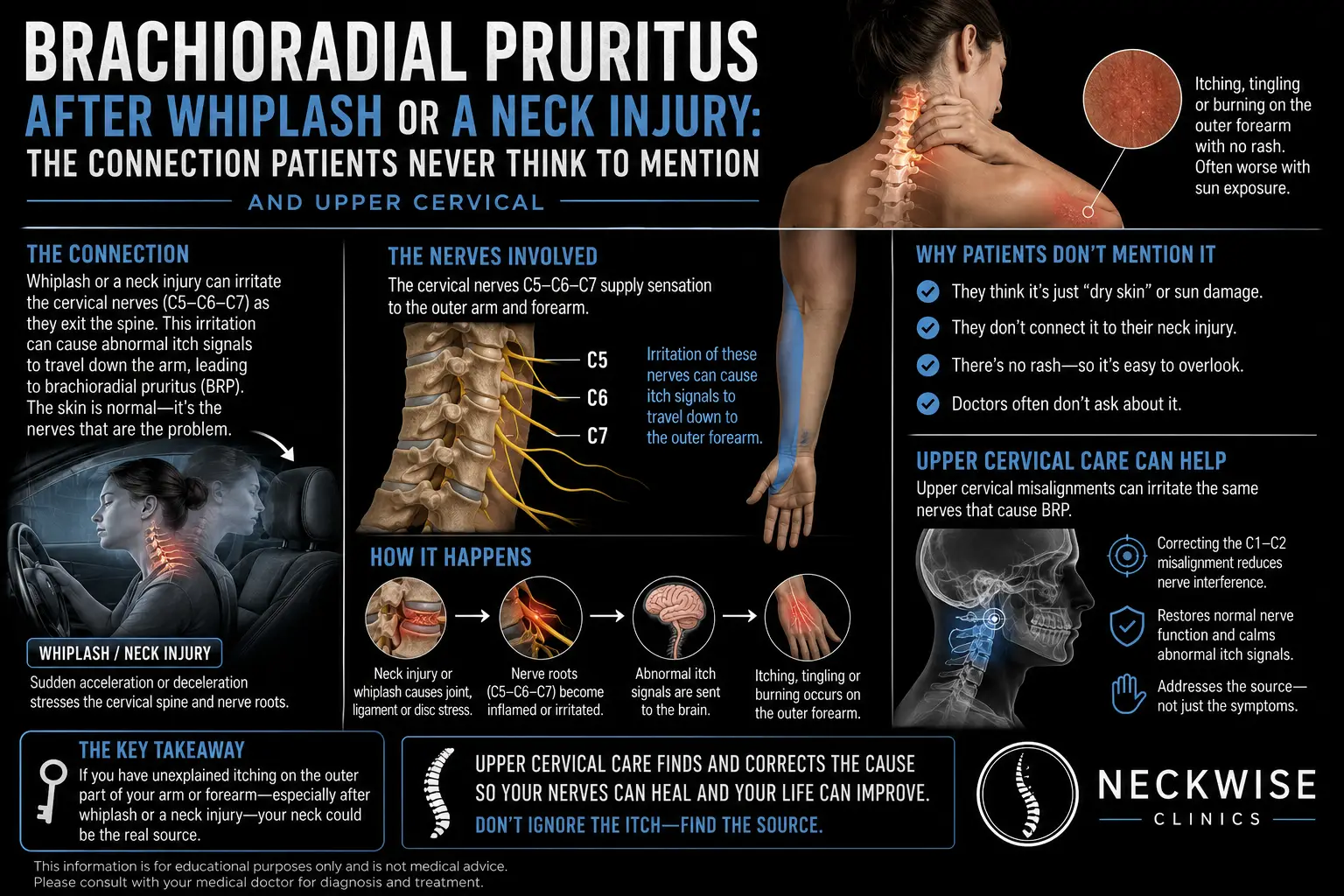
Brachioradial pruritus (BP) is a neuropathic itch. That single word — neuropathic — changes everything about where the answer might live. It means the itch is not a skin disease that happens to be itchy. It means the nerve pathway carrying and regulating the itch signal is misbehaving somewhere along its length, and the skin is simply the place where the misbehavior is felt. The published literature repeatedly points upstream from the arm toward the cervical spine. And once you accept that the neck is part of the story, an old car crash, an old fall off a bike, an old football hit, an old slip on a wet tile floor stops being irrelevant history and starts being the most useful thing you can tell a clinician.
At Lavender Family Chiropractic in Sarasota, we take a detailed trauma history from every person who comes to us with neuropathic itch — not because we assume trauma caused it, but because so many people have never been asked, and because the mechanism that connects the two is more plausible than most patients realize. This article walks through that connection: what whiplash actually does to the upper neck, how an injury from 1998 can plausibly relate to an itch that started in 2022, and what precise, low-force upper cervical care can and cannot offer.
The History Nobody Asks About: Whiplash
Dermatology visits are, understandably, organized around the skin. The intake form asks about soaps, detergents, new medications, sun exposure, travel, family history of eczema and psoriasis. It rarely asks whether you have ever been rear-ended at a stoplight. There is no line on the form for “concussion in high school” or “fell off a ladder in 2009.”
Patients, in turn, do not volunteer it. Why would they? The mental model most people carry is that a car accident is a neck-and-back event, and an itch is a skin event, and the two live in separate departments of the body. Even patients who remember their crash vividly do not mention it, because it seems like noise in a conversation about a rash that is not even a rash.
There is a second reason the history stays buried: the delay. Brachioradial pruritus commonly shows up in the fourth through sixth decades of life, and it is often described as arriving out of nowhere. The StatPearls clinical reference on brachioradial pruritus notes that symptoms typically arise between the fourth and sixth decades, that the average symptom duration is around 4.5 years, and — strikingly — that despite the high prevalence of cervical spine abnormalities on imaging in these patients, few of them report neck pain, spinal narrowing, or trauma. Read that again, because it is the crux of this article. The neck findings are common. The reported neck history is not. That gap is exactly where an old, forgotten, or dismissed injury hides.
Third, there is a diagnostic delay layered on top of the trauma-history delay. The same reference summarizes recent work showing that fewer than 15% of BP patients were accurately diagnosed at their first consultation, nearly 70% required evaluation by multiple clinicians, and most experienced a diagnostic delay exceeding three years, with common misdiagnoses including atopic dermatitis and allergic reactions. By the time somebody finally says the words “brachioradial pruritus,” the patient has already been through a gauntlet, and the idea of going back to a crash from a decade ago feels absurd.
It is not absurd. It may be the single most informative piece of history in the file.
What Whiplash Does to the Upper Cervical Spine
Whiplash is not a diagnosis of a bruise. It is a description of a motion: rapid acceleration and deceleration of the head relative to the torso. In a rear-end collision, the torso is pushed forward by the seat while the head, which weighs roughly as much as a bowling ball and sits on a narrow column, lags behind and then whips forward. The whole sequence is over in a fraction of a second — faster than any protective muscle reflex can meaningfully engage.
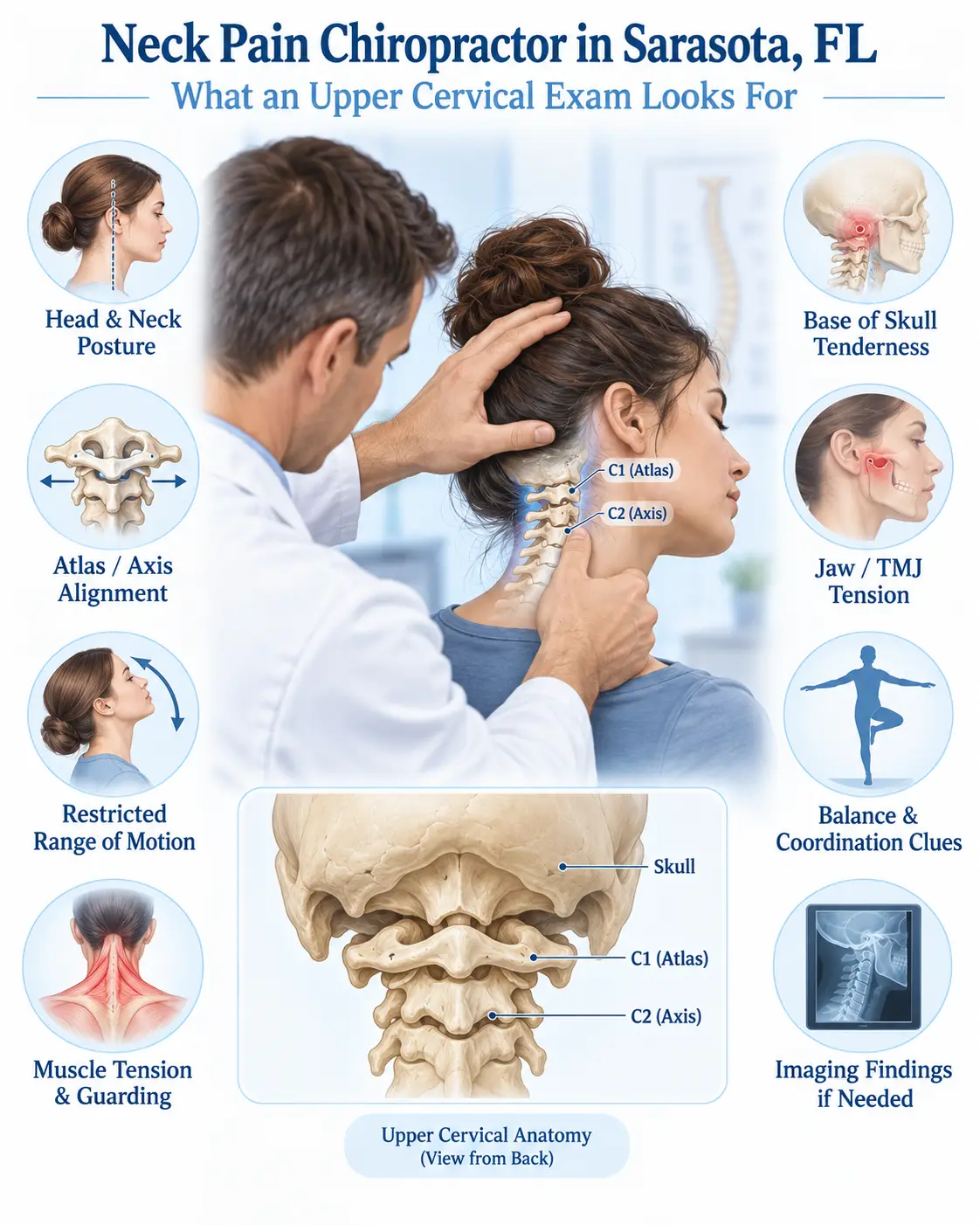
The region that absorbs the most of this is the top of the neck: the occiput (base of the skull), the atlas (C1), and the axis (C2). This is the craniocervical junction, and it is anatomically unusual. It is the most mobile segment of the entire spine — roughly half of your head’s rotation happens between C1 and C2 alone — and it purchases that mobility by giving up bony stability. There are no intervertebral discs between the occiput and C1, or between C1 and C2. What holds this region together and defines its limits is ligament: the alar ligaments, the transverse ligament of the atlas, the capsular ligaments of the facet joints, and the surrounding connective tissue.
Ligaments are the tissue most vulnerable to a rapid, unguarded stretch. And unlike muscle, ligament does not have a rich blood supply, which is part of why ligamentous strain in this area can leave behind a lasting change in joint mechanics even after the acute soreness has faded. The person feels better in six weeks. The joint may not be moving the way it did before.
Here is where patients get failed by the imaging conversation. Many people who were in a crash were told their films were “normal” and reasonably concluded that nothing was wrong. But standard imaging is designed to find fracture, dislocation, and gross instability — the things that need urgent attention. It is not designed to characterize a subtle, position-specific alteration in how the atlas sits on the axis.
The research on upper neck ligament imaging after whiplash is genuinely humbling and worth reporting honestly. A prospective controlled study published in the American Journal of Neuroradiology followed patients with grade 1–2 whiplash-associated disorders and imaged the alar and transverse ligaments in the acute phase and again twelve months later. The signal-intensity grading did not change over that year, and the prevalence of high-signal changes in the whiplash group did not differ significantly from the prevalence in non-injured patients with chronic neck pain. The authors concluded that these high-signal findings could not be explained by the trauma, and that dedicated upper neck MR imaging cannot be recommended as a routine examination in these patients.
That is not a finding that says “whiplash does not injure the upper neck.” It is a finding that says the specific MRI signal marker researchers hoped would flag ligament injury is not a reliable indicator, because it shows up in uninjured people too. The practical takeaway for a patient is this: a negative or unremarkable upper neck MRI after a crash does not settle the question of whether your upper cervical mechanics changed. Structure and alignment need to be assessed differently — with imaging and measurement designed for that specific purpose — which is precisely why we use 3D CBCT imaging rather than relying on a report that was written to rule out fracture.
How a Neck Injury Can Lead to Neuropathic Itch Years Later
This is the section that matters most, and it rests on two mechanisms. Neither one requires anything exotic. Both are ordinary neurology and ordinary biomechanics applied to a region that is usually skipped over.
Mechanism One: The Brake on the Itch Signal Lives in the Upper Cervical Cord
Itch is not a simple wire running from skin to brain. Itch signals travel up unmyelinated C-fibers from the skin, arrive at the dorsal horn of the spinal cord, and are then relayed upward. But at that dorsal horn relay, the signal is heavily edited. Inhibitory interneurons dampen it locally, and — critically — descending pathways from the brainstem run down the spinal cord and actively suppress how much itch traffic gets passed along. This is the body’s volume knob. It is why you are not consciously aware of every fiber twitch and hair movement on your skin all day long. Descending inhibition is turning most of it down.
The BP literature describes exactly this system failing. In their case series in Cureus, Shields and colleagues summarize the proposed pathophysiology of brachioradial pruritus as irritation of pruritus-sensitive neurons leading to spontaneous firing of damaged neurons, the loss of the feedback mechanism for their descending inhibitory neurons, or loss of inhibitory interneurons leading to spinal hyperexcitability. Those are the authors’ own terms: loss of descending inhibition, and spinal hyperexcitability. In plain language, the brake fails and the cord becomes over-responsive, so a stimulus that should register as nothing — warmth, a shirt sleeve, sun on the forearm — registers as unbearable itch.
Now ask a simple anatomical question: where do those descending inhibitory pathways physically travel?
They travel down the spinal cord. And the segment of spinal cord immediately below the brainstem — the segment through which every descending pathway to the entire body must pass — is the upper cervical cord, housed inside the ring of the atlas and the axis. There is no other route. Every descending brake line to every dorsal horn in your body threads through a bony corridor that is stabilized almost entirely by ligaments, and that ligamentous complex is exactly what a whiplash event strains.
This is the mechanistic reasoning at the heart of upper cervical care for neuropathic itch. It is not a claim that any published study imaged C1 and C2 in BP patients and found a lesion there — it did not, and we will not pretend otherwise. The imaging studies in BP looked at the mid and lower cervical spine, and that is what they reported. What we are saying is narrower and more defensible: the pathophysiology the itch researchers describe is a failure of descending inhibitory control, and the anatomy of descending inhibitory control runs directly through the upper cervical spine. If a region is going to be examined for its influence on a system, it should be the region that system passes through. The upper cervical spine is where the brake on the itch signal lives.
Add to that a subtler point about signal quality. The upper cervical spine is one of the densest sources of proprioceptive input in the human body — the small suboccipital muscles have an extraordinarily high density of muscle spindles, feeding continuous position information to the brainstem and cerebellum. Altered mechanics in this region change that input stream. And the brainstem regions that generate descending inhibition are not isolated from the systems receiving that input. A neck that is feeding the brainstem distorted positional information for twenty years is not a neutral variable in a system whose defining failure is loss of top-down inhibitory control.
Mechanism Two: Upstream Misalignment Drives Downstream Loading for Decades
The second mechanism explains the timeline, which is the part patients find hardest to believe.
Start with what the BP imaging studies actually document. In the Shields series, all nine patients with BP had cervical spine disease on MRI — disc protrusions, spondylosis, spinal stenosis, and/or foraminal stenosis — and eight of nine had electrodiagnostic evidence of chronic radiculopathy, predominantly involving C6 and C5. Only one patient had single-level pathology; the rest had multi-level changes. The authors also cite earlier work in which the large majority of BP patients had foraminal stenosis or disc protrusion producing nerve compression, with the location of compression correlating significantly with where the pruritus was felt.
So the picture in the literature is degeneration and foraminal narrowing in the mid-to-lower cervical spine, at levels that supply the exact patch of forearm skin that itches. Fine. But that raises an obvious question that the dermatology literature does not try to answer, because it is not a dermatology question: why did that person’s C5–C6 segment degenerate in the first place?
Degenerative change is not random. It follows load. A joint that carries more than its share of mechanical demand, or carries it at an abnormal angle, or carries it while its neighbors are restricted, wears faster than a joint that does not. Cervical degeneration concentrates where mechanical stress concentrates.
The upper cervical spine sits at the top of that chain, and it is the segment that determines head position relative to the body. When the atlas position shifts after a traumatic ligamentous strain, the head no longer sits neutrally over the neck. The body will not tolerate a tilted visual horizon or a disturbed vestibular reference — it compensates, immediately and automatically, by making adjustments lower down. The lower cervical segments alter their curve and their loading pattern to bring the eyes back to level. Postural muscles adopt new resting tone to hold that compensation. Weight distribution across the facet joints and disc surfaces changes at C4-5, C5-6, and C6-7.
Then the person goes and lives their life for fifteen or twenty years inside that compensated pattern. Every hour at a desk, every night of sleep, every gravitational cycle of every day is loaded slightly wrong. That is not a dramatic injury. It is a slow one. And it is a highly plausible explanation for why the degenerative and foraminal changes that BP studies document keep showing up in the mid-to-lower cervical spine of people whose original trauma was at the top.
Now put both mechanisms side by side, and the years-long delay stops being mysterious:
- At the moment of the crash, the upper cervical ligaments are strained. Mechanics change. Descending inhibitory pathways run through a segment that is no longer moving or sitting as it should. The itch brake may already be a little less effective — but it is still functioning well enough that nothing is felt.
- Over the following decade or two, compensatory loading grinds down the lower cervical segments. Foramina narrow. Nerve roots at C5 and C6 become progressively more irritable. Peripheral input into the dorsal horn becomes noisier.
- Somewhere along the way, a threshold is crossed. The peripheral signal is now noisy enough, and the descending brake is now weak enough, that the system tips into the state the researchers describe: spinal hyperexcitability. Alloknesis — itch from a stimulus that should not itch — sets in.
- A Florida summer, a boat weekend, a bike ride with the arms exposed adds ultraviolet load to already-sensitized skin nerves, and the itch arrives with full force.
The patient experiences this as sudden. Physiologically it was decades in the making. That is why “my accident was fifteen years ago” is not a reason to dismiss the accident — it is a reason to take it seriously.
There is also direct, if limited, evidence in the literature that trauma belongs in this conversation at all. The StatPearls reference notes Heyl’s documented patient who developed brachioradial pruritus after a neck injury and experienced symptom relief with cervical traction. Shields and colleagues note BP reported following traumatic spinal cord injury and in the setting of post-traumatic syringomyelia, and explicitly state that patients with a past history of trauma were excluded from their own series — which is worth noticing, because it means the most detailed BP imaging series available deliberately screened out exactly the population this article is about. The trauma-related cases exist. They have simply never been studied as a group.
Other Trauma That Counts
Car accidents get the headline, but the same mechanism does not care what caused the acceleration. When we take a trauma history at Lavender Family Chiropractic, we are asking about all of the following:
Falls. A fall onto the buttocks or back transmits force up the spinal column into the head and neck. A fall onto an outstretched arm loads the shoulder girdle and cervicothoracic junction. A fall backward with the head striking the ground is a direct craniocervical event. Falls from a bicycle, off a horse, off a ladder, down stairs, on a wet floor, or on a boat deck all count. So does a fall you got up from and laughed about.
Sports impacts. Football, hockey, wrestling, rugby, soccer heading, gymnastics, cheerleading, martial arts, diving, surfing, and skiing all produce repeated or single high-force loading of the head and neck. Cumulative sub-concussive impacts across a high school and college career are relevant even without a single dramatic injury.
Concussion and head injury. A concussion is, by definition, an event in which the brain moved inside the skull. That requires acceleration of the head. Any acceleration sufficient to concuss the brain has also loaded the craniocervical junction. Neck involvement in concussion is increasingly recognized, and persistent post-concussive symptoms frequently overlap with cervical findings.
“Minor” accidents. This is the category patients most reliably dismiss. Low-speed collisions in a parking lot. Being rear-ended at a light with “barely any damage” to the bumper. A rear-end tap that did not deploy an airbag. The relationship between vehicle damage and occupant loading is not simple: modern bumpers are engineered to absorb energy without visible deformation, and a stiff, undamaged bumper can transmit acceleration to the occupant efficiently. The size of the repair bill is a poor proxy for what happened to your neck.
Birth trauma and childhood events. Difficult deliveries involving forceps, vacuum extraction, or prolonged positioning can strain a newborn’s upper cervical region. So can the ordinary catastrophes of childhood — falling off the monkey bars, going over the handlebars, a diving-board mishap. Adults who cannot recall any trauma sometimes find that a parent can.
Repetitive occupational and postural loading. Not a single event, but worth mentioning: sustained forward head posture, long hours of overhead work, heavy pack carrying, and prolonged awkward head positions all impose the kind of chronic loading that compounds an existing structural compensation.
An important honesty note: none of this means trauma caused your brachioradial pruritus. BP has well-documented associations with ultraviolet exposure and with degenerative cervical spine disease that occurs without trauma at all, and a substantial number of people have both a history of injury and an itch that turns out to be driven by something else entirely. What the trauma history does is generate a testable hypothesis about your specific neck, which can then be examined objectively.
How Precise Upper Cervical Care Fits at Lavender Family Chiropractic
Our approach is specific and narrow by design, and it starts with information rather than with treatment.
A consultation with an actual trauma history. We ask the questions listed above and we ask them slowly. When was your first crash — not your worst one, your first one? Were you the driver? Which direction was the impact? Was your head turned? Did you have symptoms in the days afterward that went away? Did you ever have imaging, and what were you told? What sports did you play, and for how long? We want the whole timeline, because we are trying to find out whether there is a plausible mechanical origin story that predates your itch by years. We also want your dermatology and neurology history: what has been tried, what the biopsy showed, whether an ice pack relieves the itch, and whether the distribution matches the C5–C6 dermatome.
3D CBCT imaging. Cone beam computed tomography lets us look at the craniocervical junction in three dimensions rather than inferring three-dimensional relationships from flat films. We are measuring how the occiput, atlas, and axis are oriented relative to one another, and we are evaluating the bony architecture that the correction vector will be built from. This is the difference between guessing at a misalignment and measuring one. It is also how we identify anatomy that would make us refer out rather than proceed.
Tytron paraspinal infrared thermography. Skin temperature along the paraspinal region is regulated by the autonomic nervous system. Reproducible left-right asymmetry in that thermal pattern is an objective, non-invasive signal that autonomic regulation in a region is not symmetric. We take repeated readings over time to distinguish a stable, reproducible pattern from ordinary day-to-day variation, and we use it as one of several indicators of whether care is being retained.
The Knee Chest Upper Cervical technique. This is a precise, low-force correction delivered along a vector calculated from your imaging. It is not high-velocity twisting manipulation. There is no cracking or popping of the neck, no rotational thrust, and no forceful stretching. The patient is positioned in a knee-chest posture that allows the correction to be applied with very little force in a specific direction. The goal is to restore the positional relationship at the top of the neck so that the compensations below it are no longer being driven from above, and so that the neurological structures passing through that corridor are working in a less mechanically compromised environment.
It is worth being precise about the published chiropractic literature here, because we do not want to overstate it. Two case reports in the Journal of Contemporary Chiropractic document BP patients improving under chiropractic management of the cervical spine — one using an upper cervical instrument approach at the craniocervical junction combined with a high-velocity adjustment and instrument work at C5, and one using cervical manipulation and manual therapy. Those are case reports, not controlled trials, and the techniques used in them are not identical to ours. They establish that this line of inquiry is being pursued and documented; they do not establish efficacy, and we will not present them as if they do.
Customized care plans. Your plan is built from your findings — your imaging, your thermography pattern, your history, and how you respond. Some people hold a correction for long stretches and need very few visits. Others require more frequent attention early on. We are cash-pay and out-of-network, and we provide superbills you can submit to your insurance for possible reimbursement. Everything is tailored to your individual findings and explained up front.
Coordination, not competition. We want you to have a confirmed diagnosis from a physician or dermatologist, and we want systemic causes of chronic itch — thyroid disease, liver and kidney disease, iron deficiency, certain blood disorders, medication effects, and others — ruled out by the appropriate specialist. If you develop new neurological symptoms after a trauma, including weakness, numbness, changes in coordination, bowel or bladder changes, or severe headache, that needs medical evaluation promptly, not a chiropractic appointment. We are glad to work alongside your dermatologist, neurologist, primary care physician, and pain management team.
What this care can and cannot do. It cannot cure brachioradial pruritus, and nothing in this article should be read as claiming otherwise. It does not replace dermatologic or neurologic care. It does not address ultraviolet exposure, which is a well-documented contributor and which you have to manage yourself. What it can do is address the structural and neurological environment of the upper cervical spine in a precise, measured, low-force way — a variable that, for most BP patients, has never been examined by anyone.
Ready to Have Your Neck Looked At?
If you have brachioradial pruritus and a history of whiplash, a fall, a sports impact, or a concussion — even one you have not thought about in twenty years — that history deserves to be part of your evaluation.
Call Lavender Family Chiropractic at (941) 243-3729 to schedule a consultation, or book online at https://intake.chirohd.com/new-patient-scheduling/724/lavender-family-chiropractic.
We are located at 5899 Whitfield Avenue, Suite 107, Sarasota, FL 34243, at the corner of University and Whitfield — convenient to Sarasota, Bradenton, Lakewood Ranch, and University Park.
What the Research Says
- Brachioradial Pruritus — StatPearls, NCBI Bookshelf (Bookshelf ID NBK459321; PMID 29083620). This continuously updated clinical reference describes BP as a focal neuropathic dysesthesia of the dorsolateral upper extremities, states that most patients demonstrate cervical spine abnormalities on imaging including foraminal stenosis and degenerative change, notes that few patients report neck pain or trauma despite those findings, documents diagnostic delays exceeding three years in most patients, and records a historical case of BP developing after a neck injury that responded to cervical traction.
- Brachioradial Pruritus: Clinical, Electromyographic, and Cervical MRI Features in Nine Patients — Shields LB, Iyer VG, Zhang YP, Shields CB, Cureus 2022;14(2):e21811 (PMCID PMC8896843; PMID 35291549). All nine BP patients in this series had cervical spine disease on MRI — disc protrusions, spondylosis, spinal stenosis, and/or foraminal stenosis — and eight of nine had electrodiagnostic evidence of chronic radiculopathy predominantly at C6 and C5; the discussion describes BP pathophysiology as including loss of the feedback mechanism for descending inhibitory neurons and loss of inhibitory interneurons leading to spinal hyperexcitability.
- Follow-Up MR Imaging of the Alar and Transverse Ligaments after Whiplash Injury: A Prospective Controlled Study — Vetti N, et al., American Journal of Neuroradiology 2011;32(10):1836–1841 (PMID 21920865). In patients with grade 1–2 whiplash-associated disorders, alar and transverse ligament MRI signal grading was essentially unchanged from the acute phase to twelve months, and the prevalence of high-signal changes did not differ significantly from non-injured neck pain controls, leading the authors to conclude that these signal findings cannot be explained by the trauma and that dedicated upper neck MR imaging is not recommended as a routine examination in this population.
- Upper Cervical Chiropractic and Pierce Technique for Medication-Resistant Brachioradial Pruritus: A Case Report — Steward T, Journal of Contemporary Chiropractic 2024;7(1):77–83. A single-patient case report describing a 42-year-old woman with a three-year history of BP unresponsive to topicals, gabapentin, antihistamines, physical therapy, and acupuncture, who was managed over twelve visits with Orthospinology upper cervical adjusting of the craniocervical junction plus a high-velocity adjustment and later instrument work at C5, with the author reporting sustained symptomatic improvement at follow-up; the paper is explicit that it is limited to one patient and that direct causative links between cervical lesions and BP require further study.
- Conservative Management of Brachioradial Pruritus in a 47-Year-Old Female: A Case Report — Afghani P, LaCourt S, Aponte B, Culicerto M, Journal of Contemporary Chiropractic 2025;8(1):270–274. A case report of a 47-year-old woman who presented to a chiropractic clinic with neck stiffness and bilateral upper extremity itching, was diagnosed with BP in part via a positive ice-pack test, and reported that her itching symptoms subsided under a course of cervical manipulation and manual therapy; the authors emphasize the paucity of literature and call for evidence-based treatment guidelines.
Self-Care and Next Steps
None of the following is a substitute for a physician’s evaluation, and none of it addresses the underlying neurology. It is symptom management and damage limitation, and it matters.
Cold, not heat. The ice-pack response is so characteristic in BP that it is used diagnostically — cooling the area typically brings immediate relief that fades once the cold is removed. Keep gel packs in the freezer, keep a damp cloth in the refrigerator, and reach for cold before you reach for scratching. A cool shower before bed can take the edge off nighttime symptoms.
Sun protection, seriously and consistently. Ultraviolet exposure is one of the two best-documented contributors to BP, and living in Sarasota makes this harder than it sounds. Long-sleeved UPF clothing is generally more reliable than sunscreen because it does not wear off or get missed. Pay particular attention to the driver’s-side arm — the forearm resting on a car window or door frame accumulates a startling amount of UV exposure over years of Florida driving. Consider UV-filtering window film. Limit direct exposure between roughly 10 a.m. and 2 p.m.
Stop scratching, and make it easier to stop. Scratching in BP does not relieve the itch; it damages the skin and can drive a self-perpetuating cycle of excoriation, lichenification, and further irritation. Keep fingernails cut short. Sleep in long, light sleeves so nighttime scratching is blunted. Substitute a cold pack, firm pressure, or a slap for a scratch. If you already have open excoriations, get them evaluated so they do not become infected.
Neck mechanics through the day. Set your monitor so the top third of the screen is at eye level and you are not tipping your head down for hours. Hold your phone up rather than dropping your chin to it. Use a pillow that supports the neck in a neutral position rather than propping the head forward. Take a genuine break from static positions every thirty to forty-five minutes. If you were in a crash and you have not had your neck assessed since, get it assessed — and if you want to understand what a whiplash injury does over the long term, our article on whiplash and the upper cervical spine covers the mechanics in more depth, and our overview of car accident chiropractic care explains what evaluation after a collision involves.
Get the diagnosis confirmed and the systemic workup done. Before you chase a mechanical explanation, make sure you are chasing the right condition. See a dermatologist. Ask specifically about the ice-pack sign and about the dermatomal distribution of your symptoms. Get bloodwork to screen for systemic causes of chronic itch. If there is any suggestion of weakness, sensory loss, reflex change, or progressive neurological symptoms, ask for a neurology referral.
Then look at the neck. If your workup has ruled out systemic causes, your diagnosis is BP, and you have a trauma history nobody has ever asked about, the upper cervical spine is a reasonable next place to look. That is what we do at Lavender Family Chiropractic. Call (941) 243-3729 or use our contact page if you would like to talk through whether an evaluation makes sense for you.
Serving Sarasota and Surrounding Communities
Lavender Family Chiropractic sits at 5899 Whitfield Avenue, Suite 107, Sarasota, FL 34243 — at the corner of University and Whitfield, close to the Sarasota-Manatee county line and easy to reach from either direction.
We regularly care for patients from Sarasota, Bradenton, Lakewood Ranch, Venice, Palmer Ranch, Osprey, Siesta Key, Longboat Key, Lido Key, University Park, Parrish, Ellenton, Myakka City, Punta Gorda, and St. Petersburg.
Because our care is built around precise measurement rather than frequent high-volume visits, patients from the outer edges of that range — Punta Gorda to the south, St. Petersburg to the north, Myakka City to the east — often find the travel manageable. We are happy to discuss scheduling that accounts for a longer drive.
Top 15 Questions
1. My accident was fifteen years ago. Could it still matter? Yes. This is the single most common reason people leave a relevant injury out of their history, and it is the reason the delay makes sense rather than the reason it does not. A traumatic strain of the upper cervical ligaments changes how the top of the neck sits and moves. The body compensates below that, and then loads those compensating segments for years. That cumulative loading is a plausible driver of the mid-to-lower cervical degeneration and foraminal narrowing that BP studies consistently document. Meanwhile, the descending inhibitory pathways that normally suppress itch at the dorsal horn have been running through a mechanically compromised segment that whole time. The itch shows up when the combination of a noisier peripheral signal and a weaker descending brake crosses a threshold — which can easily be a decade or two after the event. A fifteen-year-old accident is not too old to be relevant. It is exactly the right age.
2. Can you cure my brachioradial pruritus? No. We cannot cure it, and no honest provider will tell you they can. Brachioradial pruritus is a complex neuropathic condition with multiple contributing factors, including ultraviolet exposure that no spinal care addresses. What we offer is a precise, low-force approach to the upper cervical spine — a variable in the equation that most BP patients have never had properly evaluated. Some people respond meaningfully. Some do not. We will tell you honestly what we find and whether we think our care is a reasonable option for you.
3. Do I need to have been in a car accident for this to apply? No. Falls, sports impacts, concussions, birth trauma, and low-speed “minor” collisions all load the same region. Some patients with relevant upper cervical findings have no recalled trauma at all. The trauma history is a useful clue, not a requirement.
4. My MRI after the accident was normal. Doesn’t that rule out neck injury? It rules out the things the MRI was ordered to find — fracture, dislocation, cord compression, gross instability. It does not characterize subtle positional and mechanical change at the craniocervical junction. As the AJNR study cited above illustrates, even dedicated upper neck ligament MRI signal findings turned out not to distinguish whiplash patients from non-injured controls, which is why that research group did not recommend it as a routine examination. We use 3D CBCT because it is designed to measure the structural relationships we need to see.
5. Is this the same as regular chiropractic neck cracking? No. We use the Knee Chest Upper Cervical technique, which is a precise, low-force correction along a vector calculated from your own imaging. There is no twisting, no rotational thrust, and no cracking or popping of the neck.
6. Do you take my insurance? We are a cash-pay, out-of-network practice. We do not bill insurance directly. We provide detailed superbills that you can submit to your insurance carrier yourself, and many patients receive some reimbursement depending on their out-of-network benefits. We are transparent about fees up front so there are no surprises.
7. Why cash-pay instead of billing insurance? Because it lets us build care around your findings rather than around what a payer will authorize. Insurance coverage for chiropractic care is often structured around short-term pain complaints and visit caps, which does not fit a measurement-driven approach to a chronic neurological complaint. Being out-of-network means the care plan is determined by your imaging, your thermography, and your response — not by a benefit schedule.
8. My itch started after a car accident and I have an active personal injury case. Can you help? Yes. For car accident cases, our practice can work with personal injury attorneys through a Letter of Protection, which allows care to proceed while your case is pending. If you have an attorney, let us know at your first contact and we will coordinate directly with their office. If you do not, we can discuss the options available to you. Documentation of your findings and your care is provided as part of that coordination.
9. What actually happens at the first visit? A thorough consultation covering your symptom history, your full trauma history, your dermatologic and neurologic workup to date, and everything you have already tried. A physical and neurological examination. Tytron paraspinal thermographic scanning. If indicated, 3D CBCT imaging of the craniocervical junction. We then review the findings with you and tell you plainly whether we think we can help, whether we would want additional workup first, or whether we would refer you elsewhere.
10. How long before I know whether this is working? That varies, and we will not give you a number we cannot support. We track objective markers — thermographic pattern stability, postural findings, structural measurement — alongside your symptom reports, and we reassess at defined intervals. If objective findings are not changing and your symptoms are not changing, we will tell you rather than continuing indefinitely.
11. Will I need repeat imaging? Sometimes. Post-correction imaging is used to verify that a correction was achieved as calculated. We do not image reflexively, and we weigh the value of each image against the reason for taking it.
12. Should I stop my gabapentin or my topical medications? Not without talking to the prescribing physician. Never adjust prescribed medications based on something you read on a chiropractic website, including this one. Coordinate all medication decisions with the doctor who prescribed them.
13. Do I still need to see a dermatologist? Yes, and we will encourage it. Confirming the diagnosis and ruling out systemic causes of chronic itch — thyroid disease, liver and kidney disease, iron deficiency, blood disorders, medication reactions, and others — is a physician’s job, not ours. We want to be one part of a team, not a substitute for one.
14. I have new numbness and weakness in my arm since my accident. Should I come in? Get medical evaluation first. New neurological symptoms after trauma — weakness, numbness, coordination changes, bowel or bladder changes, or severe headache — need prompt medical assessment. Once you have been evaluated and serious causes have been addressed, we are glad to talk about whether upper cervical care fits into your longer-term plan.
15. I live in Punta Gorda / St. Petersburg / Myakka City. Is the drive worth it? That is your call, and it depends on your situation. What we can tell you is that our model is built around precision rather than high visit frequency, so many out-of-area patients find the schedule workable. Call (941) 243-3729 and we will talk honestly about what your care would likely involve before you commit to the drive.
Closing CTA
If you have been chasing an itch on your forearms for years — through creams, antihistamines, biopsies, and specialists — and nobody has ever asked you about your neck, there is a piece of your history that has never been on the table.
An old crash. A fall you got up from. A concussion in high school. A rear-end tap in a parking lot that did not even dent the bumper. Any of those could have altered the mechanics of the one segment of your spine that every descending inhibitory pathway in your body has to pass through, and set in motion two decades of compensatory loading in the exact cervical levels that BP research keeps identifying.
We cannot promise you an outcome. We can promise you a genuine evaluation: a real trauma history, 3D CBCT imaging of your craniocervical junction, Tytron thermographic scanning, and an honest conversation about whether precise, low-force upper cervical care makes sense in your case — or whether you would be better served somewhere else.
Call (941) 243-3729.
Book online: https://intake.chirohd.com/new-patient-scheduling/724/lavender-family-chiropractic
Visit us: Lavender Family Chiropractic, 5899 Whitfield Avenue, Suite 107, Sarasota, FL 34243 — corner of University and Whitfield.
This article is for educational purposes and is not medical advice. It does not diagnose any condition. Chiropractic care does not cure brachioradial pruritus. Please work with your physician or dermatologist to confirm your diagnosis and rule out systemic causes of chronic itch, and seek prompt medical evaluation for new neurological symptoms following any trauma.