Central Sensitivity Syndromes: Why Fibromyalgia, Migraine, TMJ, and IBS So Often Travel Together
By Dr. Rusty Lavender — Lavender Family Chiropractic, Sarasota, FL
Central Sensitivity Syndromes: There is a certain kind of patient who arrives at our Sarasota office carrying a folder. Not a metaphorical folder — an actual one, thick with printouts, lab results, imaging reports, and a list of specialists that reads like a hospital directory. Inside are the diagnoses collected over years: fibromyalgia from a rheumatologist, migraine from a neurologist, TMJ disorder from a dentist, irritable bowel syndrome from a gastroenterologist, maybe a note about chronic tension headaches, disrupted sleep, and a nervous system that seems to react to everything. Each specialist treated their piece. Each was thorough. And yet the person holding the folder still feels like no one has explained the thing that puzzles them most: why do I have all of these at once?
It is a fair question, and for a long time the honest medical answer was some version of “bad luck” or “these things sometimes cluster.” But over the past two decades, research has offered a far more satisfying and unifying explanation. Many of these seemingly unrelated conditions are not separate accidents. They belong to a recognized family called central sensitivity syndromes (CSS), and they share a common thread that runs, quite literally, through the nervous system. Understanding that thread does not make the individual diagnoses disappear, but it can change how you and your care team think about the whole picture — and it can explain why the upper cervical spine, the small but pivotal region where your skull meets your neck, keeps showing up in the conversation.
This article is a connector. Rather than diving deep into any single condition, it steps back to look at what fibromyalgia, migraine, TMJ/TMD, IBS, and tension headache have in common, why they so often travel together, and where careful, coordinated care fits. If you want to go deep on any one of them, we have dedicated resources for fibromyalgia, migraines, TMJ/TMD, neck pain, and trigeminal neuralgia. But here, we connect the dots.
What Are Central Sensitivity Syndromes?
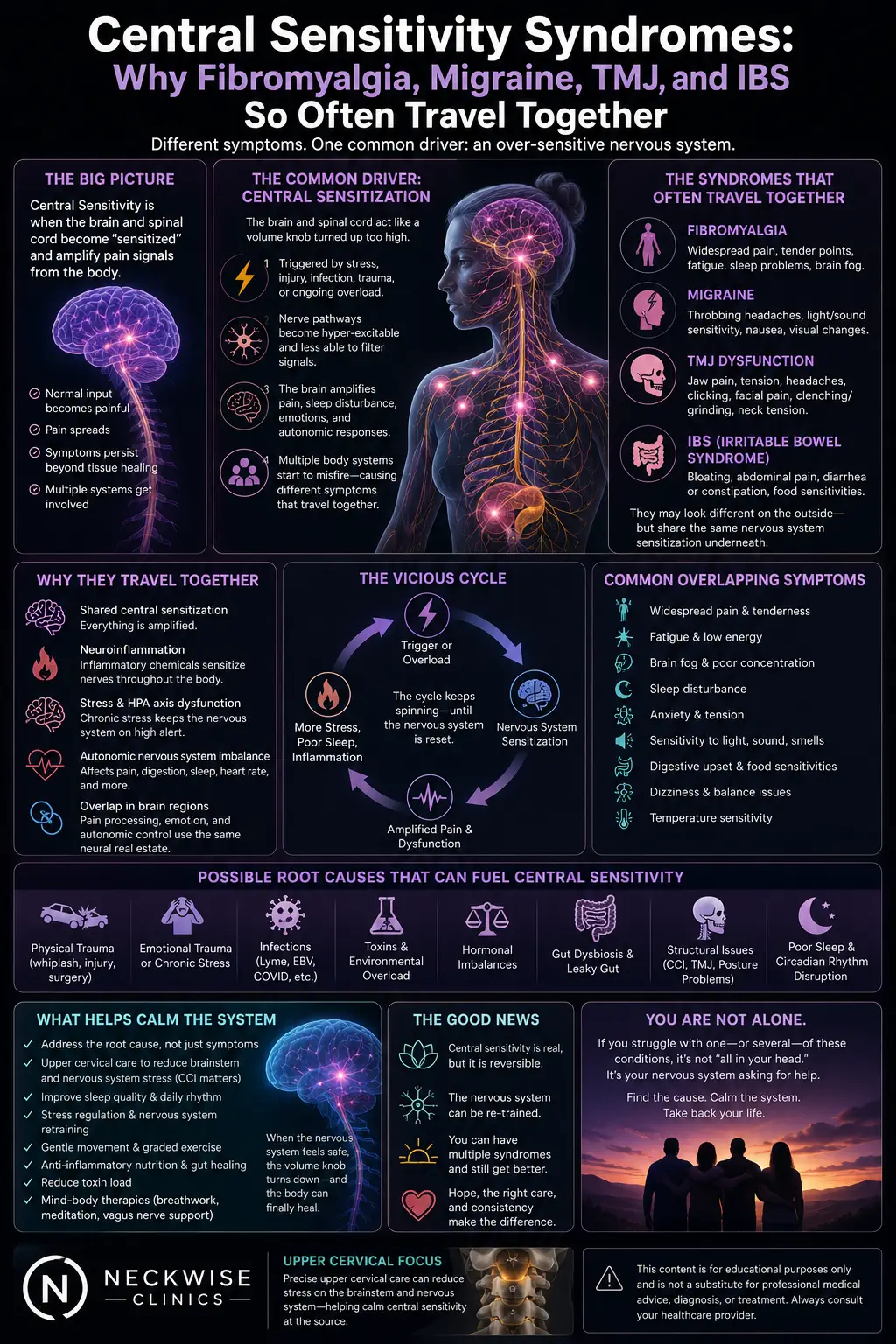
Central sensitivity syndromes are a group of chronic conditions that share an underlying feature: the central nervous system — the brain and spinal cord — becomes more sensitive than it should be to signals coming from the body. The formal name for that process is central sensitization, and it describes a state in which the volume knob on pain and sensory processing has been turned up and, importantly, left up.
To picture it, imagine a sound system where every input is being amplified. A whisper comes across as a shout. A light touch registers as pressure. A normal digestive contraction that most people never notice becomes cramping and urgency. A jaw click that should be background noise becomes a sharp, attention-grabbing signal. None of this means the person is imagining things or exaggerating. The signals are real, and so is the amplification. The problem is that the nervous system’s processing has shifted toward heightened responsiveness, so ordinary input produces an outsized experience.
Researchers and clinicians group a number of conditions under the CSS umbrella because they tend to show this same amplification pattern and because they overlap so heavily in the same patients. The commonly recognized members of the family include:
- Fibromyalgia, characterized by widespread body pain, tenderness, fatigue, and cognitive fog. It is often considered a prototype of central sensitization. Our dedicated resource lives at the fibromyalgia page.
- Migraine, a neurological condition involving recurrent, often disabling headaches with sensitivity to light, sound, and movement. Learn more on the migraines page.
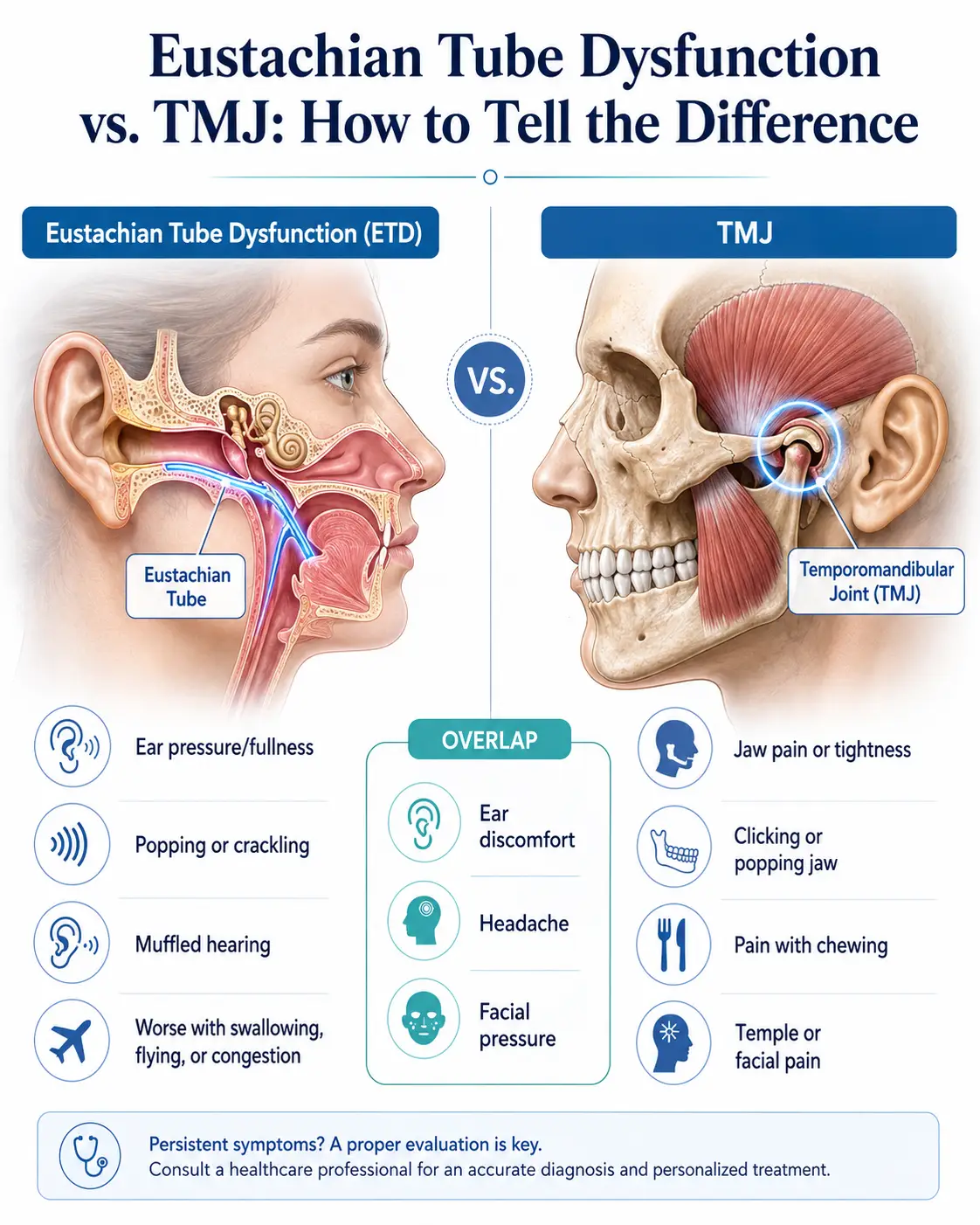
- Temporomandibular disorders (TMJ/TMD), involving jaw pain, clicking, limited opening, and facial discomfort, detailed on the TMJ/TMD page.
- Irritable bowel syndrome (IBS), a disorder of gut-brain interaction featuring abdominal pain, bloating, and altered bowel habits without structural disease.
- Tension-type headache, the band-like, pressure headaches that frequently coexist with neck tension and the other conditions here.
- Related conditions often mentioned alongside these, including chronic fatigue, interstitial cystitis, chronic pelvic pain, restless legs, and certain facial pain syndromes such as trigeminal neuralgia.
What is striking is how frequently these travel in pairs, trios, and quartets. A person with fibromyalgia is far more likely than average to also have migraine and IBS. A person with TMD often reports neck pain and headaches. The overlap is not coincidence — it reflects a shared underlying biology. It is worth stating clearly, though, before we go further: these are real, physician-diagnosed medical conditions. They deserve real medical evaluation and, in most cases, multidisciplinary and medical first-line care. Nothing in this article replaces that. The goal here is to explain the connection and to describe one contributing piece — the cervical spine — that is sometimes overlooked when conditions are treated only in isolation.
The Shared Mechanism: An Amplified Nervous System and a Weak Pain Brake
Here is the heart of the matter, and the reason these conditions belong together.
Your nervous system does not simply passively receive pain and sensory signals from the body. It actively regulates them. Signals travel up from the tissues toward the brain, but the brain and brainstem send signals back down that can dampen or suppress those incoming messages before they ever reach conscious awareness. This top-down regulation is called descending inhibition, and you can think of it as the nervous system’s built-in brake on pain. When the brake is working well, the system filters out the constant background noise of normal bodily sensation, so you can go about your day without feeling your own digestion, your heartbeat, the pressure of your clothing, or the low-level aches of an active life.
Central sensitization involves two problems happening together. First, the incoming signals are amplified — the “gas pedal” of pain processing is pressed harder than it should be. Second, and just as importantly, the descending brake is weakened. When both occur, the result is a nervous system that turns up the volume on sensation and then fails to turn it back down. That combination is a recipe for widespread, persistent, and seemingly unexplained symptoms that migrate around the body and defy the logic of “one problem, one location.”
This is not just theory. Research into fibromyalgia has documented exactly this pattern of altered descending pain modulation — a weakened top-down brake — as a core feature of the condition, helping to explain why pain becomes widespread and why ordinary stimuli feel painful. A detailed review of descending pain modulation in fibromyalgia lays out how the failure of these inhibitory pathways contributes to central sensitization. Once you understand that the brake itself is faltering, the pattern across all the CSS conditions starts to make sense. It is not that each organ system independently malfunctioned. It is that the shared control system regulating them all has shifted toward amplification.
This also explains some of the frustrating features patients describe. Why does stress make everything worse? Because the same circuits that regulate pain are tightly linked to stress-response systems; when stress is high, the brake tends to release less effectively. Why does poor sleep flare every symptom at once? Because restorative sleep is when much of this regulatory system resets, and without it the amplification climbs. Why do the symptoms move around — a bad gut week, then a headache week, then a jaw-and-neck week? Because the underlying state is systemic, and the loudest signal simply changes.
There is also growing recognition that connective tissue traits play a role in some of these patients. People with hypermobility — joints that move beyond the typical range — show a notably high overlap with fibromyalgia and a long list of comorbid conditions. One large study of hypermobile Ehlers-Danlos syndrome and hypermobility spectrum disorders documented extensive overlap with fibromyalgia and roughly 40 associated comorbidities, reinforcing the idea that these conditions share deep biological roots rather than occurring by chance. More recently, researchers examining long COVID have noted shared pathophysiology between long COVID and hypermobility spectrum disorders, another sign that central sensitivity and connective tissue vulnerability form a recognizable cluster that spans many labels.
So when a patient asks, “Why do I have so many diagnoses?” the most honest and current answer is: because you likely have one underlying tendency — a nervous system biased toward amplification with a weakened pain brake — expressing itself through several different systems. The diagnoses are the local names for a shared central problem.
Why the Upper Cervical Spine Sits at the Crossroads
If central sensitivity is fundamentally about the nervous system’s amplification and its failing brake, then the natural question is: where in the body do these shared circuits actually pass through? This is where the upper cervical spine — the topmost segment of the neck, where the skull balances on the first two vertebrae — enters the picture in a way that is anatomically specific rather than hand-waving.
Two features of this region matter enormously.
First, the descending inhibitory pathways — the pain brake — travel from the brainstem down through the upper cervical spinal cord on their way to modulating signals from the rest of the body. This part of the nervous system is not tucked safely deep in the skull; a critical portion of it runs through the very top of the neck. The brainstem and the upper cervical cord are functionally continuous. That means the upper cervical region is not merely near the spine’s most important control center — it is part of the corridor through which the brake’s signals must travel.
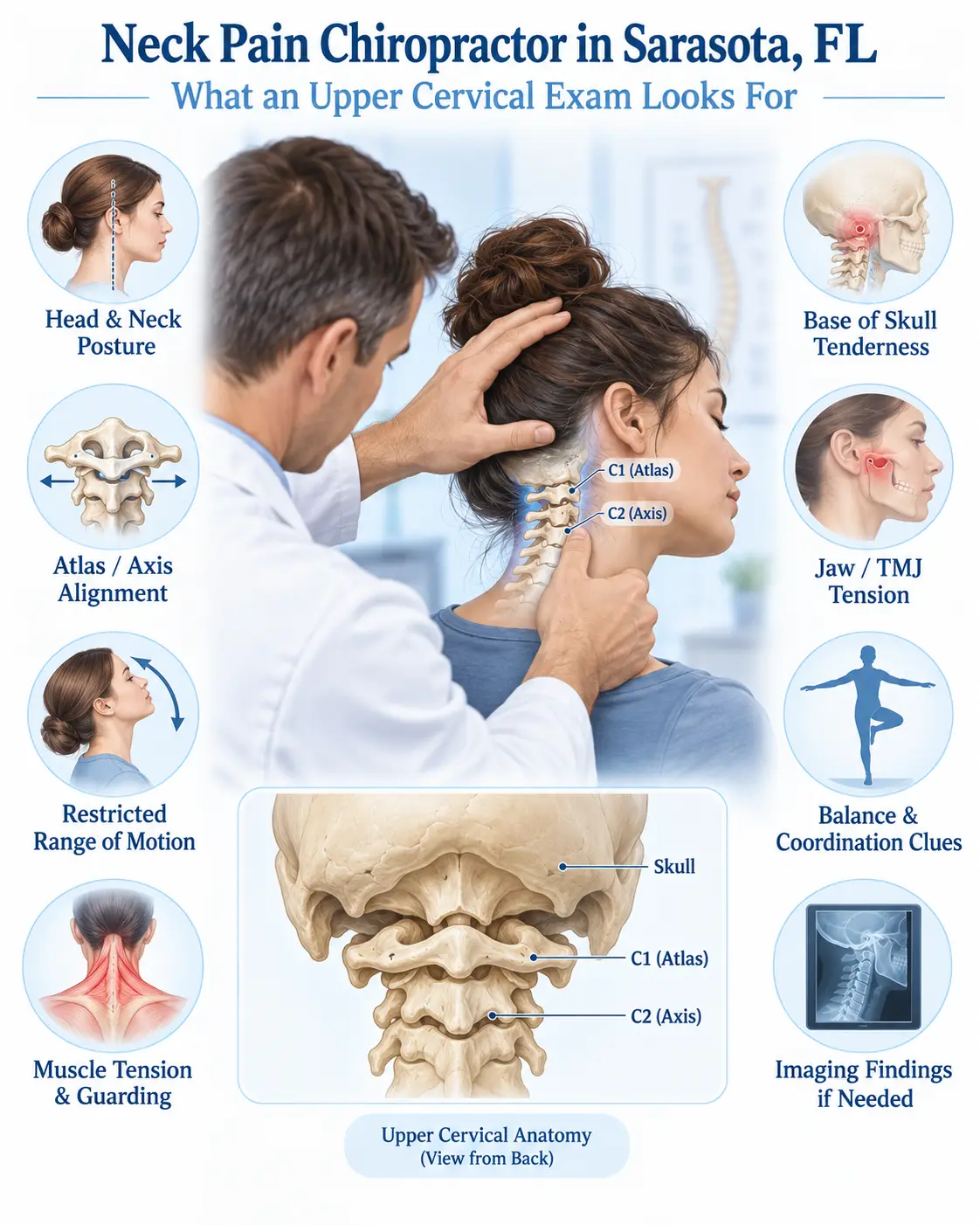
Second, and even more striking, is a structure called the trigeminocervical nucleus. The trigeminal nerve is the great sensory nerve of the face, head, jaw, and much of the cranium — it carries sensation from your forehead, your eyes, your sinuses, your teeth, and your jaw. The nerves from the upper part of the neck carry sensation from the back of the head and the upper cervical structures. Remarkably, these two systems do not stay separate. They converge and share processing in a region of the upper cervical cord and lower brainstem known as the trigeminocervical nucleus. In other words, signals from the face and jaw and signals from the neck pour into the same processing pool.
This convergence has profound implications, and the research bears it out. A review of the trigeminocervical nucleus and its integration of orofacial, cranial, and cervical input describes exactly how input from these different regions is combined at this shared relay. This anatomy is why a problem in the neck can produce a headache felt in the front of the head, why jaw dysfunction and neck dysfunction so often coexist, and why migraine, TMD, tension headache, and neck pain form such a tight cluster. They are, in a very real sense, wired through the same junction.
The jaw-neck connection specifically has been studied in patients with TMD. Research examining the craniocervical and cervical spine features of TMD patients has documented meaningful links between neck disability and jaw disability, supporting the clinical observation that the two regions influence one another and often need to be considered together rather than as separate problems in separate specialties.
Put the two features side by side and the picture becomes clear. The upper cervical spine sits precisely where the descending pain brake passes through and where the trigeminal and cervical sensory systems converge. It is a crossroads. When the alignment and mechanics of this region are disturbed, it is at least plausible — and consistent with the anatomy — that the neighboring neural traffic can be affected. That does not mean the neck is the cause of fibromyalgia, migraine, TMD, or IBS. These conditions have multiple contributors and require medical management. But it does mean the upper cervical region is one place where several of the shared circuits physically pass, which makes it a reasonable area to evaluate as part of a coordinated approach.
How Precise Upper Cervical Care Fits
Given that anatomy, where does chiropractic care of the upper cervical spine fit into the picture of someone managing several central sensitivity conditions? The answer has to be framed honestly, and that honesty is something we take seriously at our practice.
Upper cervical chiropractic care does not treat fibromyalgia, migraine, TMD, or IBS as diseases, and it does not claim to make them disappear. What it addresses is the cervical contribution — the possibility that misalignment or dysfunction at the top of the neck is adding mechanical and neurological stress to a region where these shared pain-processing circuits pass. For a nervous system that is already amplifying and already struggling to apply its brake, reducing an ongoing source of upper cervical irritation is a sensible, targeted goal. It is one input among many, offered alongside — not instead of — the care provided by your physicians.
The method matters, too. We use the Knee Chest Upper Cervical technique, a precise, low-force approach. It is not the forceful twisting or “cracking” that many people picture when they hear the word chiropractic, and it is not general spinal manipulation. It is a specific, gentle correction directed at the upper cervical region. For patients whose nervous systems are already turned up and sensitive, a low-force approach is particularly appropriate, because the last thing an amplified system needs is an aggressive input.
Precision depends on knowing exactly what we are working with, which is why imaging and measurement come first. We use 3D CBCT (cone beam computed tomography) imaging to see the upper cervical anatomy in three dimensions, so that any correction is based on your individual structure rather than a generic template. We also use Tytron thermography, a non-contact scan that reads patterns of surface temperature reflecting nervous system activity, to help track how the region is responding over time. These tools let us be specific and let us monitor whether care is a reasonable fit for you.
Just as important as the technique is the philosophy of coordination. Central sensitivity syndromes are managed best when the care team communicates and shares a picture of the whole person. We view upper cervical care as one coordinated piece within a larger plan that includes your rheumatologist, neurologist, dentist, gastroenterologist, primary care physician, and any therapists you work with. We do not ask patients to abandon medical care, and we flag red-flag symptoms — sudden severe headache unlike any before, neurological changes such as weakness or vision loss, unexplained weight loss, fever with neck stiffness, or any rapidly worsening pattern — as reasons to seek prompt medical attention rather than a chiropractic appointment.
Finally, a practical note on how we structure care. We are a cash-pay, out-of-network practice. We provide superbills you can submit to your insurance for possible reimbursement, and we build customized care plans based on your individual findings and goals — never one-size-fits-all. If upper cervical care does not appear to be a good fit for your situation, we will tell you.
If you are holding that folder full of diagnoses and wondering whether the top of your neck is a piece worth evaluating, the honest next step is a conversation. You can schedule a consultation with our doctors to review your history, discuss whether imaging is appropriate, and get a straight answer about whether this approach makes sense for you. Call us at (941) 243-3729 or book online.
What the Research Says
We keep the evidence base transparent, and we will not overstate what studies show. Here is a plain-language summary of the specific research that informs this article.
Descending pain modulation is weakened in fibromyalgia. A review of descending pain modulation in fibromyalgiadescribes how the top-down inhibitory system — the pain brake — functions poorly in this condition. This is central to understanding central sensitization: it is not only that pain signals are amplified, but that the mechanism meant to dampen them is underperforming. This helps explain why fibromyalgia pain is widespread and why ordinary sensations can feel painful.
The trigeminal and cervical systems converge at a shared relay. A review of the trigeminocervical nucleus explains how sensory input from the face, cranium, and neck is integrated at one processing station in the upper cervical cord and lower brainstem. This anatomical convergence is the mechanistic basis for why neck problems, headaches, migraine, and jaw disorders so often overlap and refer symptoms into one another.
Neck and jaw dysfunction are linked in TMD patients. Research on the craniocervical and cervical spine features of TMD patients documents associations between neck disability and jaw disability, supporting the view that the cervical spine and the temporomandibular system influence each other and are worth evaluating together.
Hypermobility overlaps heavily with fibromyalgia and many comorbidities. A large study of hypermobile Ehlers-Danlos syndrome and hypermobility spectrum disorders found extensive overlap with fibromyalgia and around 40 associated comorbidities. This reinforces the idea that these conditions cluster because they share underlying biology, not because of coincidence.
Long COVID and hypermobility spectrum disorders share pathophysiology. A discussion of the shared pathophysiology between long COVID and hypermobility spectrum disorders highlights how central sensitivity, autonomic involvement, and connective tissue traits recur across many labels, further supporting the central sensitivity syndrome framework.
Taken together, these studies do not prove that upper cervical care treats any of these conditions. What they do is establish the shared mechanism (an amplified system with a weak brake), the anatomical crossroads (the trigeminocervical convergence and descending pathways through the upper cervical cord), and the clinical overlap that patients live with every day. That is the honest scope of the evidence, and it is the reasoning behind considering the cervical spine as one contributor worth evaluating.
Living With Overlapping Conditions: Self-Care
If your nervous system is running hot, the daily choices that steady it are not trivial extras — they are part of the core work. None of these replace medical care, but they consistently show up as the foundations that help a sensitized system settle rather than escalate. Think of them as ways to ease your foot off the gas pedal and give the brake a chance to recover.
Protect your sleep above almost everything else. Restorative sleep is when the nervous system’s regulatory systems reset, and poor sleep reliably flares pain, headaches, gut symptoms, and fatigue all at once. Keep a consistent sleep and wake time, dim screens and lights in the evening, keep the bedroom cool and dark, and treat sleep as a scheduled priority rather than whatever is left over at the end of the day. If a sleep disorder is suspected, it deserves medical evaluation, because untreated sleep problems can undermine everything else.
Pace yourself and avoid the boom-and-bust cycle. Many people with these conditions push hard on good days and then crash for several bad ones. Pacing means spreading activity more evenly, breaking tasks into smaller pieces, resting before you are exhausted rather than after, and accepting that a steady moderate effort usually leaves you better off than heroic bursts followed by collapse. Over time, a pacing rhythm tends to raise the floor of what you can reliably do.
Work with stress rather than against it. Because the stress-response system and the pain-regulation system are tightly connected, chronic stress keeps the brake from releasing. Practices that down-regulate the nervous system — slow breathing, gentle mindfulness, time in nature, unhurried walks, or simply protected quiet time — are not about “thinking away” real symptoms. They are about lowering the baseline arousal that keeps the volume turned up.
Move gently and consistently. Complete rest tends to make sensitized systems worse over time, but so does overexertion. Low-intensity, regular movement — walking, gentle stretching, water-based activity, restorative yoga, or graded strengthening guided by a professional — helps the system tolerate normal sensation again. Start smaller than you think you should, and build slowly. Because neck and jaw tension are so intertwined for many of these patients, addressing the cervical region is often part of the movement conversation; our neck pain resource covers that piece in more detail.
Track patterns, not just symptoms. A simple log of sleep, stress, activity, food, and symptom flares can reveal your personal triggers and, just as usefully, show you what actually helps. Bring that log to your appointments; it makes coordinated care far more precise.
The through-line of all of this is consistency. A sensitized nervous system responds to steady, predictable, gentle inputs far better than to dramatic swings. Small, sustainable habits repeated daily tend to do more than intense efforts that cannot be maintained.
Serving Sarasota and Surrounding Communities
Our office is located at 5899 Whitfield Avenue, Suite 107, Sarasota, FL 34243, at the corner of University and Whitfield — a convenient location for patients across the region. We are grateful to serve people from Sarasota, Bradenton, Lakewood Ranch, Venice, Palmer Ranch, Osprey, Siesta Key, Longboat Key, Lido Key, University Park, Parrish, Ellenton, Myakka City, Punta Gorda, and St. Petersburg.
Whether you are driving in from the barrier islands, from the communities along the I-75 corridor, or from farther afield, we know that people managing overlapping conditions often feel they have run out of places to turn. If you are curious whether the upper cervical piece belongs in your plan, we welcome the conversation. You can reach us at (941) 243-3729 or through our contact page.
Top 12 Questions
1. Can you cure my fibromyalgia, migraine, TMJ, or IBS? No. These are real medical conditions, and no responsible provider should claim to cure them. Upper cervical care does not cure these conditions. It addresses the possible cervical contribution to the shared circuits involved, as one coordinated piece alongside your medical care.
2. Why do I have so many diagnoses at once? Because they likely share a root. Central sensitivity syndromes reflect a nervous system biased toward amplifying signals with a weakened pain brake. That single underlying tendency can express itself across many systems, producing several separate diagnoses that are really different faces of the same central problem.
3. Does this mean my symptoms are “in my head”? No. Central sensitization is a physical process in the nervous system. The amplification is real, the signals are real, and the pain and other symptoms are real. Understanding the mechanism is the opposite of dismissing it.
4. What is the upper cervical connection specifically? The top of the neck is where the descending pain-inhibition pathways pass on their way from the brainstem, and it is where the trigeminal (face and jaw) and cervical (neck) sensory systems converge at the trigeminocervical nucleus. That makes it an anatomical crossroads for several of the shared circuits.
5. Is your technique the forceful “cracking” I have seen? No. We use the Knee Chest Upper Cervical technique, which is precise and low-force. It is not general spinal manipulation and not aggressive twisting — an approach that is especially appropriate for sensitive, amplified nervous systems.
6. Why do you take 3D CBCT imaging first? Because precision requires knowing your individual anatomy. The 3D CBCT scan lets us see the upper cervical region in three dimensions so any correction is based on your structure, not a generic model. We also use Tytron thermography to monitor how the region responds over time.
7. Should I stop my medical treatment? No. We consider medical and multidisciplinary care the first line and coordinate with your physicians. Upper cervical care is meant to complement that care, never to replace it. Keep your specialists in the loop.
8. Do you take my insurance? We are a cash-pay, out-of-network practice. We provide superbills that you can submit to your insurance for possible reimbursement, depending on your plan’s out-of-network benefits.
9. How are your care plans structured? We build customized care plans based on your individual findings, history, and goals. Plans are tailored to the person in front of us rather than sold as one-size-fits-all.
10. What symptoms should send me to a doctor instead of a chiropractor? Red flags include a sudden, severe headache unlike any you have had before, new neurological symptoms such as weakness, numbness, slurred speech, or vision loss, fever with a stiff neck, unexplained weight loss, or any rapidly worsening pattern. These warrant prompt medical attention.
11. Could hypermobility be part of my picture? Possibly. Research shows a high overlap between hypermobility spectrum disorders and fibromyalgia along with many comorbidities. If you bruise easily, have very flexible joints, or have been told you are “double-jointed,” it is worth mentioning to your care team, as it can shape the overall approach.
12. How do I know if upper cervical care is right for me? The honest answer is that it depends on your individual findings, which is why we start with a consultation and, when appropriate, imaging. If it is not a good fit for your situation, we will tell you directly. You can schedule a consultation with our doctors to find out.
Closing
If you have spent years being handed one diagnosis after another, it can feel as though your body is a collection of unrelated malfunctions. The central sensitivity framework offers a different and more hopeful way to see it: not many random problems, but one underlying nervous-system tendency wearing several names. That reframing does not erase the conditions, and it does not replace the specialists who manage them. But it can explain the pattern, and it can point toward pieces of the puzzle — like the upper cervical spine, where so many of these shared circuits physically pass — that are sometimes overlooked when everything is treated in isolation.
We would be glad to look at that piece with you, honestly and without pressure. To explore whether careful, low-force upper cervical care belongs in your coordinated plan, schedule a consultation with our doctors. Call (941) 243-3729, visit our contact page, or book online. You are welcome at 5899 Whitfield Avenue, Suite 107, Sarasota, FL 34243, at the corner of University and Whitfield.
This article is for general education and does not constitute medical advice, diagnosis, or a promise of any particular result. Central sensitivity syndromes are real medical conditions that require evaluation and management by qualified physicians. Upper cervical chiropractic care does not diagnose, treat, or cure disease; it addresses the cervical contribution as part of coordinated care. If you have red-flag symptoms, seek prompt medical attention.