TMJ and Tinnitus: Why Jaw Problems Make Your Ears Ring
By Dr. Rusty Lavender, D.C. — upper cervical chiropractor, Lavender Family Chiropractic, Sarasota, FL. Reviewed and updated October 2026.
If you have a ringing, buzzing, hissing, or roaring sound in your ears that no one else can hear — and you also deal with jaw pain, clicking, or clenching — you may have wondered whether the two are connected. It is one of the most common questions we hear from patients in Sarasota, and it is a fair one. The jaw joint sits close enough to the ear that you can feel it move when you place a fingertip just in front of your ear canal and open your mouth. When something is not working right in that neighborhood, it is reasonable to ask whether your ears are picking up on it.
The short, honest answer is that the connection is real for a meaningful number of people, it is grounded in shared anatomy and nerve pathways, and it is increasingly well described in the medical literature. The equally honest answer is that tinnitus is complicated, it has many possible causes, and no single provider or treatment “fixes” it for everyone. What follows is a plain-language tour of what the jaw, the upper neck, and the ear have to do with one another, why jaw and neck problems can turn the volume knob on ear symptoms, and what a sensible, team-based approach to feeling better looks like.
I want to be clear from the start about my role. I am an upper cervical chiropractor. I do not treat tinnitus as a disease, and I do not treat temporomandibular disorders as a dentist would. What I care about is the neck’s contribution to head, jaw, and ear symptoms — one piece of a larger puzzle that often includes your dentist, your primary care physician, and sometimes an ear, nose, and throat (ENT) specialist. Read this as education, not as a promise, and definitely not as a substitute for an in-person evaluation.
First, Some Definitions
What is tinnitus?
Tinnitus is the perception of sound when there is no external source producing it. Most people describe it as ringing, but it can also sound like buzzing, hissing, humming, whooshing, clicking, or a high-pitched tone. It can be constant or come and go. It can affect one ear, both ears, or seem to live somewhere in the middle of your head. Tinnitus is a symptom, not a diagnosis in itself — much like a fever or a cough. It is extremely common, and for many people it is more of an occasional nuisance than a serious problem. For others, it is genuinely distressing, disrupting sleep, concentration, and mood.
Importantly, tinnitus has many possible drivers: age-related hearing changes, noise exposure, earwax, certain medications, blood-pressure and vascular issues, stress, and disorders of the muscles, joints, and nerves of the head and neck. Because the list is long, a careful evaluation matters. Not every ringing ear is a jaw problem, and assuming so can cause people to overlook something else that needs attention.
What is TMD (and TMJ)?
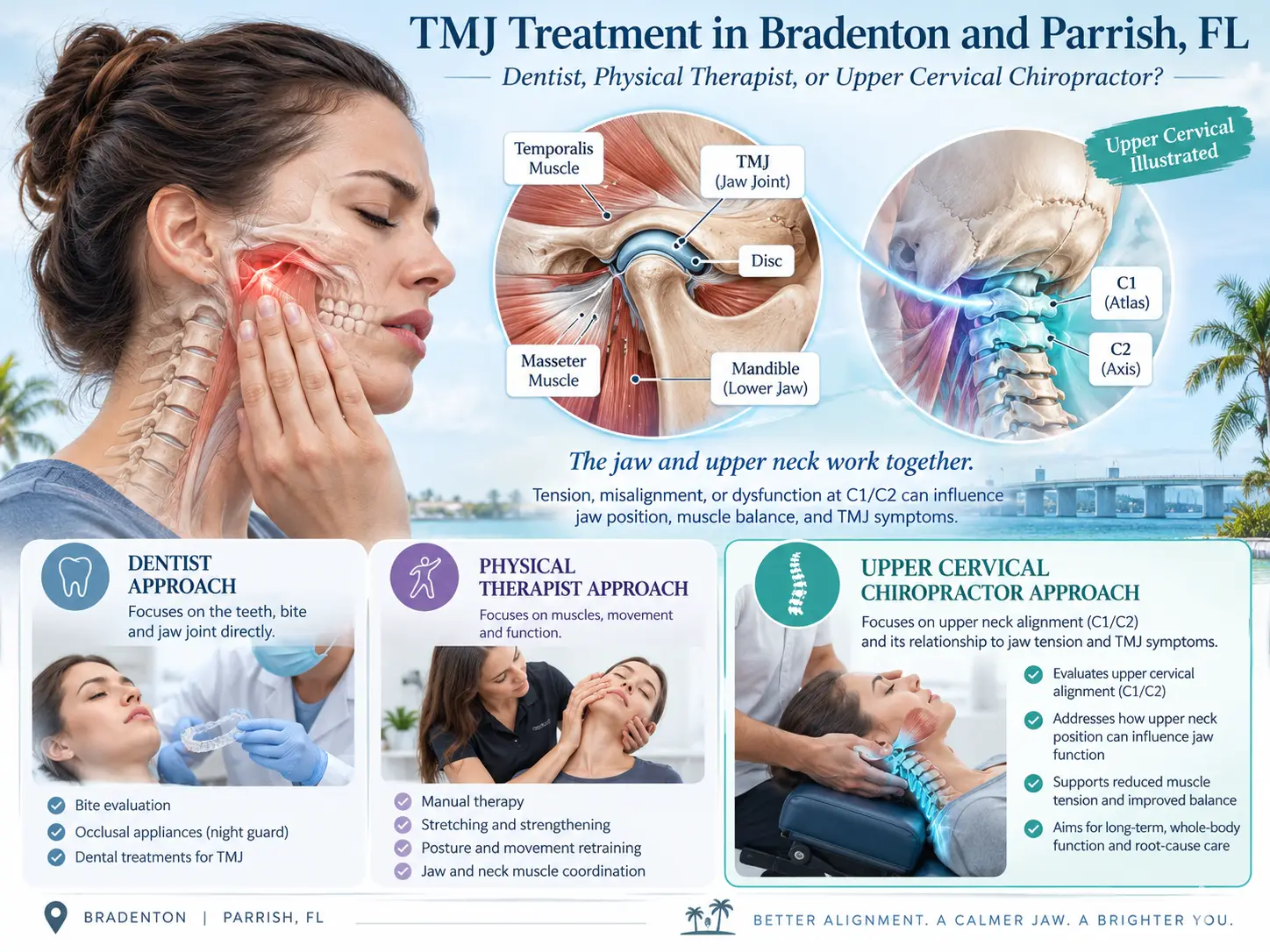
The temporomandibular joint (TMJ) is the hinge-and-slide joint that connects your lower jaw to your skull, just in front of each ear. You have two of them, and they work together every time you talk, chew, yawn, or swallow. “TMD” — temporomandibular disorder — is the umbrella term for a group of conditions affecting that joint, the muscles that move it, and the surrounding tissues. Signs of TMD include jaw pain or tenderness, clicking or popping when you open and close, limited or deviating jaw movement, headaches around the temples, and a sensation of fullness or pressure in the ears.
The reference framework clinicians use to diagnose these conditions is the Diagnostic Criteria for Temporomandibular Disorders, or DC/TMD, a standardized system that helps distinguish muscle-related pain from joint-related problems and ensures different providers are speaking the same language. When people casually say they have “TMJ,” they usually mean TMD — a problem with the joint — rather than simply naming the anatomy.
Somatosensory tinnitus: the bridge concept
Here is the key idea that ties this article together. There is a recognized category called somatosensory tinnitus(sometimes “somatic tinnitus”). This describes tinnitus that can be modulated — made louder, softer, higher, or lower — by movements or muscle contractions of the jaw, neck, head, or even the eyes. If clenching your teeth, pressing on your jaw, or turning your head changes the sound in your ears, that is a classic fingerprint of the somatosensory type.
Somatosensory tinnitus is the mechanistic bridge between “my jaw hurts” and “my ears ring.” It tells us that in some people, signals from the muscles and joints of the jaw and upper neck are feeding into the same nervous-system pathways that process sound — and effectively coloring what the brain perceives. That is not mystical. It reflects how the wiring of the head and neck is actually organized, which is where we turn next.
Why the Jaw, the Upper Neck, and the Ear Are Wired Together
Neighbors sharing a nerve
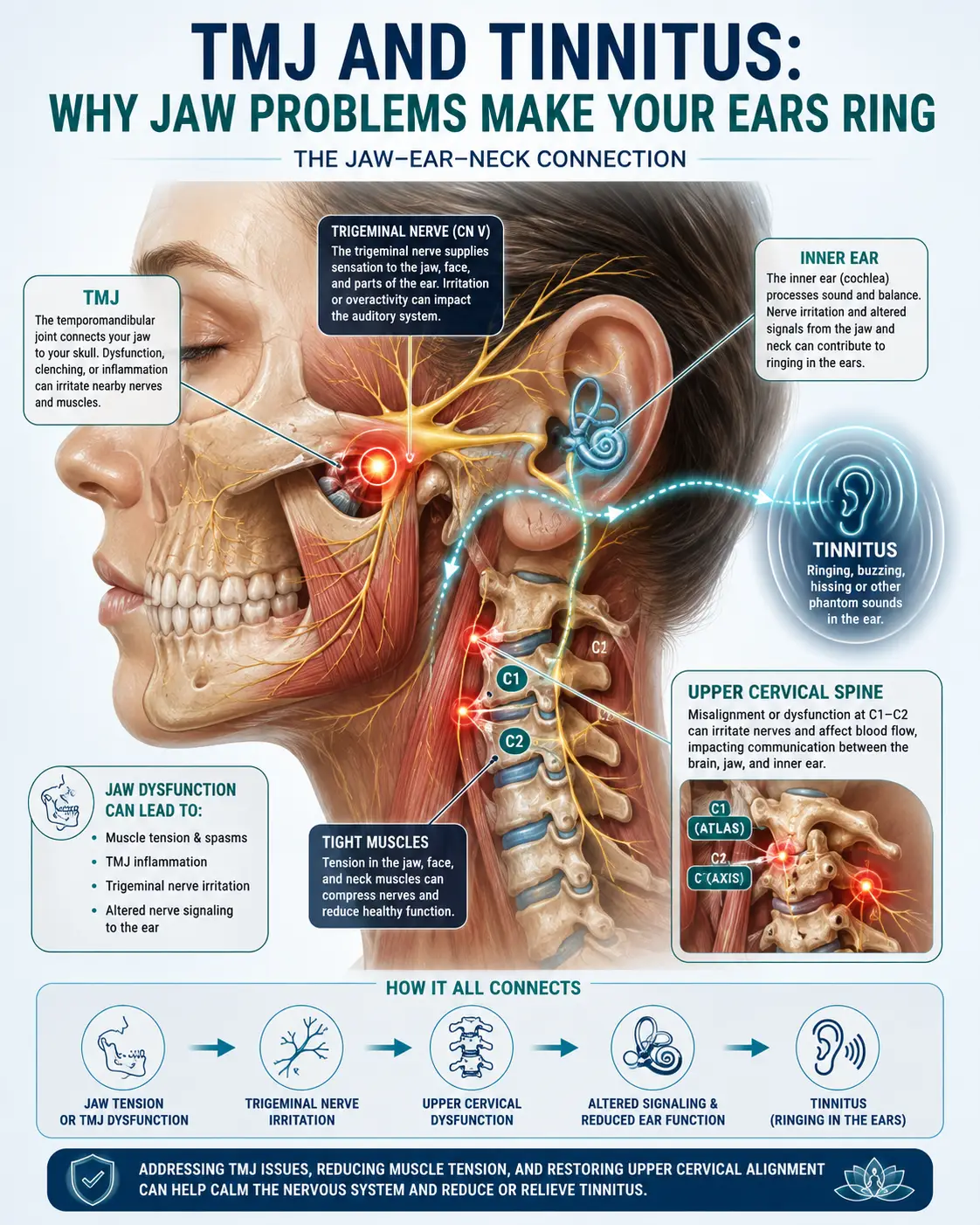
The jaw joint, the ear, and the upper neck are close neighbors, and they share both real estate and nerve supply. The main sensory nerve of the face and jaw is the trigeminal nerve (cranial nerve V). It carries sensation from the TMJ, the chewing muscles, much of the face, and parts of the ear. Because so much converges on this nerve, the brain sometimes has trouble telling exactly where a signal originated — a phenomenon called referred sensation. This is why a jaw problem can be “felt” as ear pain or ear fullness even when the ear itself is perfectly healthy.
The trigeminocervical convergence
Now add the neck. The sensory nerves from the upper cervical spine — particularly the first three cervical nerve roots (C1, C2, C3) — funnel into a shared processing area in the brainstem alongside the trigeminal nerve. Clinicians call this convergence the trigeminocervical complex. Practically speaking, it means the upper neck and the face/jaw are not processed in separate silos; they pour into a common pool. Irritation or dysfunction in the upper neck can therefore influence how facial, jaw, and head signals are interpreted, and vice versa. This same convergence is a well-accepted explanation for why neck problems can produce headaches felt in the forehead or behind the eyes.
The auditory connection
The final piece is the link to hearing. The brainstem structures that first receive input from the ear — notably the cochlear nucleus — also receive input from the trigeminal and upper cervical systems. In other words, the “sound” pathway and the “jaw and neck” pathways are not fully separate; they cross-talk very early in processing. When the jaw-and-neck side of that circuit is noisy — say, from a strained chewing muscle, an irritated joint, or a dysfunctional upper neck segment — that extra traffic can nudge the auditory side and change what you perceive. This cross-talk is the leading explanation for somatosensory tinnitus and for why pressing, clenching, or moving can change the sound.
A few extra anatomical footnotes
There are additional plausible contributors that get discussed in this context. Small muscles near the ear and jaw — the tensor tympani and tensor veli palatini — share nerve supply with the chewing muscles via the trigeminal nerve, and some researchers propose that abnormal muscle tone here could contribute to ear symptoms. There are also embryological ligament remnants near the middle ear that have been described as a possible mechanical link. These ideas are interesting and biologically reasonable, but they are less firmly established than the shared-nerve-pathway story. I mention them so you have the full picture, not because they are settled facts.
The takeaway: the jaw, the upper neck, and the ear are anatomically intertwined through the trigeminal nerve, the upper cervical nerves, and their convergence in the brainstem. That shared wiring is exactly why dysfunction in one area can express itself as a symptom in another.
What the Research Says
Patient education should be honest about evidence — both where it is encouraging and where it is uncertain. Here is a fair summary of the peer-reviewed literature, with the sources linked so you can read them yourself.
First, on whether tinnitus and TMD travel together: a systematic review published in Cranio in 2025 examined the associations between temporomandibular disorders and tinnitus and found a consistent relationship reported across studies. Reviews like this pool many smaller studies to see whether a pattern holds up, and here the pattern does: people with TMD report tinnitus more often than you would expect by chance, supporting a genuine link rather than a coincidence.
Second, the direction and strength of that association. An earlier systematic review and meta-analysis in the Journal of Oral Rehabilitation (2019) asked directly whether there is a higher prevalence of tinnitus in patients with TMD. It concluded that tinnitus does appear more commonly among people with TMD than among people without it. A meta-analysis is a step up in rigor because it statistically combines results, and its findings reinforce that the jaw-and-ear connection is more than anecdote.
Third, a question reviews alone cannot answer: does having TMD actually raise the future risk of developing tinnitus? A population-based retrospective cohort study in the European Archives of Oto-Rhino-Laryngology (2016) followed large groups of people over time and reported an increased risk of subsequently developing tinnitus among those with TMD compared with those without. Cohort studies that track people forward in time are especially useful for suggesting that one thing may precede and contribute to another, rather than the two merely occurring side by side.
Fourth, the relationship runs both ways. A 2025 systematic review and meta-analysis in the Journal of Clinical Medicinelooked at the co-occurrence of TMD in patients who were diagnosed with tinnitus — flipping the question around — and again found the two conditions overlapping more than expected. So whether you start from the jaw or start from the ear, you tend to find the other condition showing up more frequently in the same people.
Fifth, on how these conditions are properly identified in the first place. The Diagnostic Criteria for Temporomandibular Disorders (DC/TMD), published in the Journal of Oral & Facial Pain and Headache in 2014, is the standardized, evidence-based framework clinicians use to diagnose TMD reliably. This matters because good research and good care both depend on everyone defining and measuring these conditions the same way. When your dentist or physician evaluates your jaw carefully, this is the kind of structured approach that stands behind it.
Two honest caveats belong here. First, an association is not the same as proof of cause. The studies above establish that TMD and tinnitus overlap and that TMD may raise tinnitus risk, but they do not show that treating the jaw or neck reliably eliminates ear ringing. Second, when it comes to hands-on treatment, most of the higher-quality evidence for helping TMD involves manual therapy and exercise delivered in a physiotherapy context — jaw and neck mobilization, soft-tissue work, and self-care — rather than spinal adjustments specifically. I am not aware of strong evidence that chiropractic adjustment eliminates tinnitus or TMD, and I would be skeptical of anyone who told you otherwise. What the evidence supports is that the jaw, neck, and ear are connected, and that addressing muscle and joint dysfunction in that region is a reasonable, low-risk part of a broader plan.
Where Upper Cervical Care Fits — Honestly
I practice upper cervical chiropractic, and I want to describe its role in this picture without overselling it.
The premise is simple and anatomical. As covered above, the upper neck (C1–C3) and the jaw both feed into the trigeminocervical complex, and that shared processing area cross-talks with the auditory pathway. If the upper cervical spine is contributing irritation or dysfunction to that system, it is reasonable to think that improving how the upper neck moves and functions could reduce some of the “noise” flowing into a sensitized circuit. For a person whose tinnitus is genuinely of the somatosensory type — the kind that changes when they move their head or clench — the neck is a plausible lever worth examining.
That is a hypothesis about a contribution, not a claim of a cure. Here is how I try to keep it honest:
- Upper cervical care in our office is precise, gentle, and low-force. There is no twisting, cracking, or popping.The technique I use, Knee Chest Upper Cervical, is a specific low-force method rather than a general manipulation of the whole spine.
- This work is one part of a team approach. For jaw problems, your dentist (and sometimes a TMD specialist or an orofacial pain provider) leads. For the ear itself and for hearing, an ENT and audiologist lead. My focus is the neck’s contribution.
- I do not promise that adjusting your neck will stop your ears from ringing. Tinnitus is multifactorial, and no ethical provider can guarantee an outcome for it.
How we evaluate the upper neck
To decide whether the neck is even relevant for a given person, we rely on objective assessment rather than guesswork:
- 3D CBCT imaging (cone-beam computed tomography) lets us see the upper cervical anatomy in three dimensions so that any care is based on your actual structure, not assumptions.
- Paraspinal infrared thermography is a non-invasive way to measure temperature patterns alongside the spine, which can reflect changes in the nervous system’s regulation over time.
- A careful history and examination, including whether your ear symptoms change with jaw or neck movement — the somatosensory signature that suggests the musculoskeletal system is involved.
If the evaluation suggests the neck is not a meaningful contributor to your particular situation, the most useful thing I can do is tell you so and point you toward the providers who are best positioned to help. Good care sometimes means being the person who refers you elsewhere.
A Sensible, Team-Based Plan
Because tinnitus has so many possible causes, the smartest first move is a proper diagnostic sort-out. Here is the kind of pathway I encourage patients to think about.
Start with the right evaluations
- See your physician or an ENT if tinnitus is new, persistent, or bothersome — especially to rule out hearing loss, earwax, medication effects, blood-pressure issues, and other medical causes. An audiogram (hearing test) is often part of this.
- See a dentist or TMD-aware provider if you have jaw pain, clicking, locking, frequent headaches around the temples, or you catch yourself clenching or grinding. They can evaluate the joint and muscles using a structured framework like the DC/TMD.
- Consider the neck — particularly if your ear symptoms change when you move your head, clench, or press on your jaw, or if you also have neck pain and headaches. That is where an upper cervical evaluation may add something.
Conservative, low-risk self-care that many people find helpful
None of these are cures, but they are generally safe and often part of what physiotherapy-style TMD care recommends:
- Rest the jaw. Favor softer foods during flare-ups, cut food into smaller pieces, and avoid gum, ice-chewing, and wide yawns when your jaw is irritated.
- Mind your posture, especially “tech neck” from phones and desks, which loads the upper neck and jaw. Gentle position changes through the day help.
- Address clenching and grinding. Daytime awareness helps, and a dentist may recommend a custom night guard if you grind in your sleep.
- Manage stress and sleep. Both jaw clenching and tinnitus distress are strongly influenced by stress and poor sleep. This is not “in your head” in a dismissive sense — it is real physiology.
- Gentle jaw and neck mobility and relaxation exercises, ideally guided by a physical therapist or dentist familiar with TMD, are where much of the supportive evidence actually sits.
- Sound enrichment for tinnitus — low-level background sound, fans, or specialized sound therapy — can make the ringing less noticeable for many people. An audiologist can guide this.
Where I come in
If your evaluation points to an upper-neck contribution, I offer a gentle, low-force upper cervical approach, coordinated with your dentist and physician, aimed at the neck’s role in that shared trigeminocervical system. I will be candid with you about what I do and do not expect to change, and I will keep you connected to the rest of your team. The goal is not to compete with your other providers — it is to make sure the neck piece is not being ignored.
Red Flags: When to Seek Prompt Medical Attention
Most tinnitus is not dangerous, but certain patterns deserve prompt professional evaluation rather than a wait-and-see approach. Please do not sit on these:
- Pulsatile tinnitus — a rhythmic whooshing or thumping that keeps time with your heartbeat. This warrants medical evaluation because it can reflect a vascular cause.
- One-sided (unilateral) tinnitus, especially with hearing loss in that ear. Asymmetric tinnitus with hearing changes should be assessed by an ENT.
- Sudden hearing loss — treat this as urgent; prompt evaluation can matter for outcomes.
- Tinnitus with dizziness, vertigo, or balance problems, or with neurological symptoms such as facial weakness, numbness, difficulty speaking, or severe sudden headache. Seek medical care promptly.
- Tinnitus following a significant head or neck injury.
- New tinnitus with ear pain, drainage, or signs of infection.
None of these are situations where a chiropractic office should be your first or only stop. If any apply to you, please see a physician or ENT first. Upper cervical care, when appropriate, comes into the picture after serious causes have been considered.
Top Questions
Can a jaw problem really cause tinnitus? It can contribute to it. The research consistently shows that tinnitus and TMD overlap more than chance would predict, and there is a recognized mechanism — somatosensory tinnitus — by which jaw and neck signals modulate what you hear. That said, “contribute to” is not the same as “solely cause.” Many people have more than one factor at play, which is why a broad evaluation matters.
If I fix my jaw, will my ringing go away? Maybe partly, maybe not, and there are no guarantees. Some people notice their ear symptoms ease when their jaw and neck function improves; others do not. The honest position is that addressing TMD and neck dysfunction is a reasonable, low-risk thing to do that may help, but it is not a reliable switch that turns tinnitus off.
How do I know if my tinnitus is the “somatosensory” type? A telltale sign is that the sound changes — louder, softer, or a different pitch — when you clench your teeth, move your jaw, press near the joint, or turn your head. If that is you, the musculoskeletal system of the jaw and neck is more likely to be part of the story, and a clinician can assess it further.
Does upper cervical chiropractic cure tinnitus or TMD? No. I do not make that claim, and I would be wary of anyone who does. Upper cervical care is a precise, gentle, low-force approach that addresses the neck’s possible contribution to a shared nerve system. It is one part of a team that ideally includes your dentist and physician or ENT.
Is the adjustment going to hurt, or involve cracking my neck? No. The upper cervical technique I use is precise, gentle, and low-force, with no twisting, cracking, or popping. It is quite different from the forceful, whole-spine manipulation people often picture.
Do I need imaging? For upper cervical care, we use 3D CBCT imaging so that anything we do is based on your actual anatomy, and paraspinal infrared thermography to track nervous-system patterns over time. For the ear and hearing side, an audiogram through an ENT or audiologist is often the appropriate test. Different questions call for different tools.
What is the difference between TMJ and TMD? “TMJ” is the joint itself — the temporomandibular joint. “TMD” is a disorder of that joint and its muscles. Most people who say they “have TMJ” actually mean they have TMD.
Should I see you or my dentist first? If your main problem is jaw pain, clicking, or grinding, start with a dentist or TMD-aware provider. If your ear symptoms are prominent — especially with any red flags — start with a physician or ENT. If your ear symptoms clearly change with neck or jaw movement, or you also have neck pain and headaches, an upper cervical evaluation can be a sensible addition. When in doubt, a conversation is a good first step, and we are happy to help you figure out the right order.
Is tinnitus dangerous? Usually not, but some patterns warrant prompt evaluation — see the red flags above, particularly pulsatile or one-sided tinnitus, sudden hearing loss, or tinnitus with neurological symptoms. When in doubt, get it checked.
The Bottom Line
The link between jaw problems and ringing ears is not folklore — it is anatomy. The jaw, the upper neck, and the ear share the trigeminal and upper cervical sensory pathways, and those pathways converge and cross-talk with the brain’s sound-processing system. That is why dysfunction in the jaw or neck can modulate ear symptoms, and it is why a category called somatosensory tinnitus exists in the first place. The research consistently shows TMD and tinnitus overlapping, and it suggests TMD may raise the risk of tinnitus over time.
What the research does not show is a magic bullet. Tinnitus is multifactorial, TMD is best managed by a team, and the strongest hands-on evidence for TMD comes from physiotherapy-style manual therapy and exercise rather than from any claim that adjustments cure ear ringing. My role is narrow and honest: to evaluate and, when appropriate, gently address the neck’s contribution to that shared system, using precise, low-force care and good imaging, while keeping you connected to your dentist, physician, and ENT. Sometimes the neck is a real piece of the puzzle. Sometimes it is not, and the most valuable thing I can do is say so.
If you have been living with ringing ears and a cranky jaw and no one has connected the dots, you deserve a careful look and a straight answer.
Serving Sarasota and Beyond
Lavender Family Chiropractic (NeckWise North Sarasota) proudly serves Sarasota, Bradenton, Lakewood Ranch, University Park, Palmetto, and the surrounding Gulf Coast communities. If you are dealing with jaw tension, headaches, neck pain, or ear symptoms that seem to change when you move — and you want an honest evaluation of whether the upper neck is part of your picture — we would be glad to talk with you.
Schedule a consultation with our doctors. We will listen, evaluate carefully, coordinate with your other providers, and tell you plainly whether upper cervical care makes sense for you.
Lavender Family Chiropractic (NeckWise North Sarasota) 5899 Whitfield Avenue, Suite 107 Sarasota, FL 34243(941) 243-3729
This article is for general educational purposes and is not medical advice, a diagnosis, or a treatment recommendation for any individual. Upper cervical chiropractic care addresses the upper-neck component that tinnitus and temporomandibular disorders can share, as part of a broader, team-based approach. If you have concerning symptoms — including pulsatile or one-sided tinnitus, sudden hearing loss, dizziness, or neurological changes — please seek prompt evaluation from a physician or ENT.
Related Articles


Get our upper cervical articles first.