Fibromyalgia and Small-Fiber Neuropathy: The Nerve Story No One Connected to Your Neck
By Dr. Rusty Lavender, D.C. — upper cervical chiropractor, Lavender Family Chiropractic, Sarasota, FL. Reviewed and updated October 2026.
You have been told your labs are normal, your imaging is clean, and your pain is “just fibromyalgia.” But here is what almost no one has told you: in study after study, roughly half of people carrying the fibromyalgia label have measurable nerve damage — and fibromyalgia so often begins after a whiplash, a concussion, or a blow to the head or neck. The nervous system that processes all of that pain is governed at the brainstem, which sits a finger’s width above the top two bones of your neck. If those bones — the atlas and axis — were knocked out of alignment by the same trauma that started your symptoms, they can keep your entire pain system stuck in overdrive. And in most fibromyalgia workups across Sarasota, Lakewood Ranch, and Bradenton, that is the one place nobody checked.
If you live with fibromyalgia, you already know how maddening it is to explain. The pain is everywhere and nowhere at once. Yet the aching, burning, tingling, and bone-deep exhaustion are undeniably real. For years the medical system asked you to prove your pain was legitimate. This article does the opposite. It takes your pain as real, connects it to objective nerve findings, and then goes one step further than most articles dare — it asks why your nervous system got stuck this way in the first place, and points to the overlooked structural driver at the very top of your spine.
This article is for general educational purposes only and is not medical advice, diagnosis, or treatment. Fibromyalgia and small-fiber neuropathy require evaluation and management by a qualified medical provider. Always consult your physician about your individual health.
What Fibromyalgia Actually Is — a Pain System Turned Up Too High
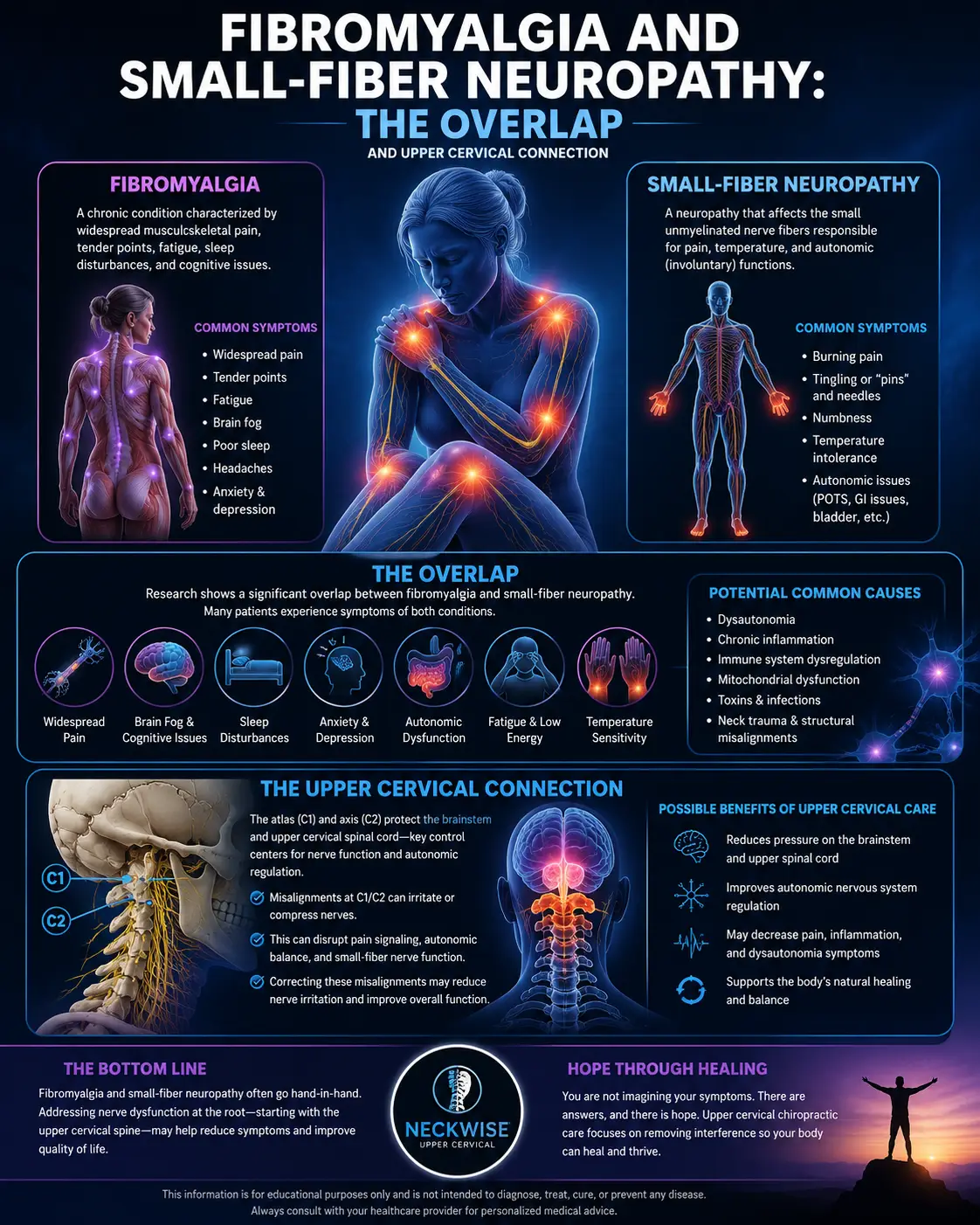
Fibromyalgia is a chronic condition defined by widespread musculoskeletal pain, usually paired with fatigue, unrefreshing sleep, cognitive difficulty (“fibro fog”), and heightened sensitivity to touch, temperature, sound, and light. It affects an estimated 2 to 4 percent of people, more often women, though anyone can develop it. Across Sarasota, Lakewood Ranch, and Bradenton, it is one of the most common chronic-pain diagnoses we hear about — and one of the most poorly explained to the people living with it.
The leading scientific framework for fibromyalgia is central sensitization — central pain amplification. In a landmark clinical review published in JAMA, fibromyalgia is characterized as a disorder of pain regulation in which the central nervous system processes pain signals abnormally, essentially turning up the volume on sensations that would not normally hurt (Clauw, JAMA 2014). The “dial” that governs how your brain and spinal cord interpret incoming signals is set too high. A firm handshake, a snug waistband, or ordinary muscle fatigue registers as genuine pain.
This is not the pain being imagined. Central sensitization is a real, measurable phenomenon involving changes in neurotransmitters, altered activity in the brain’s pain-processing regions, and a nervous system that amplifies and sustains signals long after it should have stood down. It is why fibromyalgia so often travels with irritable bowel syndrome, migraine, jaw disorders, and interstitial cystitis — all conditions of altered sensory processing. And it is why chasing pain in one isolated body part almost never helps: the problem is in how the whole system is regulating sensation.
Now here is the question that changes everything, and the one most discussions skip. If fibromyalgia is a nervous system stuck in overdrive, what is holding the switch down? A dial that is set too high did not set itself. For a great many people, the honest answer traces back to where the nervous system is most vulnerable to mechanical stress — the junction where the skull meets the spine.
Where Your Pain System Is Actually Governed: The Brainstem and the Craniocervical Junction
To understand why the neck belongs at the center of the fibromyalgia conversation, you have to know where central pain processing physically happens. The amplification, the “volume knob,” the constant threat-detection that defines a sensitized nervous system — a great deal of it is orchestrated in the brainstem, the stalk of neural tissue that connects your brain to your spinal cord. The brainstem is home to the pain-modulating pathways that are supposed to turn pain down. When those pathways malfunction, pain gets turned up and stays up. That is central sensitization in physical terms.
Now look at the anatomy. The brainstem does not float in isolation. It descends through the base of your skull and continues into the top of your spine at the craniocervical junction — the meeting point of your skull, your atlas (C1), and your axis (C2). These are the two most specialized, most mobile, and least mechanically protected vertebrae in your entire spine. Unlike the interlocking bones lower down, the atlas and axis are held in position largely by ligaments, and they carry the full weight of your head while allowing it to nod and rotate. There is nowhere else in the body where such critical neural tissue sits in such intimate mechanical relationship with bones this mobile.
Read that again, because it is the piece almost every fibromyalgia workup ignores: the region that governs how your body turns pain up or down sits directly on top of, and moves with, the two bones most likely to be knocked out of position by trauma. When the atlas or axis shifts out of alignment, the surrounding tissues at the skull base come under abnormal tension and stress — at the exact junction where pain-modulating pathways live. The plausible consequence is not a simple neck ache. It is a nervous system that cannot settle, a pain dial that will not turn back down, and an autonomic system stuck in fight-or-flight. In other words: the textbook picture of fibromyalgia.
The Trauma Clue Hiding in Plain Sight
Here is the pattern we see over and over, and it is the loudest clue of all. Fibromyalgia so frequently begins — or dramatically worsens — after an injury to the head or neck. A car accident. A whiplash. A concussion. A hard fall. A sports collision. Patients across Sarasota, Lakewood Ranch, and Bradenton describe it the same way: “I was fine, and then after the accident, everything changed.”
Think about what a whiplash or concussion actually does mechanically. It violently loads the craniocervical junction — the atlas and axis — the exact ligament-dependent segment that sits beneath the brainstem’s pain-control machinery. It is entirely plausible that the same event that started your widespread pain also destabilized the top of your neck, and that the two facts are not a coincidence but a cause. If your fibromyalgia started after something happened to your head or neck, that is not a footnote in your history. It may be the most important sentence in your entire chart — and in most standard workups, no one connected the dots or examined the region where the injury landed.
What Are Small Nerve Fibers — and Why the Research Matters
Your peripheral nervous system contains nerve fibers of different sizes. Large, myelinated fibers carry muscle strength, vibration, and position sense — the things a neurologist checks with reflex hammers and tuning forks. Small fibers are the thinly myelinated and unmyelinated endings that carry a different set of signals: pain, temperature, and itch, along with the autonomic signals that regulate automatic functions like sweating, blood flow, heart rate, and blood pressure.
These small fibers include the tiny nerve endings in your skin — the epidermal nerve fibers. When they are damaged or reduced in number, the result is called small-fiber neuropathy. Its classic symptoms are burning pain, tingling, prickling, numbness, and sometimes changes in sweating, skin color, and temperature regulation. If that list sounds a great deal like what you live with, you are not imagining the overlap — and that overlap is exactly what caught researchers’ attention.
Small-fiber pathology can be measured objectively. The most established method is a skin biopsy, in which a small punch of skin (usually from the lower leg) is examined under a microscope to count the density of nerve fibers in the epidermis. A reduced count — low intraepidermal nerve fiber density — is an objective marker. Other tests, such as quantitative sensory testing and corneal confocal microscopy, can also assess small-fiber function. The point is that these are objective, measurable findings, not subjective reports.
What the Research Says
Beginning around 2013, several independent research groups asked a direct question: if we take people who meet the criteria for fibromyalgia and examine their small nerve fibers, what do we find? The answers, published in respected peer-reviewed journals, were remarkably consistent.
One influential study examined adults diagnosed with fibromyalgia and found that roughly half had objective evidence of small-fiber polyneuropathy on skin biopsy and related testing. The authors argued pointedly that some illness currently labeled fibromyalgia may in fact be an under-recognized small-fiber neuropathy with an identifiable, testable basis (Oaklander et al., Pain 2013). That was a striking claim: for a subset of patients, there was a definable nerve abnormality hiding beneath the label.
Around the same time, a German group published a careful study using skin biopsy, quantitative sensory testing, and nerve recordings. They too found evidence of small-fiber impairment in people with fibromyalgia compared with healthy participants, documenting both reduced nerve fiber density and abnormal functional measures (Üçeyler et al., Brain 2013). A different country, somewhat different methods, and a convergent conclusion — the hallmark of a finding worth taking seriously.
A third group, publishing in a leading rheumatology journal, specifically examined epidermal nerve fiber density in fibromyalgia patients and again documented abnormally reduced density compared with controls (Caro & Winter, Arthritis & Rheumatology 2014). Independent replications using the objective skin-biopsy method moved this from a curiosity toward an established observation.
But how common is it, really? To answer that, researchers pooled the available data in a systematic review and meta-analysis — the kind of study that combines many investigations into an overall estimate. This analysis concluded that small-fiber pathology is present in roughly half of fibromyalgia patients across the studies examined, a prevalence far higher than chance would predict (Grayston et al., Seminars in Arthritis and Rheumatism 2019). That is the source of the widely cited “about 40 to 50 percent” figure. It is a genuine, reproducible signal.
So the headline is this: a substantial share — on the order of 40 to 50 percent — of people diagnosed with fibromyalgia have measurable small-fiber nerve pathology. That is real, peer-reviewed, replicated science. And it fits the framework built above rather than fighting it. A nervous system driven into overdrive at the top of the neck, kept in a state of chronic threat-detection and autonomic dysregulation, is precisely the kind of environment in which peripheral nerves can suffer. One plausible reading of all this evidence is that irritated small fibers in the periphery send a constant stream of signals upinto an already-sensitized system, while a dysregulated system driven from the craniocervical junction fails to calm the periphery down — the two reinforcing each other, both traceable back toward how the nervous system is being governed.
What the Research Does Not Say
Honesty matters more than a dramatic headline, so let me be precise about the limits.
It is a subset, not everyone. If roughly half of fibromyalgia patients show small-fiber pathology, then roughly half do not. The finding identifies a distinct group; it does not explain every case.
Correlation is not the same as cause. Finding reduced nerve fiber density in someone with fibromyalgia tells us the two co-occur. It does not by itself prove the small-fiber changes cause the widespread pain, fatigue, and cognitive symptoms. Small-fiber pathology may be a driver in some people, a parallel process in others, or a downstream consequence.
The central-sensitization model still stands, and the upper cervical spine is a piece of it, not a replacement for it.The widespread pain, the heightened multi-system sensitivity, and the strong overlap with other central sensitivity conditions are best explained by altered central pain processing (Clauw, JAMA 2014). The small-fiber findings add to that picture; the upper cervical story explains why the central system may be stuck. None of these ideas competes with the others.
Methods and thresholds still vary between studies. Different teams used different biopsy sites, staining techniques, and cutoff values, so the exact percentage shifts with those choices. That is normal for an evolving science, and it is why “40 to 50 percent” is a reasonable central estimate rather than a fixed value.
Why the Overlap Matters to You
Validation. Many people with fibromyalgia have spent years being told, subtly or not, that their pain isn’t real or explainable. Objective nerve abnormalities are measurable in a large share of cases. Your experience is real, and science increasingly reflects that.
Possible diagnostic clarity. If you have prominent burning pain, tingling, numbness, or autonomic symptoms — unusual sweating, lightheadedness on standing, temperature-regulation problems — that pattern may prompt your physician to consider testing for small-fiber neuropathy. When it is identified, it opens the door to searching for treatable underlying causes such as diabetes and prediabetes, thyroid disease, vitamin B12 deficiency, and certain autoimmune conditions. That is a conversation for your physician, rheumatologist, or neurologist.
A more complete model of your nervous system. Whether or not you ever have a biopsy, the overlap reinforces the essential truth: fibromyalgia is fundamentally a nervous-system condition — involving how nerves signal at the periphery and, critically, how the brainstem and spinal cord govern those signals centrally. That framing is exactly why the region where the brainstem meets the spine deserves a place in your evaluation that it almost never gets.
How We Evaluate the Overlooked Structural Driver at Lavender Family Chiropractic
At Lavender Family Chiropractic (NeckWise North Sarasota), we focus exclusively on the upper cervical spine — the atlas, the axis, and the craniocervical junction where the skull meets the neck, the same region that sits directly beneath the brainstem’s pain-control machinery. We are not guessing. Our approach is built on measurement.
We use 3D CBCT imaging (cone-beam computed tomography) to see your upper cervical alignment in three dimensions, so any care is tailored to your individual anatomy rather than assumptions. And we use paraspinal infrared thermography to read how your nervous system is actually behaving along the spine — directly relevant when the entire question is autonomic regulation and a system stuck in overdrive. When a correction is warranted, we use the Knee Chest Upper Cervical technique: precise, gentle, and low-force, with no twisting, cracking, or popping. For a nervous system that is already sensitized and easily overwhelmed, that gentleness is not a marketing line — it is the whole point.
I want to be precise about what these tools are and are not. They help us understand your anatomy and monitor nervous-system patterns so we can make careful, individualized decisions. They are not a test for fibromyalgia or small-fiber neuropathy, and they do not diagnose those conditions. Diagnosis belongs with your physician and, when appropriate, a neurologist or rheumatologist. What we add is attention to the one region that sits at the crossroads of the pain-processing brainstem and the moving spine — the piece your workup almost certainly never examined. Keep your physician. Keep your medical plan. But if your fibromyalgia started after a head or neck injury and no one has ever evaluated the top of your neck, that is the missing evaluation, and it is worth getting.
Serving Sarasota, Lakewood Ranch & Bradenton
Lavender Family Chiropractic (NeckWise North Sarasota) serves patients throughout Sarasota, Lakewood Ranch, Bradenton, and the surrounding Manatee and Sarasota County communities, including North Sarasota, University Park, Palmetto, and Ellenton. Families across Sarasota, Lakewood Ranch, and Bradenton come to us for one reason: we look at the region their fibromyalgia workup skipped.
If your fibromyalgia traces back to a car accident, a whiplash, or a concussion — and so many cases across Sarasota, Lakewood Ranch, and Bradenton do — the craniocervical junction is worth evaluating rather than assuming. We offer a consultation with our doctors, where we listen to your full story, explain what we can and cannot offer, and coordinate with your physician or rheumatologist. There is no pressure and no obligation — just a careful look at the one place that may be driving the whole picture.
→ Call (941) 243-3729 to schedule. We’re at 5899 Whitfield Avenue, Suite 107, Sarasota, FL 34243 — convenient to Sarasota, Lakewood Ranch, and Bradenton at the corner of University and Whitfield.
Red Flags: When to Seek Prompt Medical Attention
Fibromyalgia is a real diagnosis, but it should never become a catch-all that causes other conditions to be missed. Please seek prompt medical evaluation — not chiropractic care — if you experience any of the following. These can signal conditions that require timely medical attention.
- New, progressive, or severe weakness in the arms or legs, or loss of coordination.
- Numbness in the “saddle” region (inner thighs, groin, buttocks), or new loss of bladder or bowel control — this can be a medical emergency.
- Sudden, severe headache unlike any you’ve had before, or a headache with fever, stiff neck, confusion, or vision changes.
- Symptoms of stroke: sudden facial drooping, arm weakness, difficulty speaking, sudden vision loss, or severe imbalance. Call 911 immediately.
- Unexplained weight loss, fevers, or night sweats accompanying your pain.
- Rapidly worsening burning pain, numbness, or autonomic symptoms (such as fainting, marked changes in sweating, or new digestive problems), which warrant medical workup for neuropathy and its causes.
- Pain following significant trauma, such as a fall or car accident.
None of these should be assumed to be “just fibromyalgia.” When in doubt, contact your physician or seek emergency care.
Top Questions
Does having small-fiber neuropathy mean I don’t really have fibromyalgia? Not necessarily. In some people, small-fiber neuropathy may better explain their symptoms, and identifying it can point to treatable underlying causes. In others, small-fiber changes and central sensitization coexist — a sensitized system driven from the top of the neck and irritated nerves in the periphery feeding each other. This is exactly the kind of distinction your physician or neurologist is positioned to sort out, sometimes with a skin biopsy.
My fibromyalgia started after a car accident. Does that matter? It matters enormously. A whiplash or concussion violently loads the craniocervical junction — the atlas and axis — the exact region beneath the brainstem’s pain-control pathways. If your symptoms began or worsened after a head or neck injury, the upper cervical spine is a primary driver worth evaluating rather than assuming.
Should I ask for a skin biopsy? That is a reasonable conversation to have with your physician, particularly if you have prominent burning pain, tingling, numbness, or autonomic symptoms such as lightheadedness on standing. Whether testing is appropriate depends on your full clinical picture. It is a medical decision.
Is central sensitization still the main way to understand fibromyalgia? Yes. Altered central pain processing remains the leading scientific model. The upper cervical story does not replace it — it helps explain why the central system gets stuck in overdrive, because the brainstem that governs pain modulation sits directly on the craniocervical junction.
Is upper cervical care safe if my nervous system is very sensitive? Our approach is precise, gentle, and low-force, with no twisting, cracking, or popping — which many sensitive patients find far more tolerable than forceful techniques. Appropriateness still depends on your individual health. We evaluate carefully, coordinate with your physician, and will tell you honestly if care is not a good fit.
Can your thermography or imaging diagnose small-fiber neuropathy? No. Our infrared thermography and 3D CBCT imaging help us understand your upper cervical anatomy and observe nervous-system patterns to guide gentle care. They are not diagnostic tests for fibromyalgia or neuropathy. Those diagnoses belong with your medical team.
Putting It All Together
The overlap between fibromyalgia and small-fiber neuropathy is one of the most meaningful developments in this field in years. The research — published in respected journals, replicated by independent groups, and summarized in a formal meta-analysis — shows that roughly 40 to 50 percent of people diagnosed with fibromyalgia have objective, measurable small-fiber nerve pathology on skin biopsy (Oaklander 2013; Üçeyler 2013; Caro & Winter 2014; Grayston 2019). That validates what so many patients have long known: their pain is real and rooted in the nervous system. It fits alongside, rather than against, the central-sensitization model (Clauw 2014).
And it points at the question no one asked you: if your nervous system is stuck in overdrive, what is holding the switch down — and did anyone ever look at the craniocervical junction where your pain system is governed and where your old injury landed? For a great many people across Sarasota, Lakewood Ranch, and Bradenton, that is the missing piece, and it is the one place no one checked.
Lavender Family Chiropractic (NeckWise North Sarasota) 5899 Whitfield Avenue, Suite 107 Sarasota, FL 34243(941) 243-3729
This article is for general educational purposes only and is not medical advice. It is not intended to diagnose, treat, or replace care from your physician. Fibromyalgia and small-fiber neuropathy require evaluation and management by a qualified medical provider. Always consult your physician about your individual health, and seek prompt or emergency care for any of the red-flag symptoms described above.
Related Articles
Related Posts


Get our upper cervical articles first.