Idiopathic Neuropathy: Numbness and Tingling When You Don’t Have Diabetes
By Dr. Rusty Lavender, D.C. — upper cervical chiropractor, Lavender Family Chiropractic, Sarasota, FL. Reviewed and updated October 2026.
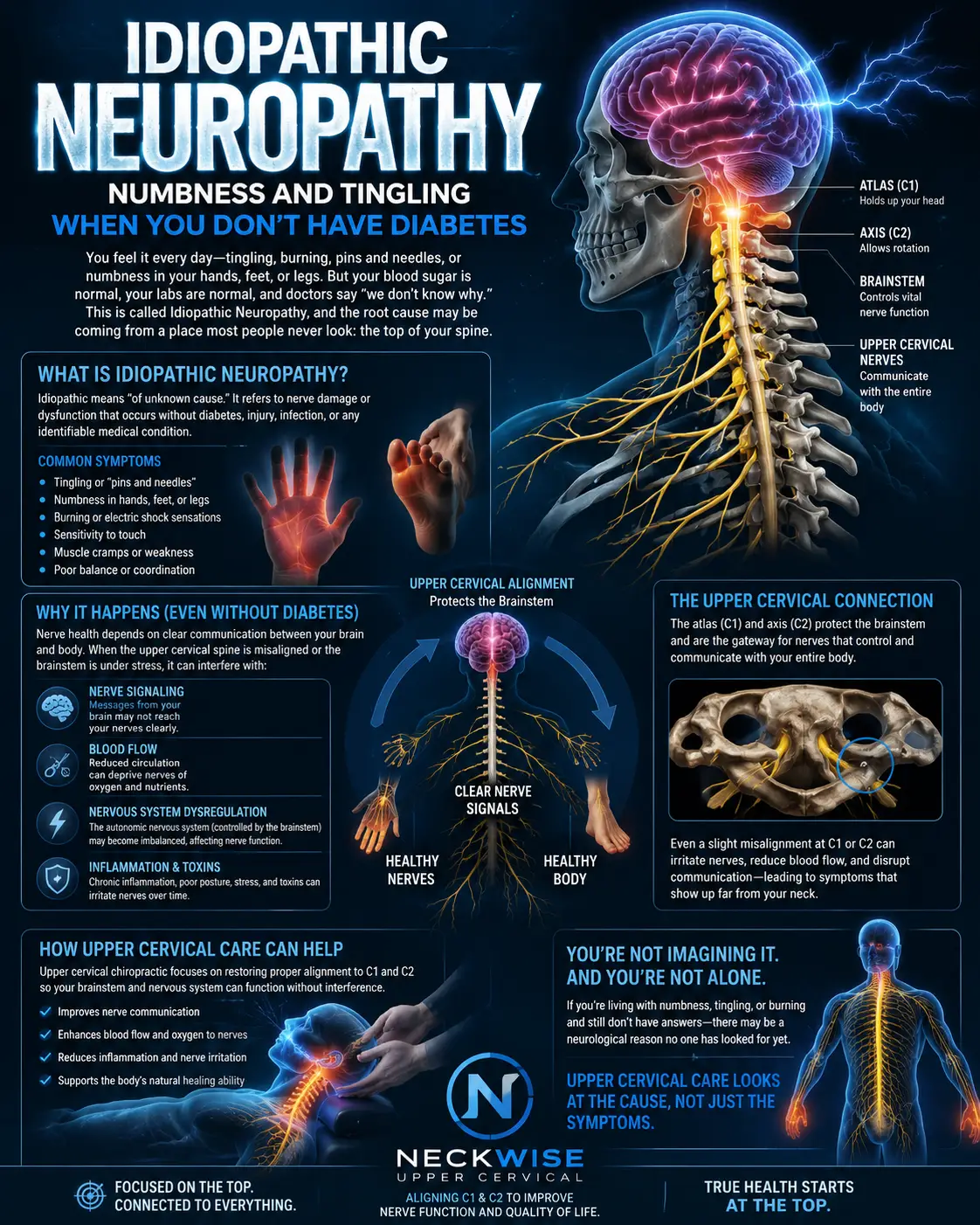
You have numbness, tingling, burning, or a “walking on cotton” feeling in your feet — and your doctor has already ruled out diabetes. Then came the word that sounds like a shrug: idiopathic. Here is the truth patients from Sarasota to Lakewood Ranch to Bradenton rarely hear said plainly: “idiopathic” does not mean there is no cause. It means the search stopped before it found one — and in an overwhelming number of workups, one region is never examined at all. The atlas and axis at the top of your neck surround the brainstem and upper spinal cord, the master relay that receives and regulates every sensory signal your body produces. When that junction is misaligned, it can irritate and dysregulate the very nervous system deciding how loudly your nerves fire. “Idiopathic” so often means no one checked the one place that could be driving this.
This article gives you the confident, cause-forward version: what peripheral neuropathy actually is, how a careful physician hunts for hidden causes, which tests uncover them, what to do when everything comes back “normal,” and why the overlooked structural piece at the base of your skull deserves to be evaluated instead of ignored. My goal is to send you into your next appointment as an informed partner who knows which stones have not yet been turned over.
This article is for general educational purposes only and is not medical advice. If you have a health condition, are pregnant, or take medications, talk with your physician before starting anything new.
What Peripheral Neuropathy Actually Is
Your peripheral nervous system is the vast network of nerves branching out from your brain and spinal cord to reach every corner of your body — skin, muscles, organs, hands, and feet. Peripheral neuropathy is the general term for damage or dysfunction in those nerves.
The most common pattern by far is called distal symmetric polyneuropathy. The name tells you a lot:
- Distal means it starts far from the center of the body — toes and feet first, sometimes later reaching fingers and hands.
- Symmetric means it affects both sides roughly equally. Left foot and right foot, not just one.
- Poly means many nerves are involved, not a single pinched one.
- Neuropathy means nerve disease or dysfunction.
Because the longest nerves run down to your feet, they tend to show wear first. That is why the classic story is tingling or numbness that begins in the toes and slowly creeps upward over months or years in a “stocking” distribution — and later, if it reaches the mid-shin, sometimes a “glove” pattern begins in the fingertips.
Symptoms fall into a few categories. Sensory symptoms are the most common: numbness, tingling (“pins and needles”), burning, electric or shooting pains, and heightened sensitivity where even a bedsheet feels uncomfortable. Some people describe the opposite — a deadened, muffled feeling, as if their feet were wrapped in cloth. Motor symptoms, when present, include weakness, cramps, or tripping. Autonomic symptoms involve the automatic nerves and can include lightheadedness on standing, sweating changes, or digestive irregularity.
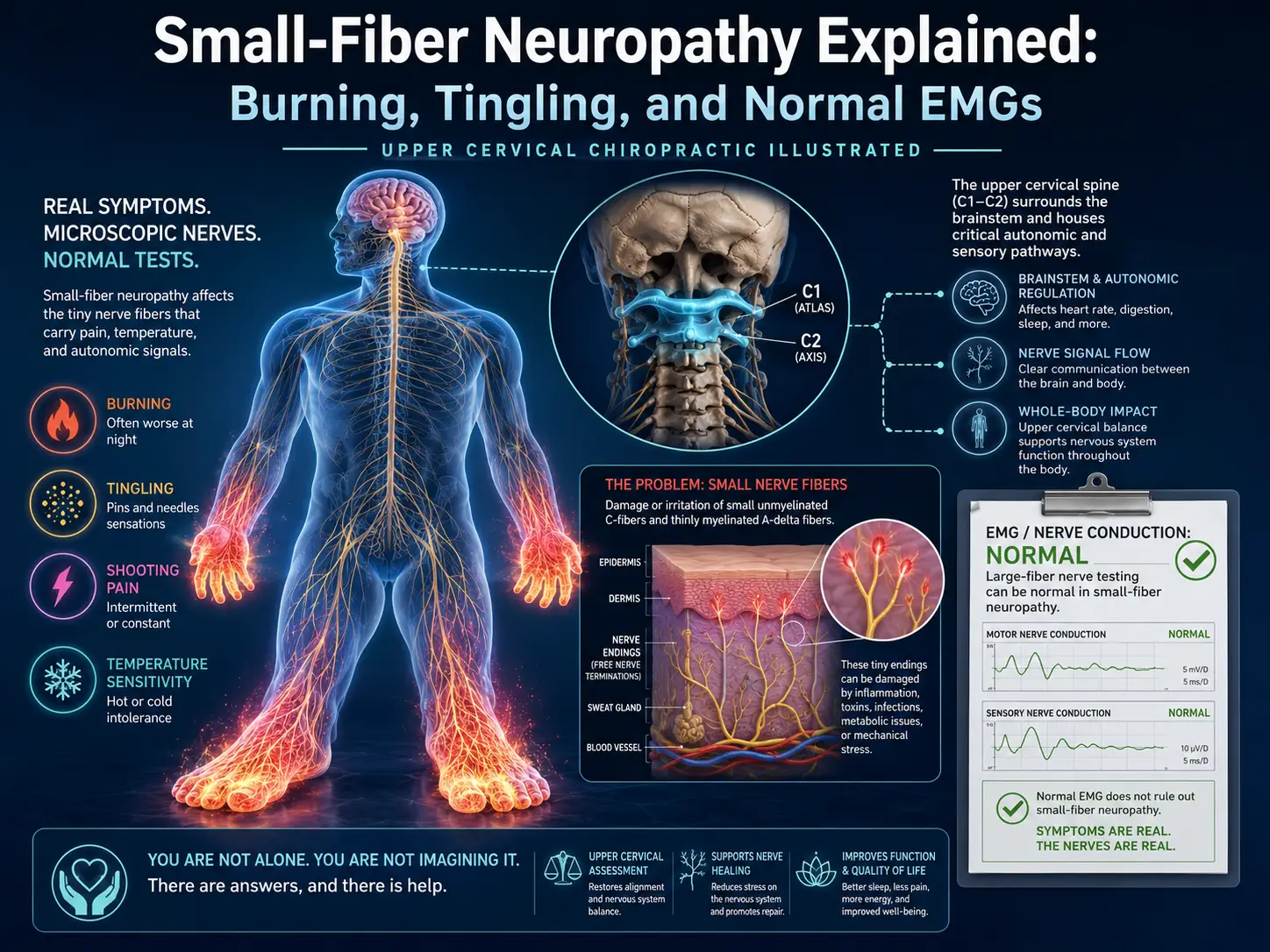
Idiopathic neuropathy is most often a predominantly sensory process. When it mainly affects the small nerve fibers that carry pain and temperature, ordinary nerve conduction tests can even look normal despite very real burning and tingling. And here is the frame worth holding onto: your nerves do not decide on their own how loudly to fire. They report upward to the brainstem and upper spinal cord — the control center that processes and regulates all of it — and that center sits at the very top of your neck.
Why “Idiopathic” Is Not the Same as “Uncommon”
Here is something that surprises many patients: unexplained sensory polyneuropathy is remarkably common, especially after age 60. In older adults who develop this gradual, symmetric, sensory-predominant pattern, a substantial fraction never receive a definitive cause despite a reasonable workup. A comprehensive review of distal symmetric polyneuropathy published in JAMA underscores how frequently clinicians encounter this and how a structured approach helps sort out causes from cases that remain unexplained.
The condition has more formal names in the literature. You may see it called cryptogenic sensory polyneuropathy — “cryptogenic” being a close cousin of “idiopathic,” meaning “of hidden origin.” The foundational description by Wolfe and Barohn in Seminars in Neurology helped define a large group of patients, typically older, with a slowly progressive, sensory-predominant neuropathy and no identifiable cause after standard testing. Others call it chronic idiopathic axonal polyneuropathy, a term examined in detail in a systematic review in the Journal of Neurology.
The point: you are not an oddity, and your case did not stump everyone. You belong to a well-recognized, well-studied group — which means there are established steps for evaluating you, and there are stones that a standard workup routinely leaves unturned.
How Doctors Work Up Neuropathy: Finding the Hidden Causes
When a physician approaches new neuropathy, the guiding philosophy is: look hardest for the causes you can actually do something about. Some causes are treatable or even reversible if caught, so the workup is designed to catch those before anyone settles on “idiopathic.”
The American Academy of Neurology published two detailed practice parameters — expert-consensus roadmaps — for exactly this evaluation. They tell you what a thorough workup looks like.
The History and Physical Exam
Everything starts here, and it is more powerful than any single lab test. Your doctor will want the tempo (days, months, or years?), the distribution (feet first? symmetric?), whether there is weakness or only sensory change, and your full context: medications, alcohol, diet, family history, other conditions, possible toxin exposures. The exam checks sensation to light touch, pinprick, vibration, and temperature, along with reflexes, strength, and balance. A skilled history and exam often narrow the possibilities dramatically before a single tube of blood is drawn — and a genuinely thorough exam includes the neck and the upper cervical spine, because that is where the sensory relay lives.
Blood Tests: The Highest-Yield Screening
This is where many “hidden” causes get discovered. The AAN practice parameter on laboratory and genetic testing found that the tests with the highest yield for uncovering a cause in distal symmetric polyneuropathy are:
- Blood glucose testing — and importantly, this includes screening for prediabetes and impaired glucose tolerance, not just full-blown diabetes. You can be told “you don’t have diabetes” based on a normal fasting glucose or A1c and still have impaired glucose tolerance, which is associated with neuropathy. This is why some physicians order an oral glucose tolerance test, where blood sugar is measured after a sugary drink. It can reveal a glucose-handling problem a simple fasting number misses. If your workup stopped at a single fasting glucose, that is a reasonable thing to ask about.
- Vitamin B12 testing, with metabolites. B12 deficiency is a classic, treatable cause, and it is easy to miss. A low-normal B12 can still represent a functional deficiency, which is why physicians often add methylmalonic acid (and sometimes homocysteine) — these metabolites rise when B12 is truly insufficient at the tissue level, even when serum B12 looks acceptable. Correcting a genuine B12 deficiency is one of the more satisfying moments in this field.
- Serum protein electrophoresis (SPEP), often with immunofixation. This looks for abnormal proteins produced by certain blood and plasma-cell disorders that can cause neuropathy. Because some are treatable and important to catch, protein studies are high-value.
Depending on your history, your physician may add thyroid studies, kidney and liver function, and other targeted tests. The guideline’s message is not “run every test on everyone” but “the glucose, B12-with-metabolites, and protein studies carry the most weight, so make sure they’re done.”
Electrodiagnostic Testing: EMG and Nerve Conduction Studies
If the picture is unclear, nerve conduction studies and electromyography (EMG) may be ordered. Small electrical pulses measure how fast and strongly your nerves transmit, and fine needle recordings assess muscle. These tests can confirm a neuropathy exists, tell whether it affects the nerve fiber itself (axonal) or its insulation (demyelinating), and distinguish a diffuse polyneuropathy from a single pinched nerve. Notably, in pure small-fiber neuropathy these tests can be normal — which does not mean nothing is wrong. It means the problem is in fibers too small for these tests to measure.
Specialized Testing: Autonomic Studies, Skin Biopsy, and Nerve Biopsy
For selected patients, a second AAN practice parameter on autonomic testing, nerve biopsy, and skin biopsy reviewed additional tools:
- Skin biopsy with measurement of intraepidermal nerve fiber density is a validated, minimally invasive way to diagnose small-fiber neuropathy when standard nerve conduction studies are normal.
- Autonomic testing evaluates the automatic nerves and is useful when there are symptoms like dizziness on standing or sweating changes — symptoms governed, in part, by the same upper cervical region.
- Nerve biopsy — removing a small piece of a sensory nerve — is far more invasive and reserved for specific situations such as suspected vasculitis or amyloid. It is not part of a routine workup.
Knowing this list is not so you request every test. It is so you understand that “idiopathic” should be a conclusion reached after a sensible, staged evaluation — including a look at the region that governs sensory regulation — not a label applied before the search is finished.
When the Tests Come Back “Normal”
So you have had the bloodwork, maybe the nerve conduction studies, and everything is “normal.” Now what? This is often the hardest moment, so let’s be honest and constructive.
First, Reframe What “Normal” Means
“Normal” testing does not mean your symptoms are imaginary. It means the tests performed did not find one of the specific abnormalities they were designed to detect. Small-fiber neuropathy routinely produces normal nerve conduction studies. Impaired glucose tolerance hides behind a normal fasting glucose. A functional B12 problem hides behind a low-normal level. “Normal” is information, not a verdict.
Second, Ask Whether the Workup Was Complete
It is entirely appropriate to ask your physician:
- Did we check glucose tolerance / prediabetes, or only fasting glucose or A1c?
- Was B12 checked with metabolites (methylmalonic acid), not just a serum level?
- Were protein studies (SPEP) done?
- Given my symptoms, would electrodiagnostic testing or a skin biopsy add anything?
- Has anyone examined my upper cervical spine — the region where sensory signals are processed and regulated?
- Is a referral to a neurologist appropriate for a second look?
These are not confrontational questions. Good clinicians welcome them.
Third, Understand That “Idiopathic” Can Change Over Time
One of the most important facts about idiopathic neuropathy is that the label is not always permanent. A borderline glucose problem becomes clearer, a vitamin issue develops, a new symptom points somewhere specific — or a structural driver that was never examined finally gets evaluated. The word “idiopathic” is best understood with a silent “so far” attached: the cause has not been found yet. A thorough initial workup, thoughtful follow-up, and a willingness to examine every region — including the neck — give you the best chance of catching a driver if one declares itself.
Fourth, Look Where the Standard Workup Didn’t
When no reversible metabolic cause is found, the next honest question is not “there’s nothing to do” — it is “what didn’t we look at?” And the answer, in the vast majority of cases, is the upper cervical spine.
The Overlooked Driver: How the Upper Neck Can Dysregulate Your Nerves
Here is where nearly every article on this topic stops short. The workup above assumes the numbness in your feet is purely a downstream, local problem. But how loudly a nerve fires is not decided in the foot alone — it is processed and modulated upstream, in the brainstem and upper spinal cord.
Consider the anatomy. The atlas (C1) and axis (C2) are the two most mobile vertebrae in the body, carrying the entire weight of your head and held mostly by ligaments rather than interlocking bone. They surround the brainstem and the top of the spinal cord — the master relay for all sensory and autonomic signaling. When that top segment shifts out of alignment, the surrounding tissues, muscles, and structures at the skull base come under abnormal tension and stress, at the exact junction where sensory traffic is routed and regulated. The plausible consequence is not a simple neck ache. It is ongoing irritation of the very system that governs how your nerve signals are processed, gated, and amplified.
There is an autonomic and blood-flow angle, too. The autonomic control that governs vascular tone and circulation to the extremities runs through this same upper cervical region. When the autonomic nervous system is chronically dysregulated at its most vulnerable structural point, the peripheral nerves that depend on stable autonomic input and healthy blood flow are operating in a compromised environment. That is a mechanism worth evaluating rather than dismissing.
This also explains a pattern we see constantly: people whose unexplained neuropathy traces back to a head or neck injury. A concussion, a whiplash, a car accident, or years of forward-head posture at a screen loads and destabilizes the very region the brainstem and upper cord occupy. If your numbness and tingling began or worsened after something happened to your head or neck, that is a loud clue that a structural driver may be sitting one inch below your skull — in the one region your workup almost certainly never examined. This does not replace the metabolic hunt. It means the upper cervical spine belongs on the list, not left off it — which is exactly why “idiopathic” so often just means “no one checked the neck.”
How We Evaluate the Structural Piece at Lavender Family Chiropractic
At Lavender Family Chiropractic in Sarasota, we focus exclusively on the upper cervical spine — the atlas, the axis, and the junction where the skull meets the neck, the same region that houses the master relay for your sensory and autonomic nervous system. Our approach is built on measurement, not guesswork. We use 3D CBCT imaging to see your upper cervical alignment in three dimensions, and paraspinal infrared thermography to read how your nervous system is actually behaving along the spine — directly relevant when the whole question is nerve signaling and autonomic regulation. When a correction is warranted, we use the Knee Chest Upper Cervical technique: precise, gentle, and low-force, with no twisting, cracking, or popping. For an already-irritated nervous system, that gentleness is the entire point.
The goal is simple: give an overloaded nervous system a calmer structural environment. Keep your physician, keep the metabolic workup, keep confirming the glucose tolerance, B12 metabolites, and protein studies — those matter enormously. What we add is attention to the one region that sits at the crossroads of your spine and the sensory control center, the piece the standard neuropathy workup leaves out. If you have numbness, tingling, normal tests, and the word “idiopathic,” that is the evaluation you have been missing.
Serving Sarasota, Lakewood Ranch & Bradenton
Patients come to our Sarasota office from all over the region — Sarasota, Lakewood Ranch, Bradenton, University Park, Palmetto, and the greater Manatee–Sarasota area — because so few clinics anywhere examine the upper cervical spine when neuropathy is labeled “idiopathic.” If you live in Sarasota, Lakewood Ranch, or Bradenton and you have been handed that word and sent on your way, you do not have to accept a dead end. We are at the corner of University and Whitfield, minutes from Lakewood Ranch and a short drive from downtown Bradenton, and we would be glad to evaluate whether your upper neck is part of your picture.
Red Flags: When to Seek Prompt Medical Attention
Most idiopathic sensory neuropathy is slow and gradual. Certain features are not typical of that benign pattern and warrant prompt medical evaluation. Please contact your physician promptly — or seek urgent care — if you experience any of the following:
- Rapid onset or fast progression of numbness or weakness over days to a few weeks, rather than months to years.
- Significant muscle weakness, especially if worsening, or difficulty walking, climbing stairs, or gripping objects.
- Markedly asymmetric symptoms — clearly worse on one side, or in one specific area — rather than the usual symmetric feet-first pattern.
- Autonomic symptoms such as fainting, severe lightheadedness on standing, or new bladder or bowel dysfunction.
- Ascending weakness or numbness moving quickly up the legs, or any trouble breathing or swallowing — these can signal a medical emergency and warrant immediate care.
- A new severe pain, or a wound or ulcer on a numb foot that isn’t healing — and if you have diabetes, any sign of a diabetes complication warrants urgent care.
None of these should be “watched” at home. Rapid, asymmetric, or motor-predominant patterns can point to specific conditions that need timely diagnosis and treatment.
What the Research Says
Let me summarize honestly what the literature does and does not tell us.
On the workup: The two AAN practice parameters give evidence-based guidance. The laboratory testing parameteridentifies blood glucose (including glucose tolerance screening), vitamin B12 with metabolites, and serum protein electrophoresis as the highest-yield screening tests for finding a cause in distal symmetric polyneuropathy. The companion parameter supports skin biopsy as a validated way to diagnose small-fiber neuropathy and clarifies the more limited, selective roles of autonomic testing and nerve biopsy. Together they describe a rational, staged approach.
On the condition itself: The classic description of cryptogenic sensory polyneuropathy by Wolfe and Barohn established that a large group of (often older) patients present with a slowly progressive, sensory-predominant neuropathy without an identifiable cause after standard testing — and that this group tends to follow a relatively benign, indolent course. The systematic review of chronic idiopathic axonal polyneuropathy similarly characterizes this as typically slowly progressive and, while it can affect quality of life and balance, generally not leading to severe disability or dramatically shortened life. The broad JAMA review of distal symmetric polyneuropathy reinforces the structured diagnostic approach and the reality that a meaningful proportion of cases remain idiopathic even after appropriate evaluation.
The through-line: the workup is rational and staged, the highest-yield tests are well defined, and a large share of cases still get labeled idiopathic — which is precisely why a region that governs how sensory signals are processed should not be left unexamined before the search is called finished.
Top Questions
My doctor said my neuropathy is “idiopathic.” Does that mean there’s really no cause? Not necessarily. “Idiopathic” means no cause has been identified with the testing done so far. Sometimes a cause emerges later, which is why follow-up matters — and one region is routinely left out of the search entirely. It is reasonable to confirm the highest-yield tests were done (glucose tolerance, B12 with metabolites, SPEP) and to ask whether your upper cervical spine has been examined.
I don’t have diabetes, so why do I have neuropathy? Diabetes is the most common cause, but far from the only one. Prediabetes and impaired glucose tolerance (which a single fasting glucose can miss), B12 deficiency, certain protein disorders, thyroid problems, alcohol, and medications can all contribute — and in many people, especially older adults, no cause is found on standard testing, often because the region that regulates sensory signaling was never evaluated.
My nerve test was normal but I still have burning and tingling. How? Standard nerve conduction studies mainly measure large nerve fibers. Small-fiber neuropathy affects tiny fibers those tests can’t detect, so the study can read “normal” while your symptoms are entirely real. A skin biopsy measuring nerve fiber density is one validated way to evaluate it — and how intensely those fibers fire is regulated upstream, at the top of your neck.
Why would my neck matter for numbness in my feet? Because your feet do not set their own signal strength. Sensory input reports to the brainstem and upper spinal cord — the master relay that processes and regulates it — housed within the atlas and axis at the top of your neck. When that junction is misaligned, it can irritate and dysregulate the system governing how loudly your nerves fire. That makes the upper cervical spine worth evaluating, especially when the cause is called “idiopathic.”
Is idiopathic neuropathy going to leave me disabled? For most people with the typical slowly progressive, sensory-predominant form, the outlook is relatively reassuring. It can affect comfort, sensation, and balance, but generally does not cause severe disability or dramatically shorten life. Rapid progression, significant weakness, or asymmetric symptoms are different and warrant prompt evaluation.
Should I see a neurologist? If your symptoms are progressing, if the cause is unclear after initial testing, or if you simply want a specialist’s eye, a neurology referral is very reasonable. Your primary care physician can help arrange it.
Are the adjustments forceful? No — precise, gentle, low-force, with no twisting, cracking, or popping.
Don’t Accept a Dead End
Living with numbness and tingling that no one has explained is genuinely hard. But “idiopathic” is not a verdict — it is a status that can change the moment someone examines what the standard workup skipped. You are not imagining it, you are not alone, and this is a well-recognized situation, especially as we age. The most valuable thing you can bring to your care is the knowledge that “normal tests” does not end the story — and that the one region governing how your nervous system processes these signals is worth checking.
If you are in Sarasota, Lakewood Ranch, or Bradenton and want an honest, cause-forward conversation about your symptoms — while your physician leads the medical evaluation — we would be glad to look at the piece almost everyone else leaves out.
Call (941) 243-3729 or book a consultation. Find out whether the one place no one checked is part of your story.
Lavender Family Chiropractic (NeckWise North Sarasota) · 5899 Whitfield Avenue, Suite 107, Sarasota, FL 34243 · (941) 243-3729 · Serving Sarasota, Lakewood Ranch & Bradenton
This article is for general educational purposes only and is not medical advice. It is not a substitute for evaluation, diagnosis, or treatment by your physician or a neurologist. Peripheral neuropathy should be evaluated and managed by your medical team. If you experience rapidly progressing weakness or numbness, trouble breathing or swallowing, new bladder or bowel changes, or other red-flag symptoms described above, seek prompt medical care.
Related Articles
Related Posts


Get our upper cervical articles first.