Cubital Tunnel Syndrome: Numb Pinky and Ring Finger — Why the Elbow May Not Be the Whole Story
By Dr. Rusty Lavender, D.C. — upper cervical chiropractor, Lavender Family Chiropractic, Sarasota, FL. Reviewed and updated October 2026.
Your little finger and the side of your ring finger have gone numb, tingly, or “asleep” — especially when your elbow is bent — and everyone points to the elbow. Here is what patients from Sarasota to Lakewood Ranch to Bradenton are rarely told: the ulnar nerve that feeds those fingers does not begin at your elbow. It begins at the lower nerve roots of your neck, around C8 and T1, at the base of your cervical spine. When those roots are irritated where they exit the neck, they can mimic, compound, or lower the threshold for the very symptoms everyone is blaming on the elbow alone. It is called the “double crush,” and it is exactly why the neck must be evaluated — not just the elbow. If your workup checked one end of the nerve and never looked at the other, no one examined half of what could be driving this.
This article gives you the confident, cause-forward version: what cubital tunnel syndrome is, why the pinky and ring finger are involved, how it is diagnosed, what conservative and surgical management look like, the red flags that mean you should not wait — and why the upper end of the ulnar nerve, in your neck, deserves to be evaluated instead of ignored. Because you can treat the elbow perfectly and still be stuck if a second irritation at the nerve roots in your neck was never examined.
This article is for general educational purposes only and is not medical advice. If you have a health condition, are pregnant, or take medications, talk with your physician before starting anything new.
What the Ulnar Nerve Is, and Why the Pinky — and Why the Neck
To understand the symptoms, it helps to know the plumbing.
Your arm is served by three major nerves that run down from the neck: the median, the radial, and the ulnar. Each one starts as a bundle of fibers exiting the spinal cord in your neck (the cervical spine), joins a network called the brachial plexus near your shoulder, and then travels down the arm to supply specific muscles and specific patches of skin.
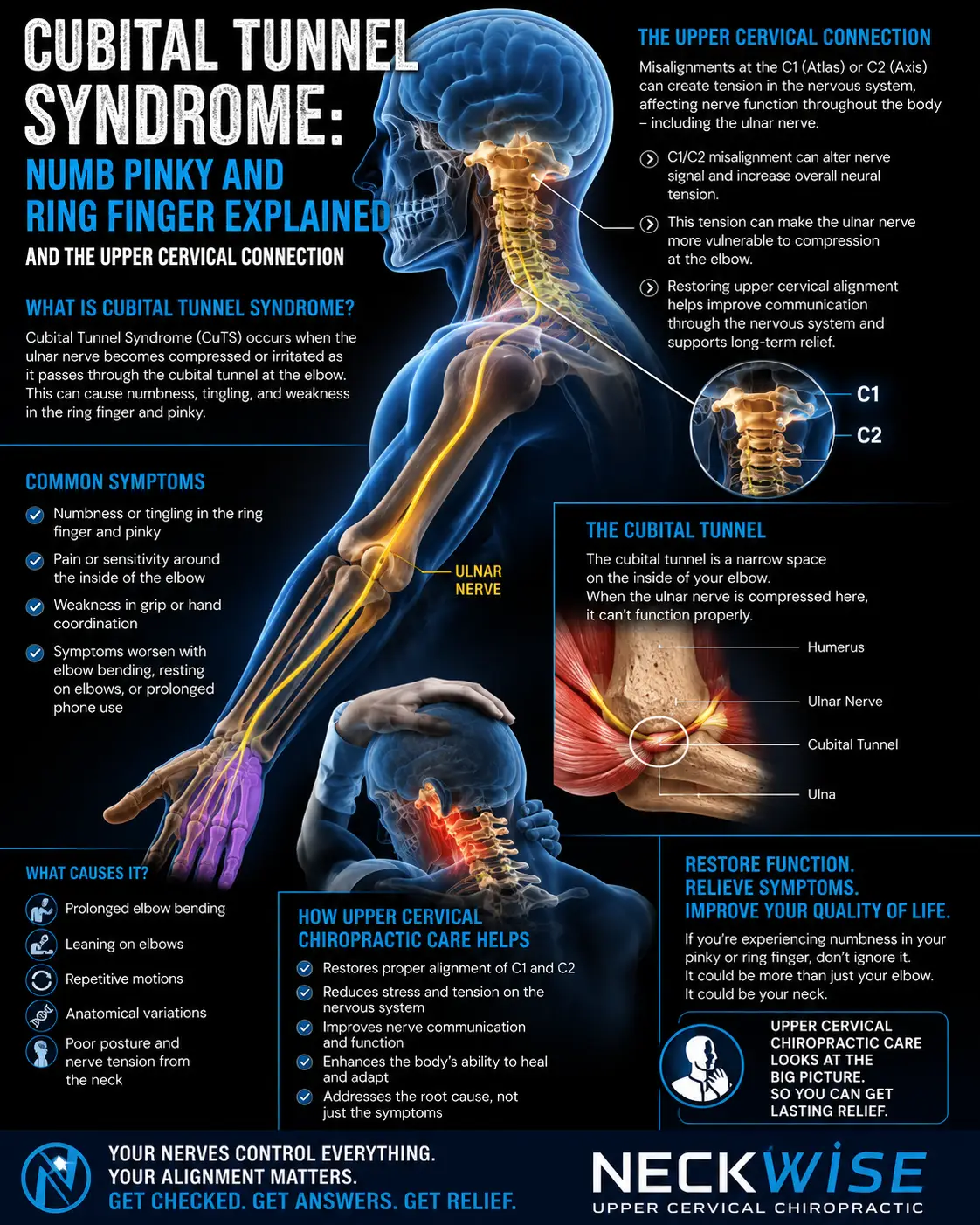
The ulnar nerve carries fibers that originate mainly from the lower cervical nerve roots — around C8 and T1. Read that again, because it is the piece everyone skips: the ulnar nerve’s story begins in your neck. From there it runs down the inner side of the upper arm and does something vulnerable — it passes behind the bony bump on the inside of your elbow. That bump is the medial epicondyle, and the groove the nerve sits in is what most people call the “funny bone.” When you smack it and feel that electric zing into your little finger, you are feeling the ulnar nerve get bumped.
After rounding the elbow, the nerve slips under a small band of tissue and muscle. This tunnel — formed by the bone, ligament, and muscle around the inside of the elbow — is the cubital tunnel. From there the nerve continues down the forearm to the hand.
By the time it reaches the hand, the ulnar nerve does two big jobs:
- Sensation. It supplies feeling to the little finger and to the half of the ring finger nearest it, along with the edge of the palm on that side. This is exactly why cubital tunnel syndrome announces itself as a numb pinky and ring finger rather than the thumb or index finger.
- Movement. It powers most of the small muscles inside the hand — the ones that spread your fingers, pinch strongly, and perform fine, coordinated movements. It also helps drive grip strength. This is why an irritated ulnar nerve can eventually cause a weak grip, clumsiness, and difficulty with jars, buttons, or typing.
Here is the frame that changes the whole picture. The exact same fibers that can be pinched at the elbow start their journey at the C8–T1 nerve roots in your neck. A problem at either end produces symptoms in the same fingers. That is precisely why an elbow-only workup can leave you frustrated — and why the neck belongs in the evaluation from the start.
Why the Elbow Is a Vulnerable Spot — and Why It’s Only Half the Nerve
The cubital tunnel is a demanding neighborhood for a nerve, and several features of anatomy and daily habit make it a common site of trouble.
Bending stretches the nerve. Every time you flex your elbow, the cubital tunnel narrows and the ulnar nerve stretches tighter around the medial epicondyle. Hold that bend — sleeping with your arm curled under a pillow, cradling a phone against your ear, resting bent elbows on a desk — and the nerve is under sustained tension. Many people notice symptoms are worst at night or first thing in the morning for exactly this reason.
Direct pressure. The nerve sits close to the surface at the elbow with little padding. Leaning on a hard armrest, a car door, or a desk edge presses right on it.
Repetition and anatomy. Repeated bending and straightening, certain occupational and athletic demands, prior elbow injuries or arthritis, and normal anatomic variations can all raise the risk.
All true — and all describing only the lower half of the nerve. The upper half runs through the C8–T1 nerve roots in your neck, a region loaded and destabilized by whiplash, old injuries, and years of forward-head posture at a screen. When both ends are stressed, the nerve is being squeezed from two directions at once. That is the whole point of examining the neck alongside the elbow rather than pretending the elbow is the entire story.
Symptoms: What Cubital Tunnel Syndrome Actually Feels Like
Cubital tunnel syndrome tends to progress through a typical sequence, though not everyone experiences every stage. Where you are on this spectrum matters, because earlier stages respond far better to simple measures.
Early symptoms are usually sensory and intermittent:
- Numbness and tingling in the little finger and the pinky-side half of the ring finger.
- A “pins and needles” feeling that comes and goes, often triggered by keeping the elbow bent.
- Symptoms that wake you at night or that you notice on waking.
- An achy or tender feeling along the inside of the elbow, sometimes radiating down the forearm.
As it progresses, motor symptoms may appear:
- A weakening grip and reduced pinch strength.
- Clumsiness or dropping things.
- Difficulty with fine tasks — buttons, coins, typing, an instrument.
- A tendency for the little and ring fingers to drift into a slightly clawed position.
In advanced cases:
- Numbness that becomes constant rather than coming and going.
- Visible thinning (wasting) of the muscles between the thumb and index finger and along the pinky side of the hand.
- Persistent weakness and loss of dexterity.
That progression from “comes and goes” to “constant,” and from tingling to muscle wasting, is the single most important thing to track — and it is also a clue about where the problem lives. Symptoms that flare with neck position, radiate up toward the shoulder, or don’t add up with elbow testing alone are exactly the situations where an unexamined cervical component may be part of the picture.
How Cubital Tunnel Syndrome Is Diagnosed
Good diagnosis combines listening, examining, and — when appropriate — testing. According to a comprehensive review of cubital tunnel syndrome published in Orthopedic Reviews, diagnosis rests on a careful history and physical examination, supported by nerve studies when the picture needs clarification.
History
The clinician asks about the pattern and timing: which fingers, whether numbness comes and goes or stays, whether bending or leaning on the elbow makes it worse, whether you wake at night, and how grip and dexterity have been. They ask about work, hobbies, sleep posture, prior elbow injuries, and general health conditions such as diabetes or thyroid problems that affect nerves — and, done thoroughly, about the neck.
Physical examination
A focused exam typically includes:
- Mapping the numbness. Confirming the sensory changes follow the ulnar nerve’s territory rather than another nerve’s pattern.
- Tinel’s sign. Gently tapping over the nerve at the elbow to see if it produces a tingling “electric” sensation into the pinky-side fingers.
- Elbow flexion test. Holding the elbow fully bent (sometimes with pressure over the nerve) to see if it reproduces your symptoms.
- Strength and muscle testing. Checking grip, pinch, finger spreading, and looking for muscle wasting.
- Neck and shoulder screening. A thorough examiner also checks the neck and shoulder, because irritation higher up the nerve’s path — at the C8–T1 roots — can mimic or coexist with elbow entrapment. This step is exactly the one that gets skipped, and skipping it is how a cervical contributor goes unseen.
Nerve tests and imaging
- Nerve conduction studies and electromyography (EMG) measure how fast and how well signals travel along the ulnar nerve and can often localize the slowdown — frequently at the elbow. They also help gauge severity and rule out other conditions.
- Ultrasound or MRI can sometimes visualize the nerve, show swelling or a structural cause, or reveal the nerve slipping out of its groove.
- X-rays occasionally look at the bony anatomy of the elbow.
One important point: nerve studies are helpful but not perfect. Symptoms can be real even when tests look mild, and the clinical picture always matters. A skilled examiner weighs the whole story — the whole nerve, from neck to hand — rather than any single result.
Conservative Management: The Sensible First Step
For most people — particularly those in the earlier, intermittent stage — treatment starts conservatively. A comprehensive review in Cureus tracing the path from conservative measures to surgical interventions emphasizes that non-surgical management is the appropriate first-line approach for mild to moderate cubital tunnel syndrome, and that many patients improve without ever needing an operation.
Conservative care centers on reducing the two things that aggravate the nerve at the elbow: sustained bending and direct pressure.
Activity and ergonomic changes
This is the foundation, and often the most powerful lever:
- Mind the bend. Avoid keeping the elbow fully flexed for long stretches. Switch phone calls to a headset or speakerphone. Adjust a desk setup that has you resting on bent elbows.
- Protect the funny bone. Stop leaning on your elbows. Pad hard surfaces such as armrests, desk edges, and car doors.
- Adjust your workstation. Keep the elbows in a more open angle, and take breaks to straighten the arm.
- Watch repetitive tasks. Identify the movements that reliably trigger symptoms and modify them.
Night splinting
Because so many people flare at night from sleeping with bent elbows, keeping the elbow relatively straight during sleep is one of the most effective simple measures — a padded splint, a soft brace, or even a towel loosely wrapped around the extended elbow. A review and management guidelines paper in Central European Neurosurgery notes that conservative measures such as activity modification and night-time splinting to limit elbow flexion are reasonable initial management for milder cases.
Nerve gliding and therapy
Hand or physical therapists sometimes use gentle “nerve gliding” or “nerve flossing” exercises to help the ulnar nerve move more freely, along with strengthening and posture work — including posture of the neck and upper back, which directly affects the C8–T1 roots. Evidence for specific exercise protocols is mixed, but a skilled therapist can tailor an approach.
Time and patience
Nerves heal slowly. When conservative measures work, they work over weeks to months. The key is direction: track whether symptoms are stable, improving, or worsening — because worsening symptoms, especially new weakness or constant numbness, change the plan.
Surgical Management: When It’s Needed
Surgery becomes a serious consideration when symptoms are moderate to severe, when there is measurable weakness or muscle wasting, when nerve studies show significant compression, or when a fair trial of conservative care hasn’t helped. The goal is to take pressure off the nerve and give it a healthier path.
Common procedures include:
- Cubital tunnel release (decompression). The tight band over the nerve is divided to relieve pressure, leaving the nerve where it lies — the least invasive option.
- Anterior transposition. The nerve is moved from behind the medial epicondyle to a new position in front of it, so it no longer stretches over the bony bump when the elbow bends.
- Medial epicondylectomy. A portion of the bony bump is removed so the nerve can glide more smoothly.
The right choice depends on the individual — severity, anatomy, whether the nerve is unstable in its groove, and the surgeon’s judgment. Outcomes tend to be more favorable when the nerve is treated before damage becomes advanced. That is one more reason not to ignore progressive symptoms — and one more reason to make sure the whole nerve, including its cervical origin, has been evaluated, so an operation on the elbow is not asked to fix a problem that was partly in the neck.
Red Flags: When to Stop Waiting
I want to make this section unmistakable, because it is the part that protects you.
Most cubital tunnel syndrome is not an emergency, and a careful trial of conservative care is reasonable. But certain findings mean you should seek prompt evaluation by a hand or orthopedic specialist rather than continuing to wait:
- Constant numbness. When the numbness stops coming and going and becomes always-present, it signals more advanced nerve involvement.
- Muscle wasting. Visible thinning or hollowing of the hand muscles — especially the web between the thumb and index finger — means the nerve has been compromised enough to affect the muscles it feeds.
- Progressive or significant weakness. A grip that keeps weakening, difficulty pinching, dropping objects, or a hand becoming clumsy.
- Clawing of the ring and little fingers. A developing claw posture reflects meaningful motor involvement.
- Rapidly worsening symptoms over a short period.
Here is why this matters so much: when a nerve is compressed severely or for a long time, some damage can become permanent, and recovery — even after surgery — may be incomplete. Catching and addressing significant compression before that point is one of the most protective things you can do. If you recognize these red flags, do not sit on them. Get evaluated by the appropriate specialist promptly to avoid permanent damage.
The “Double Crush”: Why the Neck Must Be Evaluated
Now to the concept that most explains why the neck belongs in this conversation.
In 1973, two researchers named Upton and McComas published a short but influential paper in The Lancet proposing what they called the “double crush” hypothesis. Their observation: many patients with a nerve compressed at one point along its length (say, the elbow) also had evidence of compression or irritation of the same fibers higher up — often at the nerve roots in the neck. Their proposed mechanism is compelling. A nerve fiber already partially impaired at one site is rendered more vulnerable at a second site, because the two insults add up. A proximal irritation can make the downstream part of the nerve more susceptible to a second compression. Hence “double crush” — two hits along one nerve, each lowering the threshold at which the other becomes symptomatic.
For the ulnar nerve, the proximal site is the lower cervical nerve roots (C8–T1) in the neck, and the distal site is the cubital tunnel at the elbow. Irritation of those nerve roots in the neck can lower the threshold at which an elbow entrapment starts producing symptoms — and can produce ulnar-pattern numbness and tingling in the same fingers even when the elbow itself is only mildly involved. That is why symptoms sometimes don’t fully add up with elbow findings alone. It is also why the neck is not an afterthought here; it is the other half of the nerve.
Now, the honest boundaries. The double crush concept is a hypothesis, and a debated one. A review in Chiropractic & Osteopathy examining carpal tunnel syndrome and the double crush hypothesis, with implications for chiropractic practice lays out both sides. It notes that while the idea is mechanistically plausible, the evidence is not settled — some original observations can be explained other ways, and rigorous proof that treating a proximal site changes the course of a distal entrapment is limited. So let me be precise about what the double crush idea does and does not mean:
- It does give a reasonable, testable reason to examine the whole length of a nerve rather than just the site of worst symptoms. If your ulnar symptoms are in the hand, the neck is a legitimate and important place to look.
- It does describe a plausible way two problems along one nerve interact to make you more symptomatic than either would alone.
- It is not a claim that a neck correction by itself resolves an elbow entrapment. The elbow is managed by your hand or orthopedic specialist. The point is not that the neck replaces that care — the point is that the neck is a real, evaluable contributor that too often goes unexamined.
The bottom line is straightforward: the ulnar nerve begins in your neck and ends in your hand. Evaluating only the elbow examines half the nerve. The cervical component deserves to be assessed — not overstated, not ignored.
How We Evaluate the Cervical Component at Lavender Family Chiropractic
At Lavender Family Chiropractic in Sarasota, we focus exclusively on the upper cervical spine and the junction where the skull meets the neck — the region that sets the tone for the entire cervical spine below it, including the C8–T1 roots where the ulnar nerve begins. Our approach is built on measurement, not guesswork. We use 3D CBCT imaging to see your cervical alignment in three dimensions, and paraspinal infrared thermography to read how your nervous system is behaving along the spine. When a correction is warranted, we use the Knee Chest Upper Cervical technique: precise, gentle, and low-force, with no twisting, cracking, or popping.
Our role is clear and coordinated. If we assess you and find no meaningful cervical component, that is genuinely useful information, and the plan stays focused on the elbow with your specialist. If we do find something at the neck that appears to be contributing, addressing it is aimed at that cervical component — alongside, never instead of, the appropriate care for the elbow entrapment. Care for cubital tunnel syndrome should be coordinated: the hand or orthopedic specialist manages the entrapment itself, and we evaluate and address the cervical spine as one real piece of a larger picture that too often gets left out entirely.
Serving Sarasota, Lakewood Ranch & Bradenton
Patients come to our Sarasota office from across the region — Sarasota, Lakewood Ranch, Bradenton, University Park, Palmetto, and the surrounding Gulf Coast communities — because so few clinics anywhere examine the neck when hand numbness is blamed entirely on the elbow. If you live in Sarasota, Lakewood Ranch, or Bradenton and you have a numb pinky, a weakening grip, or lingering questions about whether your neck is part of the story, you do not have to accept an elbow-only answer. We are at the corner of University and Whitfield, minutes from Lakewood Ranch and a short drive from downtown Bradenton, and we would be glad to evaluate the cervical half of your nerve.
What the Research Says
Let me pull the evidence together in one place.
On the condition itself. The comprehensive review in Orthopedic Reviews describes cubital tunnel syndrome as the second most common upper-limb nerve entrapment, characterizes the ulnar nerve anatomy and the typical sensory and motor symptoms, and frames diagnosis around history, physical examination, and nerve studies — supporting everything in the diagnosis section above, including the value of screening the neck and shoulder.
On the treatment ladder. The Cureus review on conservative and surgical management walks through the progression from conservative measures — activity modification, splinting, therapy — up through the surgical options, reinforcing that non-surgical care is the appropriate starting point for milder disease, with surgery reserved for more severe or unresponsive cases. The management guidelines review in Central European Neurosurgery similarly supports conservative first-line management, including activity changes and night splinting to limit elbow flexion, while outlining when surgery is indicated.
On the double crush idea. The original Upton and McComas paper in The Lancet introduced the hypothesis that a proximal nerve lesion can make a distal segment more vulnerable to a second compression. The later review in Chiropractic & Osteopathy examines this critically, presenting both the case for it and the reasons for caution — and does so from within the chiropractic literature itself, an honest internal reckoning with what the evidence does and does not support.
The through-line: the condition is well described, conservative care is the sensible first move, surgery helps appropriately selected patients (and works more favorably before damage becomes advanced), and the double crush hypothesis is a legitimate reason to evaluate the whole nerve — including its origin in the neck — rather than assuming the elbow is the entire story.
Top Questions
Is cubital tunnel syndrome the same as carpal tunnel syndrome? No. Both are nerve entrapments in the arm, but they involve different nerves at different places. Carpal tunnel involves the median nerve at the wrist and typically affects the thumb, index, and middle fingers. Cubital tunnel involves the ulnar nerve at the elbow and typically affects the little finger and pinky-side of the ring finger. The finger pattern is one of the quickest clues to which one you’re dealing with.
Why are only my pinky and ring finger numb? Because those are precisely the fingers the ulnar nerve supplies with sensation. Whether the nerve is irritated at the elbow or at its origin in the neck (C8–T1), the sensory fibers heading toward the pinky-side of the hand are the ones affected — which is exactly why the same fingers go numb from a problem at either end.
What is the double crush hypothesis in plain terms? It is the idea that a nerve already irritated at one spot — such as the C8–T1 roots in the neck — may become more easily symptomatic at a second spot farther along, such as the elbow. It is biologically plausible and has been discussed for over fifty years. It remains debated, but it is a solid reason to evaluate the neck, not just the elbow.
Does chiropractic replace elbow treatment for cubital tunnel? No. The elbow entrapment itself is managed with ergonomic changes, splinting, and, if needed, surgery by a hand or orthopedic specialist. What upper cervical care adds is evaluation of whether a cervical component — the other half of the ulnar nerve — is contributing, coordinated with your specialist. It is care aimed at a real, often-overlooked piece of the picture.
When do I need surgery? Surgery is generally considered when symptoms are moderate to severe, when there is weakness or muscle wasting, when nerve studies show significant compression, or when a reasonable trial of conservative care hasn’t helped. A hand or orthopedic specialist makes that call. Outcomes tend to be better when the nerve is addressed before damage becomes advanced.
How long should I try conservative care before doing more? The key is direction, not just duration. If symptoms are stable or improving, continuing is reasonable. If they are worsening — especially new weakness, muscle wasting, or constant numbness — seek specialist evaluation promptly rather than waiting out an arbitrary timeline.
Are your adjustments forceful? No — precise, gentle, low-force, with no twisting, cracking, or popping.
Evaluate the Whole Nerve — Not Just the Elbow
Cubital tunnel syndrome is real, and its elbow-focused treatments live with your hand and orthopedic specialists. But the ulnar nerve begins in your neck, and an evaluation that looks only at the elbow examines only half of it. The double crush concept is a fifty-year-old, biologically grounded reason to check the C8–T1 nerve roots — the piece that so often goes unexamined while everyone stares at the funny bone.
If your symptoms are mild and intermittent, start with the simple conservative steps and get properly evaluated. If you’re seeing red flags — constant numbness, weakening grip, muscle wasting — seek prompt specialist evaluation to avoid permanent damage. And if you’re in Sarasota, Lakewood Ranch, or Bradenton and want a careful, objective look at whether your neck is part of your particular story, that’s a conversation we’re glad to have — coordinated with the specialists managing your elbow.
Call (941) 243-3729 or book a consultation. Make sure someone examined the one end of the nerve everyone forgot.
Lavender Family Chiropractic (NeckWise North Sarasota) · 5899 Whitfield Avenue, Suite 107, Sarasota, FL 34243 · (941) 243-3729 · Serving Sarasota, Lakewood Ranch & Bradenton
This article is for general educational purposes only and is not a substitute for individualized medical advice, diagnosis, or treatment. Cubital tunnel syndrome should be evaluated and managed by qualified healthcare professionals, including hand or orthopedic specialists. If you are experiencing constant numbness, progressive weakness, or muscle wasting, please seek prompt professional evaluation. Upper cervical chiropractic care described here is oriented toward assessing and addressing a possible cervical component and is not presented as a stand-alone treatment for cubital tunnel syndrome.
Related Articles
Related Posts


Get our upper cervical articles first.