
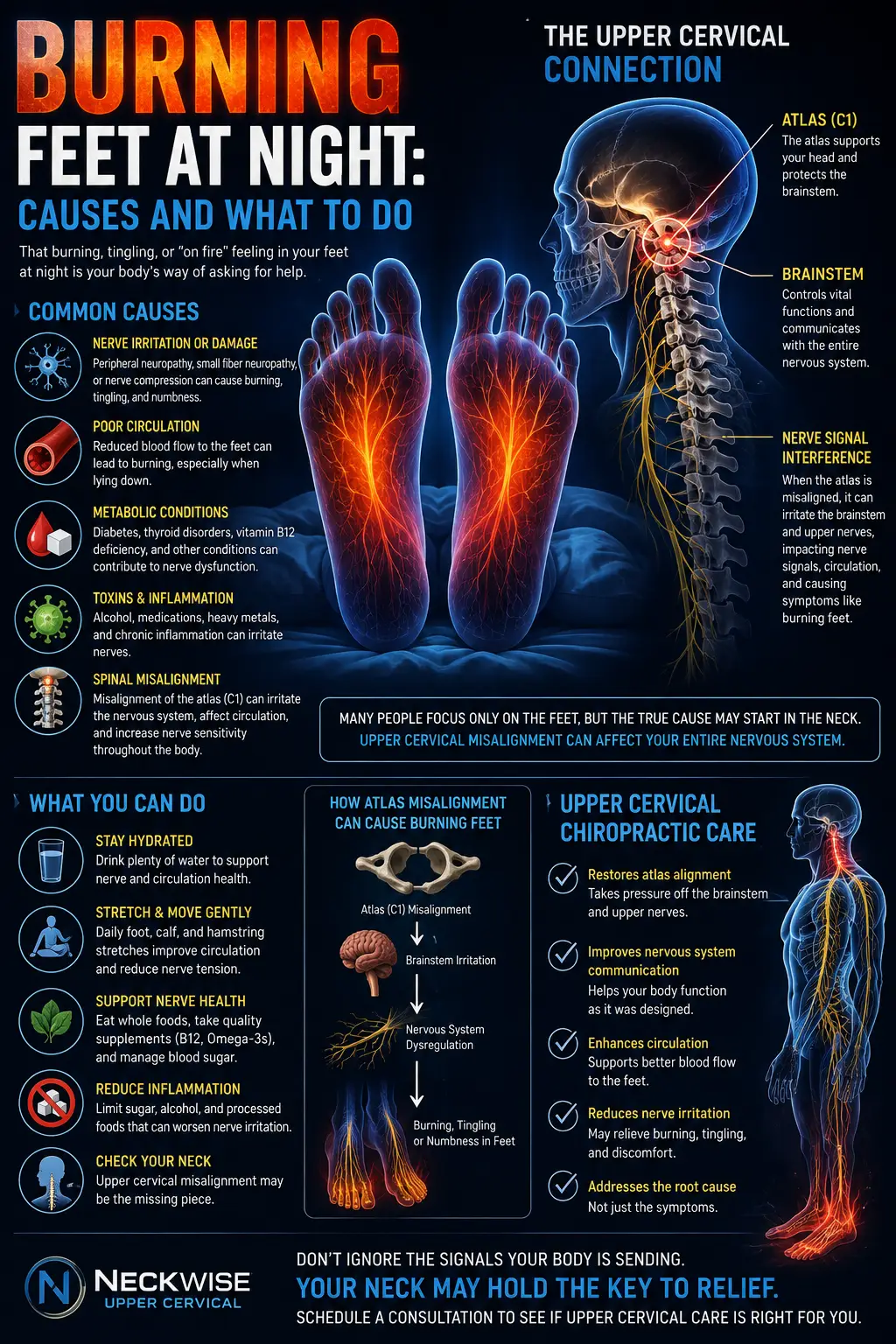
Burning Feet at Night: Causes, Red Flags, and the One Place No One Checked
By Dr. Rusty Lavender, D.C. — upper cervical chiropractor, Lavender Family Chiropractic, Sarasota, FL. Reviewed and updated October 2026.
Our complete guide to neuropathy treatment in Sarasota covers the causes of numbness and tingling, when the neck is the source, and how we evaluate it.
You climb into bed, the house goes quiet, and your feet light up like a stovetop — burning, tingling, prickling, impossible to ignore. It is one of the most common complaints we hear across Sarasota, Lakewood Ranch, and Bradenton, and one of the most maddening. Here is what patients are rarely told plainly: your feet do not decide on their own how loudly to burn. Every sensory signal they send is received, processed, and regulated by the brainstem and upper spinal cord — the master relay that sits at the very top of your neck, cradled by the atlas and axis. When that junction is misaligned, it can irritate and dysregulate the exact system that decides how intensely your nerves fire. Blood sugar, B12, and thyroid matter enormously and must be checked. But when the search stops short and the burning still won’t quit, ask the question no one asks: has anyone examined the one place that governs how these signals are turned up or down?
This article gives you the confident, cause-forward version: why feet burn worse at night, the common and important drivers you must rule out, the red flags that demand urgent care, how a good clinician evaluates it — and why the overlooked structural piece at the base of your skull deserves to be evaluated instead of ignored. Because you can chase the fire in your feet for years, but if the control center that regulates those signals is being irritated one inch below your skull, half the picture was never examined.
This article is for general educational purposes only and is not medical advice. If you have a health condition, are pregnant, or take medications, talk with your physician before starting anything new.
Why Feet Burn Worse at Night
Almost everyone with burning feet notices the same maddening thing: daytime is tolerable, and then nighttime roars. There are several overlapping reasons, and understanding them takes away some of the fear.
The first is the loss of distraction. During the day your brain is flooded with input — work, conversation, movement, screens, errands. All of it competes for attention and drowns out the quiet, steady signal from irritated nerves in your feet. At night, when the lights go off and the world goes silent, nothing competes. The signal that was always there suddenly has the stage. Many people assume their nerves are “getting worse at night” when the signal is roughly constant and they are only now hearing it fully — because the system upstream is amplifying what reaches it.
The second is temperature. Warm feet under blankets dilate the small skin blood vessels and can amplify the firing of already-sensitive small nerve fibers. Some people get relief sticking a foot out from under the covers; for others, cold makes it worse. Misbehaving nerves don’t follow tidy rules.
The third is your body’s daily rhythm. Blood pressure, circulation, hormone levels, and inflammatory chemistry all shift on a roughly 24-hour cycle. Circulation to the extremities changes when you lie down and go still, and for irritated nerves those shifts can tip a quiet sensation into a loud one — much of that circulatory tone governed by the autonomic nervous system, which is regulated from the top of the neck.
The fourth is stillness itself. During the day you move, shift, and reposition constantly, keeping blood flowing and feeding your nervous system a steady stream of normal sensation. Lying still removes all of that, and a nerve that only complains when nothing else is happening finally gets heard.
None of these explain the underlying cause of the nerve irritation — only the timing. To get at the cause, we have to look at the nerves, the body chemistry that supports them, and the control center that regulates them.
The Most Common Culprit: Small-Fiber Neuropathy
When we talk about burning, tingling, prickling, or electric feet — especially at night, especially starting in the toes and soles — we are very often talking about small-fiber neuropathy.
Your peripheral nerves come in different sizes. The large fibers handle strength, balance, vibration sense, and position sense. The small fibers handle temperature, pain, and burning-type sensations, and they help regulate sweating and blood-vessel tone. When the small fibers become damaged or irritated, the classic result is exactly what people describe: burning, tingling, pins-and-needles, and sometimes a strange feeling that the skin isn’t quite its own — all while strength and reflexes may look completely normal on a basic exam.
Small-fiber neuropathy characteristically begins in the longest nerves first, which is why it so often starts in the toes and feet and slowly climbs upward in a “stocking” distribution over months or years. Because the small fibers are so involved in pain signaling, the discomfort can be out of proportion to how normal the feet look. A helpful overview written for clinicians describes this well in a review that literally set out to answer “the burning questions” about small-fiber neuropathy, capturing how this condition presents and why it is so often missed early.
Diagnosing small-fiber neuropathy is genuinely challenging, because the standard nerve-conduction studies that measure the large fibers can come back completely normal even when the small fibers are clearly damaged. A person can be told “your nerve tests are fine” and still be suffering nightly. A thorough review in a leading neurology journal walks through this diagnostic challenge, including the specialized tools — such as skin biopsy to count nerve fiber density and quantitative sensory testing — that can detect small-fiber damage when routine testing misses it. The practical takeaway: a normal basic nerve test does not mean nothing is wrong. If your symptoms are real, keep advocating for a proper evaluation.
And crucially, small-fiber neuropathy is not a diagnosis that ends the conversation — it starts one. Once a clinician recognizes the pattern, the next question is always why. That is where the important, treatable drivers live — and where the search too often stops one region short.
Diabetes and Prediabetes: The Cause You Cannot Ignore
If I could get every reader to remember one thing, it is this: the single most important cause to rule out for burning feet is problems with blood sugar, and that includes not just full diabetes but prediabetes.
Diabetes is one of the leading causes of peripheral neuropathy worldwide, and painful diabetic neuropathy is a well-recognized, extensively studied condition. It classically produces burning, tingling, shooting, or electric-shock sensations in the feet — and the symptoms are notorious for being worse at night. A clinical review on the diagnosis and management of painful diabetic neuropathy describes this burning, distal, often nocturnal pattern and underscores how common and under-recognized it is.
Here is the part that surprises people. You do not need full-blown, diagnosed diabetes to develop this nerve damage. Elevated blood sugar in the prediabetic range — higher than normal but not yet diabetic — is increasingly recognized as a cause of small-fiber neuropathy. This is good news wrapped in a warning: for some people the burning feet are an early alarm bell, ringing at a stage when lifestyle changes, weight management, and blood-sugar control can make a real difference before permanent damage sets in.
This is exactly why the workup for burning feet should almost always include blood-sugar testing. A fasting glucose gives a snapshot, but a hemoglobin A1c — reflecting your average blood sugar over two to three months — is often more revealing, and sometimes a glucose tolerance test is added because it can catch abnormal sugar handling a fasting number misses. If you have burning feet and haven’t had your blood sugar checked recently, that is the conversation to have with your primary care provider this month.
For those with diabetic neuropathy, there are established medical approaches to managing the pain and protecting the feet from complications. A review of the treatment of painful diabetic neuropathy lays out the range of options clinicians use, from optimizing blood-sugar control to specific medications developed for nerve pain. The details are a discussion for you and your physician, but the existence of real, studied options is a reason for hope.
The Other Metabolic Causes: B12, Thyroid, and Alcohol
Blood sugar is the headliner, but far from the only metabolic cause — and several others are straightforward to test for and, in many cases, reversible.
Vitamin B12 Deficiency
Vitamin B12 is essential for healthy nerves, and deficiency is a classic cause of peripheral neuropathy producing tingling, burning, and numbness in the feet and hands. It is more common than many realize — particularly in older adults, strict vegetarians or vegans, people with digestive conditions that impair absorption, and those taking certain common medications long-term, including metformin and some acid-reducing drugs. B12 is easy to check with a simple blood test and often correctable with diet, supplements, or injections when caught before damage becomes permanent. Catching it early genuinely matters.
Thyroid Problems
An underactive thyroid — hypothyroidism — is another well-established and often-overlooked cause. When the thyroid doesn’t produce enough hormone, metabolism slows and peripheral nerves can suffer, sometimes producing tingling, burning, or numbness in the feet along with fatigue, weight gain, cold intolerance, dry skin, and constipation. Like B12 deficiency, it is checked with a simple blood test and is highly treatable, which is why a thoughtful workup includes thyroid function tests.
Alcohol
Chronic heavy alcohol use is directly toxic to peripheral nerves and a recognized cause of painful, burning neuropathy in the feet, through two routes at once: the direct toxic effect on nerve tissue, and the nutritional deficiencies — particularly of B vitamins — that often accompany heavy drinking. If alcohol is a regular part of your life and your feet are burning, it is worth being honest with your physician, because reducing intake and correcting nutrition can halt and sometimes partly reverse damage before it becomes fixed.
There are other drivers worth naming: certain autoimmune and inflammatory conditions, chronic kidney disease, some infections, toxin exposures, medication side effects (chemotherapy drugs are notable), and — in a meaningful number of cases — no cause found on standard testing, which doctors call idiopathic. The point is not to alarm you but to make clear why a proper medical evaluation is the correct path. And it is also why the word “idiopathic” should never be the end of the road: in the vast majority of these workups, one region — the upper cervical spine, where sensory signals are processed and regulated — is never examined at all.
The Restless Legs Differential: Not Everything at Night Is Neuropathy
Not every unpleasant nighttime leg-and-foot sensation is burning neuropathy. One of the most important conditions to distinguish it from is restless legs syndrome, sometimes called Willis-Ekbom disease.
Restless legs and small-fiber neuropathy can feel deceptively similar — both strike in the evening and at night, both involve unpleasant leg and foot sensations, and both wreck sleep. But there are characteristic differences, and a literature review specifically on the differential diagnosis and treatment of restless legs syndrome lays out the classic features clearly.
Restless legs syndrome is defined by an almost irresistible urge to move the legs, usually with sensations people describe as crawling, creeping, pulling, or aching rather than purely burning. The hallmark that most distinguishes it is that movement brings relief: getting up and walking, stretching, or shifting the legs eases the sensation, at least temporarily. Symptoms are worse at rest and worse in the evening. Neuropathic burning, by contrast, typically is not relieved by getting up and moving — you cannot walk it off.
The distinction matters because causes and treatments differ. Restless legs is strongly associated with low iron stores (specifically low ferritin, even when standard blood counts look normal), and correcting iron can substantially help. It is also linked to kidney disease, pregnancy, and certain medications. Some people have both conditions at once, which is one more reason a careful history is so valuable. If your main experience is an urge to move that eases when you walk, mention that specifically — it is a crucial clue.
The Overlooked Driver: How the Upper Neck Can Turn the Fire Up
Here is where nearly every article on burning feet stops short, and it is the most important part. Every cause above is treated as if the burning is purely a downstream, local problem in the foot. But how loudly a nerve fires is not decided in the foot alone — it is received, processed, and modulated upstream, in the brainstem and upper spinal cord.
Consider the anatomy. The atlas (C1) and axis (C2) are the two most mobile vertebrae in the body, carrying the entire weight of your head and held mostly by ligaments rather than interlocking bone. They surround the brainstem and the top of the spinal cord — the master relay for all sensory and autonomic signaling. When that top segment shifts out of alignment, the surrounding tissues, muscles, and structures at the skull base come under abnormal tension and stress, at the exact junction where sensory traffic is routed and regulated. The plausible consequence is not a simple neck ache. It is ongoing irritation of the very system that governs how your nerve signals are processed, gated, and amplified — which can keep an already-sensitized system dialed up no matter what is happening in your feet.
The autonomic and blood-flow angle is especially relevant here. Small fibers help regulate blood flow and vascular tone in the skin, and the autonomic control that governs circulation to the extremities runs through this same upper cervical region. When the autonomic side of the nervous system is chronically dysregulated at its most vulnerable structural point, the small fibers that depend on healthy blood flow and stable autonomic input are working in a hostile environment — and warm, still feet at night are exactly when that shows up loudest.
This also explains a pattern we see constantly: people whose burning feet trace back to a head or neck injury. A concussion, a whiplash, a car accident, or years of forward-head posture at a screen loads and destabilizes the very region the brainstem and upper cord occupy. If your burning, tingling, or nighttime foot symptoms started or worsened after something happened to your head or neck, that is a loud clue that a structural driver may be sitting one inch below your skull — in the one region your workup almost certainly never examined. None of this replaces finding the metabolic cause. It means the upper cervical spine belongs on the list, not left off it.
How We Evaluate the Structural Piece at Lavender Family Chiropractic
At Lavender Family Chiropractic in Sarasota, we focus exclusively on the upper cervical spine — the atlas, the axis, and the junction where the skull meets the neck, the same region that houses the master relay for your sensory and autonomic nervous system. Our approach is built on measurement, not guesswork. We use 3D CBCT imaging to see your upper cervical alignment in three dimensions, and paraspinal infrared thermography to read how your nervous system is actually behaving along the spine — directly relevant when the whole question is nerve signaling and autonomic regulation. When a correction is warranted, we use the Knee Chest Upper Cervical technique: precise, gentle, and low-force, with no twisting, cracking, or popping. For an already-sensitized nervous system, that gentleness is the entire point.
The goal is simple: give an irritated, overloaded nervous system a calmer structural environment. Keep your physician, keep the metabolic workup, keep chasing the blood sugar, B12, thyroid, and iron answers — those matter enormously. What we add is attention to the one region that sits at the crossroads of your spine and the sensory control center, the piece the standard burning-feet workup leaves out. If your feet burn every night, your nerve tests are “normal,” and no one can tell you why, that is the evaluation you have been missing.
Serving Sarasota, Lakewood Ranch & Bradenton
Patients travel to our Sarasota office from all over the region — Sarasota, Lakewood Ranch, Bradenton, University Park, Palmetto, and the greater Sarasota-Manatee area — because so few clinics anywhere examine the upper cervical spine when burning feet won’t settle. If you live in Sarasota, Lakewood Ranch, or Bradenton and you have spent your nights fighting the fire in your feet with nothing but “normal” results to show for it, you do not have to accept a dead end. We are at the corner of University and Whitfield, minutes from Lakewood Ranch and a short drive from downtown Bradenton, and we would be glad to evaluate whether your upper neck is part of your picture.
When Burning Feet Are Serious: Red Flags
Most burning feet are a chronic nuisance that deserves a thorough but unhurried workup. Some situations, however, call for prompt medical attention. Please take these seriously and seek prompt medical care if you experience any of the following:
- Rapidly spreading numbness or weakness. Metabolic neuropathy typically develops slowly over months to years. Numbness, weakness, or tingling that spreads quickly over hours or days — especially climbing up the legs, involving the hands at the same time, or affecting your ability to walk — can signal a more serious neurological process that needs urgent evaluation.
- Any foot wound, sore, blister, ulcer, or infection in a person with diabetes. This one is not optional. When diabetic neuropathy dulls protective sensation, an injury can go unfelt and a small sore can progress to a serious infection with alarming speed. If you have diabetes, inspect your feet daily and treat any non-healing wound, redness, warmth, swelling, drainage, or foul odor as a reason to contact your provider promptly. Signs of a diabetes complication warrant urgent care.
- Sudden, severe pain, or a cold, pale, or pulseless foot, which can indicate a circulation emergency rather than a nerve problem.
- Loss of bladder or bowel control, or numbness in the groin or inner thighs, accompanying leg symptoms, which can signal a spinal cord or nerve-root emergency and warrants immediate care.
- Symptoms following a fall, injury, or new medication, or accompanied by fever, unexplained weight loss, or feeling systemically ill.
If none of these apply and your burning feet have been a slow, stable, nagging presence, you are most likely dealing with a chronic neuropathy that still deserves a proper workup — just not an emergency one. When in doubt, call your medical provider and describe what you are feeling. It is always reasonable to ask.
How Burning Feet Are Evaluated
There is a logical, well-worn path for evaluating burning feet. A good clinician follows a recognizable sequence.
It starts with a careful history. When did it start? Which parts of the feet, and is it spreading? Is it burning, tingling, crawling, or aching? Is it worse at night, and does movement help? What is your medical history — diabetes, thyroid, kidney, autoimmune conditions? What medications? How much alcohol? What is your diet? What about past head or neck injuries? These answers frequently point straight at the cause, and the movement-relief question helps separate restless legs from neuropathy.
Next comes a physical and neurological exam. A clinician checks sensation to light touch, pinprick, temperature, and vibration; tests reflexes; assesses strength and balance; and looks at the skin, color, and pulses of the feet. In small-fiber neuropathy, much of this can look normal even when symptoms are significant — a known diagnostic trap, not evidence that nothing is wrong.
Then come blood tests, where the common, treatable causes are caught. A sensible panel typically includes fasting glucose and hemoglobin A1c, vitamin B12 (and sometimes related markers), thyroid function tests, and often a complete blood count, kidney function, and iron studies including ferritin — the last especially if restless legs is on the table. Additional autoimmune or inflammatory tests may be added based on history.
In some cases, specialized nerve testing is added. Nerve-conduction studies and EMG assess the large fibers and can identify or exclude certain patterns. But as the neurology literature makes clear, these standard tests can be entirely normal in small-fiber neuropathy. When small-fiber damage is strongly suspected despite normal routine testing, specialists may turn to skin biopsy or quantitative sensory testing to confirm what the standard tests miss.
If a burning-feet workup doesn’t at least look at your blood sugar, B12, and thyroid, it is reasonable to ask why. If you are told your nerve tests are normal but you are still suffering, it is reasonable to ask whether small-fiber neuropathy has been considered — and whether anyone has examined the upper cervical spine that regulates how these signals are amplified. Good medicine welcomes good questions.
What the Research Says
The research is clear and consistent on several things. Burning, painful sensations in the feet are a hallmark of neuropathy affecting the small nerve fibers, and this pattern is well documented as often being worse at night and starting in the toes and feet before moving upward, as described in the review addressing the “burning questions” of small-fiber neuropathy. The research also confirms that diagnosing small-fiber neuropathy is genuinely difficult and that standard nerve tests can miss it, which is precisely the diagnostic challenge detailed in the Lancet Neurology review. This is why patients with real symptoms sometimes have to advocate for a deeper look.
The research is equally clear that diabetes is a major, common, and important cause. Painful diabetic neuropathy is a well-studied condition with a recognizable burning, distal, nocturnal pattern, as laid out in the review on its diagnosis and management, and there are established medical strategies for managing it, summarized in the review of its treatment. The consistent theme is that identifying and controlling the underlying metabolic cause — blood sugar above all — is central to protecting the nerves and the feet.
And the research supports the importance of the restless legs differential, with the literature review on restless legs syndrome describing the characteristic urge to move, the relief with movement, the evening timing, and the association with low iron stores — features that help distinguish it from neuropathy and point toward a different set of treatments.
The through-line: the causes of burning feet are real and largely identifiable, standard tests can miss small-fiber damage, and a careful, complete search is what protects your nerves and your feet — which is exactly why a region that governs how sensory signals are processed should not be left unexamined before the search is called finished.
Practical Steps You Can Take Tonight
While you arrange the medical evaluation that is the real cornerstone, here are sensible, low-risk comfort measures many people find helpful. None treat the underlying cause, and none replace seeing your doctor.
- Keep your feet cool. Since warmth often amplifies the burning, some people sleep better with lighter bedding over the feet, a fan, or a foot left outside the covers. A cool (not ice-cold) foot soak before bed helps some.
- Mind the bedtime routine. Consistent bedtimes, a cool dark room, limiting screens and stimulants in the evening — good sleep hygiene won’t fix a neuropathy, but it can make a symptom that thrives in a restless mind easier to bear.
- Move during the day. Regular walking and gentle activity support circulation and metabolic health, and are broadly good for nerve health over time.
- Look at the alcohol question honestly. If you drink regularly and your feet are burning, cutting back is a reasonable, no-downside experiment while you await your workup.
- If you have diabetes, protect your feet. Inspect them daily, keep them clean and moisturized, wear well-fitting shoes, never go barefoot outdoors, and treat any wound as a reason to call your provider promptly.
- Write down your pattern. Note when the burning happens, what makes it better or worse, whether movement helps, and whether it started after any head or neck injury. This record is gold for the clinician evaluating you.
Above all, do not let a slow, nagging symptom go unexamined for years. Burning feet are often the body’s early way of pointing at something — blood sugar, a vitamin, the thyroid, or the way your nervous system is being regulated — that is far easier to address sooner than later.
Top Questions
Why do my feet burn only at night and feel fine during the day? The nerve irritation is usually present around the clock, but daytime activity and sensory input drown out the signal. At night, stillness, silence, and the warmth of bed covers let the sensation take center stage — and the control center that regulates signal intensity sits at the top of your neck. This timing is very characteristic of neuropathy and is worth evaluating, not minimizing.
Does burning feet always mean I have diabetes? No, but diabetes and prediabetes are the most important causes to rule out, which is why blood-sugar testing (glucose and A1c) belongs in nearly every workup. Other causes include B12 deficiency, thyroid problems, heavy alcohol use, certain medications, and small-fiber neuropathy that sometimes has no cause found on standard testing. Only proper testing can sort this out.
My nerve test came back normal, but my feet still burn. What now? A well-known situation. Standard nerve-conduction studies measure the large fibers and can be normal in small-fiber neuropathy, which affects the tiny fibers responsible for burning and temperature. If your symptoms are real and basic tests are normal, ask about small-fiber neuropathy, specialized testing such as skin biopsy — and whether the upper cervical spine that regulates these signals has been examined.
Why would my neck matter for burning in my feet? Because your feet do not set their own signal strength. Sensory input reports to the brainstem and upper spinal cord — the master relay that processes and regulates it — housed within the atlas and axis at the top of your neck. When that junction is misaligned, it can irritate and dysregulate the system governing how loudly your nerves fire, and it can disturb the autonomic control of blood flow to your feet. That makes the upper cervical spine worth evaluating, especially when the burning won’t settle and no cause has been found.
How do I know if it is restless legs syndrome instead of neuropathy? The biggest clue is the urge to move and whether movement helps. Restless legs involves an almost irresistible urge to move the legs, with crawling or aching sensations that ease when you walk. Neuropathic burning usually does not improve with movement. Restless legs is also strongly linked to low iron, so ferritin testing is part of its workup. Some people have both, so describe your experience carefully.
When should I treat burning feet as an emergency? Seek prompt medical care for rapidly spreading numbness or weakness, any foot wound or sore in a person with diabetes, a sudden cold or pale or pulseless foot, loss of bladder or bowel control, numbness in the groin, or symptoms with fever or feeling systemically ill. Most burning feet are chronic and not emergencies, but these situations need attention right away.
Are the adjustments forceful? No — precise, gentle, low-force, with no twisting, cracking, or popping.
Find the Cause — and Check the One Place No One Looked
Burning feet at night are common, frustrating, and often a meaningful signal from your body. In most cases they point to the peripheral nerves and the metabolic chemistry that keeps them healthy: blood sugar first and foremost, along with B12, thyroid, and sometimes alcohol or iron. The single most valuable step is a proper medical workup that looks at these causes, because many are treatable and some are reversible when caught early.
But if you have done the bloodwork, sat through the “normal” nerve test, and still can’t sleep for the fire in your feet, ask the question the standard workup never does: has anyone examined the one region that governs how your nervous system turns these signals up or down? For a great many people from Sarasota, Lakewood Ranch, and Bradenton, that upper cervical evaluation is exactly what has been missing — and it is the one place no one checked.
Let us look at what the standard workup skips. Call (941) 243-3729 or book a consultation. Find the cause — and make sure the master relay is free to do its job.
Lavender Family Chiropractic (NeckWise North Sarasota) · 5899 Whitfield Avenue, Suite 107, Sarasota, FL 34243 · (941) 243-3729 · Serving Sarasota, Lakewood Ranch & Bradenton
This article is for general educational purposes only and is not medical advice, diagnosis, or treatment. It does not create a doctor-patient relationship. Burning, tingling, or numbness in the feet can reflect serious underlying medical conditions and should be evaluated by a qualified medical provider. If you have diabetes and notice any foot wound, or if you experience rapidly spreading numbness or weakness, seek prompt medical care.
Related Articles
Related Posts


Get our upper cervical articles first.