By Dr. Rusty Lavender — Lavender Family Chiropractic, Sarasota, FL
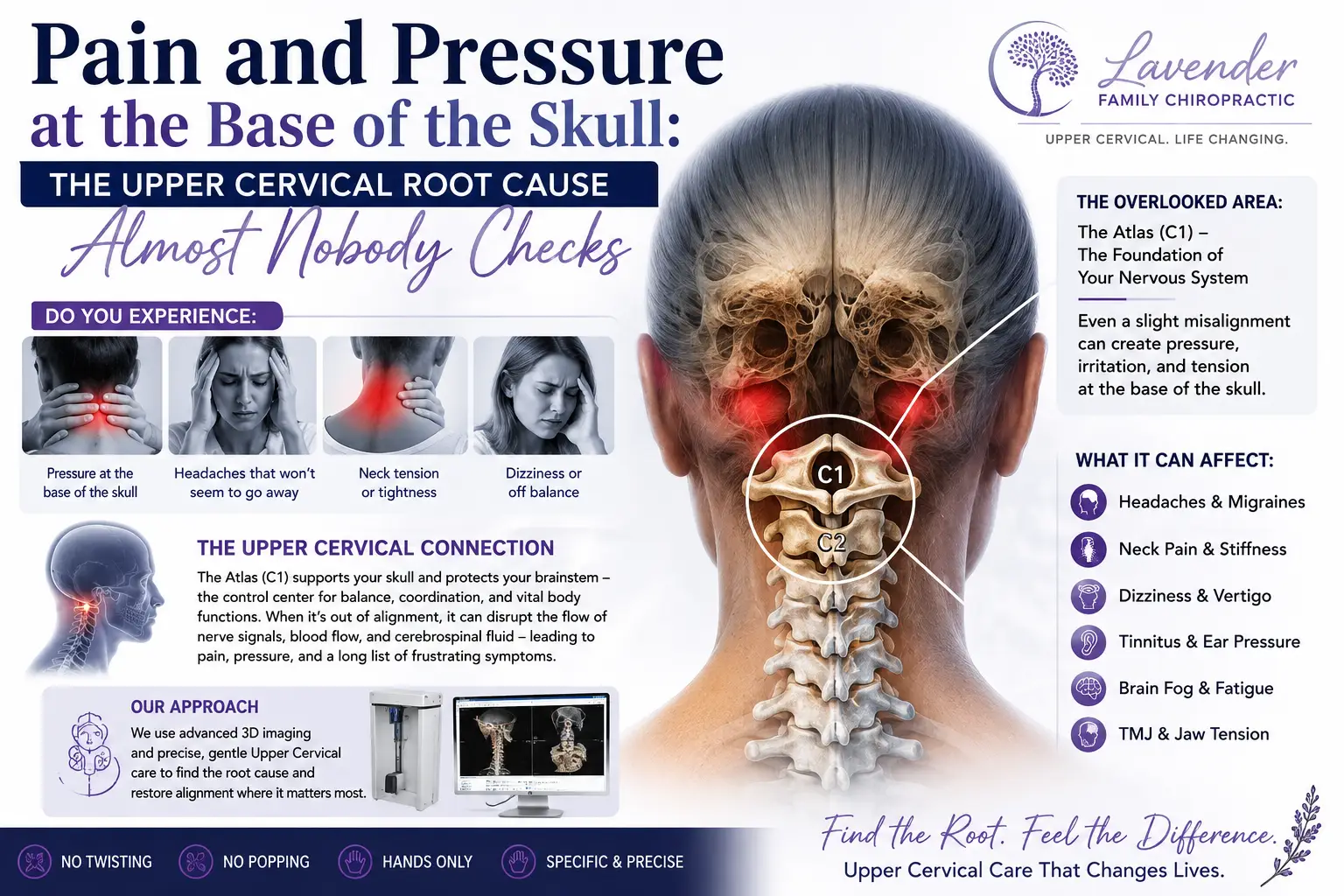
If you press your thumb into the spot where your skull meets your neck and feel a deep ache, a band of tightness, or a strange pressure that seems to push up into your head or behind your eyes, you are touching one of the most mechanically important — and most overlooked — regions in the human body. The base of the skull is not just where your neck stops and your head begins. It IS the craniocervical junction: the meeting point of the occiput, the atlas (C1), and the axis (C2), wrapped in the suboccipital muscles, threaded by the greater occipital nerve, and sitting a fraction of an inch from your brainstem. When people ask “why does the base of my skull hurt,” they are usually treated for the symptom — the headache, the tension, the pressure — while the structural driver at the top of the neck goes unexamined. That missing evaluation is what this article is about.
Pain at the base of the skull is one of the most common complaints we see, and one of the most misunderstood. It gets called a “tension headache,” a “stress knot,” or “just posture,” and people spend months on massage, painkillers, and stretches that loosen things for an afternoon and then let them tighten right back up. Here is the honest version: for a large number of people, the reason base-of-skull pain and pressure keep coming back is that the problem lives in the bones and nerves of the upper neck — the exact junction those treatments never actually address. This article explains what is really going on at the base of your skull, why the pain refers up into your head and behind your eyes, what the research says about the nerves involved, and why an upper cervical evaluation is so often the piece that has been missing.
This article is educational and not a substitute for medical advice. If you have a health condition, are pregnant, take medications, or have new or severe symptoms, talk with your physician.
What “The Base of the Skull” Actually Is — and Why It Matters
Run your fingers up the back of your neck until they meet the hard ridge of bone at the bottom of your skull. That ridge is the occiput, and just beneath it, hidden under a dense layer of muscle, is the single most complex mechanical joint system in your spine. Pay attention to this anatomy, because it is the entire point.
The base of the skull is the craniocervical junction — the place where the occiput sits on top of the atlas (C1), which in turn sits on the axis (C2). Unlike the rest of your spine, these top two vertebrae have almost no interlocking bony support and no discs between the skull and C1, or between C1 and C2 in the usual sense. They are held together and guided almost entirely by ligaments and muscles. This gives you the enormous range of motion you need to nod, turn, and tilt your head — you can look over your shoulder because of the atlas and axis. But that same freedom means the region depends heavily on precise alignment and balanced muscle tension to stay comfortable and stable.
Layered over this junction are the suboccipital muscles — four small, deep pairs of muscles that connect the skull to C1 and C2. They are postural muscles, constantly firing to keep your head balanced on your neck, and they are exquisitely rich in sensory receptors. When they are overworked, tense, or reacting to a misalignment underneath them, they generate exactly the deep, aching, pressure-like pain that so many people feel at the base of the skull.
And running right through this region is the greater occipital nerve, which arises largely from the C2 nerve root, pierces up through the suboccipital muscles, and fans out across the back and top of the scalp. Keep that nerve in mind — it is the reason base-of-skull pain so often does not stay at the base of the skull.
So when you feel pain at the base of the skull or pressure at the base of the skull, you are not feeling a vague “tension” in a random spot. You are feeling a signal from a specific, ligament-dependent, nerve-dense, muscle-covered junction that carries the weight of your head and sits inches from your brainstem. That is why it deserves a real evaluation, not a shrug.
Why Does the Base of My Skull Hurt? The Real Drivers
There is rarely a single cause, but base-of-skull pain and pressure almost always trace back to some combination of the following — and notice how many of them converge on the upper cervical spine.
Suboccipital Muscle Tension
The most immediate source of pain is usually the suboccipital muscles themselves. When these small muscles are chronically contracted — from posture, stress, screen time, or bracing against an underlying joint problem — they become tender, ropey, and painful. Because they are so densely packed with sensory receptors, even modest tension here produces an outsized ache. This is the classic “tight band at the base of the skull” feeling, and it is real. But here is the key question most treatment skips: why are these muscles locked up in the first place? Muscles that keep re-tightening after every massage are often responding to something underneath them — a misalignment at the joint they are trying to stabilize.
Atlas and Axis Misalignment
Because C1 and C2 are held largely by ligaments and balanced by those suboccipital muscles, they are the vertebrae most able to shift out of their ideal position and stay there. When the atlas or axis is misaligned, the whole junction is put under abnormal mechanical stress. The suboccipital muscles tighten to compensate, the joints load unevenly, and the surrounding tissues — including the nerves that pass through — come under tension they were never meant to carry. This is why the same spot hurts day after day: the muscles are downstream of a structural problem at the top of the neck. Addressing the muscle without addressing the alignment is treating the smoke and ignoring the fire.
Greater Occipital Nerve Irritation
When the greater occipital nerve — arising from C2 — becomes irritated or compressed as it passes up through the tense suboccipital muscles and the craniocervical junction, the result can be a sharp, shooting, burning, or electric pain that travels from the base of the skull up over the back and side of the head. This pattern is known clinically as occipital neuralgia, and it is a well-recognized consequence of trouble at exactly this region. If your base-of-skull pain sometimes zaps or shoots upward, or if your scalp feels tender or tingly, the occipital nerve is very likely part of the story. (We go deeper into this in our page on occipital neuralgia in Sarasota.)
Cervicogenic Headache
“Cervicogenic” simply means “coming from the neck.” A cervicogenic headache is a headache whose actual source is the cervical spine — most often the upper cervical joints and the C1–C3 nerves — even though the pain is felt in the head. These headaches classically start at the base of the skull and spread forward, often on one side, and they are frequently mistaken for tension headaches or even migraines. The distinguishing feature is that they are driven by the neck: certain head positions, sustained postures, or pressure on the upper cervical region can provoke or reproduce them. When the base of your skull hurts and it turns into a headache, cervicogenic headache is one of the most important possibilities to evaluate.
Forward-Head Posture
Spend hours with your head drifting forward over a phone, laptop, or steering wheel, and you dramatically increase the load on the base of your skull. For every inch the head moves forward of the shoulders, the effective weight the neck and suboccipital muscles must hold rises sharply. Forward-head posture keeps the suboccipital muscles in a state of constant contraction and shifts the mechanics of the craniocervical junction. This is one reason neck pain at the base of the skullhas become so common — our daily posture loads the exact region least equipped to tolerate it.
Whiplash and Head or Neck Trauma
A car accident, a fall, a sports collision, or any whiplash-type event delivers a sudden, violent load to the craniocervical junction. Because C1 and C2 rely on ligaments rather than bony locking, they are especially vulnerable to being knocked out of alignment and destabilized by trauma. Many people trace the onset of their base-of-skull pain and pressure to an injury — sometimes one from years earlier that was never properly evaluated at the upper neck. If your symptoms started or worsened after a head or neck injury, that is a loud signal that the structural driver may be sitting at the top of your spine. (Our overview of craniocervical instability explains why ligament integrity at this junction matters so much.)
Why It Refers Into Your Head and Behind Your Eyes
Here is the part that confuses so many people — and the part that reveals why the upper neck is so central. Why would a problem at the base of the skull cause pain over the top of the head, in the temples, or even behind the eyes? The answer is one of the most important pieces of anatomy in headache science: the trigeminocervical convergence.
In the brainstem — right there at the base of the skull — the sensory nerves from the upper cervical spine (C1, C2, and C3) share a processing center with the trigeminal nerve, the main sensory nerve of the face, forehead, and the region behind the eyes. This shared center is called the trigeminocervical nucleus. Because signals from the upper neck and signals from the face and head converge onto the same neurons, the brain can genuinely struggle to tell them apart.
The practical consequence is profound: irritation arising from the upper cervical joints and the occipital nerves can be perceived as pain in the head, the forehead, the temples, and behind the eyes — regions the trigeminal nerve serves. This is called referred pain, and it is not imaginary; it is a direct product of how these nerves are wired together at the base of the skull. It is why cervicogenic headaches and occipital nerve irritation so often masquerade as “front of the head” headaches or eye pressure, and why people chase symptoms in their forehead or eyes for years while the actual driver sits quietly at the top of the neck.
Understanding trigeminocervical convergence reframes the whole problem. That pressure behind your eyes, that band around your head, that ache in your temples — when it travels together with pain and pressure at the base of the skull, there is a strong anatomical reason to look at the upper cervical spine as the source rather than assuming the problem lives where you feel it.
What the Research Says
The connection between the upper cervical spine, the greater occipital nerve, and pain felt across the head is not a fringe idea — it is grounded in a substantial anatomical and clinical literature. A few threads worth knowing:
The anatomy of the greater occipital nerve and its relationship to the C2 nerve root and the suboccipital region has been studied in detail, clarifying exactly where and how this nerve can become entrapped or irritated as it passes from the upper neck to the scalp. Anatomical and clinical work on the greater occipital nerve and occipital neuralgia describes these pathways and their role in pain at the base of the skull and the back of the head (Cesmebasi et al., 2015 anatomy review; greater occipital nerve anatomy and clinical relevance).
Research on occipital neuralgia specifically has examined how irritation of the greater and lesser occipital nerves produces the sharp, shooting, base-of-skull-to-scalp pain pattern, and how identifying the nerve involvement guides management (occipital neuralgia clinical review). This body of work supports what we see clinically: pain that begins at the base of the skull and travels upward frequently traces to the occipital nerves and the C2 region that feeds them.
On the headache side, the literature on cervicogenic headache has established it as a distinct disorder in which upper cervical structures generate pain felt in the head, and has explored the role of the upper cervical joints and nerves as the source (cervicogenic headache mechanisms and diagnosis; cervicogenic headache clinical features). The concept of trigeminocervical convergence — the shared brainstem processing that lets neck-derived signals be felt as head and facial pain — is a recurring theme in this research and is central to understanding referred head pain (convergence and referred head pain).
Taken together, these studies point in one consistent direction: the upper cervical spine, the C2 nerve root, and the occipital nerves are legitimate, well-documented sources of pain and pressure at the base of the skull and across the head. They do not prove that any single treatment is a cure, and we would never claim one. What they establish is that the region deserves to be evaluated — and that is precisely what so often gets skipped.
Why Upper Cervical Evaluation Is the Missing Piece
Step back and look at the pattern. The base of the skull is the craniocervical junction. The muscles that ache there attach to C1 and C2. The nerve that shoots pain up your scalp arises from C2. The headaches that start there are driven by the upper cervical joints. The pressure behind your eyes is referred from the upper neck through convergence at the brainstem. Whiplash, forward-head posture, and old injuries all load this exact junction. Every major thread runs back to the same place — the top of the neck.
And yet, in most people’s workup, that is the one place no one examines with any precision. They get told it is stress, or posture, or a tension headache. They get a massage that helps for a day. They get a prescription that dulls the pain without touching the source. They stretch, they use a heating pad, they buy a better pillow — and the pain and pressure keep coming back, because the structural driver at the craniocervical junction was never identified or addressed.
This is the gap. Not because those other approaches are worthless — good posture, stress management, and appropriate medical care all matter — but because for a meaningful number of people, they are treating the symptom while the mechanical cause at the upper neck goes unexamined. An upper cervical evaluation asks the question none of them ask: is the atlas or axis misaligned? Is the craniocervical junction under abnormal stress? Is the suboccipital region tight because it is compensating for something underneath it? Is the occipital nerve being irritated where it passes through? Those are answerable questions — but only if someone actually looks. (This is the entire focus of our approach to upper cervical chiropractic care and to neck pain that centers at the base of the skull.)
None of this replaces your physician, and it does not mean the neck is the answer for everyone. It means that when pain and pressure at the base of the skull will not settle, the upper cervical spine is the driver most worth evaluating — and it is the one that usually gets left out.
How We Evaluate the Base of the Skull at Lavender Family Chiropractic
At Lavender Family Chiropractic (NeckWise North Sarasota), we focus exclusively on the upper cervical spine — the occiput, the atlas, the axis, and the craniocervical junction where the base of the skull meets the neck. This is the region this entire article is about, and it is the only region we work on, because getting it right requires specialized attention rather than a general approach.
Our work is built on measurement, not guesswork. We use 3D CBCT imaging (cone-beam computed tomography) to see your upper cervical alignment in three dimensions, so that any misalignment of the atlas or axis is measured precisely rather than estimated. We use paraspinal infrared thermography to read how your nervous system is behaving along the spine — directly relevant when the question involves nerves like the greater occipital nerve and the sensitive junction at the base of your skull. Together, these give us an objective picture of what is actually happening at your craniocervical junction.
When a correction is warranted, we use the Knee Chest Upper Cervical technique: precise, gentle, and low-force, with no twisting, no cracking, and no popping. For an already irritated region at the base of the skull — tender muscles, an aggravated nerve, a stressed junction — that gentleness is not a marketing line; it is the whole approach. The goal is to give the craniocervical junction a calmer, better-aligned structural environment so the suboccipital muscles can stop bracing and the nerves passing through can stop being provoked.
Keep your physician. Keep good posture and stress management. What we add is a careful look at the one region that sits at the crossroads of every driver of base-of-skull pain — the upper cervical spine — using imaging and measurement, and a correction that is gentle enough for a region this sensitive.
→ Call Lavender Family Chiropractic at (941) 243-3729 to schedule a complimentary consultation. We are at 5899 Whitfield Avenue, Suite 107, Sarasota, FL 34243 — corner of University and Whitfield.
Red Flags: When Base-of-Skull Pain Needs Urgent Care
Most pain and pressure at the base of the skull is mechanical and not dangerous — but not all of it. Some symptoms can signal a serious medical emergency, and you should not wait, stretch, or “see if it passes.” Seek emergency care immediately if base-of-skull pain or pressure comes with any of the following:
- A sudden, severe “thunderclap” headache — the worst headache of your life, coming on in seconds to a minute. This can signal bleeding around the brain and is a medical emergency.
- Fever together with a stiff neck, especially if you also feel very ill, are sensitive to light, or are confused — this combination can indicate meningitis.
- Neurological changes — weakness, numbness, difficulty speaking, vision loss, trouble walking, loss of coordination, drooping on one side of the face, or confusion.
- Recent head or neck trauma with worsening headache, vomiting, drowsiness, or any of the above — particularly a significant fall or car accident.
- A headache that is new and severe in someone over 50, a headache that steadily worsens over days, or one that wakes you from sleep or is dramatically worse with coughing, straining, or lying down.
If any of these apply, call 911 or go to the nearest emergency department. Upper cervical evaluation is for ongoing, recurring, mechanical pain and pressure — not for a sudden emergency. When in doubt, get checked by a physician first.
Top Questions
Why does the base of my skull hurt? Most often it is a combination of tight suboccipital muscles, misalignment of the atlas (C1) or axis (C2), and sometimes irritation of the greater occipital nerve that arises from C2. Because these top vertebrae are held mostly by ligaments and carry the full weight of your head, they are prone to strain from posture, stress, and old injuries — and the muscles and nerves at the base of the skull register that strain as deep ache, tightness, or pressure. When it keeps coming back, the driver is usually at the upper cervical junction rather than in the muscle alone.
What causes pressure at the base of the skull that pushes up into my head? That pushing, expanding pressure often comes from suboccipital muscle tension combined with irritation traveling along the occipital nerves, and from referred pain through the trigeminocervical convergence in the brainstem. Because upper-neck nerves share a processing center with the nerves of the head and face, tension at the base of the skull can be felt as pressure spreading upward and even behind the eyes.
Why do I feel it behind my eyes if the pain is in my neck? Because of trigeminocervical convergence. The sensory nerves from your upper neck (C1–C3) share a brainstem center with the trigeminal nerve, which serves your face and the area behind your eyes. Signals from the neck can be perceived by the brain as pain behind the eyes or in the forehead. It is genuine referred pain, and it is a major reason upper cervical problems are mistaken for other kinds of headaches.
Is neck pain at the base of the skull the same as a tension headache? Not necessarily, and that distinction matters. What gets labeled a “tension headache” is frequently a cervicogenic headache — a headache actually driven by the upper cervical spine — or occipital nerve irritation. Both start at the base of the skull. The difference is that these are driven by the neck, which means evaluating the upper cervical spine can identify a source that stress-and-tension explanations miss.
Could my old car accident be causing this? Very possibly. Whiplash and other head or neck trauma can knock the ligament-dependent atlas and axis out of alignment and destabilize the craniocervical junction, sometimes years before symptoms fully surface. If your base-of-skull pain began or worsened after an injury, the upper cervical spine is a driver worth evaluating rather than assuming.
Is the adjustment forceful? Will you crack my neck? No. Our Knee Chest Upper Cervical technique is precise, gentle, and low-force, with no twisting, cracking, or popping. For a sensitive, already-irritated region at the base of the skull, that gentleness is the point.
Is this a substitute for medical care? No. This article is educational. If you have new, severe, or worsening symptoms, any of the red flags listed above, a diagnosed condition, are pregnant, or take medication, work with your physician. Upper cervical care complements good medical care — it does not replace it.
Serving Sarasota, Bradenton & Lakewood Ranch
If you have pain and pressure at the base of your skull that keeps coming back — and you are anywhere around Sarasota, Bradenton, or Lakewood Ranch — the upper cervical evaluation you have been missing is close by. Lavender Family Chiropractic (NeckWise North Sarasota) sits at 5899 Whitfield Avenue, at the corner of University and Whitfield, minutes from the Lakewood Ranch corridor and just across from Bradenton, so patients from all three communities reach us easily. We regularly care for people from Sarasota, Bradenton, and Lakewood Ranch, as well as neighbors coming from Venice, Osprey, Port Charlotte, Parrish, and Myakka. Wherever you are in the region, we evaluate the craniocervical junction at the base of your skull using 3D CBCT imaging and paraspinal infrared thermography, so the real driver of your pain is measured rather than guessed.
Whether you live in Sarasota, work in Lakewood Ranch, or are coming from Bradenton, the base of your skull deserves a real look at the one region every major cause of this pain runs back to — the upper cervical spine.
Look at the Root, Not Just the Ache
Pain and pressure at the base of the skull is one of the most common complaints there is, and one of the most consistently mislabeled. It gets called stress, posture, or a tension headache, and it gets treated at the surface — while the region that actually drives it, the craniocervical junction where the occiput meets C1 and C2, goes unexamined. But when you follow the anatomy, everything converges on the same place: the suboccipital muscles that attach there, the greater occipital nerve that arises from C2, the cervicogenic headaches driven by the upper cervical joints, and the referred pressure behind your eyes explained by convergence in the brainstem.
If you have chased this pain with massage, medication, and stretches and it keeps returning, do not assume you are stuck with it. Ask the question the usual workup skips: is the upper cervical spine — the base of your skull itself — the driver that no one has actually evaluated? For a great many people, that structural piece is exactly what has been missing.
Let us look at the region every thread leads back to. Call (941) 243-3729 or book a complimentary consultation. Find the root of the pain and pressure at the base of your skull — and stop chasing the ache. (You can also read more about how upper cervical care relates to migraines that begin at the base of the skull.)
Lavender Family Chiropractic (NeckWise North Sarasota) · 5899 Whitfield Avenue, Suite 107, Sarasota, FL 34243 · (941) 243-3729
This article is for general educational purposes only and is not medical advice, diagnosis, or treatment. Please consult your physician before making changes to your health routine, especially if you have a medical condition, are pregnant, take medication, or have new, severe, or worsening symptoms.