Itchy Inside of the Elbow vs. Outside: Eczema or a Nerve Problem? How to Tell, and Why the Neck Matters
By Dr. Rusty Lavender, D.C. and Dr. Jacob Temple, D.C. — upper cervical chiropractors, Lavender Family Chiropractic, Sarasota, FL. Published October 2026.
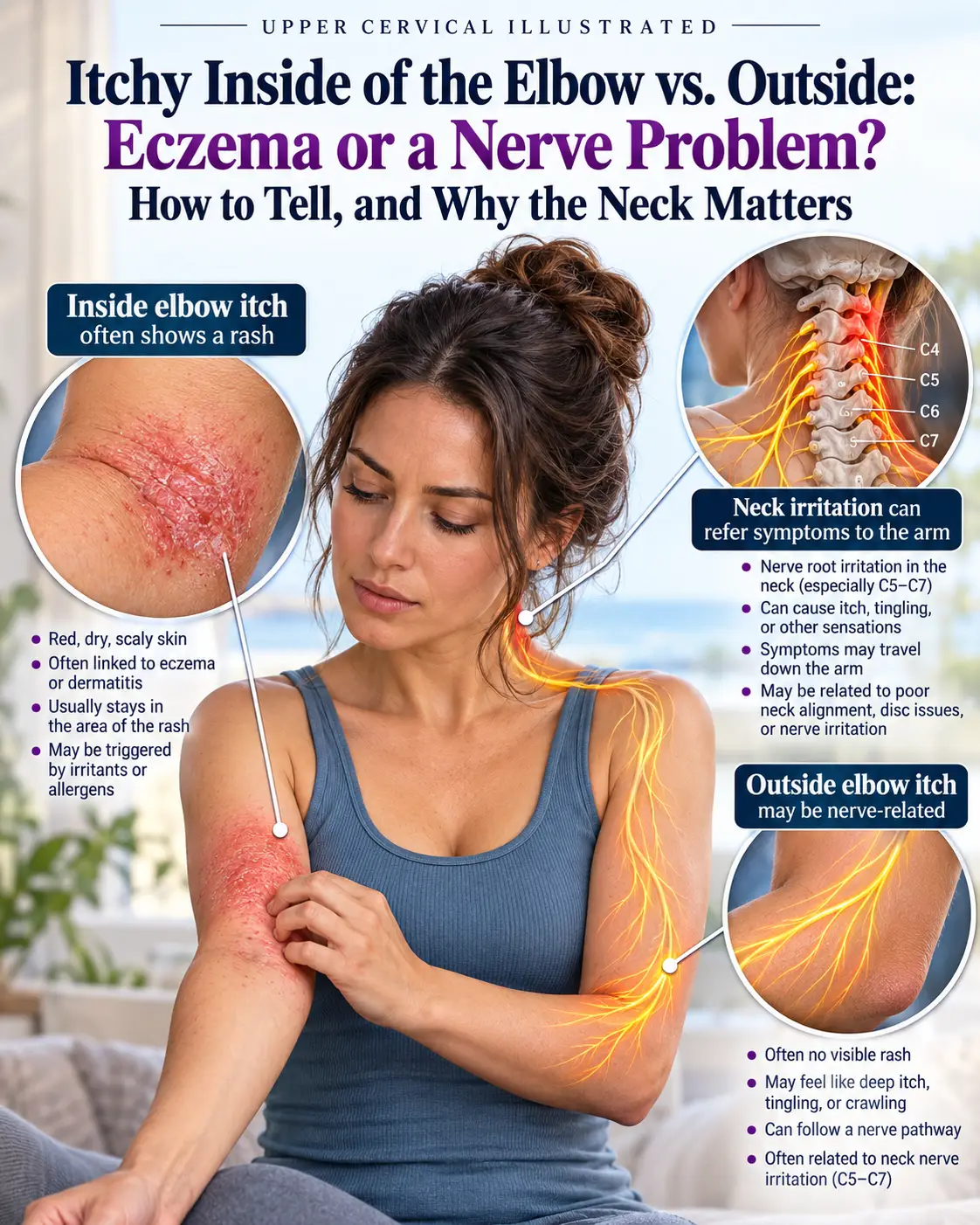
“My elbow itches” sounds like one complaint. It’s actually two very different ones, and the difference is a matter of inches. An itch inside the elbow — the soft crease where your arm bends — is usually a skin problem, most often eczema. An itch on the outside of the elbow and down the forearm, with nothing visible on the skin, is usually a nerve problem called brachioradial pruritus, and its source is almost always the neck. They have different causes, different treatments, and different specialists. Because they share the word “elbow,” people spend months — sometimes years — treating one as if it were the other.
This article tells them apart. It covers the anatomy of the two locations and why different conditions land in each; what eczema in the crease looks and behaves like; what nerve itch on the outer forearm looks and behaves like; the research that traces the outer-elbow itch to the cervical spine; what happens when a person has both at once; and what to do about each — including the upper cervical evaluation that addresses the source of the nerve itch.
This is educational content, not medical advice. A rash that is weeping, crusted, spreading rapidly, or accompanied by fever needs medical attention.
Start With Where It Itches
Stand with your arm hanging at your side, palm facing forward.
The inside of the elbow is the crease facing forward — the spot where blood is drawn. Doctors call it the antecubital fossa. The skin here is thin, warm, folds against itself when you bend your arm, and sweats. It is one of the body’s classic “flexural” areas, along with the backs of the knees, the neck folds, and the wrists.
The outside of the elbow is the bony point facing backward and the strip of forearm running from it toward the thumb side of the wrist — the part that gets sun when you drive with your arm on the window, and the part that faces the sky when you garden.
These two patches of skin are a few inches apart, but they are supplied by different nerves, exposed to different things, and prone to different conditions. Where it itches is your first and best clue to what it is.
Itchy Inside the Elbow: Usually Eczema
The inside of the elbow is one of the textbook locations for atopic dermatitis — eczema. It’s the same reason the backs of the knees itch in the same people: skin folds trap heat and sweat, rub against themselves with every movement, and the skin barrier in those areas is easily disrupted. Weidinger and Novak (2016), in a review in The Lancet, describe this flexural pattern as typical of atopic dermatitis in older children and adults: itchy, red, dry or scaly patches in the creases, often in people with a personal or family history of eczema, asthma, or hay fever.
What it looks like. Redness, dryness, flaking, sometimes small bumps, sometimes thickened leathery skin from repeated scratching. In darker skin the redness may read as darker brown or gray. There is almost always something to see, even if it’s subtle — and the itch and the rash arrive together.
What it feels like. Itch, sometimes with stinging, especially after sweating or showering. It tends to flare with heat, with dry indoor air in winter, with certain soaps and lotions, and with stress.
What else it can be. Contact dermatitis from a lotion, soap, deodorant residue, or fabric; heat rash in Florida summers; a fungal infection in the fold; or, less often, psoriasis. All of these are skin conditions, and a dermatologist is the right person to sort them.
What works. This is histamine-and-inflammation itch, so the usual tools apply — moisturizing to repair the barrier, avoiding the trigger, and, when a physician prescribes them, topical steroids or other anti-inflammatory creams. Antihistamines may take the edge off at night. This is the kind of itch those treatments were made for, and when they work, that in itself tells you the problem was in the skin.
Itchy Outside the Elbow and Forearm: Usually a Nerve
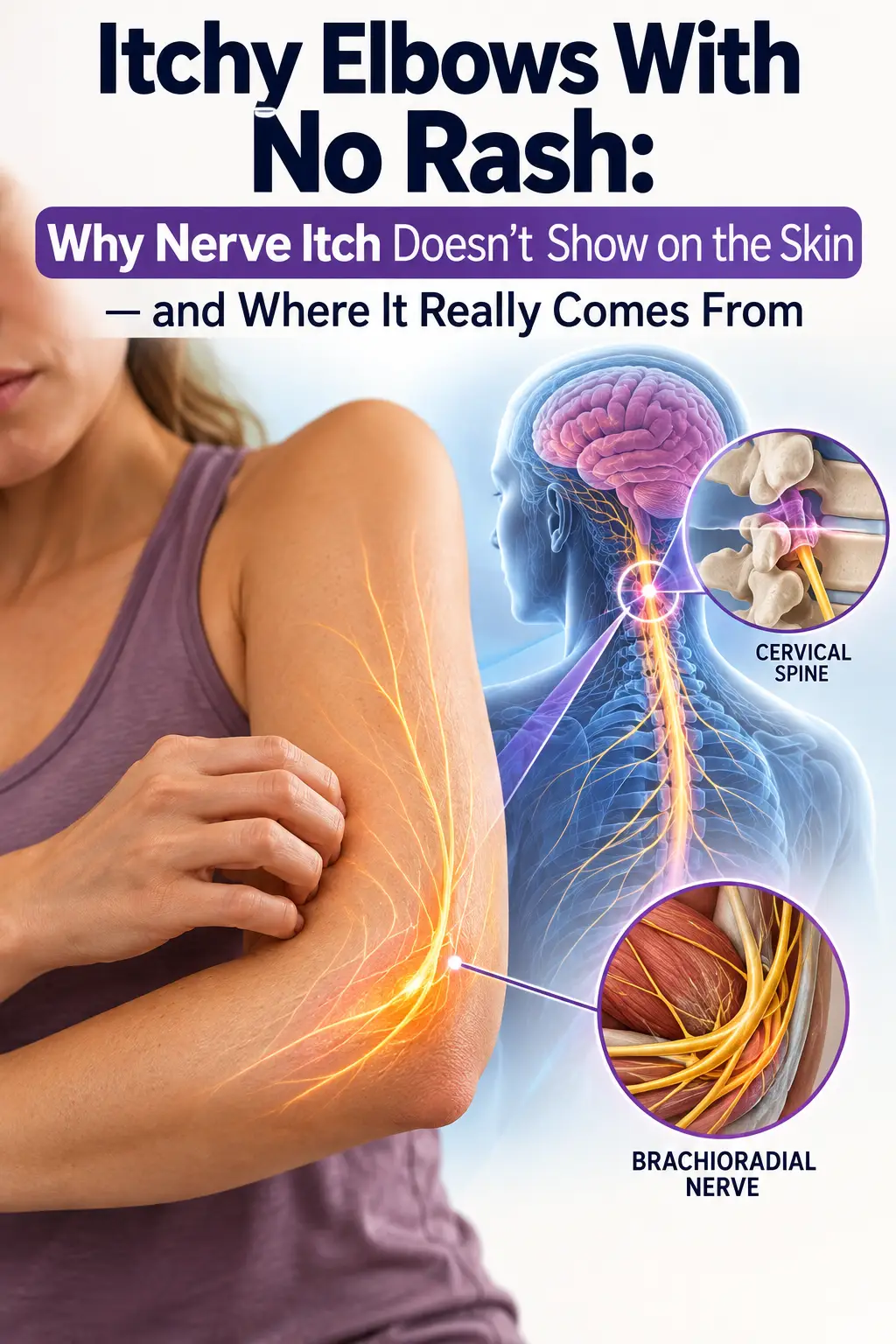
Now the other location. An itch on the outside of the elbow and along the sun-exposed forearm, with no rash before you scratched it, is the signature of brachioradial pruritus (BRP) — a nerve itch, not a skin itch.
The research is consistent on this. Cohen and colleagues (2003) described BRP as “a symptom of neuropathy” and documented nerve-conduction findings in patients. Wallengren and Sundler (2005) biopsied the itchy skin and found reduced small-nerve-fiber density — the skin’s nerves were being affected from upstream — that normalized when symptoms remitted. A rash adds inflammation to the skin; BRP thins out its nerve supply. They are opposite processes.
What it looks like. Nothing, until you scratch. Then scratch marks, sometimes darkened or thickened skin from years of it. People often say “I know it looks fine. I promise it isn’t.”
What it feels like. Itch mixed with tingling, burning, pins-and-needles, or a crawling sensation. Worse in summer and after sun. Worse in the evening and at night. And relieved almost instantly by cold — the ice-pack sign described by Bernhard and Bordeaux (2005), which is specific enough to BRP that physicians use it to confirm the diagnosis. Our article on the ice-pack sign explains it.
What else it can be. Occasionally a true skin condition on the outer forearm — sun-induced dermatitis, a reaction to sunscreen — but those show a rash. If the skin is normal, the list of alternatives is short.
What doesn’t work. The eczema tools. Antihistamines and steroid creams are aimed at the skin, and the skin isn’t the problem — our article on why they don’t work for BRP explains the mismatch. If you’ve applied steroid cream to the outside of your elbow for weeks with no change, that’s information, not failure.
Where the Outer-Elbow Itch Comes From: The Cervical Spine
Follow the nerves of the outer forearm backward and you arrive at the neck. The skin of the outer elbow and forearm is supplied by the fifth and sixth cervical nerve roots — C5 and C6 — which exit the spine in the lower neck and travel through the shoulder down the arm.
Marziniak and colleagues (2011) performed MRI on BRP patients and found cervical spine changes — disc protrusions, degenerative narrowing, nerve root involvement — in the large majority, with the spinal level matching the itchy area in most. Goodkin, Wingard, and Bernhard (2003) reached the same conclusion clinically. The nerve is being irritated at the neck, and the brain reads the signal as itch on the arm — the same mechanism by which a pinched nerve in the neck causes tingling in the hand.
This is the fundamental difference between the two elbow itches. Eczema in the crease is a local problem with a local cause. Nerve itch on the outside is a referred problem — felt in the arm, generated in the neck. Our article on what a cervical MRI shows in brachioradial pruritus goes through the imaging in detail.
The Upper Cervical Connection
Our office looks higher than C5–C6, and here’s why.
The cervical spine is organized from the top down. The atlas (C1) and axis (C2) carry the head and determine how the vertebrae below line up. When the atlas is misaligned, the head sits off-center and the lower neck compensates — the curve flattens or reverses, the lower discs take uneven load, and over years the openings where the C5 and C6 roots exit change shape. The degenerative changes the MRI studies describe at the lower neck develop in a spine that’s been carrying its load unevenly.
The upper cervical spine also sits against the brainstem, the relay through which every itch signal passes on its way to the brain and which acts as a volume control on those signals. The small muscles and joints of the upper neck feed the brainstem a constant stream of input. Irritation at the top of the neck can turn the gain up on a signal from below, so a mildly irritated C6 root is heard as a relentless itch.
An upper cervical evaluation for outer-elbow nerve itch therefore asks two things: is the top of the neck positioned in a way that’s loading the lower neck unevenly, and is the nervous system at the upper neck showing irritation? Both are measurable.
Side by Side
| Inside the elbow (crease) | Outside the elbow and forearm | |
|---|---|---|
| Usual cause | eczema / dermatitis (skin) | brachioradial pruritus (nerve) |
| Where the problem lives | the skin itself | the cervical spine |
| Visible rash | yes — red, dry, scaly, bumpy | no, until scratched |
| Sensation | itch, sometimes stinging | itch + tingling, burning, crawling |
| Pattern | flares with heat, sweat, irritants, dry air | flares with sun; worse in summer and at night |
| Ice pack | mild relief, like any itch | dramatic, near-instant relief |
| Antihistamines / steroid cream | often help | usually don’t |
| Who sorts it | dermatologist | cervical imaging; upper cervical evaluation |
When It’s Both
It happens, and it’s the main reason the two get confused.
Nerve itch that grows a rash. Years of scratching a nerve itch on the outer forearm damages the skin barrier and adds a layer of true dermatitis on top. Now there is a rash, the steroid cream helps a little, and everyone concludes it was eczema all along. The tell is that the itch outlasts the rash: the skin clears and the itching continues. If that’s your story, the rash was a consequence, not the cause, and the nerve still needs attention.
Eczema and BRP in the same arm. Eczema in the crease plus unrelated nerve itch on the outer forearm. Treat each as what it is — the crease with skin care, the outer forearm with cold, sun protection, and a neck evaluation.
One itch, two sensations. Some people describe the outer-forearm itch as starting deep and “coming to the surface,” then the surface skin getting dry and itchy from scratching. That’s nerve first, skin second.
Upper Cervical Care at Lavender Family Chiropractic
When someone with outer-elbow nerve itch comes to our Sarasota office, the first visit is an evaluation, not an adjustment.
History and examination. The pattern of the itch — where exactly, when, what triggers it, what helps — and the ice-pack response. We confirm the skin is normal and screen for anything that belongs with a physician.
Neurological examination. Reflexes, strength, and sensation by nerve root, so we know whether C5–C6 are showing signs beyond the itch.
Paraspinal infrared thermography. A non-invasive scan of the heat pattern along the spine, reflecting nervous-system activity. It gives us an objective baseline of nervous-system irritation and a way to track change visit to visit.
3D cone-beam CT (CBCT) imaging of the upper cervical spine. This shows the position of the atlas and axis relative to the skull in three dimensions and to the degree — information a flat X-ray can’t give and an MRI doesn’t address. If your physician has already imaged your neck, bring it; the two studies answer different questions.
Review of findings before any care.
Correction, if indicated. If the imaging shows a measurable misalignment of the upper cervical spine, we correct it with a precise, low-force procedure specific to your measurements — no twisting, no cracking, no rotation of the neck. Most patients describe it as pressure.
Remeasurement. Thermography after each visit and follow-up imaging when indicated.
Upper cervical care addresses the mechanical source the research points to — the neck — with measurement before and after, so progress is objective rather than guessed at. Results vary from person to person, and we tell you plainly what the findings show.
If the outside of your elbow itches and the creams haven’t helped, call (941) 243-3729 or request an appointment onlinefor an upper cervical evaluation.
What the Research Says
Inside-the-crease itch is a skin condition. Weidinger and Novak (2016) describe the flexural pattern of atopic dermatitis and its barrier-and-inflammation mechanism.
Outside-the-elbow itch is a nerve condition. Cohen and colleagues (2003) documented neuropathic findings in BRP. Wallengren and Sundler (2005) showed reduced nerve-fiber density in the skin that recovered in remission.
The source is the cervical spine. Marziniak and colleagues (2011) found cervical changes on MRI in the large majority of BRP patients at levels matching the itch. Goodkin, Wingard, and Bernhard (2003) proposed cervical spine disease as the mechanism.
Cold distinguishes them. Bernhard and Bordeaux (2005) described the ice-pack sign.
Managing Each Day to Day
For the crease (eczema): fragrance-free moisturizer twice daily; lukewarm rather than hot showers; cotton over synthetics; identify and remove the trigger product; prescribed anti-inflammatory cream during flares; see a dermatologist if it isn’t settling.
For the outer forearm (nerve itch): refrigerated gel packs or cooling gel for flares; no scratching — short nails, cold within reach; sun protection on the forearms with sleeves or UPF arm covers, especially while driving (our article on sun exposure and BRP covers the Florida problem); a cool bedroom and bare forearms at night; a pillow that holds the neck neutral; and a neck evaluation for the source.
For both: moisturize the outer forearm too, since scratched skin becomes dry skin, but understand that moisturizer treats the secondary problem, not the nerve.
For more on the outer-elbow itch specifically, see itchy elbows with no rash and why won’t my elbow stop itching. Our full brachioradial pruritus guide ties it together.
Serving Sarasota, Bradenton, Lakewood Ranch, and the Suncoast
Our office is on Whitfield Avenue in north Sarasota, minutes from the Manatee County line, and we see patients from Sarasota, Bradenton, Lakewood Ranch, Palmetto, Parrish, Ellenton, Longboat Key, Siesta Key, Osprey, Nokomis, Venice, and North Port. Both elbow itches are common here — eczema because of our humidity and heat, nerve itch because of our sun. If yours is on the outside of the elbow and nothing has worked, the upper neck is the piece that hasn’t yet been examined.
Top 15 FAQs About Inside vs. Outside Elbow Itch
1. Why does the inside of my elbow itch? Most often eczema (atopic dermatitis), which favors skin folds. Heat, sweat, friction, and irritants in soaps or lotions are common triggers. A dermatologist can confirm it.
2. Why does the outside of my elbow itch with no rash? That’s the pattern of brachioradial pruritus — a nerve itch, traced in most patients to the cervical spine and triggered by sun.
3. Can eczema have no rash? Rarely. Eczema almost always shows something — redness, dryness, scaling. Persistent itch with truly normal skin points toward a nerve cause.
4. Why does my elbow itch worse at night? Both kinds worsen at night. Skin itch worsens because skin temperature rises and the barrier leaks more overnight; nerve itch worsens for those reasons plus fewer distractions and, often, a sleeping position that aggravates the neck.
5. Can I have both at once? Yes, and chronic scratching of a nerve itch often creates a secondary skin rash. If the itch outlasts the rash, the nerve is the primary problem.
6. Does a pinched nerve in the neck cause itching only on the outside of the arm? The outer forearm is supplied by the C5–C6 nerve roots, which is why BRP lands there. Irritation of other roots produces symptoms in other territories.
7. Should I see a dermatologist first? For an inside-the-crease itch with a rash, yes. For an outside-the-elbow itch with no rash, a dermatologist can confirm the skin is normal, but the answer is in the neck.
8. Why does ice help the outside but not the inside? Cold overrides nerve-itch signals at the spinal cord, which is why it’s so dramatic for BRP. Skin itch responds to cold only mildly, like any itch.
9. My steroid cream helped a little on the outside of my elbow. Doesn’t that mean it’s eczema? Not necessarily. If years of scratching have added dermatitis on top of a nerve itch, the cream treats that layer. If the itch continues after the skin clears, the nerve is the source.
10. Is sunscreen on the forearms enough? Sunscreen helps, but for BRP physical coverage — sleeves or UPF arm covers — is more reliable, because it’s the UV reaching the sensitized nerve endings that matters.
11. Does the neck have to hurt for it to be the cause? No. Most BRP patients have no neck pain. The irritation is enough to produce itch, not enough to produce pain.
12. Is upper cervical care safe if I have a disc problem in my neck? The procedure we use involves no rotation or thrust, and we image before any care. If the imaging shows something that needs a surgeon or neurologist instead, we say so.
13. How soon would I notice a difference? When the upper neck is a factor and it’s corrected, patients typically report changes in itch intensity within the first several weeks, with nights improving first.
14. Can children get these? Eczema in the crease is very common in children. Brachioradial pruritus is rare before middle age because it tracks with cervical disc changes that develop over time.
15. Do you take insurance? Call the office and we’ll go through costs and coverage before anything begins.
Lavender Family Chiropractic in Sarasota, Florida offers a thorough upper cervical evaluation to find out whether we can help. Call (941) 243-3729 or request an appointment. 5899 Whitfield Avenue, Suite 107, Sarasota, FL 34243.
Related Articles
- Brachioradial Pruritus: Our Complete Guide
- Itchy Elbows With No Rash
- Why Won’t My Elbow Stop Itching?
- The Ice-Pack Sign
- Why Antihistamines and Steroid Creams Don’t Work for BRP
- Brachioradial Pruritus and Sun Exposure
References
- Weidinger S, Novak N. Atopic dermatitis. Lancet. 2016. PMID 26377142
- Cohen AD, et al. Brachioradial pruritus: a symptom of neuropathy. J Am Acad Dermatol. 2003. PMID 12789170
- Wallengren J, Sundler F. Brachioradial pruritus is associated with a reduction in cutaneous innervation that normalizes during the symptom-free remissions. J Am Acad Dermatol. 2005. PMID 15627097
- Marziniak M, et al. Brachioradial pruritus as a result of cervical spine pathology: the results of a magnetic resonance tomography study. J Am Acad Dermatol. 2011. PMID 21641675
- Goodkin R, Wingard E, Bernhard JD. Brachioradial pruritus: cervical spine disease and neurogenic/neuropathic pruritus. J Am Acad Dermatol. 2003. PMID 12664013
- Bernhard JD, Bordeaux JS. Medical pearl: the ice-pack sign in brachioradial pruritus. J Am Acad Dermatol. 2005. PMID 15928630