Vestibular Migraine and Neck Pain: Why They Travel Together — and What the Upper Neck Has to Do With It
By Dr. Rusty Lavender, D.C. — upper cervical chiropractor, Lavender Family Chiropractic, Sarasota, FL. Reviewed and updated October 2026.
Ask a room full of people with vestibular migraine where their neck is during an attack and most of them will reach for the base of their skull. Stiff. Tight. Aching. Some feel it before the dizziness starts — the neck tightens, and they know what’s coming. Some feel it during. Some are left with a sore, locked neck for a day after the spinning stops. And almost all of them have been told the neck pain is “just tension” or “just from the migraine,” as if it were a side effect rather than a clue.
It’s a clue. This article explains why vestibular migraine and neck pain travel together so reliably: the shared wiring between the upper neck and the migraine system, the shared wiring between the upper neck and the balance system, what the research says about neck pain as a migraine trigger, how to tell whether your neck is a cause or a consequence, and what an upper cervical evaluation adds that neither the neurologist’s nor the ENT’s workup includes.
This is educational content, not medical advice. Sudden severe neck pain with fever, stiff neck and headache, or neck pain with weakness, numbness, or trouble speaking needs immediate medical attention.
What Vestibular Migraine Is
Vestibular migraine is migraine that affects the balance system. Instead of — or in addition to — head pain, the migraine process produces vertigo, unsteadiness, motion sensitivity, and visual sensitivity, in episodes lasting minutes to hours. The diagnostic criteria by Lempert and colleagues (2012) require a migraine history and migraine features during at least half the episodes; the headache itself is optional. It affects about one percent of people over a lifetime, according to Neuhauser and colleagues (2006), and most go undiagnosed for years. Our vestibular migraine guide covers the condition in full.
What the criteria don’t mention — and what patients mention constantly — is the neck.
How Common Is Neck Pain in Migraine?
Very. In the largest study of migraine triggers, Kelman (2007) surveyed over 1,200 migraine patients and found that neck pain was reported as a trigger by roughly four in ten. It sat alongside stress, hormonal changes, skipped meals, weather, and sleep disturbance as one of the most frequently named precipitants. Neck pain is also one of the most common symptoms during migraine attacks, often more common than nausea, and many patients experience it in the hours before an attack as part of the warning phase.
In vestibular migraine specifically, Beh and colleagues (2019) characterized the clinical features, triggers, and examination findings in a large series of patients and described a condition with wide-ranging symptoms well beyond spinning — unsteadiness, motion sickness, visual sensitivity, head pressure — set off by a familiar list of triggers. Patients with vestibular migraine, in our experience, report neck symptoms at least as often as patients with classic migraine, and often more, because the neck is involved in balance as well as pain.
So the association is real and documented. The question is why.
Why They Travel Together: Shared Wiring, Part One — Pain
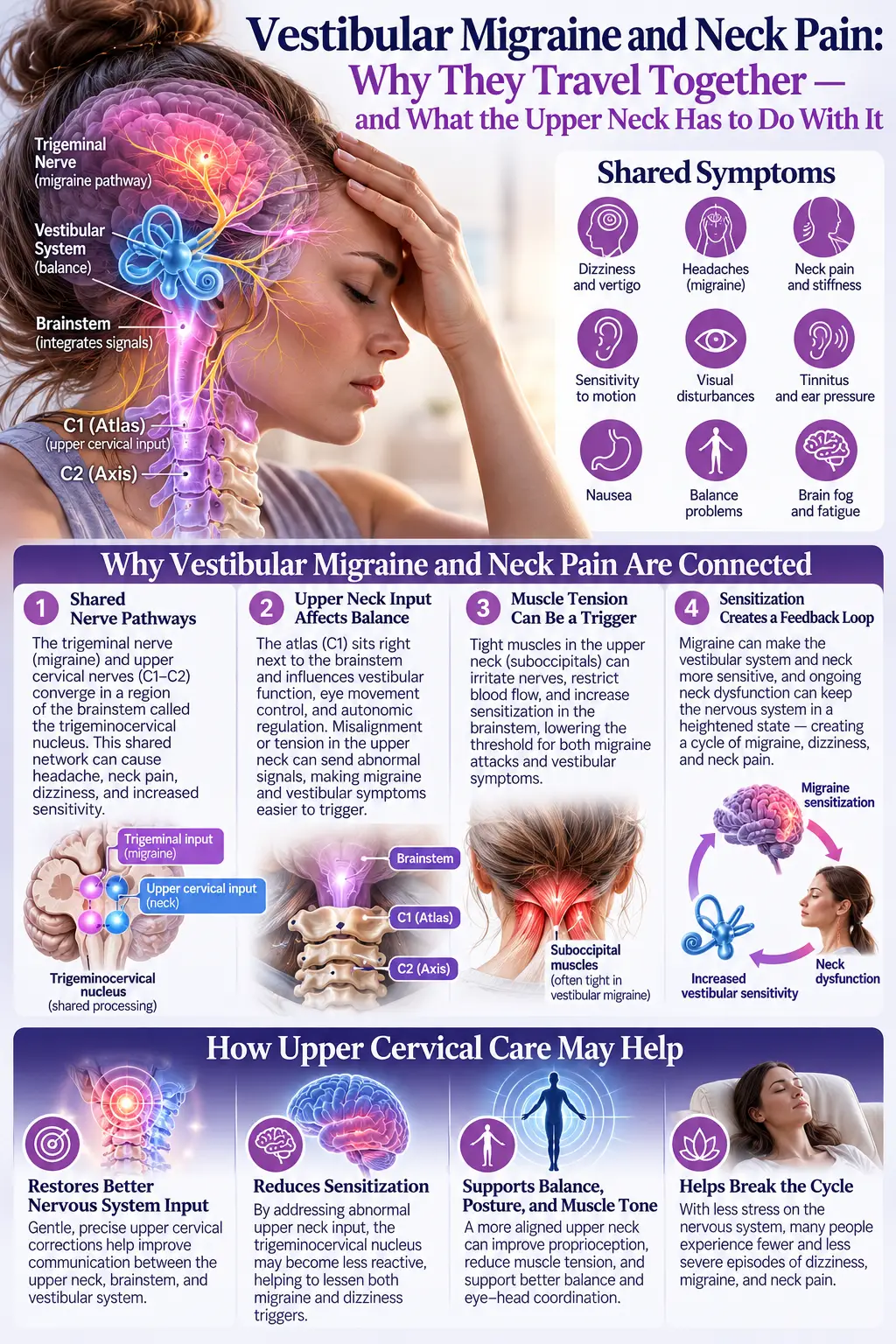
The nerves that carry pain from the upper neck and the nerves that carry pain from the head and face converge on the same cluster of cells in the brainstem. Anatomists call it the trigeminocervical complex. The trigeminal nerve brings in sensation from the face, scalp, and the coverings of the brain; the upper cervical nerve roots (C1, C2, C3) bring in sensation from the top of the neck and the back of the head. They meet in the same relay cells, which can’t tell the two sources apart.
Bartsch and Goadsby (2003) laid out the consequences in their review of the trigeminocervical complex and migraine. Input from the upper neck can activate the same brainstem cells that generate migraine pain, so an irritated upper neck can push a migraine-prone brain toward an attack. And once the migraine process is running, it sensitizes those shared cells, so the neck feels painful even if nothing has changed in the neck — the brainstem is amplifying everything that arrives. The neck pain before an attack and the neck pain during an attack are the same circuit seen from two directions.
This is why “it’s just tension” is wrong. The neck isn’t a bystander that happens to tense up. It’s plugged into the migraine generator.
Shared Wiring, Part Two — Balance
Here is the part that’s specific to vestibular migraine.
Your brain builds its sense of head position from three inputs: the inner ear, the eyes, and the neck. The upper cervical spine — the atlas and axis and the small muscles around them — carries one of the densest concentrations of position sensors in the body. That input converges in the brainstem with the signals from the ears and the eyes, and the brain expects all three to agree. Kristjansson and Treleaven (2009) reviewed how disturbed cervical input produces dizziness, unsteadiness, and altered eye-movement control on its own. Treleaven and colleagues (2003) measured it in whiplash patients: the dizzy ones had significantly worse head-position sense.
Now put that in a migraine brain. Furman and colleagues (2013) describe vestibular migraine as a disorder in which the balance-processing circuits become unstable during a migraine event — they over-respond, mis-weight the inputs, and generate vertigo. If one of those inputs, the neck, is sending distorted position data because the upper neck is misaligned or irritated, the conflict the brain has to resolve is bigger, and the threshold for an attack is lower. The neck doesn’t just hurt during vestibular migraine; it feeds the dizziness.
Cause or Consequence? How to Tell
Patients ask whether the neck pain is causing the migraines or the migraines are causing the neck pain. Usually it’s both, in a loop, but the pattern gives clues:
The neck is likely a driver if: the neck pain or stiffness comes first, hours or a day before the dizziness; attacks are provoked by neck positions — long drives, screen work, sleeping wrong, looking up; there’s a history of whiplash, a fall, or a concussion, even years ago; the pain is at the base of the skull and on one side; pressing on the upper neck reproduces the head pain; or there’s a lingering, between-attack unsteadiness that’s worse with neck movement. Our article on dizziness when turning your head covers that last clue.
The neck is likely a consequence if: the neck pain arrives only during or after the attack; it’s diffuse, both sides, and eases as the migraine does; and it doesn’t change with neck position.
It’s a loop if: both are true at different times — which is the most common answer.
Whichever direction dominates, the upper neck is in the circuit, and that’s the piece that can be measured and addressed.
Is It Vestibular Migraine or Cervicogenic Dizziness?
A related question, because the two overlap: is the dizziness coming from the migraine, or from the neck directly? Cervicogenic dizziness — dizziness arising from the cervical spine — is its own condition: unsteadiness or a floating sensation provoked by neck movement, with neck pain and limited motion, no migraine features, and no episodic pattern. Our cervicogenic dizziness guide covers it.
Vestibular migraine has the episodic pattern and the migraine features. But a person can have both — migraine as the brain condition, and a neck that’s feeding it — and when they do, treating only the migraine leaves half the problem in place. The distinction matters less than the recognition that the upper neck is a factor in either case. Sjaastad and colleagues (1998), in their criteria for cervicogenic headache, described the hallmark as pain that can be reproduced by pressure on or movement of the upper neck — a test we use at the first visit, because it tells us quickly whether the neck is talking.
The Upper Cervical Connection
Both of the shared circuits above — pain and balance — run through the brainstem, and the brainstem sits directly against the atlas and axis. That’s why our office focuses on the top of the neck rather than the neck in general.
When the atlas is misaligned, three things happen that bear on vestibular migraine. The small muscles and joints at that level, which carry the position sensors, are held under uneven tension and send distorted input into the balance circuits. The upper cervical nerve roots that feed the trigeminocervical complex are irritated, lowering the migraine threshold. And the mechanics of the whole neck below are affected — the head sits off-center, the lower neck compensates, and the muscles that hold it all up stay chronically tight, which is the “tension” patients are told they have. The tension is real; it’s downstream of the position.
Correcting the position of the upper cervical spine addresses all three at the source. Our article on pain and pressure at the base of the skull explains the anatomy of that specific pain, and our neck pain guide and migraine guide cover each side in depth.
Upper Cervical Care at Lavender Family Chiropractic
When someone with vestibular migraine and neck pain comes to our Sarasota office, the first visit is an evaluation, not an adjustment.
History. The timing relationship between the neck and the attacks — which comes first, what provokes each, injury history, what’s been tried.
Examination. Neurological screening; reproduction testing of the upper neck; a head-repositioning test that measures how accurately your neck reports head position; and positional screening for BPPV so an ear problem isn’t mistaken for a neck problem.
Paraspinal infrared thermography. A non-invasive scan of the heat pattern along the spine, reflecting nervous-system activity — an objective baseline at the upper neck and a way to track change visit to visit.
3D cone-beam CT (CBCT) imaging of the upper cervical spine. The position of the atlas and axis relative to the skull, in three dimensions and to the degree — information a flat X-ray can’t give and an MRI doesn’t address.
Review of findings before any care.
Correction, if indicated. A precise, low-force procedure specific to your measurements — no twisting, no cracking, no rotation of the neck. For a person whose dizziness is provoked by head movement, that’s not a detail. Most patients describe it as pressure.
Remeasurement. Thermography after each visit and follow-up imaging when indicated.
Upper cervical care addresses the mechanical source the research points to — the neck — with measurement before and after, so progress is objective rather than guessed at. Results vary from person to person, and we tell you plainly what the findings show. Our care works alongside your neurologist’s management of the migraine; the two address different inputs.
If your neck and your dizziness have been traveling together, call (941) 243-3729 or request an appointment online for an upper cervical evaluation.
What the Research Says
Neck pain is a major migraine trigger and symptom. Kelman (2007) found neck pain named as a trigger by roughly four in ten of over 1,200 migraine patients.
The neck and the migraine system share brainstem wiring. Bartsch and Goadsby (2003) described the trigeminocervical complex and how upper-cervical input can drive and be amplified by the migraine process.
The neck feeds the balance system. Kristjansson and Treleaven (2009) reviewed cervical sensorimotor disturbance and dizziness; Treleaven and colleagues (2003) measured impaired head-position sense in dizzy whiplash patients.
Vestibular migraine is unstable balance processing in a migraine brain. Furman and colleagues (2013) reviewed the mechanisms; Lempert and colleagues (2012) set the criteria; Beh and colleagues (2019) characterized the full clinical spectrum.
Upper-neck pain can be reproduced and localized. Sjaastad and colleagues (1998) defined the reproduction test in the cervicogenic headache criteria.
Managing the Neck Day to Day
Posture at screens. The single biggest daily load on the upper neck is forward head posture at a screen. Screen at eye level, chin tucked slightly, breaks every half hour.
Pillow. A pillow that holds the neck in a neutral line with the spine. Side-sleepers need a fuller pillow; back-sleepers a lower one with support under the neck curve. No stomach sleeping — it rotates the neck for hours.
Driving. Headrest adjusted so the back of the head touches it; seat upright; breaks on long drives. For Sarasota patients, I-75 commutes are a reliable provoker.
Gentle movement, not stretching. Slow range-of-motion within comfort. Avoid stretching the neck to end range or self-cracking it — both provoke the sensors you’re trying to quiet.
Heat, not cold, for the neck. A warm pack on the base of the skull eases the muscular component. (Cold is for the dizziness, if it helps you; many patients find a cool room helps during attacks.)
Trigger management for the migraine side. Sleep, hydration, regular meals, weather awareness, screen time — the standard migraine toolkit still applies, and it’s lighter work when the neck isn’t adding to the load.
Know what PPPD looks like. If your dizziness has become constant rather than episodic, our article on vestibular migraine vs. PPPD explains what changed.
Serving Sarasota, Bradenton, Lakewood Ranch, and the Suncoast
Our office is on Whitfield Avenue in north Sarasota, minutes from the Manatee County line. We see patients with vestibular migraine and neck pain from Sarasota, Bradenton, Lakewood Ranch, Palmetto, Parrish, Ellenton, Longboat Key, Siesta Key, Osprey, Nokomis, Venice, and North Port. If you’ve been told your neck pain is just tension, the top of your neck is the piece that hasn’t yet been examined.
Top 15 FAQs About Vestibular Migraine and Neck Pain
1. Why does my neck hurt with vestibular migraine? The upper neck and the migraine system share brainstem wiring — the trigeminocervical complex — so neck input can trigger migraine and migraine can sensitize the neck. The upper neck also feeds the balance system directly.
2. Can neck pain trigger a vestibular migraine attack? Yes. Neck pain was named as a trigger by roughly four in ten migraine patients in the largest trigger study, and the anatomy explains why.
3. Is my neck pain causing the migraines or the other way around? Usually both, in a loop. Neck pain that comes first and attacks provoked by neck positions point to the neck as a driver; neck pain only during attacks points to the migraine. Most people have both.
4. Why is the pain at the base of my skull? That’s where the upper cervical nerves enter the trigeminocervical complex, and where the atlas meets the skull. It’s the most common location for neck-related migraine pain.
5. Is it vestibular migraine or cervicogenic dizziness? Vestibular migraine is episodic with migraine features; cervicogenic dizziness is neck-movement-provoked unsteadiness without them. Many people have elements of both, and the upper neck is a factor in either.
6. My neurologist never examined my neck. Is that normal? Common, yes. Neurology manages the brain’s chemistry; the mechanical input from the upper neck is outside that scope. It’s the gap an upper cervical evaluation fills.
7. Will a neck massage help? It eases the muscular tension temporarily. It doesn’t change the position of the upper cervical spine, which is why the tension returns.
8. Can a regular chiropractor adjust my neck for this? Rotational neck adjustments provoke the motion-sensitive balance system in vestibular migraine and are poorly tolerated. Upper cervical care uses no rotation, which is why it’s suited to this condition.
9. Does the neck matter if I don’t have neck pain? It can. The upper neck can send distorted position data without hurting. Unsteadiness that’s worse with neck movement, or a history of injury, points to the neck even when pain is absent.
10. Could an old whiplash be involved? Very often. Whiplash disturbs the upper neck’s position sense, and the effects can surface years later as dizziness and migraine. Bring the history even if it was long ago.
11. What pillow should I use? One that keeps the neck neutral. The specifics depend on your sleeping position; we go through it at the evaluation.
12. Should I stop my migraine medication? No. Upper cervical care works alongside your neurologist’s management. Many patients find their preventives work better once the neck input is addressed; any medication change is your prescriber’s call.
13. How soon would I notice a difference? When the upper neck is a factor and it’s corrected, patients typically report changes in neck pain first, then attack frequency and baseline unsteadiness, within the first several weeks.
14. Is the first visit an adjustment? No. It’s history, examination, thermography, and imaging if indicated, with findings reviewed before any care begins.
15. Do you take insurance? Call the office and we’ll go through costs and coverage before anything begins.
Lavender Family Chiropractic in Sarasota, Florida offers a thorough upper cervical evaluation to find out whether we can help. Call (941) 243-3729 or request an appointment. 5899 Whitfield Avenue, Suite 107, Sarasota, FL 34243.
Related Articles
- Vestibular Migraine: Our Complete Guide
- Neck Pain: Our Complete Guide
- Cervicogenic Dizziness
- Pain and Pressure at the Base of the Skull
- Dizziness When Turning Your Head
- Migraines: Our Complete Guide
References
- Lempert T, et al. Vestibular migraine: diagnostic criteria. J Vestib Res. 2012. PMID 23142830
- Neuhauser HK, et al. Migrainous vertigo: prevalence and impact on quality of life. Neurology. 2006. PMID 17000973
- Kelman L. The triggers or precipitants of the acute migraine attack. Cephalalgia. 2007. PMID 17403039
- Beh SC, et al. The Spectrum of Vestibular Migraine: Clinical Features, Triggers, and Examination Findings. Headache. 2019. PMID 30737783
- Bartsch T, Goadsby PJ. The trigeminocervical complex and migraine: current concepts and synthesis. Curr Pain Headache Rep. 2003. PMID 12946290
- Kristjansson E, Treleaven J. Sensorimotor function and dizziness in neck pain: implications for assessment and management. J Orthop Sports Phys Ther. 2009. PMID 19411769
- Treleaven J, et al. Dizziness and unsteadiness following whiplash injury: characteristic features and relationship with cervical joint position error. J Rehabil Med. 2003. PMID 12610847
- Furman JM, Marcus DA, Balaban CD. Vestibular migraine: clinical aspects and pathophysiology. Lancet Neurol.2013. PMID 23769597
- Sjaastad O, et al. Cervicogenic headache: diagnostic criteria. The Cervicogenic Headache International Study Group. Headache. 1998. PMID 9664748
Related Posts


Get our upper cervical articles first.