Vestibular Migraine Triggers: Food, Sleep, Weather, Screens, Hormones — and the One Trigger Nobody Tracks
By Dr. Rusty Lavender, D.C. — upper cervical chiropractor, Lavender Family Chiropractic, Sarasota, FL. Reviewed and updated October 2026.
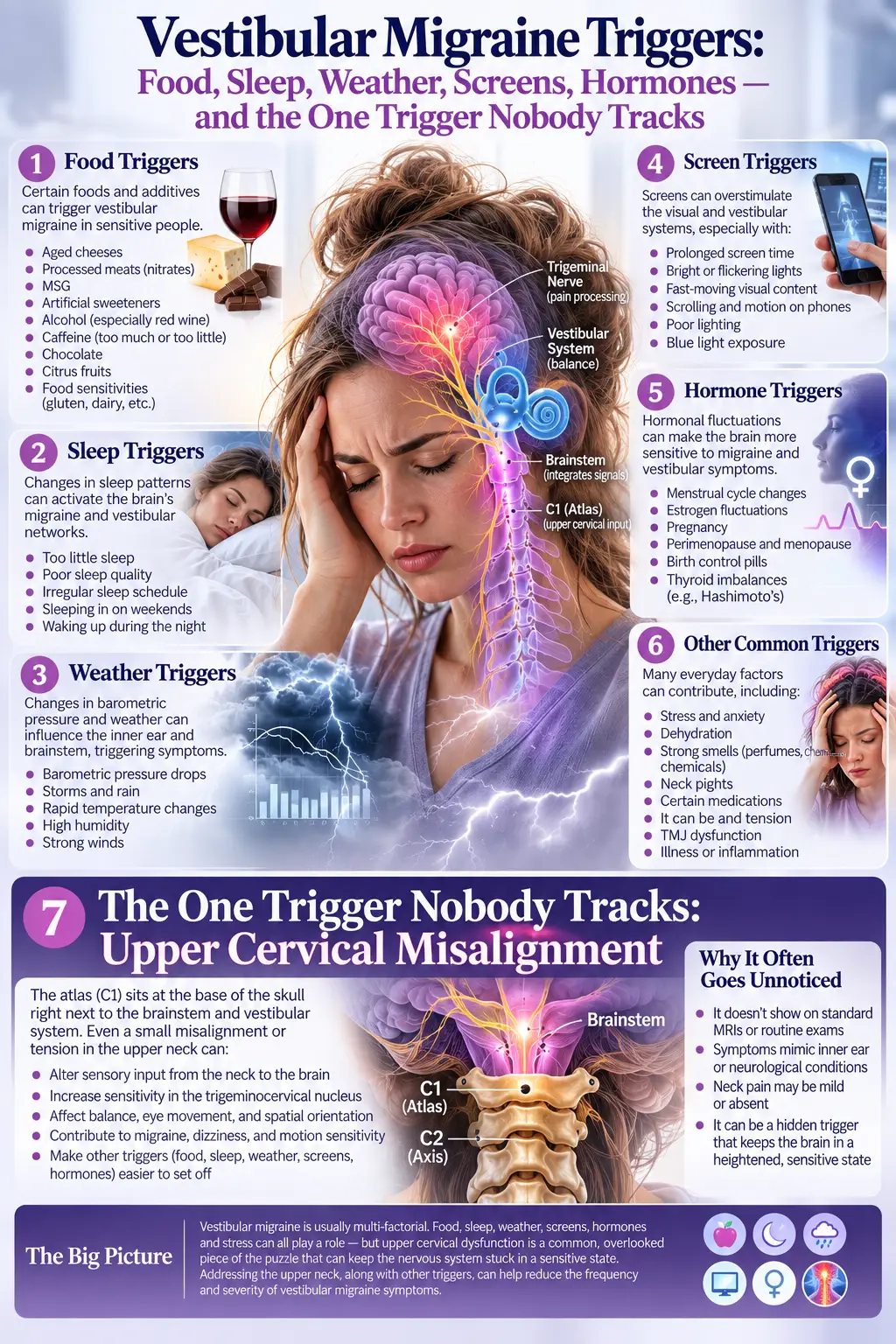
If you have vestibular migraine, you’ve probably been handed a trigger list. Red wine, aged cheese, MSG, chocolate, skipped meals, poor sleep, stress, bright lights, weather. You’ve probably tried eliminating half of it and found that attacks still come — sometimes on a day you did everything right. That’s the frustrating truth about triggers: they’re real, they matter, and they’re not the whole story. A trigger is what pushes a migraine-prone brain over a threshold. What matters just as much is where the threshold sits — and what’s holding it low.
This article covers the triggers that the research actually supports, ranked by how often patients report them, with practical notes on each; the difference between a trigger and a threshold; why vestibular migraine has a few triggers that classic migraine doesn’t; and the structural trigger that never appears on the lists — the upper neck — which can both set off attacks and keep the threshold low between them.
This is educational content, not medical advice. New vertigo with severe headache, double vision, trouble speaking, weakness, or numbness is an emergency.
What Vestibular Migraine Is
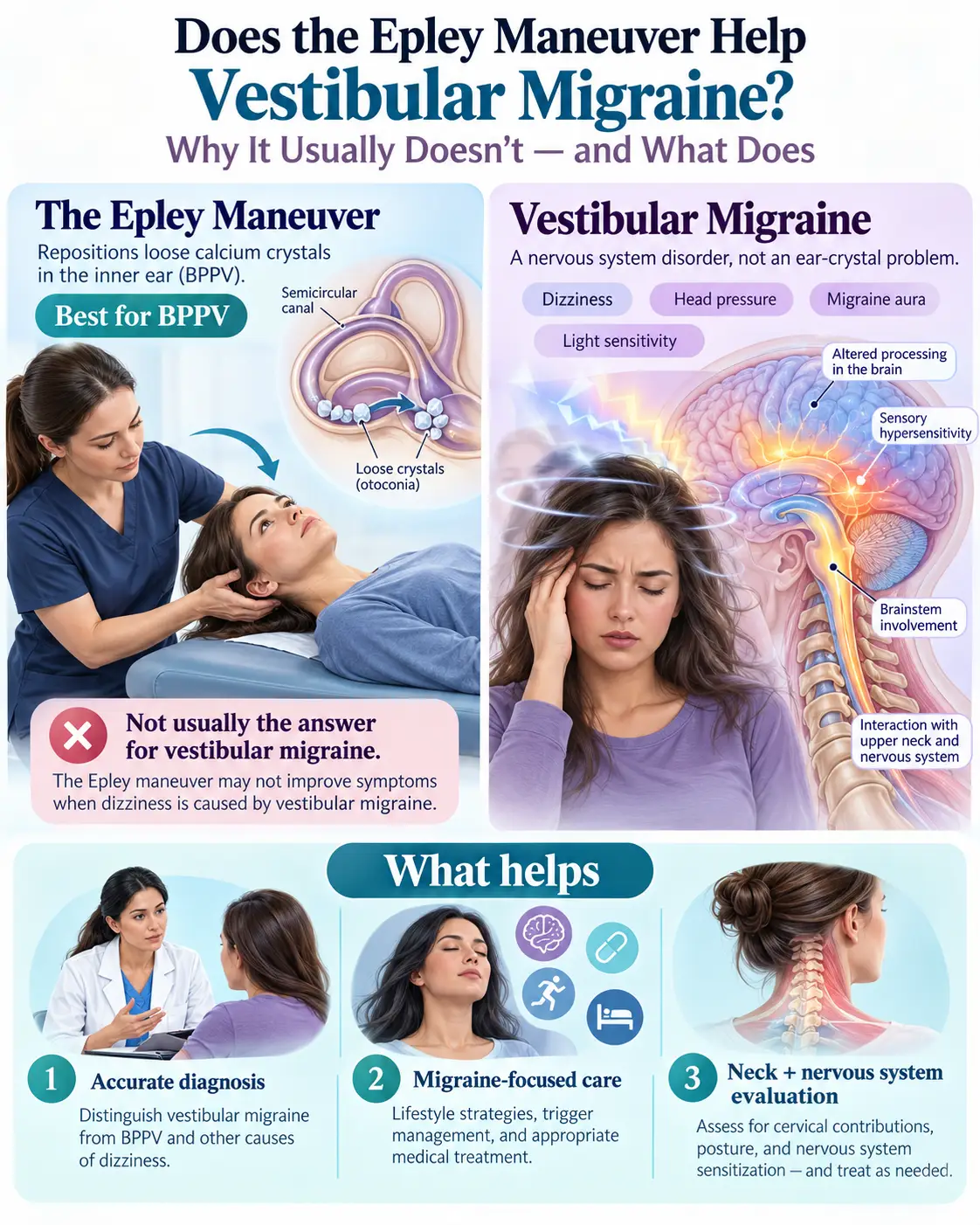
Vestibular migraine is migraine that attacks the balance system — producing vertigo, unsteadiness, motion sensitivity, and visual sensitivity in episodes lasting minutes to hours, with or without head pain. The diagnostic criteria by Lempert and colleagues (2012) require a migraine history and migraine features in at least half the episodes. Furman and colleagues (2013) describe it as a brain disorder in which the processes that generate migraine spill into the circuits that process balance. Our vestibular migraine guide covers it fully.
Because it’s a migraine, its triggers are migraine triggers — with some additions specific to the balance system.
Trigger vs. Threshold
Before the list, one idea that will make every item on it make more sense.
A migraine brain is a brain with a lower-than-normal threshold for an attack. On any given day, a set of inputs — sleep debt, a weather front, a skipped lunch, a stressful meeting, a long drive — add up. If the total crosses the threshold, an attack starts. If it doesn’t, nothing happens. The same red wine that triggered an attack last Friday did nothing this Friday because the other inputs were different.
Two things follow. First, no single trigger is “the” cause; it’s the sum. Second, anything that lowers the threshold makes every trigger more dangerous, and anything that raises it gives you room. Most trigger lists only talk about the inputs. Almost none talk about what sets the threshold — and that’s where the upper neck comes in, at the end of this article.
The Triggers, Ranked by the Research
Kelman (2007) surveyed over 1,200 migraine patients about what set off their attacks — the largest study of its kind. Beh and colleagues (2019) did the same for a large series of vestibular migraine patients specifically. The two lists overlap heavily. Here they are, roughly in order of how many people report them.
1. Stress — and the Let-Down After It
The most commonly reported trigger in Kelman’s study, named by about eight in ten patients. Two patterns: attacks during sustained stress, and — often more reliably — attacks in the let-down after stress ends, the Saturday-morning migraine after a hard week. For vestibular migraine, the let-down pattern is common; patients describe the dizziness arriving the moment they finally relax.
What helps: consistency more than relaxation. Keeping sleep, meals, and activity steady through the weekend blunts the let-down.
2. Sleep — Too Little, Too Much, or Broken
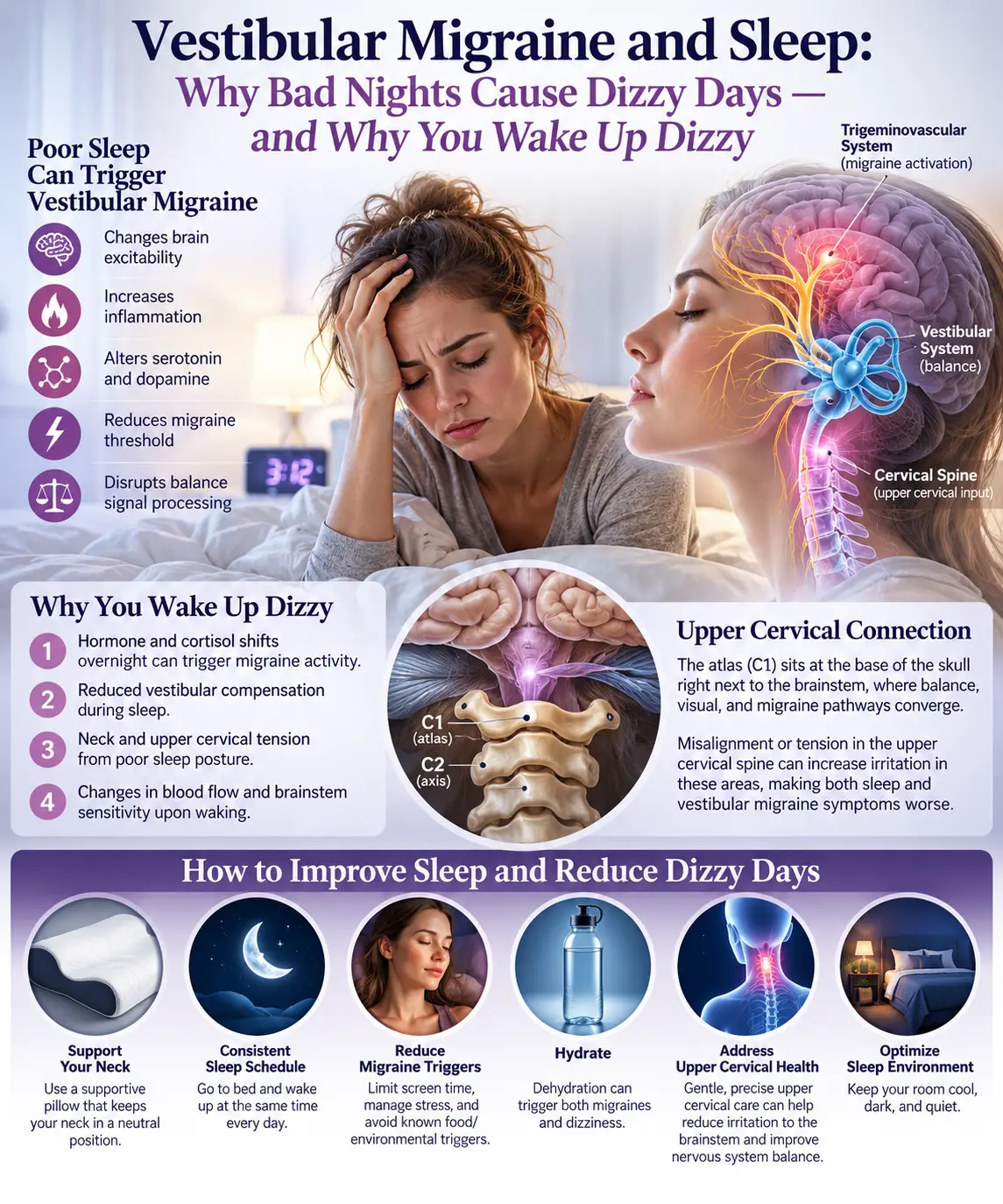
Sleep disturbance was named by about half of patients. The research has sharpened since: Bertisch and colleagues (2020), in a prospective study in Neurology, found that fragmented sleep — waking repeatedly — raised the risk of migraine the next day, independent of total hours. Short sleep, long weekend lie-ins, and jet lag all count.
What helps: a fixed wake time seven days a week, which anchors everything else. And a pillow that keeps the neck neutral — more on that below, because for vestibular migraine, the neck position you sleep in is a sleep trigger and a structural one at once. Our article on the best pillow for migraines covers it.
3. Hormones
Named by about two-thirds of women in Kelman’s study. Attacks cluster around the drop in estrogen before a period, and vestibular migraine often first appears or worsens around perimenopause, when hormone levels swing widely. Our article on hormones and vertigo goes through the cycle.
What helps: tracking attacks against the cycle so the pattern is visible; discussing options with a physician if the link is strong.
4. Skipped Meals and Dehydration
Not eating was named by more than half of patients; dehydration is a close cousin. Both drop blood sugar and blood volume, and both are brutal in a Sarasota summer. For vestibular migraine, dehydration also worsens the lightheaded component.
What helps: regular meals with protein; water throughout the day with electrolytes in the heat; never skipping breakfast.
5. Weather and Barometric Pressure
Named by about half of patients, and in Florida it’s near the top. Falling barometric pressure ahead of a front, the daily summer storm cycle, and the big swings of hurricane season are reliable provokers. For vestibular migraine, pressure changes seem to hit the balance system directly — patients describe feeling the front in their ears and their footing before the sky changes. Our barometric pressure headaches guide covers the mechanism and what to do.
What helps: a pressure-tracking app so you can see it coming and lighten the other inputs that day.
6. Sensory Overload — Light, Sound, Smell, Screens
Bright or flickering light, loud environments, strong smells (perfume, gasoline, cleaning products), and screens. Screens deserve their own mention for vestibular migraine: scrolling is visual motion, and a migraine balance system reads it as movement. Many patients can’t scroll a phone during a flare without the room tilting.
What helps: brightness down, dark mode, blue-light filtering in the evening, breaks from scrolling, sunglasses outdoors — Florida glare is a trigger in its own right.
7. Foods and Drinks
The famous list — aged cheese, red wine, processed meats with nitrates, MSG, artificial sweeteners, chocolate, caffeine withdrawal — is real for some people and irrelevant for others. The research supports that individual food triggers exist, not that any food is universal. Caffeine deserves a note: regular intake is fine; the withdrawal headache from skipping it is a trigger.
What helps: a food-and-attack diary for a month rather than blanket elimination. Most people find one or two real triggers, not twenty.
8. Motion and Visual Motion — Specific to Vestibular Migraine
Here’s where vestibular migraine departs from classic migraine. Beh and colleagues documented that motion sensitivity and visually induced dizziness are core features: car rides, boats, elevators, escalators, crowds, busy patterns, grocery store aisles, and — again — scrolling. A migraine balance system over-responds to motion it sees or feels. Motion sickness in childhood is a recognized precursor.
What helps: sitting in the front seat and watching the horizon; avoiding reading in vehicles; limiting scrolling during a flare.
9. Head and Neck Position
Also specific — or at least much more prominent — in vestibular migraine, and the bridge to the next section. Beh and colleagues noted positional provocation among the triggers. Patients report attacks set off by looking up, turning the head quickly, long drives with the neck fixed, screen work with the head forward, sleeping in an awkward position, or a dental or salon chair with the neck extended. Neck pain itself was named as a trigger by roughly four in ten migraine patients in Kelman’s study. Our article on vestibular migraine and neck pain covers the connection in depth.
What helps: neutral head position at screens and in bed, headrest contact while driving, avoiding sustained extension. And measuring the upper neck, because position provokes attacks most in people whose upper neck is already sending distorted input.
The Trigger Nobody Tracks: The Upper Neck
Every trigger above is an input. The upper cervical spine is different: it’s an input and it sets the threshold.
As an input. The nerves from the top three cervical segments feed into the same brainstem cells as the trigeminal nerve — the trigeminocervical complex described by Bartsch and Goadsby (2003). An irritated upper neck sends a steady signal into the migraine generator. The upper neck also carries one of the body’s densest concentrations of position sensors, feeding the balance circuits that vestibular migraine destabilizes; Kristjansson and Treleaven (2009) reviewed how distorted cervical input produces dizziness on its own.
As the threshold. Here’s the part that explains the “I did everything right and still had an attack” days. When the atlas is misaligned, the upper neck doesn’t send an occasional bad signal — it sends a continuous one, twenty-four hours a day. That background input keeps the migraine threshold lower than it would otherwise be, so the ordinary triggers — a front, a short night, a long drive — cross it more easily. It’s the difference between a glass that starts half-full and one that starts empty. Correcting the position of the upper neck changes the starting level.
This is why trigger management alone plateaus for so many vestibular migraine patients. They’ve removed every input they can find, and the threshold is still low because the one input they can’t see on a trigger list — the position of the top of the neck — has never been measured.
Upper Cervical Care at Lavender Family Chiropractic
When someone with vestibular migraine comes to our Sarasota office, the first visit is an evaluation, not an adjustment.
History, including your trigger pattern — which tells us a great deal about whether position is a factor.
Examination. Neurological screening; reproduction testing of the upper neck; a head-repositioning test that measures how accurately the neck reports head position; positional screening for BPPV.
Paraspinal infrared thermography. A non-invasive scan of the heat pattern along the spine, reflecting nervous-system activity — an objective baseline at the upper neck and a way to track change.
3D cone-beam CT (CBCT) imaging of the upper cervical spine. The position of the atlas and axis relative to the skull, in three dimensions and to the degree.
Review of findings before any care.
Correction, if indicated. A precise, low-force procedure specific to your measurements — no twisting, no cracking, no rotation of the neck. For a motion-sensitive patient, that’s the point. Most patients describe it as pressure.
Remeasurement. Thermography after each visit and follow-up imaging when indicated.
Upper cervical care addresses the mechanical source the research points to — the neck — with measurement before and after, so progress is objective rather than guessed at. Results vary from person to person, and we tell you plainly what the findings show. Trigger management and your neurologist’s care continue alongside; what changes is the threshold they’re working against.
If you’ve managed every trigger and the attacks still come, call (941) 243-3729 or request an appointment online for an upper cervical evaluation.
What the Research Says
The triggers, ranked. Kelman (2007) surveyed over 1,200 migraine patients: stress, hormones, skipped meals, weather, sleep disturbance, sensory inputs, and neck pain among the leaders. Beh and colleagues (2019) characterized triggers and features in a large vestibular migraine series, including motion and visual-motion sensitivity.
Sleep fragmentation predicts next-day attacks. Bertisch and colleagues (2020).
Vestibular migraine is unstable balance processing in a migraine brain. Furman and colleagues (2013); criteria by Lempert and colleagues (2012).
The upper neck feeds the migraine generator and the balance system. Bartsch and Goadsby (2003); Kristjansson and Treleaven (2009).
A Trigger Diary That Actually Works
Most diaries fail because they track too much. Track these, daily, for one month:
- Hours slept and whether it was broken
- Meals skipped, yes/no
- Stress level, 1–5, and whether today was a let-down day
- Barometric pressure trend (an app will do it)
- Screen hours
- Neck: stiffness on waking, 1–5; any sustained neck position (drive, screen, dental chair)
- For women, cycle day
- Attack: yes/no, time, duration, dizziness type
At the end of the month, look at the attack days and the two days before each. The pattern is usually obvious — and for vestibular migraine, the neck row is the one most people are surprised by. Bring the diary to your neurologist and to us.
If your attacks have no headache at all, our article on silent vestibular migraine explains why that doesn’t make them any less migraine. Our migraine guide covers the condition broadly.
Serving Sarasota, Bradenton, Lakewood Ranch, and the Suncoast
Our office is on Whitfield Avenue in north Sarasota, minutes from the Manatee County line. We see vestibular migraine patients from Sarasota, Bradenton, Lakewood Ranch, Palmetto, Parrish, Ellenton, Longboat Key, Siesta Key, Osprey, Nokomis, Venice, and North Port — a region where weather, glare, heat, and long drives make trigger management harder than almost anywhere. If you’ve done the trigger work and the attacks keep coming, the top of the neck is the piece that hasn’t yet been examined.
Top 15 FAQs About Vestibular Migraine Triggers
1. What are the most common vestibular migraine triggers? Stress and the let-down after it, sleep disturbance, hormonal shifts, skipped meals and dehydration, weather and barometric pressure, sensory overload including screens, specific foods for some people, motion and visual motion, and head and neck position.
2. Why do I get attacks on days I did everything right? Because triggers add up against a threshold, and the threshold varies. If something is keeping the threshold low — like continuous input from a misaligned upper neck — small inputs can cross it.
3. Which foods trigger vestibular migraine? It’s individual. Aged cheese, red wine, nitrates, MSG, artificial sweeteners, and chocolate are commonly reported, but most people find one or two real triggers, not the whole list. A diary beats elimination.
4. Does caffeine trigger it? Regular, consistent caffeine usually doesn’t. Caffeine withdrawal does. Keep your intake steady.
5. Why does weather affect me so much? Falling barometric pressure is one of the most reliable migraine triggers, and in vestibular migraine it seems to hit the balance system directly. Florida’s storm cycle and fronts make it a near-daily factor in some seasons.
6. Why does scrolling my phone make me dizzy? Scrolling is visual motion, and a migraine balance system reads it as movement. It’s one of the triggers specific to vestibular migraine.
7. Can neck position trigger a vestibular migraine? Yes. Looking up, sustained screen posture, long drives, and awkward sleep positions are commonly reported, and neck pain was named as a trigger by roughly four in ten migraine patients in the largest study.
8. How is the neck different from other triggers? Other triggers are intermittent inputs. A misaligned upper neck is a continuous input that keeps the migraine threshold low around the clock — which is why it affects every other trigger.
9. Does poor sleep cause it the same night or the next day? Research found that fragmented sleep raised the risk of migraine the next day. The attack after a bad night often arrives the following afternoon.
10. Is motion sickness related? Strongly. Motion sickness, especially in childhood, is a recognized precursor of vestibular migraine, and motion sensitivity is a core feature of the condition.
11. Should I eliminate all the trigger foods? No — that usually produces a restricted diet and no fewer attacks. Keep a diary for a month and remove only what the diary shows.
12. Can hormones trigger vestibular migraine after menopause? The swings of perimenopause are a common onset period. After menopause, hormone-related attacks often ease, though other triggers persist.
13. What does upper cervical care do about triggers? It addresses the position of the top of the neck, which is both a trigger in itself and a factor in where the threshold sits. The other triggers still matter; they just have more room before they cross.
14. How soon would I notice a difference? When the upper neck is a factor and it’s corrected, patients typically report changes in attack frequency and in how much it takes to provoke one within the first several weeks. We measure before and after.
15. Do you take insurance? Call the office and we’ll go through costs and coverage before anything begins.
Lavender Family Chiropractic in Sarasota, Florida offers a thorough upper cervical evaluation to find out whether we can help. Call (941) 243-3729 or request an appointment. 5899 Whitfield Avenue, Suite 107, Sarasota, FL 34243.
Related Articles
- Vestibular Migraine: Our Complete Guide
- Vestibular Migraine and Neck Pain
- Barometric Pressure Headaches
- Hormones and Vertigo
- Best Pillow for Migraines
- Silent Vestibular Migraine
References
- Lempert T, et al. Vestibular migraine: diagnostic criteria. J Vestib Res. 2012. PMID 23142830
- Furman JM, Marcus DA, Balaban CD. Vestibular migraine: clinical aspects and pathophysiology. Lancet Neurol.2013. PMID 23769597
- Kelman L. The triggers or precipitants of the acute migraine attack. Cephalalgia. 2007. PMID 17403039
- Beh SC, et al. The Spectrum of Vestibular Migraine: Clinical Features, Triggers, and Examination Findings. Headache. 2019. PMID 30737783
- Bertisch SM, et al. Nightly sleep duration, fragmentation, and quality and daily risk of migraine. Neurology. 2020. PMID 31843807
- Bartsch T, Goadsby PJ. The trigeminocervical complex and migraine: current concepts and synthesis. Curr Pain Headache Rep. 2003. PMID 12946290
- Kristjansson E, Treleaven J. Sensorimotor function and dizziness in neck pain: implications for assessment and management. J Orthop Sports Phys Ther. 2009. PMID 19411769
Related Posts


Get our upper cervical articles first.