
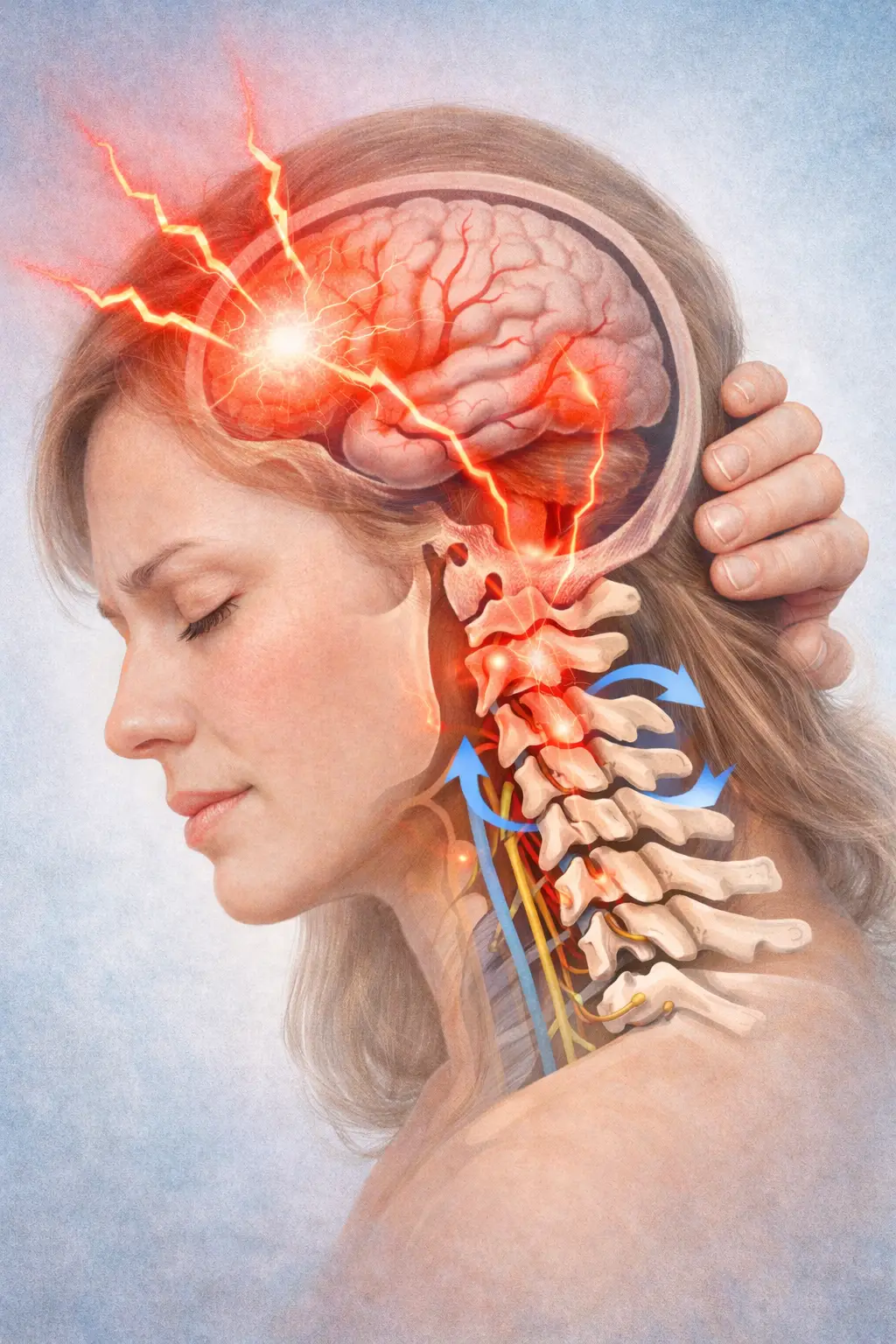
Head Pressure Relief in Sarasota Florida: The Craniocervical Junction, CSF Flow, and Upper Cervical Chiropractic Care in Sarasota Florida
By Dr. Rusty Lavender, D.C. — upper cervical chiropractor, Lavender Family Chiropractic, Sarasota, FL. Reviewed and updated October 2026.
Understanding Head Pressure Beyond the Surface
Head pressure is one of the most frustrating and misunderstood symptoms people experience. It is often described as a constant heaviness, a tight band around the head, pressure behind the eyes, or a feeling like the head is “full” or “inflated.” Many patients report that it does not behave like a normal headache. It lingers. It fluctuates. It worsens with certain positions or activities. And in many cases, it does not respond well to traditional treatments.
Most people are told that head pressure is caused by stress, sinus congestion, or migraines. While those explanations can sometimes play a role, they often fail to explain why the pressure persists, why imaging comes back normal, and why medications only provide temporary relief.
To truly understand head pressure, we have to shift our perspective away from symptoms and toward structure and function. Specifically, we need to look at one of the most important and overlooked regions in the human body: the craniocervical junction.
What Is the Craniocervical Junction?
The craniocervical junction (CCJ) is the area where the skull meets the upper neck. It includes the base of the skull and the top two cervical vertebrae, known as the atlas (C1) and axis (C2). This region is unlike any other part of the spine. It is responsible for supporting the weight of the head, allowing for a wide range of motion, and most importantly, serving as the transition point between the brain and the body.
Running through this small but critical area are structures essential for life and neurological function, including the brainstem, major arteries and veins, and the pathways for cerebrospinal fluid (CSF). Every signal from the brain to the body and every pathway responsible for fluid movement must pass through this region.
Because of this, even a small structural misalignment in the upper neck can have a significant impact on how the body functions.
The Craniocervical Junction as a Hydrodynamic Chokepoint
One of the most important concepts in understanding head pressure is the idea that the craniocervical junction can act as a chokepoint for fluid movement. The brain is not a static organ. It is constantly being supplied with blood, drained of waste, and surrounded by circulating cerebrospinal fluid.
This system relies on smooth, unrestricted flow. When that flow is disrupted, pressure can build.
Think of it like a plumbing system. If a pipe becomes narrowed or kinked, pressure increases upstream of the restriction. The same principle applies within the body. When the pathways at the base of the skull become compromised due to misalignment or structural stress, it can alter the normal movement of fluids.
This is where head pressure begins.
The Role of Cerebrospinal Fluid (CSF)
Cerebrospinal fluid is one of the most important substances in the body. It cushions the brain, removes waste products, delivers nutrients, and helps regulate intracranial pressure. The body produces and reabsorbs CSF continuously throughout the day.
For this system to function properly, CSF must be able to circulate freely between the brain and the spinal cord. The craniocervical junction is a key gateway in this circulation process.
When there is interference at this level, CSF flow can become altered. Instead of moving rhythmically and efficiently, it may slow down, become turbulent, or encounter resistance. This can lead to pressure changes within the skull.
Patients often describe this as a feeling of fullness, tightness, or internal pressure that does not go away.
Research on CSF Flow and Upper Cervical Alignment
Advanced imaging studies, including upright MRI, have demonstrated that structural changes in the upper cervical spine can influence cerebrospinal fluid dynamics. Research associated with clinicians like Scott Rosa has shown that misalignment of the atlas can correlate with abnormal CSF flow patterns.
These findings support the idea that the upper neck plays a direct role in regulating how fluids move within the central nervous system. When alignment is restored, improvements in fluid movement and pressure regulation have been observed.
This provides a powerful framework for understanding symptoms that have traditionally been difficult to explain.
Blood Flow and Venous Drainage
In addition to CSF, blood flow is also heavily influenced by the craniocervical junction. Arteries deliver oxygen-rich blood to the brain, while veins carry waste products away. Proper circulation depends on open, unobstructed pathways.
If the upper neck is misaligned, it can affect the positioning and tension of surrounding tissues, potentially impacting blood flow and venous drainage. This can contribute to a buildup of pressure within the head.
Patients may experience symptoms such as:
- Head pressure
- Brain fog
- Fatigue
- Pulsating sensations
These are not random. They are often tied to how efficiently the brain is being supplied and drained.
The Brainstem Connection
Located at the craniocervical junction is the brainstem, one of the most vital structures in the body. The brainstem controls essential functions such as balance, coordination, blood pressure regulation, and autonomic nervous system activity.
When the environment around the brainstem is altered due to structural misalignment, its function can be affected. This can lead to a wide range of symptoms that extend far beyond simple head pressure.
This is why patients often experience multiple overlapping issues at the same time.
Conditions Associated with Craniocervical Dysfunction
Head pressure rarely exists in isolation. It is often part of a broader pattern of symptoms that share a common underlying cause.
Migraines
Migraines are commonly associated with changes in blood flow and neurological signaling. Disruptions at the upper neck can contribute to both.
Idiopathic Intracranial Hypertension (IIH)
IIH involves increased pressure within the skull. Altered CSF dynamics at the craniocervical junction may play a role in this condition.
Vertigo and Dizziness
The brainstem and cerebellum are central to balance. Pressure changes and altered signaling can lead to sensations of spinning or instability.
Eustachian Tube Dysfunction
The nerves that influence ear pressure originate near the upper cervical spine. Misalignment can contribute to symptoms such as ear fullness and popping.
Sinus Pressure
Many patients with sinus pressure have clear imaging and no infection. The sensation is often due to pressure dysregulation rather than congestion.
Why Traditional Approaches Fall Short
Most conventional treatments focus on managing symptoms rather than addressing underlying causes. Medications may reduce inflammation or dull pain, but they do not correct structural issues or restore fluid dynamics.
Imaging is typically performed in a lying position, which may not reveal functional problems that occur when the body is upright and under normal gravitational forces.
As a result, many patients are left without answers.
Upper Cervical Chiropractic Care in Sarasota Florida
Upper cervical chiropractic care focuses specifically on the alignment and function of the craniocervical junction. It is a precise and specialized approach that differs significantly from general chiropractic care.
At Lavender Family Chiropractic in Sarasota Florida, the focus is on identifying and correcting misalignment at the top of the neck using advanced technology and gentle techniques.
What Makes Upper Cervical Care Unique
Precision Imaging
3D CBCT imaging is used to analyze the exact position of the atlas and axis. This allows for highly specific care tailored to each patient.
Gentle Adjustments
Adjustments are performed by hand with extreme precision. There is no twisting, cracking, or forceful manipulation.
Focus on Stability
The goal is not to adjust repeatedly but to restore alignment and allow the body to hold the correction over time.
How Upper Cervical Care Helps Head Pressure
By restoring proper alignment at the craniocervical junction, upper cervical care can:
- Improve CSF circulation
- Enhance blood flow and drainage
- Reduce pressure within the skull
- Normalize brainstem function
As these systems begin to function properly, the body can regulate itself more effectively.
A New Way to Understand Your Symptoms
Instead of viewing head pressure as a standalone problem, it is more helpful to think in terms of systems. The brain depends on movement, flow, and balance. When those systems are disrupted, symptoms emerge.
The craniocervical junction is a key control point in that system.
Upper Cervical Chiropractic and NeckWise Care: Correcting the Root Cause of Head Pressure
When people first begin to explore solutions for head pressure, migraines, dizziness, or neurological symptoms, they often assume the answer lies in medication, diet changes, or symptom management. While those approaches may offer temporary relief, they rarely address the underlying issue—especially when the problem is structural and neurological in nature.
This is where upper cervical chiropractic care, specifically NeckWise care, becomes a completely different conversation.
It is not about chasing symptoms.
It is about correcting the root cause at the craniocervical junction—the very area we’ve discussed as the chokepoint for cerebrospinal fluid, blood flow, and brainstem function.
What Is Upper Cervical Chiropractic Care?
Upper cervical chiropractic is a highly specialized form of care that focuses exclusively on the top two bones in the neck—the atlas (C1) and axis (C2).
These two bones are responsible for:
- Supporting the head
- Protecting the brainstem
- Allowing communication between the brain and body
- Facilitating proper fluid and blood movement in and out of the skull
Unlike general chiropractic, upper cervical care does not involve adjusting the entire spine.
In fact, true upper cervical care operates under a very important principle:
If you are being adjusted anywhere other than the upper neck, you are not receiving pure upper cervical care.
Why?
Because adjusting other areas of the spine can interfere with the body’s ability to stabilize the most important correction—the one at the craniocervical junction.
Upper cervical care stands alone because it recognizes that everything in the body is controlled from the top down.
What NeckWise Care Means at Lavender Family Chiropractic
NeckWise care is not just a technique—it is a system of precision, analysis, and correction designed to restore optimal nervous system function.
At Lavender Family Chiropractic in Sarasota, this system is built around three core pillars:
- Precise Measurement
- Gentle Correction
- Long-Term Stability
Every step is intentional. Nothing is guesswork.
Step 1: Precision Through Advanced Imaging
Before any correction is made, the exact misalignment must be identified.
This is where 3D CBCT (Cone Beam CT) imaging comes in.
Unlike traditional X-rays, CBCT imaging provides a three-dimensional view of the upper cervical spine, allowing doctors to measure:
- The exact angle of the atlas
- The degree of rotation or tilt
- The relationship between the skull and neck
This level of detail is critical because the atlas does not move in simple directions. It can shift in multiple planes at once, and even a millimeter of misalignment can have a significant impact on neurological function.
This is why generalized adjustments do not work for these cases.
NeckWise care is built on the idea that specificity equals results.
Step 2: Gentle, Precise Corrections
One of the biggest misconceptions about chiropractic care is that it involves cracking, twisting, or forceful manipulation.
That is not what happens in upper cervical care.
At Lavender Family Chiropractic, corrections are:
- Gentle
- Specific
- Delivered by hand
- Customized to each patient’s anatomy
There is no twisting, no popping, and no aggressive force.
Instead, the adjustment is performed with a precise vector based on the imaging findings. The goal is to guide the atlas back into proper alignment—not force it.
This matters because the upper neck is incredibly sensitive.
It houses the brainstem and critical neurological pathways. Any correction must be controlled and exact to avoid overstimulation or disruption.
Step 3: Holding the Correction
This is where upper cervical care separates itself from nearly every other approach.
The goal is not to adjust you every visit.
The goal is to:
- Make the correction
- Allow the body to stabilize
- Monitor progress over time
When the atlas is properly aligned, the body begins to:
- Restore normal muscle tone
- Improve neurological communication
- Balance fluid dynamics
Over time, the correction holds longer and longer.
This is how real healing occurs—not through constant intervention, but through restoring the body’s ability to function on its own.
How NeckWise Care Impacts Head Pressure
Now let’s bring this back to head pressure.
If the craniocervical junction is acting as a chokepoint for:
- Cerebrospinal fluid
- Blood flow
- Venous drainage
Then correcting the alignment at that level can directly influence those systems.
When the atlas is realigned:
- CSF pathways can open
- Pressure gradients can normalize
- Blood flow can improve
- Brainstem irritation can decrease
This creates an environment where the body can regulate pressure more effectively.
Patients often report improvements such as:
- Reduced head pressure
- Less fullness in the head
- Decreased migraines
- Improved clarity and focus
- Better balance and stability
These changes are not random.
They are the result of restoring proper mechanics and physiology at the base of the skull.
The Brainstem and Nervous System Reset
One of the most powerful effects of upper cervical care is its influence on the brainstem.
The brainstem is responsible for:
- Autonomic function (fight or flight vs. rest and digest)
- Blood pressure regulation
- Balance and coordination
- Sensory processing
When the atlas is misaligned, it can create abnormal tension or irritation around the brainstem.
This can lead to:
- Dysautonomia
- Dizziness
- Head pressure
- Sensory overload
- Chronic stress responses
By correcting the alignment, NeckWise care helps remove that interference, allowing the nervous system to shift back toward a more balanced state.
This is why patients often notice improvements beyond just head pressure.
Why This Approach Works When Others Don’t
Most treatments focus on managing symptoms.
NeckWise care focuses on:
- Structure
- Function
- Neurology
It addresses the cause, not the effect.
If the issue is truly coming from:
- Impaired fluid flow
- Altered pressure dynamics
- Brainstem dysfunction
Then no amount of medication or temporary therapy will resolve it long term.
You must correct the mechanical problem.
A Different Philosophy of Healing
NeckWise care operates under a simple but powerful philosophy:
The body is designed to heal—if interference is removed.
Instead of forcing change, it:
- Restores alignment
- Reduces interference
- Allows the body to adapt
This is why results often feel different.
They are not temporary relief.
They are system-wide improvements. For the full evaluation-and-care picture, see our main page on craniocervical instability treatment in Sarasota.
Who Is a Good Candidate for NeckWise Care?
This approach is especially beneficial for individuals who:
- Have chronic head pressure
- Experience migraines or dizziness
- Have been diagnosed with IIH or unexplained neurological symptoms
- Feel like something is “off” but cannot find answers
- Have tried multiple treatments without success
It is also ideal for patients who want a non-invasive, drug-free approach to addressing the root cause of their symptoms.
The Long-Term Vision
The goal of NeckWise care is not just symptom relief.
It is:
- Restoring optimal nervous system function
- Improving quality of life
- Preventing long-term dysfunction
When the craniocervical junction is functioning properly, the entire system benefits.
Flow improves.
Pressure normalizes.
The body works the way it was designed to.
Final Perspective
If you truly understand head pressure through the lens of:
- Fluid dynamics
- Brainstem function
- Structural alignment
Then upper cervical care is not just another option.
It becomes one of the most logical and effective solutions available.
NeckWise care is about precision, patience, and restoring the foundation of health.
And for many people struggling with chronic head pressure, it is the missing piece they have been searching for.
Who This Applies To
This information is especially relevant for individuals who:
- Have persistent head pressure
- Have been told everything looks normal
- Experience multiple neurological symptoms
- Have not found relief through traditional approaches
Long Term Implications
Chronic disruptions in fluid dynamics and pressure regulation can impact overall brain health. Proper circulation and waste removal are essential for optimal function.
Addressing the structural component early can help support long term neurological health and quality of life.
Final Thoughts
Head pressure is not always a simple symptom. It is often a sign that something deeper is not functioning correctly. The craniocervical junction plays a central role in regulating the movement of fluids and the function of the nervous system.
When this area becomes a chokepoint, pressure builds and symptoms appear. By restoring proper alignment and function, it is possible to address the root cause rather than just managing the symptoms.
Take the Next Step
Lavender Family Chiropractic in Sarasota Florida offers consultations to learn more about you. Click the link below!
https://intake.chirohd.com/new-patient-scheduling/724/lavender-family-chiropractic
Visit our Website!
To learn more about us go to http://www.chiropractorsarasotaflorida.com
We also service Bradenton, Parrish, Ellenton, Ruskin, Venice, Tampa, St. Pete, Osprey, Longboat, Lakewood Ranch, Myakka City.
If you are not local, visit www.uccnearme.com to find a doctor in your area.
Research
If you are looking to read the study please click here https://pmc.ncbi.nlm.nih.gov/articles/PMC2842089/
Frequently Asked Questions
What is the craniocervical junction and why is it called a chokepoint?
The craniocervical junction is where the skull meets the atlas and axis. Through that small opening pass the brainstem, the vertebral arteries, the major veins draining the head, and the cerebrospinal fluid moving between the skull and the spinal canal. Because so much traffic flows through so little space, a shift in the atlas can crowd it. We image that junction with 3D cone-beam CT to see exactly how the bones are positioned.
How does cerebrospinal fluid relate to head pressure?
Cerebrospinal fluid cushions the brain and must move freely in and out of the skull with each heartbeat and breath. When the atlas is misaligned, the space it passes through at the craniocervical junction can narrow, and patients often describe a full, heavy, or pressurized feeling in the head. Correcting the alignment is aimed at reopening that passage. We measure the nervous system’s response with thermography before and after each correction rather than assuming improvement.
Can neck alignment affect blood flow and venous drainage from the head?
Yes. The vertebral arteries thread through openings in the atlas on their way to the brainstem, and the internal jugular and vertebral veins drain the head through the same crowded region. An atlas shift can alter those paths and contribute to a congested, pressurized sensation, especially when lying down or bending forward. The Knee Chest correction repositions the atlas with low force and no rotation, and we track the result at every visit.
What serious causes of head pressure should be ruled out first?
Sudden, severe, or worsening head pressure, pressure with vision changes, fever, or neurological deficits should be evaluated promptly by a physician to rule out conditions that need medical treatment. Once that is done, we assess the upper cervical spine, which is rarely examined in standard workups. We coordinate with neurologists and share imaging on request. If our findings show the upper neck is not involved, we say so and refer you appropriately.
What happens at a head pressure evaluation in Sarasota?
At our office at 5899 Whitfield Avenue, minutes from Lakewood Ranch and Bradenton, you will have a detailed history, neurological checks, and paraspinal infrared thermography. If the findings point to the upper neck, we take cone-beam CT to calculate a precise correction. The correction is low force with no twisting or cracking, followed by rest and a repeat scan. Care plans are individual and reassessed each visit. Call (941) 243-3729 to schedule an evaluation.
Related Posts


Get our upper cervical articles first.
Patients Experience

Popular Posts