Cervical Facet Syndrome in Sarasota, Florida: Understanding Facet Joint Neck Pain and Natural Relief Through Upper Cervical Chiropractic Care at Lavender Family Chiropractic
By Dr. Rusty Lavender, D.C. — upper cervical chiropractor, Lavender Family Chiropractic, Sarasota, FL. Reviewed and updated October 2026.
Facet Syndrome Treatment and Relief in Sarasota Florida: It is a very particular kind of neck pain. It sits deep, often just to one side of your spine, and it sharpens when you tip your head back to look up at a shelf, when you turn to check your blind spot, or when you lean your head toward the painful side. It can ache after a long day at the computer and stiffen up overnight so that mornings start with a locked, sore neck that takes an hour to loosen. Sometimes it refers pain up into the base of the skull, out toward the shoulder blade, or into the upper back, even though the source is the neck itself. If this sounds like what you have been living with, there is a good chance the small joints at the back of your cervical spine, the facet joints, are involved.
If you are in Sarasota, Bradenton, Lakewood Ranch, or anywhere along the Gulf Coast and you are dealing with this pattern, you are facing one of the most common and most under-recognized sources of chronic neck pain there is. Facet joint pain is frequently misattributed to “muscle strain” or written off as something you simply have to live with, when in fact it is a specific, identifiable mechanical problem with a clear cause and a clear relationship to how your cervical spine is loaded.
At Lavender Family Chiropractic in Sarasota, our entire focus is the upper cervical spine, the atlas (C1) and axis (C2) at the very top of the neck. We use 3D CBCT imaging and paraspinal infrared thermography to find the subtle misalignments that change how every joint below them is loaded, and we correct them with the gentle, precise Knee Chest Upper Cervical technique, with no twisting, popping, or forceful cranking on already irritated joints. This guide will walk you through what cervical facet syndrome actually is, why it develops, what the upper cervical spine has to do with it, what the research says about conservative and manual care, and how you can both calm the current pain and reduce the loading pattern that keeps it coming back.
What Is Cervical Facet Syndrome?
Cervical facet syndrome, sometimes called cervical facet joint pain or cervical zygapophyseal joint pain, is neck pain that originates from the facet joints of the cervical spine. To understand it, you need to understand these joints.
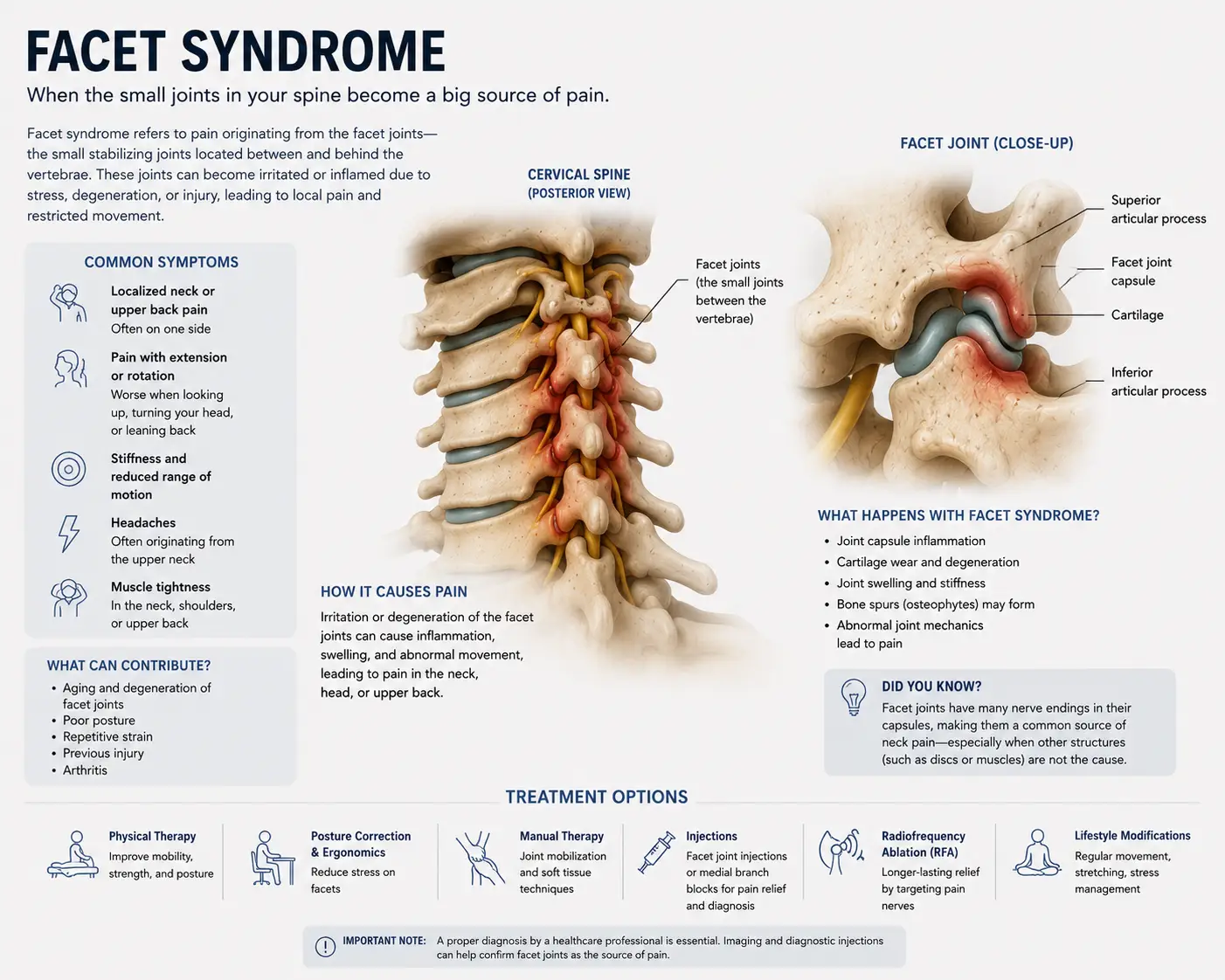
Every level of your cervical spine, from C2 down to C7, is connected to the level above and below it by a pair of small joints at the back of the spine, one on the left and one on the right. These are the facet joints, also called zygapophyseal joints or z-joints. They are true synovial joints, lined with cartilage and wrapped in a capsule, just like the joints in your knees or knuckles. Their job is to guide and limit the motion between each pair of vertebrae, allowing your neck to bend, rotate, and extend while keeping the movement controlled and stable. They also bear a meaningful share of the load that passes down through your cervical spine, especially when you tip your head backward.
Because they are richly supplied with nerve endings, facet joints are capable of generating significant pain when they become irritated, inflamed, or arthritic. When a cervical facet joint is the source of pain, the discomfort tends to follow recognizable patterns. It is usually felt deep and to one side of the neck rather than directly in the midline. It often worsens with extension, the motion of tipping the head back, and with rotation or side-bending toward the painful side, because those movements compress and load the joint. It frequently refers pain in characteristic patterns. The upper cervical facets can refer pain into the head and base of the skull, the middle cervical facets into the side and back of the neck, and the lower cervical facets into the shoulder, shoulder blade, and upper back. This referred pain is one reason facet syndrome is so often misdiagnosed, because the pain is felt in a place distant from its actual source.
Just how common is facet-mediated neck pain? The answer surprises most people. According to PM&R KnowledgeNow, the clinical reference resource of the American Academy of Physical Medicine and Rehabilitation, in patients with localized cervical pain, the prevalence of facet joint pain ranges from approximately 36% to 67%, rising to 50–60% in trauma-induced chronic pain including whiplash, and the facet joints are implicated in roughly 70% of cervicogenic headaches. A separate prospective study of 500 patients with chronic spinal pain, published in the journal Pain Physicianand indexed in PMC, found that cervical facet joints were the symptomatic source in 28% of patients with chronic spine pain, a meaningfully higher proportion than thoracic facets and comparable to lumbar facets. The foundational early work in this field, the 1992 study by Aprill and Bogduk, reported that symptomatic cervical zygapophyseal joints were found in 25% of patients with intractable neck pain, with the possibility that as many as 63% were affected. However the studies slice it, the conclusion is consistent: the facet joints are a major, frequently overlooked driver of chronic neck pain.
What Causes Cervical Facet Syndrome?
Facet joints become painful for a handful of related reasons, and in most people more than one is at work.
The most common underlying process is degeneration. Like any weight-bearing joint, the cervical facets are subject to wear over time. As the intervertebral discs at the front of the spine lose height and hydration with age, more load is transferred to the facet joints at the back. Over years, this accelerated loading wears the cartilage, irritates the joint capsule, and can prompt the formation of bone spurs around the joint margins. This is part of the broader process called cervical spondylosis, the age-related degeneration of the cervical spine, and the facet joints are central to it.
A second major cause is trauma, particularly whiplash. The rapid acceleration and deceleration of a car accident can sprain or injure the facet joint capsules, and facet injury is one of the best-documented sources of chronic pain after whiplash. This is why facet involvement is so much higher in trauma-related neck pain than in the general population. A facet joint injured in a collision can remain a pain generator for months or years afterward, sometimes long after the other tissues have healed.
A third cause, and the one most people overlook, is sustained mechanical overload from posture and alignment. The facet joints are loaded most heavily during extension and during asymmetric positions. A neck that carries a chronic forward head posture, or that is loaded asymmetrically because of an underlying misalignment, subjects certain facet joints to far more wear than they were designed to handle. Hours per day spent looking down at a phone or laptop, a pattern so common it has its own name, tech neck, dramatically increases the load on the lower cervical structures, including the facets. Over time, this sustained, uneven loading is what turns a healthy joint into a painful, arthritic one.
Other contributors include repetitive occupational strain, in jobs that require sustained or repeated neck positions, and simple acute irritation, in which a facet joint becomes transiently inflamed or locked after an awkward movement or a poor night’s sleep. In that acute scenario, the surrounding muscles clamp down to guard the irritated joint, producing the sharp, one-sided, movement-limited pain that sends many people searching for help.
The Upper Cervical Connection: Why the Top of Your Neck Determines How Your Facets Wear
It is natural to assume that if your facet pain is at C5-C6 on the right, the problem is simply at C5-C6, on the right. The joint is there. The wear is there. Why would the top of the neck matter for a problem in the lower neck?
The answer lies in how the cervical spine functions as a single, integrated system, and in how the alignment of the atlas and axis sets the mechanical baseline for every joint below them.
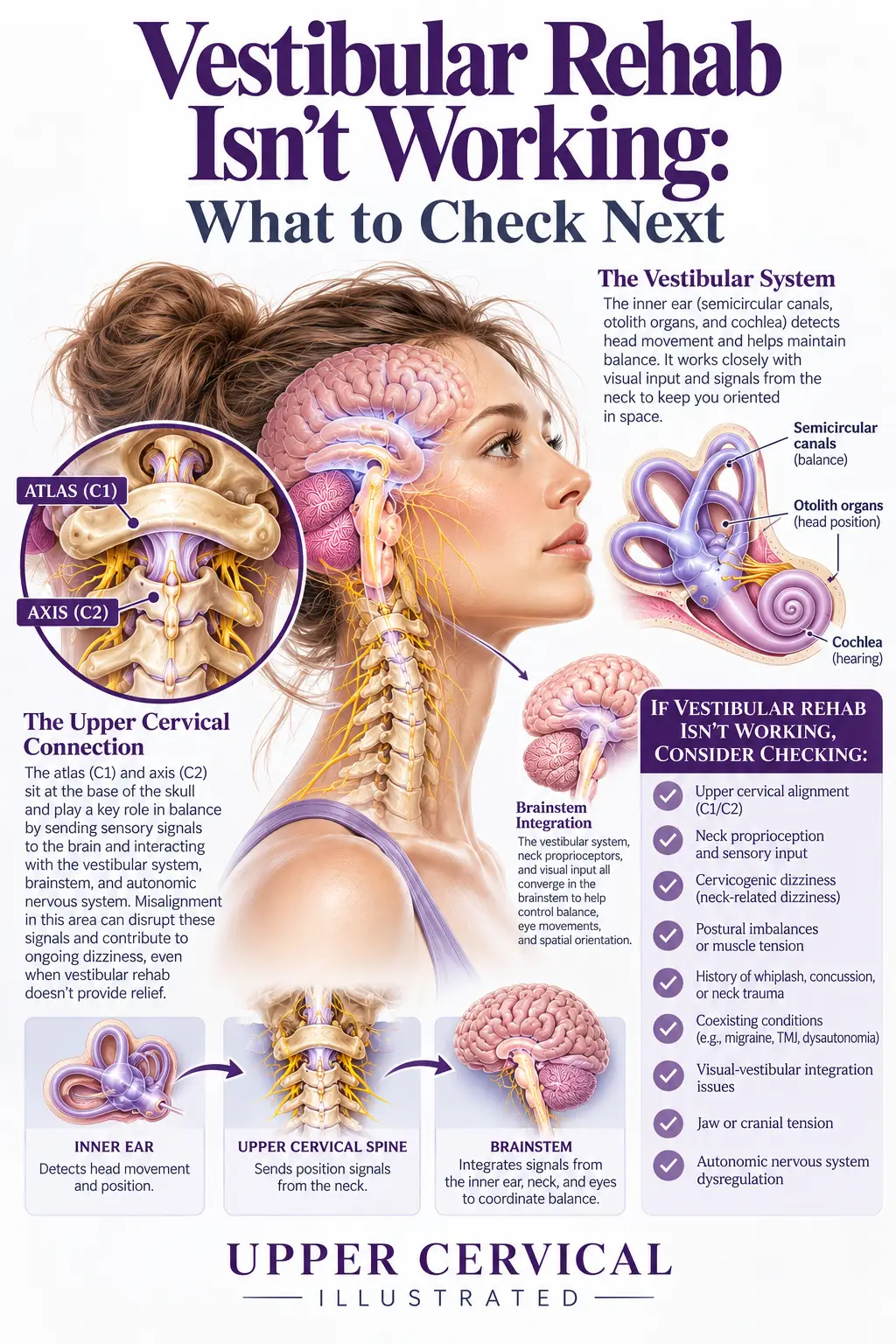
The atlas and axis form the craniocervical junction, the most mobile region of the entire spine, and the region responsible for keeping your head level and your eyes oriented to the horizon. When the atlas sits even slightly out of position, your body cannot tolerate a tilted head, because your visual and vestibular systems demand a level gaze. So the body compensates, side-bending and rotating the vertebrae below the misalignment to bring the head back toward horizontal. Those compensations propagate downward through C3, C4, C5, C6, and C7, the very levels where most painful facet degeneration occurs.
Here is the crucial consequence. The facet joints are paired, one on each side at every level. When the lower cervical spine is forced into a chronic asymmetric position to compensate for an upper cervical misalignment, the facet joints on one side are compressed and overloaded while their partners on the other side are unloaded. The overloaded facets wear faster. Their cartilage thins faster, their capsules become irritated, and bone spurs develop preferentially on that side. This is precisely the pattern seen in degenerative facet disease, where the wear is rarely symmetric. It develops more on one side than the other, and that asymmetry is a fingerprint of asymmetric loading.
In other words, a chronic upper cervical misalignment is one of the inputs that determines which facet joints wear out and become painful, and how quickly. Treating the painful facet locally, with an injection, a heat pad, or even a radiofrequency procedure that deadens its nerve supply, can quiet the symptom for a time. But if the asymmetric loading pattern that drove the wear in the first place is never addressed, the joint remains under the same uneven stress, and the pain tends to return or migrate to the next joint in line.
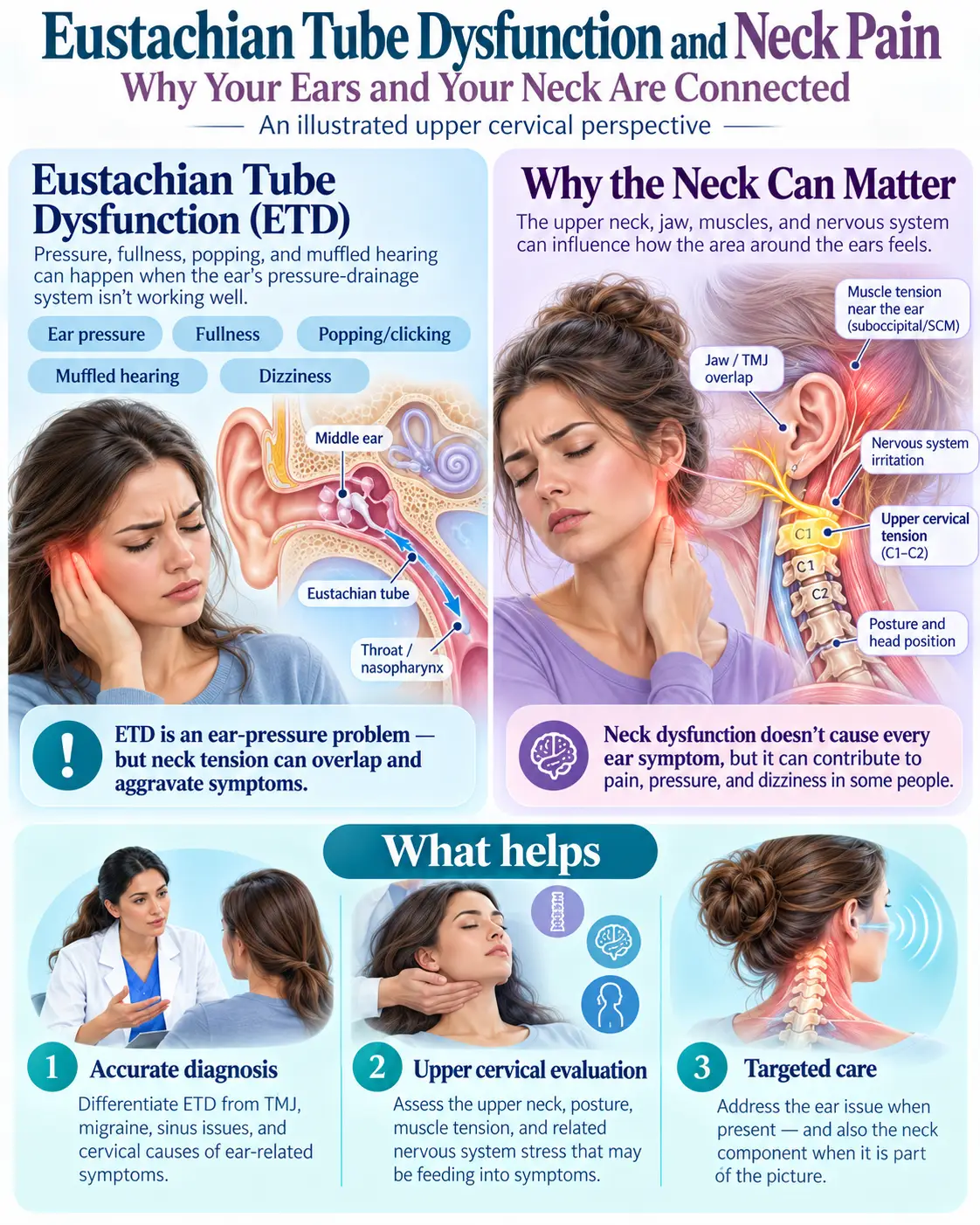
There is a second reason the upper cervical region matters. The atlas and axis surround the brainstem and are densely packed with proprioceptors, the position sensors that tell the brain where the head and neck are in space. When upper cervical alignment is compromised, the quality of that proprioceptive information degrades, muscle tone regulation becomes less precise, and the protective guarding around an irritated facet joint becomes more pronounced and more persistent. The result is a neck that is both mechanically overloaded and neurologically primed to keep guarding, a combination that perpetuates facet pain. If you also find yourself with a constant urge to crack or pop your neck at the painful spot, that urge is often the body’s attempt to mobilize a stiff, guarded facet segment, and it is another sign the same upper cervical pattern is at work.
Why Upper Cervical Care Matters for Cervical Facet Syndrome
At Lavender Family Chiropractic in Sarasota, we approach facet joint neck pain by addressing both the painful joint and the upstream loading pattern that has been driving its wear. Through the Knee Chest Upper Cervical technique, we correct atlas and axis misalignment with a precise, gentle, sub-millimeter adjustment that requires no twisting, no cracking, and no forceful rotation of the neck. This matters a great deal for facet patients, because aggressive rotational manipulation of an arthritic, irritated facet joint can aggravate it. The gentleness of the upper cervical approach is exactly what makes it appropriate when the joints below are already inflamed and sensitive.
For someone with cervical facet syndrome, restoring proper upper cervical alignment helps in several ways. First, it begins to unwind the asymmetric loading that has been silently overworking the painful facets, allowing the chronically compressed side to decompress and the worn cartilage to be loaded more evenly. Second, it improves the quality of proprioceptive input from the upper neck, which helps the nervous system reduce the protective muscle guarding that keeps the painful segment stiff and tender. Third, by restoring symmetry and motion at the top of the cervical spine, it allows the deep stabilizing muscles of the neck to resume their proper job of controlling segmental motion, which reduces the repetitive micro-stress on the facet joints during everyday movement.
What separates upper cervical care from a generic adjustment is the precision of the diagnosis and the specificity of the correction. We are not manipulating the painful, arthritic joint. We are correcting the structural foundation that has been forcing that joint to bear more than its share of load for years. This is a fundamentally different model of care, and it is why patients with longstanding facet pain who have cycled through medications, injections, and general adjustments sometimes find meaningful change only when the upper cervical driver is finally addressed.
The broader literature on manual care for the cervical spine is encouraging here. A 2025 systematic review and network meta-analysis published in Frontiers in Neurology examined manual therapy for cervicogenic headache, a condition closely tied to cervical facet dysfunction, and found that mobilization techniques directed at the cervical facet joints produced significant improvements in pain, neck disability, and range of motion, with benefits maintained over time. The review explicitly described how the mobilization works by preserving the natural arthrokinematics of the zygapophyseal joints, which is the mechanical language for restoring healthy facet joint motion. A separate systematic review in PMC comparing manual therapy to physical therapy or exercise for neck pain found that manipulation and mobilization of the cervical spine produced pain reduction and decreased disability in patients with neck pain, supporting conservative manual care as a reasonable first-line approach.
What Care Looks Like at Lavender Family Chiropractic
If you come into our Sarasota office for evaluation of facet-related neck pain, here is what to expect.
Your first visit begins with a thorough consultation. Dr. Lavender or Dr. Temple will sit down with you and review your full history: when the pain started, what triggers it, exactly where it sits and where it refers, what movements make it worse, whether you have a history of whiplash or trauma, and what treatments you have already tried. The pattern of your pain, deep, one-sided, worse with extension and rotation toward the painful side, often points clearly toward facet involvement, and we want the complete picture.
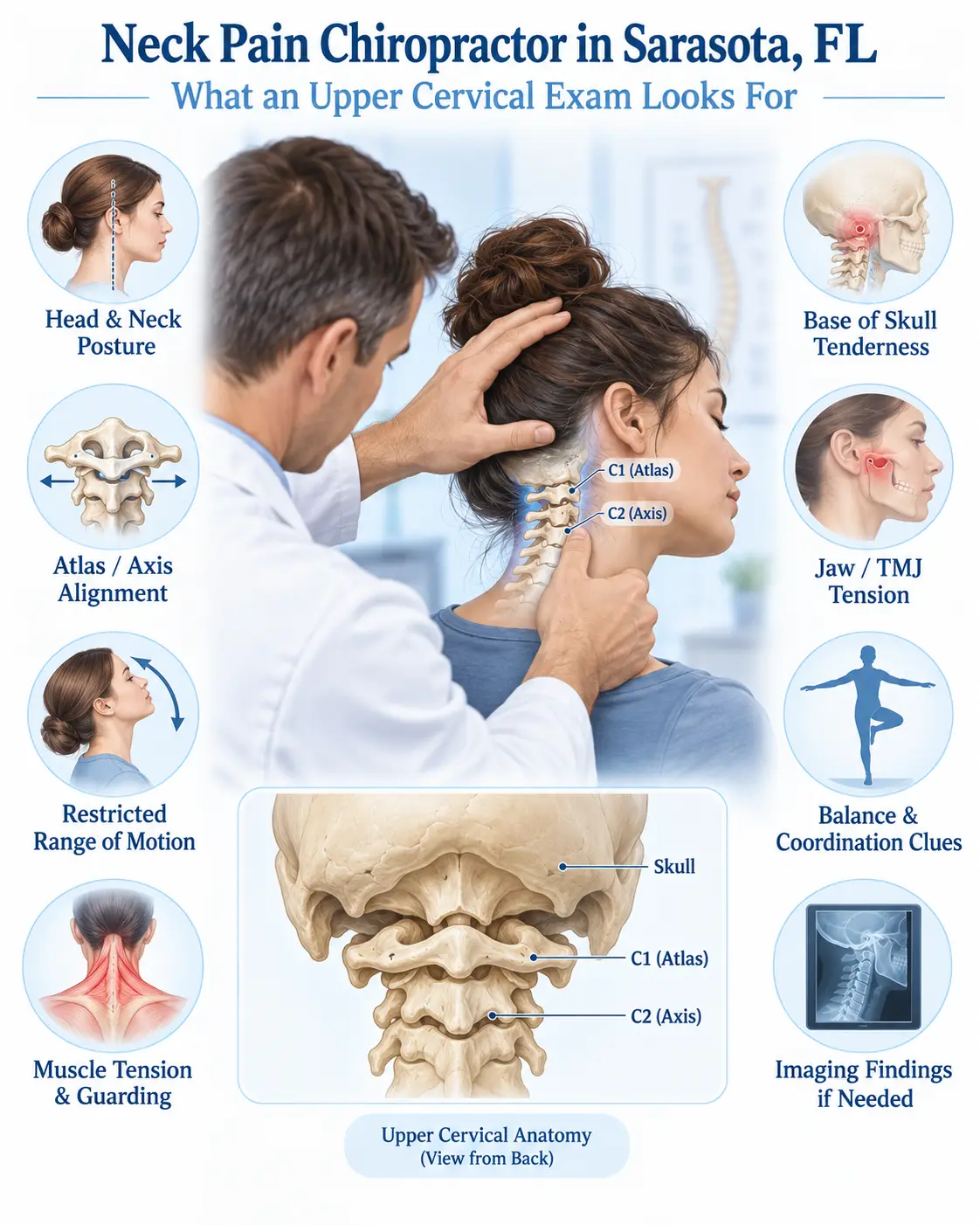
For appropriate patients, the examination includes a careful assessment of your range of motion, identification of which movements and positions provoke your pain, a neurological screen, postural analysis, and advanced 3D CBCT imaging of your cervical spine. This level of imaging is particularly valuable for facet patients because it lets us see the facet joints, joint spacing, degenerative changes, and atlas-axis alignment in three dimensions, detail that flat X-rays simply cannot provide. We also perform functional nervous system scans to objectively measure how your nervous system is operating before care begins.
If the examination reveals an upper cervical misalignment contributing to your facet loading, we will explain our findings and recommendations plainly. If your situation involves significant degenerative change, neurological deficit, or imaging findings that genuinely call for medical or surgical evaluation, we will tell you that directly and help you coordinate the appropriate care. We are not interested in keeping anyone in care who needs a different kind of help.
For patients who are appropriate candidates, care is delivered through the gentle Knee Chest Upper Cervical technique, with no popping, twisting, or rotational force, which is particularly important when the lower cervical facets are already irritated. Most patients describe the correction itself as surprisingly mild. The work the body does in response, as the loading pattern begins to normalize and the guarding begins to release, is where the meaningful change happens.
Cervical facet syndrome is a condition that has usually been developing for years, and lasting improvement comes from consistent care over time rather than a single visit. We offer customized treatment plans tailored to the severity and chronicity of your situation, and we are transparent with you about realistic timelines and what success looks like for your particular case.
📞 Call (941) 243-3729 to schedule your complimentary consultation 📅 Book your consultation online 📍 5899 Whitfield Avenue, Suite 107, Sarasota, FL 34243 — at the corner of University and Whitfield
What the Research Says About Facet Joint Pain and Conservative Care
The research on cervical facet pain has two clear threads: the facet joints are a major, well-documented source of chronic neck pain, and conservative and manual approaches have a meaningful role in managing it.
On prevalence, the evidence is consistent and striking. PM&R KnowledgeNow documents that facet joint pain accounts for roughly 36% to 67% of localized cervical pain, rising to 50–60% in whiplash-related chronic pain, and is implicated in approximately 70% of cervicogenic headaches. The prospective Pain Physician study of 500 chronic spinal pain patients found cervical facet joints to be the symptomatic source in 28% of cases. And the foundational Aprill and Bogduk work established decades ago that cervical zygapophyseal joint pain is not rare, appearing in at least 25% of patients with intractable neck pain and possibly far more. Together these establish facet pain as a legitimate, common, and clinically important driver of neck pain that deserves targeted attention rather than dismissal.
On treatment, the 2025 Frontiers in Neurology network meta-analysis found that manual therapy directed at the cervical facet joints, particularly sustained mobilization techniques, significantly improved pain, neck disability, and rotational range of motion in patients with facet-related cervicogenic headache, with effects preserved over follow-up. The systematic review in PMC comparing manual therapy to physical therapy or exercise concluded that manipulation and mobilization of the cervical spine reduced pain and disability in neck pain patients, reinforcing conservative care as a sound starting point.
It is worth being honest about the state of this evidence. Much of the high-quality treatment research studies general manual therapy and mobilization rather than upper cervical correction specifically, and the work most directly tied to facet mechanisms is often in the context of cervicogenic headache rather than isolated facet neck pain. We think it reads as more credible, not less, to say plainly that the prevalence data for facet pain is strong and well established, while the treatment evidence for conservative manual care is encouraging and growing rather than definitive. What the literature supports is clear enough to act on: facet joints are a common, real source of chronic neck pain, and gentle manual care that restores healthy joint motion is a reasonable, low-risk first-line approach.
Lifestyle Factors That Support Recovery and Protect Your Facet Joints
Whether or not upper cervical care is part of your plan, the daily inputs you control have an outsized effect on how your facet joints feel and how fast they wear. These habits are the difference between joints that calm down and joints that keep flaring.
Screen ergonomics. This is the big one for facet health. Hours spent looking down at phones, tablets, and laptops load the lower cervical facets heavily and feed the degenerative wear that drives facet pain. Bring screens up to eye level whenever possible, and take frequent breaks to move your neck gently through its range.
Sleep position and pillow. A pillow that props your head too high or lets it drop too low forces the facet joints into a sustained, stressed position for hours every night. Aim for a pillow that keeps your neck in neutral alignment, supporting the natural curve without pushing your head forward or letting it tip back. Back sleeping and side sleeping with proper support are kinder to the facets than stomach sleeping, which forces prolonged rotation.
Avoid sustained extension. Tipping your head back for long periods, whether painting a ceiling, doing overhead work, or even leaning back in a chair with your head dropped, compresses the facet joints. Be mindful of these positions and break them up frequently.
Stay gently mobile. Facet joints, like all joints, depend on movement for their health. Total immobility stiffens them and worsens guarding, while gentle, pain-free range of motion supports circulation to the joint and keeps it from locking up. Move your neck gently and often within your comfortable range.
Anti-inflammatory eating. Facet joint irritation involves inflammation, and chronic systemic inflammation makes any joint pain worse. Minimizing processed foods, refined sugars, and seed oils while emphasizing whole foods, healthy fats, omega-3-rich fish, and adequate protein supports joint and tissue health.
Hydration. The discs that share the load with your facets are roughly 80% water, and chronic dehydration accelerates the disc height loss that transfers more stress onto the facet joints. In the Florida heat this matters even more. Aim for at least half your body weight in ounces of water daily.
Manage stress and tension. Chronic stress raises baseline muscle tone throughout the neck and shoulders, increasing the compressive load on the facet joints and lowering the threshold for guarding and flare-ups. Whatever helps you regulate stress also protects your neck.
Avoid aggressive self-cracking. When a facet feels stiff, it is tempting to twist hard until it pops. This usually mobilizes the wrong, already-loose segments while the truly stiff facet stays stuck, and over time repeated forceful self-manipulation can stretch the stabilizing ligaments and worsen the underlying instability. Gentle motion helps; forceful self-cracking does not.
If you found this guide useful, you may also want to read our blog on why your neck constantly feels like it needs to pop, which explores the stiff-segment and guarding pattern that so often accompanies facet joint irritation.
Serving Sarasota and the Surrounding Communities
Lavender Family Chiropractic is located in Sarasota, Florida, at 5899 Whitfield Avenue, Suite 107, at the corner of University and Whitfield. From this central location, we serve patients throughout the region, including Bradenton, Lakewood Ranch, Palmetto, Parrish, Venice, Osprey, Nokomis, Ellenton, Ruskin, Myakka City, North Port, and the greater Tampa Bay area. Patients also travel from St. Pete, Riverview, and Manatee County to receive specialized upper cervical care here.
Facet joint pain is the kind of problem people often endure for years, cycling through treatments that quiet the symptom without addressing why the joint is overloaded in the first place. If you are tired of that cycle and want a thorough evaluation of where the upper cervical and whole-neck loading picture fits into your facet pain, we would be glad to help.
Top 15 FAQs About Cervical Facet Syndrome and Upper Cervical Chiropractic Care
1. What exactly is a facet joint? Facet joints, also called zygapophyseal or z-joints, are the small paired joints at the back of your spine that connect each vertebra to the one above and below. In the neck, they guide and limit motion and bear a share of the load, and because they are richly supplied with nerves, they can be a significant source of pain when irritated or arthritic.
2. How do I know if my neck pain is coming from a facet joint? Facet pain is typically felt deep and to one side of the neck rather than in the midline, worsens when you tip your head back or turn toward the painful side, and may refer pain into the head, shoulder blade, or upper back. A thorough examination and imaging help confirm facet involvement.
3. How common is facet joint neck pain? Very common. Depending on the study and population, cervical facet joints are the source of pain in roughly 25% to 67% of chronic neck pain cases, with the proportion rising to 50–60% after whiplash. It is one of the most common and most under-recognized sources of chronic neck pain.
4. What causes the facet joints to become painful? The main causes are age-related degeneration, in which disc height loss shifts more load onto the facets, trauma such as whiplash that injures the joint capsules, and sustained mechanical overload from poor posture and asymmetric loading. Often more than one of these is at work.
5. Why would adjusting the top of my neck help a painful joint in the lower neck? Because the atlas and axis set the alignment for the entire cervical spine. When they are misaligned, the lower cervical joints compensate with asymmetric loading that overworks the facets on one side, driving their wear and pain. Correcting the upper cervical foundation reduces that uneven loading.
6. Is upper cervical chiropractic safe for an arthritic, irritated facet joint? Yes, this is one of its advantages. The Knee Chest Upper Cervical technique is gentle and precise, with no twisting, popping, or rotational force, which makes it well suited to situations where the lower facets are already inflamed and aggressive manipulation would aggravate them. We always examine thoroughly first.
7. Will I need injections or radiofrequency procedures? Some patients pursue facet injections or radiofrequency ablation, which can reduce pain by treating the joint or deadening its nerve supply. These can help symptomatically, but they do not address the loading pattern driving the wear, which is why pain often returns or moves to the next joint. They are best considered as part of a broader strategy.
8. Can facet syndrome be cured? We are careful with that word. Degenerative changes in a facet joint do not simply reverse. What can change is how the joint is loaded, how much it is irritated, and how much pain and guarding you experience. Many patients achieve meaningful, lasting reduction in their facet pain by addressing the underlying loading pattern, even though the joint itself has some wear.
9. Is facet syndrome the same as cervical spondylosis or arthritis? They overlap. Cervical spondylosis is the broad term for age-related degeneration of the cervical spine, and facet joint arthritis is one component of it. Facet syndrome specifically refers to pain originating from those joints. You can have facet-mediated pain as part of broader spondylosis.
10. Can a car accident cause facet syndrome? Yes, and it is one of the most common causes of chronic facet pain. Whiplash injures the facet joint capsules, and facet involvement is documented in 50–60% of chronic post-whiplash neck pain. Our car accident chiropractic care addresses the whole-cervical-spine picture that trauma patients need.
11. Why does my facet pain refer into my head or shoulder blade? Because the facet joints have characteristic referral patterns. Upper cervical facets refer pain into the head and base of the skull, middle facets into the neck, and lower facets into the shoulder and upper back. This referred pain is a major reason facet syndrome is so often misdiagnosed.
12. Can stress make facet pain worse? Yes. Chronic stress raises muscle tension throughout the neck, increasing compressive load on the facet joints and lowering the threshold for flare-ups and guarding. Stress management is an underrated part of recovery.
13. Does posture really matter that much? It matters enormously. Sustained forward head posture and looking down at devices dramatically increase the load on the lower cervical facets, accelerating their wear and provoking pain. Addressing posture and the underlying alignment that drives it is central to lasting relief.
14. How will I know if upper cervical care is right for me? The only way to know for certain is a thorough evaluation. Our examination, including 3D imaging and functional scans, will show whether an upper cervical misalignment is contributing to your facet loading. If it is, we will explain exactly what we recommend. If your situation calls for a different kind of care, we will tell you honestly.
15. How do I get started? Call our Sarasota office at (941) 243-3729 or book your consultation online. We will review your history, perform a thorough examination, screen for any red flags, and give you a straight answer about how upper cervical care fits into calming your facet pain and reducing the loading pattern behind it.
Take the Next Step Toward Natural Neck Pain Relief
Cervical facet syndrome is not something you simply have to live with, and it is rarely the random, unexplained ache it gets dismissed as. It is a specific mechanical problem in specific joints, driven in large part by how your cervical spine is loaded, and that loading is shaped by the alignment of the spine above it. The people who get lasting relief are the ones who address not just the painful joint but the upstream pattern that has been wearing it down, alongside the daily habits that either protect the facets or keep stressing them.
If you are in Sarasota, Bradenton, Lakewood Ranch, or anywhere in the surrounding region and you are dealing with deep, one-sided neck pain that flares when you tip your head back or turn toward the sore side, Dr. Rusty Lavender and Dr. Jacob Temple at Lavender Family Chiropractic are here to help you understand the upper cervical piece of the picture and chart a path toward natural neck pain treatment that addresses the cause, not just the symptom.
📞 Call (941) 243-3729 today to schedule your complimentary consultation 📅 Book online here 📍 5899 Whitfield Avenue, Suite 107, Sarasota, FL 34243 — at the corner of University and Whitfield
Related Articles
- Neck Pain in Sarasota, Florida
- Why Does My Neck Feel Like It Needs to Pop?
- Pinched Nerve in the Neck (Cervical Radiculopathy) in Sarasota, Florida
- Cervical Spondylosis (Neck Arthritis) in Sarasota, Florida: Understanding Age-Related Neck Degeneration and Natural Neck Pain Relief at Lavender Family Chiropractic
Get our upper cervical articles first.