Vestibular Migraine vs PPPD: When Dizziness Becomes Constant — and the Neck at the Center of It
By Dr. Rusty Lavender — Lavender Family Chiropractic, Sarasota, FL
You have tried to describe your dizziness and watched the doctor’s pen hover uncertainly over the chart. “Dizzy” can mean a spinning room, a swimming head, a rocking deck under your feet, a fog that never lifts, or a queasy lurch every time you turn your head. Two conditions dominate this story — vestibular migraine (VM) and persistent postural-perceptual dizziness (PPPD) — and here is the part almost no one tells you: one usually sets the other in motion, and both are generated in the brainstem, which sits directly on top of the two most injury-prone vertebrae in your body, the atlas (C1) and axis (C2). The single region with the most direct neurological line into the circuits that fuel migraine and imbalance — the top of your neck — is almost always the one place your workup never examined.
This article will help you understand what separates these two conditions, where they blur together, and what evidence-based care looks like. But it will also do what the hedged articles will not: it will name the overlooked structural driver at the top of your neck — the piece that can be the reason your dizziness started and the reason it will not leave. If your dizziness began or worsened after a whiplash, a concussion, or a fall, read closely, because that history points straight at the root. We care for people across Sarasota, Lakewood Ranch, and Bradenton who have spent years chasing this exact problem.
Why This Distinction Is So Hard — and So Important
The human balance system is a marvel of redundancy. Your brainstem constantly blends three streams of information: the inner ear (which senses head motion and gravity), your eyes (visual input about where you are in space), and proprioception (position sense from muscles and joints — including the small, densely-innervated muscles at the top of your neck). When the three inputs agree, you feel steady and never think about balance. When they disagree — or when the brainstem’s interpretation of them goes awry — you feel dizzy, unsteady, or disoriented.
Vestibular migraine and PPPD both live in that interpretive layer of the brainstem. Neither is caused by a tumor or a structural catastrophe in most cases. Both are, at their core, disorders of how the brainstem processes and responds to balance information. That shared territory is exactly why they get confused, why they overlap, and why so many people bounce from specialist to specialist for years. It is also why the one structure feeding the most concentrated proprioceptive signal into that brainstem — the upper cervical spine — belongs at the center of the conversation, not off to the side.
Getting the distinction right is not academic. The treatments differ, and a plan built for the wrong diagnosis can leave you frustrated and no better. Worse, when the two coexist — which is common — treating only one can leave the other quietly driving your symptoms. And treating neither at the structural source can leave both of them fed by an irritated upper neck no one ever checked.
Vestibular Migraine: When the Brainstem’s Migraine Machinery Affects Balance
Most people think of migraine as a headache, and it often is. But migraine is fundamentally a brain and brainstem condition — a state of heightened sensitivity in which the nervous system overreacts to ordinary stimuli like light, sound, motion, and stress. In some people, that same underlying migraine biology expresses itself through the balance system, producing vestibular migraine.
What vestibular migraine feels like
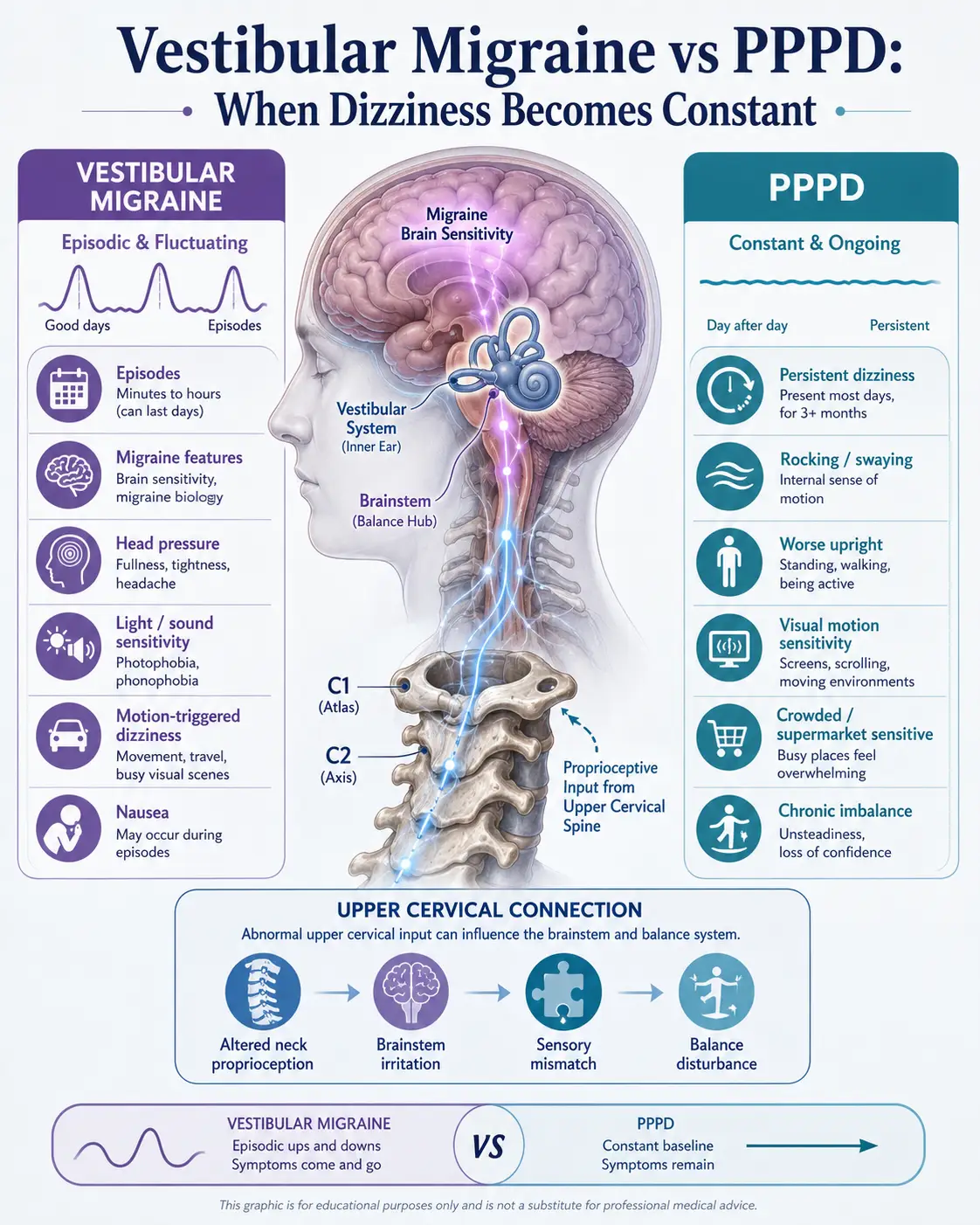
The hallmark is episodic vertigo — discrete attacks that come and go. During an attack you might experience:
- A spinning sensation (true vertigo), or a feeling of internal or external motion
- A sense of being pushed, rocked, or tilted
- Worsening dizziness with head movement
- Nausea, sometimes vomiting
- Sensitivity to light, sound, or smells
- Visual aura or other migraine features
- Difficulty concentrating or a “brain fog” during and after the episode
These attacks last anywhere from a few minutes to several hours, sometimes up to a couple of days. Crucially, a headache does not have to be present. Many people with vestibular migraine have attacks with no head pain at all, which is a big reason it goes undiagnosed for so long. Others have a personal or family history of classic migraine that offers a clue.
How vestibular migraine is diagnosed
There is no blood test or scan that confirms it. It is a clinical diagnosis based on the pattern of symptoms, using criteria developed by international experts: recurrent episodes of vestibular symptoms of moderate or greater intensity, a current or past history of migraine, migraine features accompanying at least some episodes, and the exclusion of other causes. Triggers often mirror classic migraine — irregular sleep, skipped meals, dehydration, hormonal shifts, certain foods, weather changes, and stress. Between attacks, many people feel completely normal, and that “normal in between” quality is one of the features that helps distinguish VM from PPPD.
The neuroanatomy that names the driver
Here is what the standard VM-vs-PPPD articles never explain. The trigeminal nerve — the central player in migraine — shares a nucleus in the brainstem with the sensory nerves of the upper neck, C1 through C3. This shared relay is the trigeminocervical nucleus, and the merging of head and neck signals onto the same neurons is trigeminocervical convergence. It means the upper cervical spine has a direct line into the exact brainstem circuitry that generates migraine and integrates balance. When the atlas, axis, or craniocervical junction is misaligned or irritated, it can flood that relay with abnormal signals, raising the excitability of a migraine-prone brainstem and helping tip it into an attack. That is a plausible, mechanism-based reason the upper cervical spine can be a genuine driver of vestibular migraine — and the attacks it drives are often exactly what sets PPPD in motion.
PPPD: When Dizziness Stops Leaving
Persistent postural-perceptual dizziness, usually shortened to PPPD (“three-P-D”), is a different animal. Where vestibular migraine comes in waves, PPPD is chronic, day-in and day-out. It was formally defined in 2017 by an international committee to unify several older, overlapping concepts (chronic subjective dizziness, phobic postural vertigo, visual vertigo) under one clear diagnosis.
What PPPD feels like
PPPD is dizziness, unsteadiness, or non-spinning vertigo present on most days for three months or more. The key word is non-spinning. People with PPPD rarely describe a room whirling. Instead:
- A constant swaying, rocking, or bobbing sensation, as if on a boat or dock
- A feeling of internal unsteadiness or “lightheaded fog”
- A sense that the ground is not quite solid
What makes PPPD recognizable is how it gets worse. Symptoms intensify with three particular provocations:
- Upright posture. Standing and walking feel worse than lying down.
- Active or passive motion. Your own movement or being moved (riding in a car) aggravates it.
- Complex or moving visual stimuli. Busy patterns, scrolling screens, grocery aisles, crowds, traffic, and large visual scenes can trigger or worsen symptoms — sometimes called visual dependence, where the brain leans too heavily on vision to feel stable and then gets overwhelmed by it.
Many people with PPPD develop understandable avoidance behaviors — they stop driving on the highway, avoid supermarkets, limit screen time, and move stiffly. Ironically, that caution tends to reinforce the condition rather than relieve it.
How PPPD begins
One of the most illuminating things about PPPD is how it starts. It almost always follows a precipitating event — something that acutely disrupted balance or triggered alarm about balance. Common triggers include:
- An episode of vertigo from another vestibular condition (BPPV, vestibular neuritis, or Meniere’s disease)
- A vestibular migraine attack
- A panic attack or a period of acute anxiety
- A concussion or head injury
- A medical illness or fainting spell
Here is the central insight: the original trigger resolves, but the dizziness does not. The brainstem, in effect, gets “stuck” in a high-alert, threat-monitoring posture. It keeps bracing for the next episode, over-relies on visual and postural cues, and stiffens the body’s movement strategies. The result is a self-sustaining loop that outlives its original cause. This is why PPPD is called a functional disorder — the hardware is largely intact, but the software (how the brainstem processes balance information) has developed a maladaptive pattern.
Notice how many of those triggers involve the head and neck directly — a concussion, a head injury, a vestibular migraine attack driven by the trigeminocervical system. That is not a coincidence, and it points toward the region these events have in common.
Where VM and PPPD Overlap — and Why They Travel Together
This is the part that surprises many patients: vestibular migraine and PPPD are not rival diagnoses you must choose between. They frequently coexist, and one very often precipitates the other.
Think about it mechanistically. Vestibular migraine produces exactly the kind of frightening, disorienting vertigo attacks that can prime the brainstem to become hypervigilant about balance. A person who has had several unpredictable, nausea-inducing vertigo episodes learns — understandably — to fear the next one. That hypervigilance is precisely the soil in which PPPD takes root. So a person can start with episodic vestibular migraine attacks and gradually develop a layer of constant, daily PPPD dizziness on top of them.
The two also share underlying tendencies. Both involve heightened sensitivity of the brainstem’s sensory-processing networks. Both are worsened by stress, poor sleep, and visual overload. It is not surprising they cluster together. Clinically, this creates a layered picture:
- The episodic layer (vestibular migraine): discrete attacks of spinning or motion, often with migraine features, with relatively good days in between.
- The constant layer (PPPD): daily non-spinning dizziness, worse upright, with motion, and in visually busy environments, that persists between attacks.
When someone has both, the best plans address both. And when you follow the chain back — PPPD fed by VM attacks, VM attacks fed in part by an irritated upper cervical spine — you arrive at a structural root that sits underneath the whole cascade and rarely gets examined.
A Side-by-Side Comparison
To make the distinction concrete, here is how the two typically differ. Remember that real patients do not always read the textbook, and overlap is common.
| Feature | Vestibular Migraine (VM) | PPPD |
|---|---|---|
| Pattern | Episodic attacks | Constant, most days for 3+ months |
| Quality of dizziness | Often true spinning vertigo or strong motion | Non-spinning: swaying, rocking, unsteadiness, fog |
| Between episodes | Often symptom-free | Persistent, no true symptom-free stretches |
| Worse with upright posture | Variable | Characteristically yes |
| Worse with self/passive motion | During attacks | Characteristically yes |
| Worse with busy visual scenes | Sometimes | Characteristically yes |
| Migraine features (light/sound sensitivity, headache, aura) | Common | Not required; may be absent |
| Typical trigger to onset | Migraine biology, classic migraine triggers | A precipitating event (often another vestibular episode, including a VM attack) |
| Underlying nature | Neurological (migraine) disorder affecting balance | Functional disorder of balance processing |
What Genuinely Helps: Evidence-Based Care
Clarity about the diagnosis pays off, because the two conditions have different (though sometimes complementary) treatment emphases.
Evidence-based care for vestibular migraine
Because vestibular migraine is fundamentally a migraine disorder, its management borrows heavily from migraine care and is directed by a neurologist or headache/vestibular specialist:
- Trigger identification and lifestyle regulation: consistent sleep, regular meals, hydration, stress management, moderating dietary triggers.
- Preventive strategies to reduce the frequency and severity of attacks.
- Acute strategies to manage symptoms during an attack.
- Vestibular rehabilitation in some cases, particularly with lingering imbalance or coexisting PPPD.
The goal is a reduction in how often and how hard the attacks hit — which also lowers the risk that ongoing attacks will feed a PPPD layer.
Evidence-based care for PPPD
PPPD has a well-defined, evidence-supported treatment triad, and many people are never told these options exist:
- Vestibular rehabilitation therapy (VRT): a specialized, graded program of exercises with a trained physical therapist. Rather than avoiding provoking movements and environments, VRT gradually and safely re-exposes the brain to them, retraining it to trust normal balance signals and reduce over-reliance on vision.
- Certain antidepressant medications — SSRIs and SNRIs: used here not primarily as antidepressants but because they help recalibrate the sensory-processing and threat-monitoring networks involved in PPPD. Prescribed and monitored by a physician.
- Cognitive behavioral therapy (CBT): a structured therapy that addresses the anxiety, hypervigilance, and avoidance behaviors that keep the PPPD loop spinning. CBT is not “it’s all in your head” — it is a targeted way to interrupt the brainstem’s maladaptive balance-threat response.
These three are often combined and work well together. Recovery from PPPD is usually gradual, and setbacks are normal. These are the backbone of care — and, importantly, they address the software while leaving open the question of what noisy structural input may be feeding it.
What the Research Says
I want to be careful and specific here, because in the dizziness world there is a lot of confident-sounding information that is not well supported. The following reflects what the peer-reviewed literature actually establishes.
PPPD was given a formal, unifying definition in 2017 by the Bárány Society, the international body that sets diagnostic standards for vestibular disorders. Their consensus document laid out the diagnostic criteria — dizziness, unsteadiness, or non-spinning vertigo present most days for three or more months, worsened by upright posture, motion, and complex visual stimuli, typically triggered by an event that caused acute dizziness — and consolidated older labels like chronic subjective dizziness and phobic postural vertigo into one clear diagnosis (Staab et al., Journal of Vestibular Research, 2017).
Vestibular migraine was similarly given formal diagnostic criteria by an expert consensus of the Bárány Society and the International Headache Society, defining it as recurrent vestibular symptoms of at least moderate intensity, in a person with a history of migraine, with migraine features accompanying the episodes (Lempert et al., Journal of Vestibular Research, 2012). These criteria are the reason clinicians can now recognize dizziness-predominant migraine that would once have been dismissed or mislabeled.
The connection between the two conditions is an active and important area of study. A 2023 review examined the shared mechanisms linking vestibular migraine and PPPD, exploring how the two relate at the level of the brain’s sensory and emotional processing networks and why they so often occur together in the same patient (Frontiers in Neurology, 2023). The overarching theme is that both involve altered central processing and a nervous system biased toward interpreting balance signals as threatening.
That episodic vestibular disorders can precipitate PPPD is well documented. A 2022 study looked specifically at how PPPD develops in the wake of episodic vestibular conditions — including vestibular migraine — showing how an acute vestibular event can trigger the persistent, self-sustaining dizziness that defines PPPD (Audiology Research, 2022). This is the clinical reality behind the observation that VM often “sets up” PPPD.
Finally, the overlap can be so tight that distinguishing chronic vestibular migraine from PPPD is genuinely challenging, and researchers have asked whether, in some patients, we are describing two faces of a closely related process. A 2023 paper directly took up this question — “What’s in a Name? Chronic Vestibular Migraine or Persistent Postural Perceptual Dizziness?” — examining the diagnostic gray zone and the practical implications for treatment (Brain Sciences, 2023). The takeaway for patients: careful, expert evaluation matters, and it is entirely reasonable for a thoughtful clinician to consider that both processes may be present — and to ask what upstream driver, including the upper cervical spine, may be feeding both.
The Overlooked Root: The Upper Cervical Spine
Now let me address the question that likely brought you to a chiropractor’s article in the first place: does the neck have anything to do with all this? The honest, cause-forward answer is yes — more than the standard articles will admit.
The upper cervical spine — the top two vertebrae just beneath the skull — is one of the richest sources of proprioceptive (position-sense) information in the entire body. Those signals feed directly into the same brainstem and cerebellar circuits that integrate inner-ear and visual input for balance. On top of that, the C1–C3 nerves converge with the trigeminal system in the trigeminocervical nucleus, giving the upper neck a direct line into the migraine machinery that drives vestibular migraine. So the upper cervical spine touches both conditions: it can feed the migraine attacks that ignite VM, and it can pour the mismatched proprioceptive signals that keep a sensitized, PPPD-prone brainstem stuck in threat mode.
Consider how PPPD so often begins — after a concussion, a head injury, or a vestibular migraine attack. Those are precisely the events that destabilize the atlas and axis, the vertebrae held mostly by ligaments rather than interlocking bone. This is also the segment most damaged by whiplash and years of forward-head posture over a screen. Put it together and a pattern emerges: for a meaningful number of people, an irritated upper cervical spine can be a primary driver sitting underneath the entire VM-to-PPPD cascade. It is not a side note. It can be the missing piece — and it is the one region that migraine medications, vestibular rehab, SSRIs, and CBT all leave structurally untouched.
None of this replaces evidence-based care. Keep your neurologist, your vestibular therapist, and your CBT. But if you have “done everything right” and still cannot get steady, the honest question is whether anyone has evaluated the structural root at the top of your neck — because in most cases, no one has.
What Upper Cervical Care Actually Is, at Our Office
At Lavender Family Chiropractic (NeckWise North Sarasota), our approach is precise, gentle, and low-force. There is no twisting, cracking, or popping. We use 3D CBCT imaging (cone-beam computed tomography) to understand your individual upper cervical anatomy in three dimensions, paraspinal infrared thermography to read how your nervous system is behaving along the spine, and a low-force Knee Chest Upper Cervical technique. When the top of the neck is a relevant factor, the goal is to restore more accurate signaling into the brainstem — addressing a genuine driver at the source.
If your history and imaging point to a misalignment feeding your balance circuitry, we will explain exactly how and address it gently. If the neck is not a meaningful factor for you, we will tell you that too, and help point you toward the care most likely to help.
Red Flags: When Dizziness Needs Urgent Attention
Most dizziness is not dangerous, but some patterns demand prompt medical evaluation. Seek urgent or emergency care if your dizziness comes with any of the following:
- Sudden, severe headache unlike any you have had before (“the worst headache of my life”)
- Sudden weakness, numbness, or drooping on one side of the face or body
- Slurred speech, trouble speaking, or difficulty understanding others
- Sudden vision loss, double vision, or trouble with eye movements
- Difficulty walking, severe loss of coordination, or inability to stand
- New, sudden hearing loss in one ear
- Fainting, chest pain, or an irregular or racing heartbeat
- Dizziness following a significant head or neck injury
- High fever with a stiff neck
- Numbness or tingling that is spreading, or difficulty swallowing
These can signal conditions — such as stroke — that require immediate treatment. When in doubt, call 911 or go to the nearest emergency department. A chiropractic office is not the right first stop for these symptoms.
Top Questions
Can I have both vestibular migraine and PPPD at the same time? Yes, and it is common. A frequent pattern is that vestibular migraine attacks come first, and then a layer of constant, daily PPPD dizziness develops on top because the brainstem becomes hypervigilant. When both are present, the most effective plans address both — and evaluating the upper cervical spine, which can feed both, is a rational part of that.
How can I tell which one I have? The clearest clue is the pattern. Vestibular migraine comes in discrete attacks with relatively normal stretches in between, often with migraine features. PPPD is constant — most days for three months or more — non-spinning, and worse when you are upright, moving, or in busy visual environments. The two overlap, so a proper evaluation is the reliable way to sort it out.
Does PPPD mean the dizziness is “all in my head”? No. PPPD is a real, recognized, physiological condition. It is called functional because the problem lies in how the brainstem processes balance information, not in a visible structural injury — but that processing is genuinely altered, and the dizziness is genuinely experienced. It also responds to specific, evidence-based treatments.
What actually treats PPPD? The evidence-based triad is vestibular rehabilitation therapy, certain SSRI/SNRI medications (prescribed and monitored by a physician), and cognitive behavioral therapy. These are often combined, and recovery is gradual. Addressing a genuine upper cervical driver, where present, can be a complementary piece of that plan.
My dizziness started after a concussion or car accident. Does that matter? Enormously. Those are classic PPPD triggers, and they are also exactly the traumas that destabilize the atlas and axis at the junction feeding the brainstem’s balance and migraine circuits. That history points straight at the upper cervical spine as a driver worth evaluating.
Is the upper cervical technique you use forceful? No. Our approach is precise, gentle, and low-force, with no twisting, cracking, or popping. We use detailed 3D imaging and assessment to individualize care.
Should I stop avoiding the things that make me dizzy? For PPPD specifically, avoidance tends to reinforce the condition, and gradual, guided re-exposure through vestibular rehabilitation is a cornerstone of recovery. Do this under a trained therapist’s guidance, not by pushing yourself into distress alone.
How long does it take to feel better? It varies. Vestibular migraine management is often measured over weeks to months as attack frequency comes down. PPPD recovery is also gradual, with normal setbacks along the way. Consistency with a sound plan matters more than speed.
The Bottom Line
Living with dizziness that will not leave — or that keeps ambushing you in waves — is exhausting, isolating, and frightening. Both vestibular migraine and PPPD are increasingly well understood, and both have real, evidence-based paths toward feeling steadier. The first step is an accurate diagnosis, because the right plan depends on knowing which condition (or which combination) you are dealing with.
But do not stop at the label. Both conditions play out in the brainstem, and the brainstem sits on top of the two most vulnerable vertebrae in your body. The upper cervical spine can feed the migraine attacks that start the cascade and the mismatched signals that keep it going. For a great many people — especially those whose dizziness followed a whiplash, concussion, or fall — that structural root at the top of the neck is the missing piece, and it is the one place no one has looked.
Serving Sarasota, Lakewood Ranch & Bradenton
Lavender Family Chiropractic (NeckWise North Sarasota) proudly serves patients throughout Sarasota, Lakewood Ranch, and Bradenton, along with Palmetto, Ellenton, Parrish, Osprey, Nokomis, Venice, and the surrounding Suncoast communities. If dizziness has become a constant companion, we would be glad to listen, help you understand the difference between conditions like vestibular migraine and PPPD, and evaluate whether the upper cervical spine is the structural driver your workup skipped.
If you live in Sarasota, Lakewood Ranch, or Bradenton and your dizziness followed a head or neck injury, that is exactly the pattern we want to see. We invite you to schedule a complimentary consultation with our doctors.
Lavender Family Chiropractic (NeckWise North Sarasota) 5899 Whitfield Avenue, Suite 107 Sarasota, FL 34243 Phone: (941) 243-3729
This article is for general educational purposes only and is not a substitute for individualized medical advice, diagnosis, or treatment. Vestibular migraine and PPPD require evaluation and management by qualified medical providers. If you are experiencing any of the red-flag symptoms described above, seek emergency care immediately.