TMJ vs Trigeminal Neuralgia: Two Facial Pains, One Nerve System, and the Neck in Between
By Dr. Rusty Lavender — Lavender Family Chiropractic, Sarasota, FL
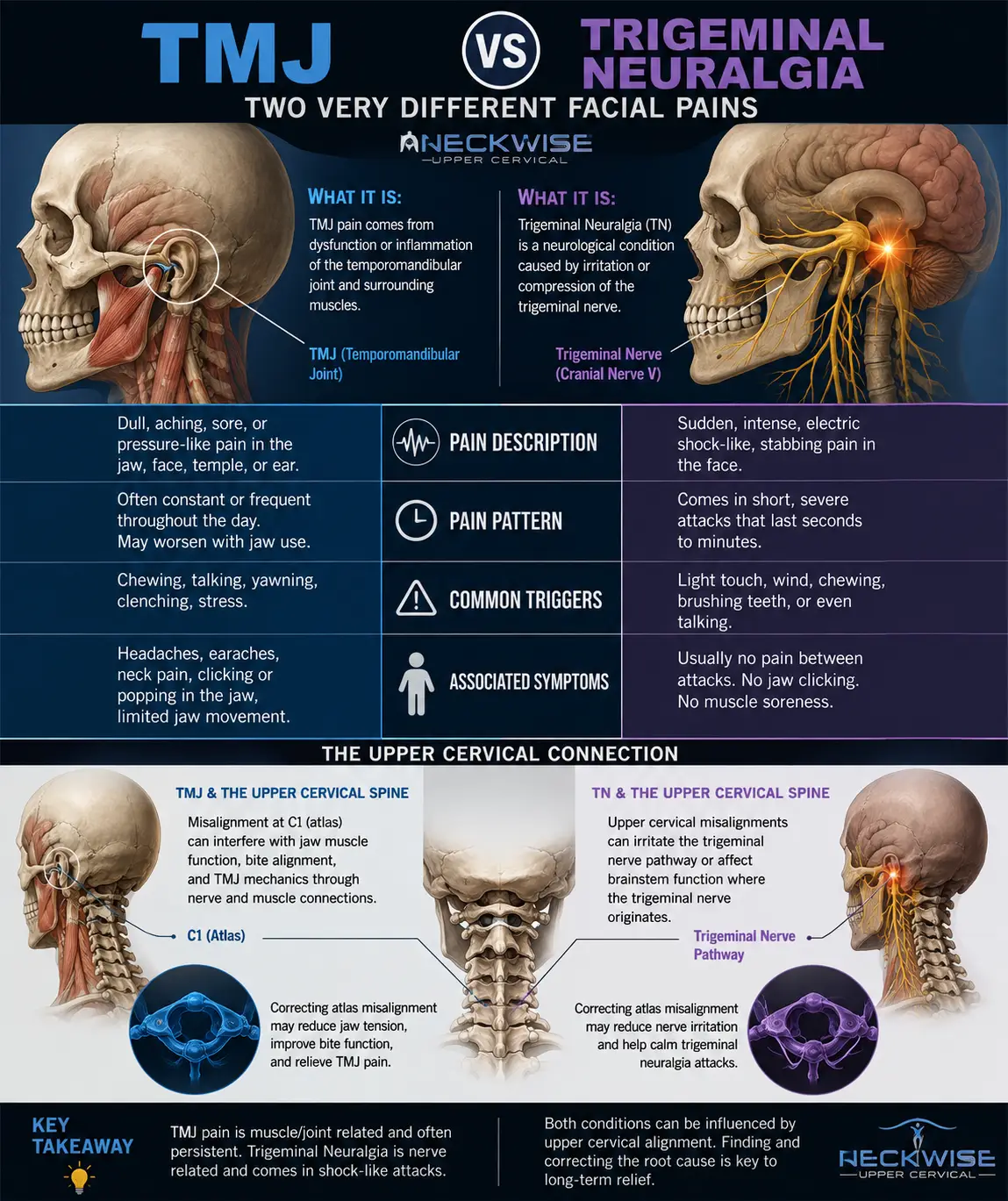
Facial pain sends people bouncing between a dentist, a physician, and the internet at 2 a.m. — and two of the most confused culprits are temporomandibular disorders (TMD, the “TMJ” everyone talks about) and trigeminal neuralgia (TN). They can live in the same corner of the face, and patients across Sarasota, Lakewood Ranch, and Bradenton routinely arrive having been told one when the picture actually fits the other. Getting that call right is the single most important thing you can do. But there is a second truth that rarely makes it into the conversation: both of these pains run through the trigeminal nerve, and the trigeminal nerve converges with the nerves of your upper neck in the brainstem. For the mechanical, muscle-and-joint pain of TMD, that upper cervical junction — the atlas and axis that position your head and jaw — is an overlooked driver that almost no one examines.
Let me be clear up front, because it matters: this article is not going to blur the line that keeps you safe. Trigeminal neuralgia is a serious neurological condition that requires proper medical diagnosis, often including MRI imaging, and physician-led management. Upper cervical chiropractic care is not a treatment for it. What this article will do is help you tell these two pains apart, show you what the research says, and be honest about where the upper neck is a genuine driver worth evaluating — and where it does not belong at all.
The Short Version: How These Two Pains Differ
If you remember nothing else, remember this contrast, because it is how clinicians separate these conditions.
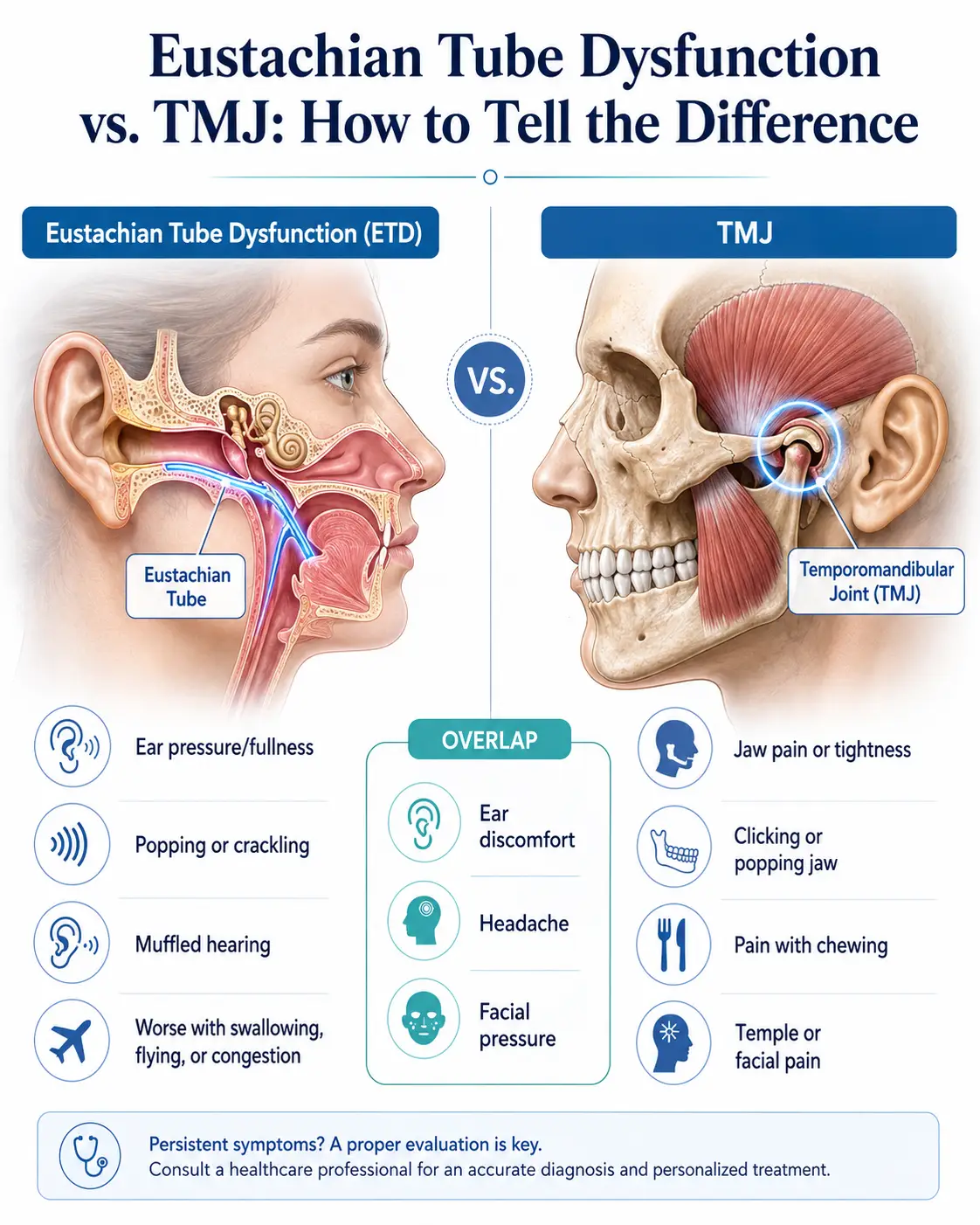
Temporomandibular disorder (TMD / “TMJ”) tends to feel like:
- A dull, aching, pressure-like pain in the jaw, cheek, temple, or in front of the ear.
- Pain that is worse with function — chewing a bagel, yawning widely, talking a long time, clenching, or grinding.
- Tenderness in the jaw muscles (the masseter along the cheek, the temporalis at the temple) or the joint itself.
- Often accompanied by clicking, popping, or grating, limited jaw opening, or a jaw that “catches” or deviates to one side.
- Pain that builds and lingers — it can ache for hours and is frequently worse in the morning after a night of clenching.
Trigeminal neuralgia (TN) tends to feel like:
- Sudden, severe, electric, shock-like, or stabbing jolts of pain.
- Brief paroxysms — each jab lasts from a fraction of a second to about two minutes — that can repeat in rapid volleys.
- Pain triggered by light, innocuous stimulation: a gentle touch, a breeze, washing your face, shaving, applying makeup, brushing your teeth, chewing, talking, or even smiling.
- Pain confined to the distribution of the trigeminal nerve — typically one side of the face, most often the cheek and jaw region.
- Often periods of complete freedom from pain between attacks, at least early on.
Put simply: TMD is a dull, mechanical, muscle-and-joint ache that worsens the more you use your jaw. TN is a sudden electric shock set off by a feather-light trigger. Real patients don’t always read the textbook, and the two can overlap or coexist — but that core contrast is where diagnosis begins.
Why Both Conditions Involve the Trigeminal System
To understand why these two pains get confused, know a little about the trigeminal nerve — cranial nerve V, the great sensory highway of the face and a central player in nearly all jaw pain.
The trigeminal nerve carries sensation from nearly your entire face and much of the inside of your mouth. It has three divisions: the ophthalmic (forehead and around the eye), the maxillary (cheek, upper jaw, upper teeth), and the mandibular (lower jaw, lower teeth, and the muscles you chew with). Because this one nerve system serves the jaw joint, the chewing muscles, the teeth, and the skin of the face, problems as different as a strained jaw muscle and an irritated nerve root can both “speak” through the same trigeminal channels.
That shared wiring is exactly why a person with TMD can sometimes describe pain that seems to shoot, and why a person with TN can have jaw-region pain a dentist first suspects is a tooth or joint problem. In fact, many people with trigeminal neuralgia see a dentist first and sometimes undergo dental procedures before the true diagnosis is recognized — one of the strongest reasons to slow down and get the picture right before anyone drills, extracts, or performs an irreversible procedure.
The trigeminocervical convergence — where the neck enters the picture
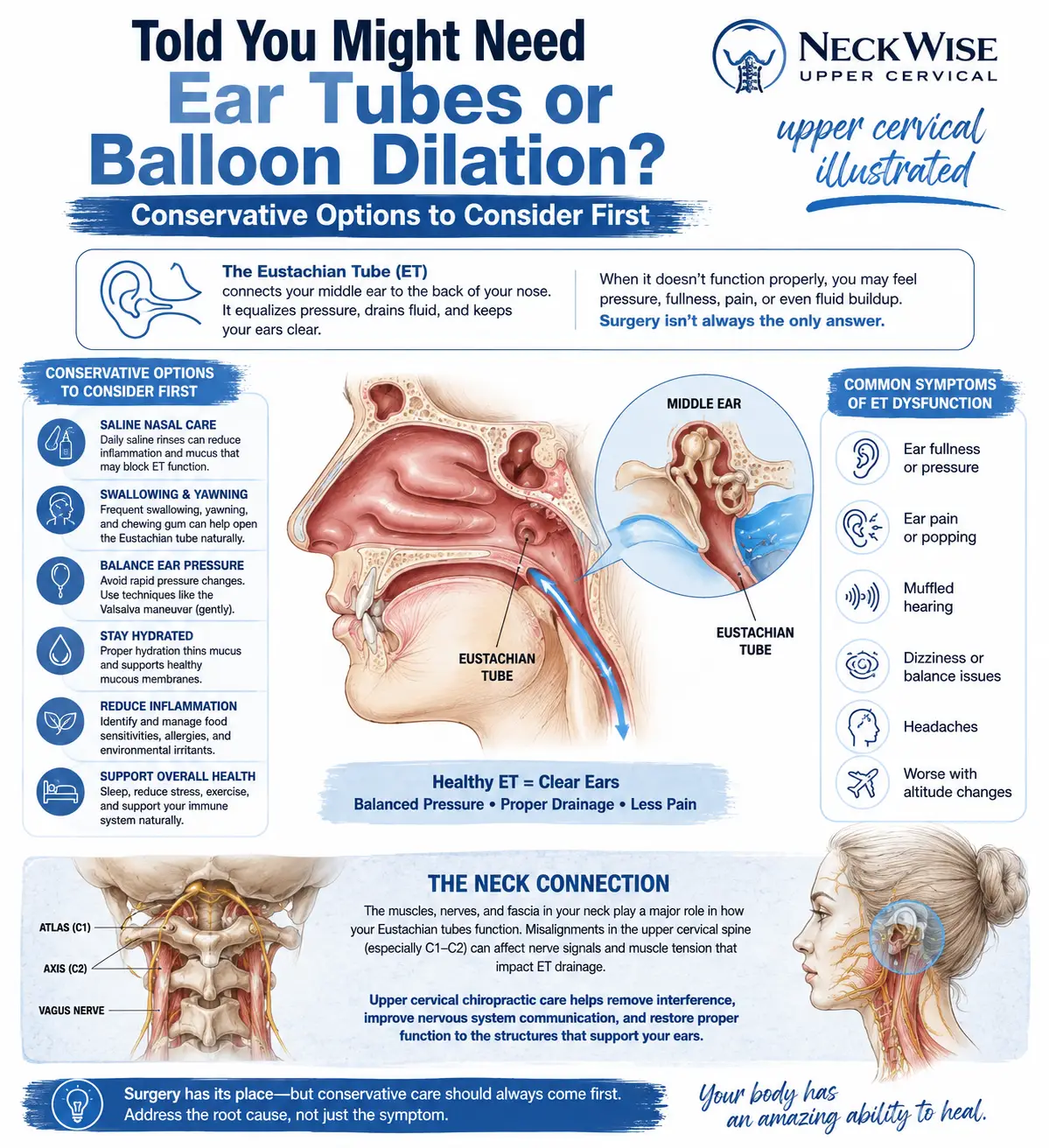
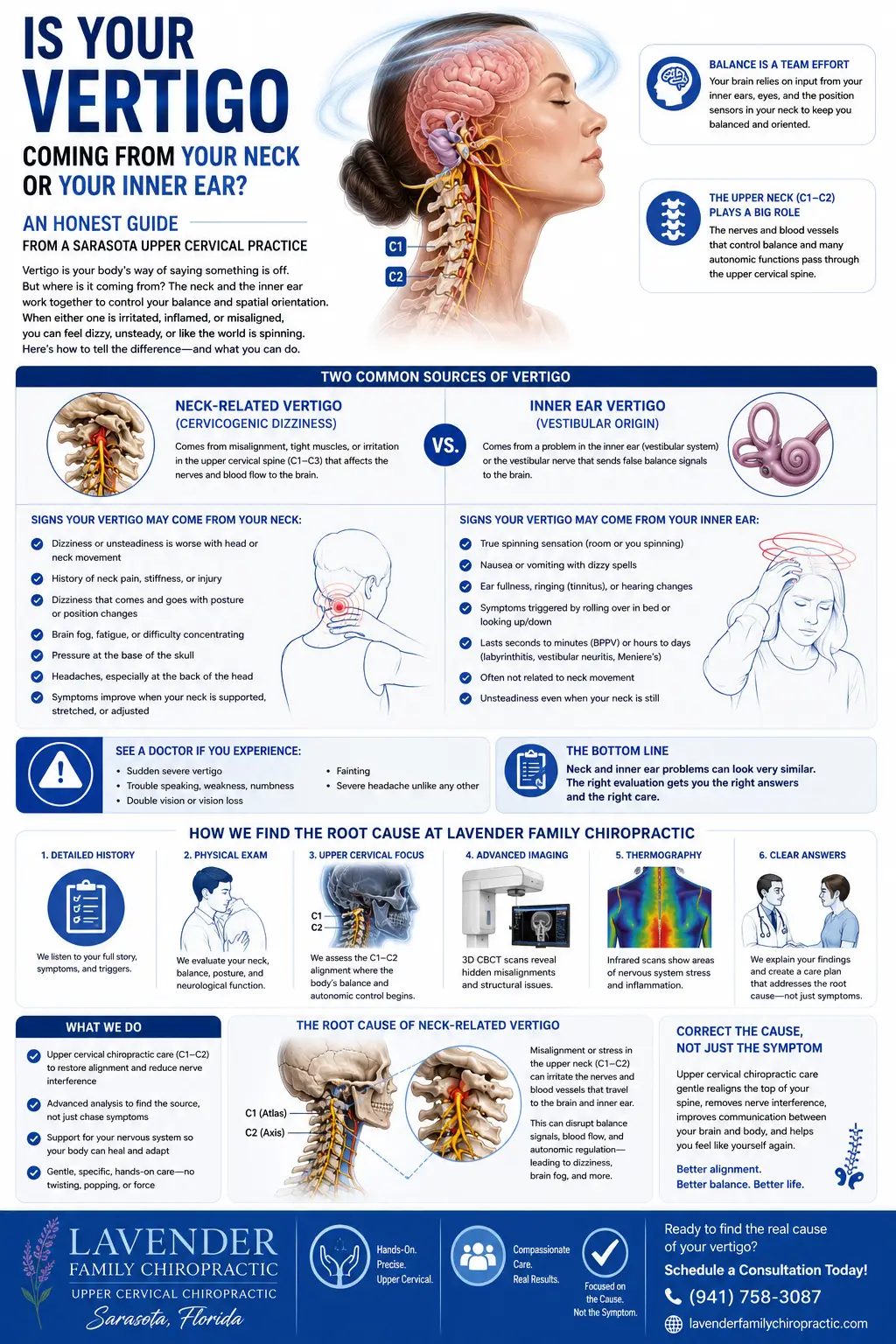
Here is the anatomical relationship that drives the rest of this discussion. The sensory nerves of the upper neck — the first three cervical segments, C1, C2, and C3 — feed into an overlapping region in the brainstem alongside the trigeminal nerve, called the trigeminocervical complex. In plain terms, the top of your neck and your face share the same sensory switchboard. This is a well-recognized reason why upper-neck problems refer pain into the head and face, and why facial pain and neck tension so often travel together.
For TMD specifically, this convergence is not a footnote — it is central. When the atlas (C1) and axis (C2) are misaligned, the head drifts into forward-head posture, the jaw’s resting position and mechanics shift, and irritated upper cervical input pours into the exact brainstem pool that also handles jaw and facial signals. The result is a nervous system feeding extra “noise” into the jaw-and-face circuit while the mechanics of the jaw are simultaneously loaded unevenly. That is why, for the mechanical facial pain of TMD, the upper cervical spine is a plausible primary driver worth evaluating — and it is the region the standard dental workup never touches.
Temporomandibular Disorders (TMD), in Depth
“TMJ” is the nickname, but technically the TMJ is just the joint — the temporomandibular joint that connects your lower jaw to your skull, just in front of each ear. The umbrella term for the painful conditions affecting this joint and its muscles is temporomandibular disorders (TMD).
What TMD feels like
Most TMD pain is myofascial — it comes from the chewing muscles rather than the joint itself. People describe a deep, tiring ache in the cheek, temple, or angle of the jaw, frequently bilateral or shifting though it can be one-sided. Common features:
- Pain that worsens with jaw use — chewing tough foods, prolonged talking, wide yawning.
- Morning soreness from nighttime clenching or grinding (bruxism).
- Joint noises — clicking, popping, or a sandy/grating sensation.
- Limited or uneven opening — the jaw won’t open as wide, catches, locks, or deviates.
- Referred symptoms such as ear fullness, ringing, temple headaches, or tenderness when you press on the chewing muscles.
What tends to drive TMD
TMD is usually multifactorial: clenching and grinding, stress and muscle tension, jaw trauma, arthritis, bite-related issues, and general pain-sensitivity conditions. But posture and neck tension accompany TMD so consistently — and fit the trigeminocervical relationship so neatly — that the upper cervical spine deserves to be treated as a leading contributor rather than an afterthought. Forward-head posture and a misaligned atlas alter how the jaw loads and how much irritation the upper neck feeds into the shared circuit. When someone with TMD also carries neck pain, headaches, or a history of whiplash or concussion, that is a loud clue the neck is part of the engine, not a bystander.
How TMD is generally managed
Most TMD is managed conservatively and improves with reversible, low-risk care: patient education and reassurance, jaw rest and softer foods during flares, moist heat or ice, gentle jaw exercises and physical therapy, stress management, and often a custom occlusal splint (night guard) from a dentist. Short courses of anti-inflammatory or muscle-relaxing medication are sometimes used. Irreversible treatments are reserved for carefully selected cases. A dentist with an interest in orofacial pain is a central member of the team — and, for the neck component so many TMD patients share, an upper cervical evaluation is a reasonable addition that targets a driver the dental workup misses.
Trigeminal Neuralgia (TN), in Depth
Trigeminal neuralgia is a distinct and serious condition that deserves careful, respectful attention. It has been described for centuries as one of the most severe pains a person can experience. I mention that not to frighten you, but to underline why proper diagnosis and medical management are non-negotiable — and why I will not blur the line here.
What TN feels like
The hallmark is paroxysmal pain: sudden, recurrent, brief attacks of electric-shock-like, shooting, stabbing, or lancinating pain. Each attack is short — from less than a second to a couple of minutes — but attacks cluster, and the fear of the next jolt can be constant. Key features:
- Pain limited to one or more divisions of the trigeminal nerve, usually on one side of the face.
- Pain triggered by innocuous stimuli: light touch, chewing, talking, brushing teeth, cold air, washing the face, shaving.
- “Trigger zones” — specific spots that set off an attack when touched.
- Often pain-free intervals between attacks, especially early on.
- Sometimes a background of continuous aching or burning between the shocks.
Classification and why “why” matters
Modern classification separates TN by underlying cause:
- Classical TN, in which imaging shows a blood vessel compressing the trigeminal nerve root in a way that changes the nerve.
- Secondary TN, caused by an identifiable disease such as multiple sclerosis or a tumor pressing on the nerve pathway.
- Idiopathic TN, when no clear cause is found.
This is precisely why MRI imaging is so important in a TN workup: it looks for vascular compression and, critically, excludes secondary causes like multiple sclerosis or a tumor. Features such as symptoms on both sides, sensory loss, deafness, or onset in a younger person raise concern for a secondary cause and make imaging even more essential. You cannot reliably sort this out from symptoms alone.
How TN is generally managed
The cornerstone of medical treatment is medication, first-line typically carbamazepine (or oxcarbazepine), an anticonvulsant that calms the misfiring nerve signals under a physician’s supervision. When medications fail or stop working, surgical and procedural options exist — including microvascular decompression and various ablative procedures. These decisions belong to a neurologist and, where appropriate, a neurosurgeon. Trigeminal neuralgia is not a condition to manage with alternative care alone, and it is not something upper cervical chiropractic treats, cures, or resolves.
Side-by-Side: The Differential at a Glance
| Feature | TMD (“TMJ”) | Trigeminal Neuralgia (TN) |
|---|---|---|
| Quality of pain | Dull, aching, pressure-like | Sudden, sharp, electric, shock-like |
| Duration | Prolonged; aches for minutes to hours | Very brief; seconds to ~2 minutes per jab |
| What makes it worse | Jaw function: chewing, yawning, talking, clenching | Light touch, breeze, chewing, brushing teeth, shaving |
| Trigger zones | Not typical; tenderness in muscles/joint | Characteristic; a light touch to a spot sets it off |
| Joint noises / locking | Common (clicking, popping, limited opening) | Not a feature |
| Location | Jaw joint, cheek muscles, temple, in front of ear | Along trigeminal divisions, usually one-sided |
| Between episodes | Often lingering soreness | Often completely pain-free (early on) |
| Core team | Dentist / orofacial pain, PT, upper cervical evaluation | Neurologist; MRI; sometimes neurosurgery |
A caution worth repeating: this table is an educational guide, not a diagnostic tool. Some patients have features of both, some have other conditions entirely, and only a qualified clinician who examines you can make the call.
What the Research Says
I want to keep this grounded in the published literature rather than in marketing claims.
Facial pain has been formally classified to reduce exactly this kind of confusion. The International Classification of Orofacial Pain, 1st edition (ICOP), published in Cephalalgia in 2020, was created to give clinicians and researchers a shared, structured system for diagnosing facial pain — including temporomandibular disorders and neuropathic facial pains like trigeminal neuralgia. The existence of a dedicated classification underscores how varied and easily confused these conditions are.
Trigeminal neuralgia has its own modern diagnostic framework. The paper Trigeminal neuralgia: New classification and diagnostic grading for practice and research, published in Neurology in 2016, established the now widely used categories of classical, secondary, and idiopathic TN and set out how to grade diagnostic certainty. This is a major reason clinicians emphasize identifying the underlying cause rather than simply labeling pain “trigeminal neuralgia” and moving on.
Imaging and cause-finding are central to good TN care. The review Advances in diagnosis, classification, pathophysiology, and management of trigeminal neuralgia, published in The Lancet Neurology in 2020, summarizes how understanding of TN has advanced — the role of neurovascular compression, the importance of MRI in identifying compression and excluding secondary causes, and the stepwise approach from medications to surgery. It reinforces that TN is fundamentally a neurological diagnosis.
Medication remains first-line, and diagnosis drives treatment. The article Trigeminal neuralgia – diagnosis and treatment, published in Cephalalgia in 2017, reviews the clinical features that define TN, the diagnostic workup, and the treatment ladder — with carbamazepine and oxcarbazepine as first-line therapy and surgical options reserved for refractory cases.
And the two conditions have been directly compared. The study Differential diagnostics of pain in the course of trigeminal neuralgia and temporomandibular joint dysfunction, published in BioMed Research International in 2014, addresses this exact topic — how to distinguish TN from temporomandibular joint dysfunction — precisely because the two are so often mistaken for one another. Its existence validates why careful differential diagnosis protects patients from the wrong treatment.
The through-line across all five sources is consistent: get the diagnosis right, use imaging when indicated, and match the treatment to the actual condition. Nothing in the literature supports treating trigeminal neuralgia as a chiropractic condition, and I would not suggest otherwise. What the literature does support — through the well-recognized trigeminocervical convergence — is that the upper neck genuinely shares pathways with the trigeminal system, which is why it is a legitimate consideration for the mechanical facial pain of TMD.
Where the Upper Neck Is a Driver — and Where It Is Not
Now to the part where I need to be especially careful and especially honest, because this is where facial-pain patients are most likely to encounter overblown promises.
At Lavender Family Chiropractic (NeckWise North Sarasota), we practice upper cervical chiropractic care — a precise, gentle, low-force approach focused on the alignment and function of the atlas and axis at the top of the neck. There is no twisting, cracking, or popping. We use tools that let us be specific and measured:
- 3D CBCT (cone-beam computed tomography) imaging to see the upper cervical anatomy in three dimensions.
- Paraspinal infrared thermography to assess patterns of nervous-system-related changes along the spine.
- A low-force Knee Chest Upper Cervical technique that delivers a gentle, specific correction without the forceful manipulation many people picture.
For TMD, the upper neck is a genuine, cause-forward consideration. Because the atlas and axis position the head and jaw, and because the upper cervical nerves converge with the trigeminal system in the brainstem, upper cervical misalignment can contribute to how the jaw loads and how much irritation feeds the shared circuit. For someone whose jaw pain travels with neck tension, headaches, forward-head posture, or a trauma history, addressing the upper neck targets a driver the dental workup misses. That is not a fringe claim — it follows directly from the trigeminocervical convergence.
For trigeminal neuralgia, the line is firm. Upper cervical chiropractic care is not a cure and not a treatment for trigeminal neuralgia, and it is not a substitute for the neurological workup — including MRI when indicated — and the medical management TN requires. If your presentation suggests TN, the most valuable thing I can do is help you recognize it and get you to the right physician promptly.
Coordination, not competition. For a patient with jaw pain, that may mean your dentist leading TMD care while we address the upper cervical driver so many TMD patients share. For a patient with suspected nerve pain, your neurologistleads with imaging and medication while we stay firmly in our lane. If upper cervical care isn’t appropriate for your situation, I will tell you so directly.
Red Flags: When to Seek Prompt Medical Attention
Some facial and head symptoms should never wait. Please seek prompt medical care — and in an emergency, call 911 — if you experience any of the following:
- Sudden, severe “worst headache of your life,” or a thunderclap headache.
- Facial or body weakness, drooping, numbness, slurred speech, vision loss, or difficulty walking — possible signs of stroke.
- Facial pain on both sides, progressive numbness, or loss of sensation, which can point to a secondary cause of trigeminal neuralgia that needs urgent imaging.
- New facial pain with fever, jaw claudication (pain in the jaw with chewing), scalp tenderness, or vision changes in an adult over 50 — which can suggest giant cell arteritis, a medical emergency.
- Facial pain with swelling, redness, fever, or a spreading infection, or significant dental pain that could indicate an abscess.
- A first-ever episode of severe facial pain of unknown cause, or facial pain with hearing loss, dizziness, or neurological changes.
- Pain that is rapidly worsening, not responding to treatment, or associated with unexplained weight loss.
When in doubt, get evaluated. The cost of an extra check-up is small compared to the cost of missing something serious.
Top Questions
Can TMJ turn into trigeminal neuralgia, or vice versa? No — they are distinct conditions with different mechanisms. TMD is primarily a muscle-and-joint problem; TN is a nerve-signaling problem. However, they can be confused for each other, and a person can have both, which is one more reason a careful diagnosis matters.
I have jaw pain that sometimes feels sharp. Is that trigeminal neuralgia? Not necessarily. TMD pain can occasionally feel sharp with certain movements, but its defining pattern is a dull ache that worsens with jaw function. TN’s signature is brief, electric jolts triggered by light touch, with pain-free gaps in between. Only an examination can sort this out, so please don’t self-diagnose.
Why do I need an MRI if my doctor already suspects trigeminal neuralgia? Because MRI helps identify neurovascular compression and, crucially, rules out secondary causes such as multiple sclerosis or a tumor. Two different underlying causes can produce similar pain, and the treatment path can differ. Imaging is a core part of a thorough TN workup.
Can a chiropractor cure my trigeminal neuralgia? No. Trigeminal neuralgia is a neurological condition that requires medical diagnosis and management, often including medication like carbamazepine and sometimes surgery. Upper cervical chiropractic care does not cure or resolve TN. If you have or may have TN, the most helpful thing we can do is support you in getting the right neurological care.
Then why would the upper neck matter at all for facial pain? Because the upper neck and the trigeminal nerve share the same brainstem switchboard — the trigeminocervical convergence — and the atlas and axis position the head and jaw. For the mechanical facial pain of TMD, upper cervical misalignment is a plausible driver that alters jaw loading and feeds irritation into the shared circuit. That makes gentle, low-force upper cervical care a reasonable, cause-forward consideration for TMD — alongside your dental care, never as a treatment for TN.
Is the adjustment going to hurt? The neck “cracking” sound makes me nervous. Our approach is precise, gentle, and low-force. There is no twisting, cracking, or popping. The Knee Chest Upper Cervical technique delivers a specific, measured correction without forceful manipulation. If you’re anxious, tell us — we will explain every step.
What is the difference between “TMJ” and “TMD”? “TMJ” technically refers to the joint itself, but people use it to mean the painful condition. “TMD” (temporomandibular disorder) is the accurate umbrella term for the painful disorders of the jaw joint and chewing muscles.
My dentist made me a night guard but I still have shooting facial pain. What now? If your pain is dull and related to clenching and jaw use, a night guard is a sensible TMD measure — though it does not address the upper neck that helps drive TMD. But if you’re having sudden electric jabs triggered by light touch, that pattern deserves evaluation for a neuropathic cause like TN. Bring those specific details back to your dentist or physician.
Can stress make either condition worse? Stress commonly aggravates TMD through clenching and muscle tension. Stress and fatigue can also make TN attacks harder to cope with. Managing stress is worthwhile, though it is not a stand-alone treatment for TN.
How do I know which specialist to see first? If your symptoms fit the dull, functional jaw-pain pattern, a dentist or orofacial-pain provider is a great starting point, and an upper cervical evaluation is a reasonable addition for the neck component. If they fit the electric-shock, light-touch-triggered pattern, ask your physician about a neurology referral and imaging. If you’re unsure, a complimentary consultation with our doctors can help you understand your options and point you toward the right member of the team.
Putting It All Together
Facial pain is frightening precisely because the face is so central to how we eat, speak, and connect. But confusion is not the same as being stuck. Once you understand the two core patterns — the dull, aching, function-worsened jaw pain of TMD versus the sudden, electric, light-touch-triggered shocks of trigeminal neuralgia — you can describe your symptoms far more precisely, which helps every clinician you see.
A few principles to carry with you:
- Diagnosis comes first. Naming the problem correctly is the most important step, because the treatments diverge sharply.
- Trigeminal neuralgia is a medical, neurological condition. It warrants proper evaluation — often including MRI to exclude secondary causes — and physician-led management such as carbamazepine, with surgery for refractory cases. It is not something to treat with alternative care alone.
- TMD usually responds to conservative, reversible care led by a dental and orofacial-pain team — and for the many people whose jaw pain travels with neck involvement, the upper cervical spine is a driver worth evaluating.
- The upper neck and the face share nerve pathways. That trigeminocervical relationship is real, and it is why gentle upper cervical care is a reasonable, cause-forward consideration for TMD — coordinated with, never replacing, your dentist or neurologist.
- Watch for red flags and seek prompt care when they appear.
My promise is straightforward: honest information, careful examination, and a willingness to say when something is outside what upper cervical care can offer. That clarity is worth more than any bold promise.
Serving Sarasota, Lakewood Ranch & Bradenton
If you’re living with jaw or facial pain and you’re not sure what you’re dealing with, we would be glad to help you make sense of it and connect you with the right members of your care team. Our office sits on Whitfield Avenue, convenient to downtown Sarasota, the Lakewood Ranch corridor, and Bradenton across the Manatee County line. We offer a complimentary consultation with our doctors to discuss your history, your symptoms, and whether precise, gentle, low-force upper cervical care might be an appropriate part of your plan — always in coordination with your dentist and physician.
Lavender Family Chiropractic (NeckWise North Sarasota) 5899 Whitfield Avenue, Suite 107 Sarasota, FL 34243Phone: (941) 243-3729
We are proud to serve Sarasota, Lakewood Ranch, Bradenton, and the greater Manatee and Sarasota County area. Whether your facial pain turns out to be TMD, trigeminal neuralgia, or something else entirely, our goal is the same: to help you get pointed toward the right diagnosis and the right care.
This article is for general educational purposes only and is not medical advice, nor a substitute for diagnosis or treatment by a qualified healthcare professional. Upper cervical chiropractic care is not a cure or treatment for trigeminal neuralgia or temporomandibular disorders. If you are experiencing facial pain, please consult a licensed dentist, physician, or neurologist for evaluation. If you have symptoms of a medical emergency, call 911.