Itchy Elbows With No Rash: Why Nerve Itch Doesn’t Show on the Skin — and Where It Really Comes From
By Dr. Rusty Lavender, D.C. and Dr. Jacob Temple, D.C. — upper cervical chiropractors, Lavender Family Chiropractic, Sarasota, FL. Published October 2026.
You’ve looked. There’s nothing there. The outside of your elbow and forearm itch so badly that you’ve scratched them raw, and the only marks on your skin are the ones your fingernails left. The dermatologist looked too, saw nothing, and handed you a steroid cream that did nothing. The allergist ran a panel that came back clean. Somebody suggested it might be stress. And still, every evening, the itch arrives like it has an appointment.
If that’s you, this article explains the thing nobody told you: itching with no rash is one of the clearest signs that the problem isn’t in your skin. It’s in a nerve. The most common nerve itch of the elbow and forearm has a name — brachioradial pruritus — and a source that almost nobody suspects: the neck. We’ll walk through the two kinds of itch and how to tell them apart, the research that shows where this one comes from, why the upper cervical spine is the part of the picture that’s usually missing, and what to do about it — including the one test you can do at home tonight.
This is educational content, not medical advice. Widespread itching without a rash — all over the body rather than confined to the arms — can occasionally signal a liver, kidney, thyroid, or blood condition; see your physician for bloodwork first if that describes you.
Two Kinds of Itch
Itch comes in two fundamentally different flavors, and telling them apart is the whole game.
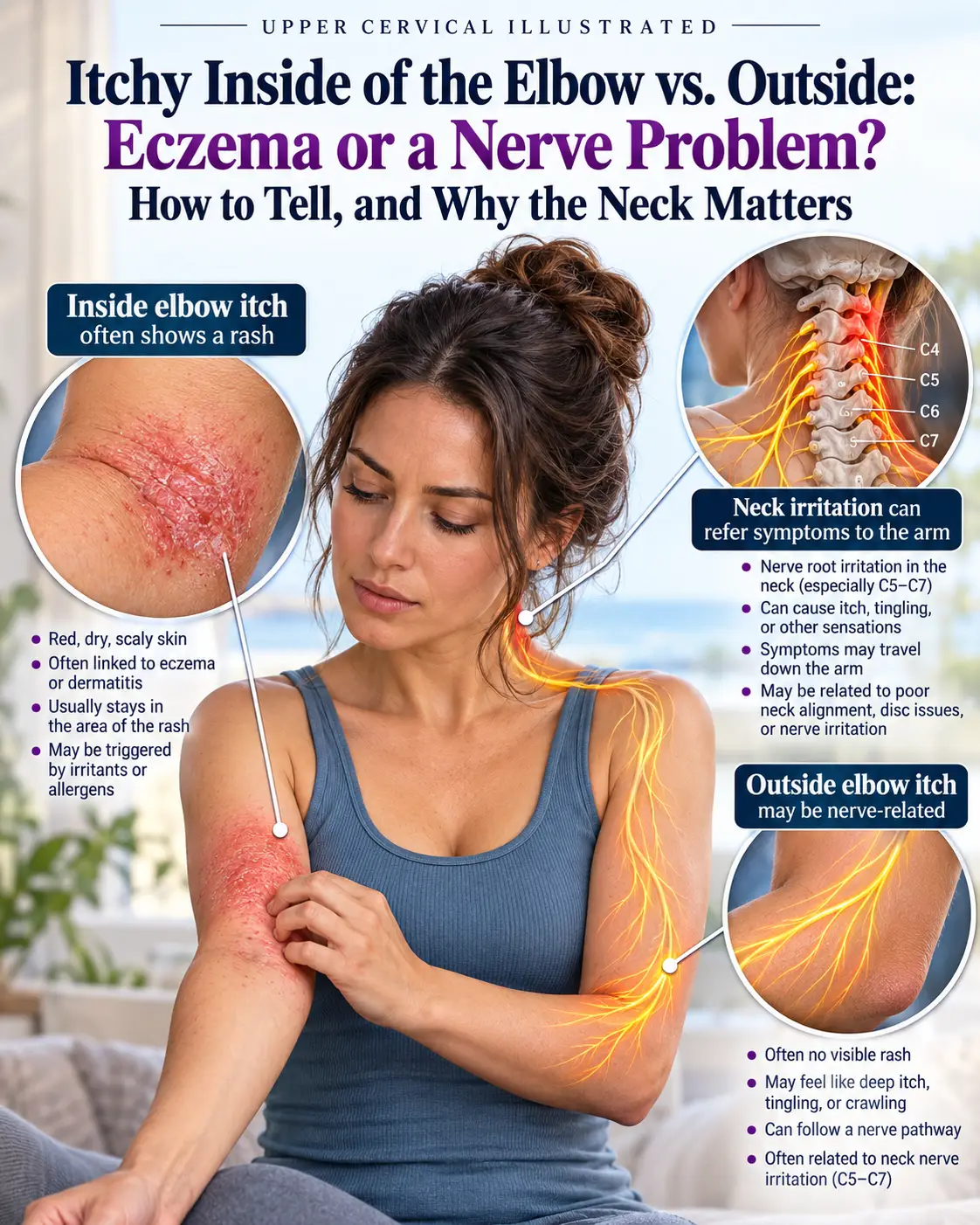
Skin itch starts in the skin. Something — an allergen, dry skin, eczema, a bug bite, a plant, a detergent, a new lotion — triggers cells in the skin to release histamine and other chemicals, and those chemicals activate the itch nerves that end in the skin. Because the trigger is in the skin, you can see it: redness, bumps, scaling, hives, a visible rash. Antihistamines and steroid creams work on this kind of itch because they act on the skin’s chemistry. Most of the itch in the world is this kind, which is why it’s what every doctor looks for first.
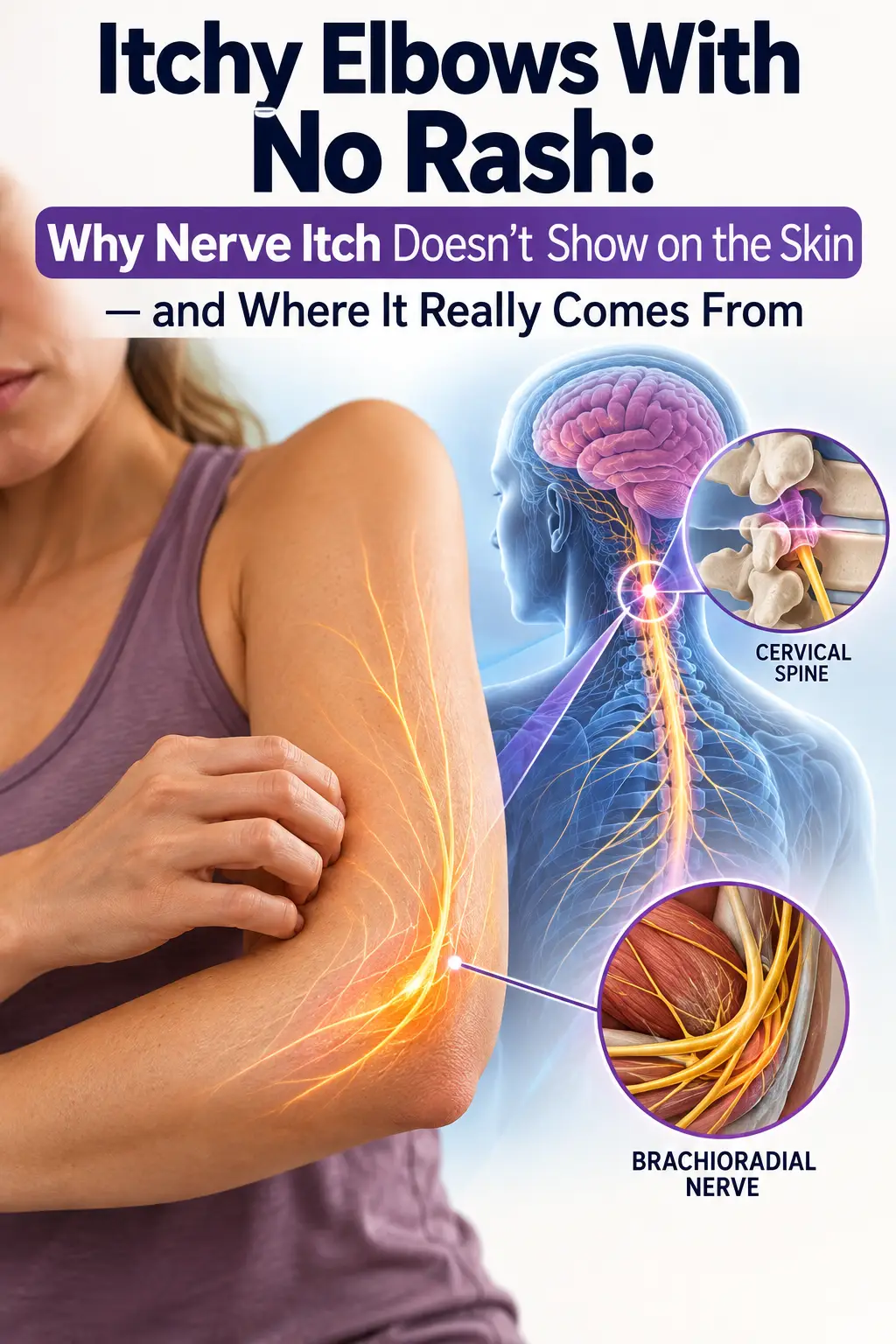
Nerve itch — the medical term is neuropathic pruritus — starts in the nerve itself. Somewhere along its path from the skin to the brain, the nerve is irritated, compressed, or damaged, and it fires itch signals without anything happening in the skin at all. The skin looks normal because it is normal. Antihistamines don’t work because there’s no histamine to block. Steroid creams don’t work because there’s no inflammation in the skin to calm. The itch is every bit as real; it’s just being generated somewhere else.
The clues that you’re dealing with nerve itch rather than skin itch:
- No rash before scratching. Marks appear only where you’ve scratched.
- A specific, consistent location that matches a nerve’s territory rather than a place that touches something.
- Mixed sensations. Itch with tingling, burning, stinging, pins-and-needles, or a crawling feeling. Skin itch is usually just itch.
- Dramatic relief from cold — out of proportion to anything else you’ve tried.
- Worse at night and after sun, rather than after contact with a substance.
If four of those five fit, you are almost certainly looking at a nerve.
The Nerve Itch of the Elbow: Brachioradial Pruritus
When nerve itch shows up on the outside of the elbow and forearm — the sun-exposed strip from the elbow toward the thumb side of the wrist, sometimes up the outer arm to the shoulder — it’s usually brachioradial pruritus (BRP). The name is anatomical: brachioradialis is the forearm muscle under the itchy area, and pruritus means itch.
The research is consistent that BRP is a nerve problem, not a skin problem. Cohen and colleagues (2003) titled their paper “Brachioradial pruritus: a symptom of neuropathy” and documented nerve-conduction findings in patients. Wallengren and Sundler (2005) took skin biopsies from the itchy areas and found fewer small nerve fibers than normal — the skin’s nerve supply was being affected from upstream — and the fiber density recovered during symptom-free periods. That is the opposite of what a skin disease does. A rash adds inflammation; it doesn’t thin out the nerves.
The Mayo Clinic’s review of 111 patients by Mirzoyev and Davis (2013) fills in the typical picture: middle-aged and older adults, more often women, itch of the outer arms with normal-appearing skin, symptoms made worse by sun, and a high rate of cervical spine findings when the neck was imaged.
The Test You Can Do Tonight
A simple bedside test points the same way. Bernhard and Bordeaux (2005) described the ice-pack sign: an ice pack placed on the itchy area relieves BRP almost instantly and nearly completely, in a way that doesn’t happen with skin itch. The relief lasts as long as the cold does and often a while after.
Tonight, when the itch starts, wrap a cold gel pack or a bag of frozen peas in a thin towel and lay it on your forearm. If the itch vanishes within a minute, that’s a strong sign you’re dealing with nerve itch rather than skin itch. Our article on the ice-pack sign explains why cold works and how to use it well.
Where the Nerve Is Being Irritated: The Cervical Spine
If the itch isn’t coming from the skin, where is it coming from? Follow the nerve backward.
The nerves that supply the skin of the outer forearm come from the neck — specifically the fifth and sixth cervical nerve roots (C5 and C6), which exit the spinal column between the vertebrae in the lower neck, travel through the shoulder, and run down the arm. Anything that irritates those roots where they leave the spine can produce symptoms anywhere along their territory, including itch on the forearm.
Marziniak and colleagues (2011) put BRP patients in an MRI scanner and found that the large majority had cervical spine changes — bulging discs, degenerative narrowing, nerve root involvement — and that in most, the level of the spinal finding matched the area of itch on the arm. Goodkin, Wingard, and Bernhard (2003) reported the same association from a clinical series and proposed that cervical spine disease is the common thread in BRP. The nerve is being irritated at the neck, and the brain interprets the signal as itch on the arm — the same way a pinched nerve in the neck produces pain or tingling in the hand.
This is why there’s no rash. The skin on your elbow is an innocent bystander. Our article on what a cervical MRI shows in brachioradial pruritus goes through the imaging findings in detail.
Sun exposure is the other half of the story: it’s the trigger that sets off an already-irritated nerve, which is why BRP flares in summer and why Florida is a hotspot for it. But the sun on its own isn’t the cause — most people get sun on their forearms and don’t itch. The neck is what makes the difference.
The Upper Cervical Connection
Here is where our perspective comes in, and why we look higher than the C5–C6 level where the itch nerves enter the spine.
The neck is a single mechanical system, and it’s organized from the top down. The atlas (C1) and axis (C2) — the top two vertebrae — carry the weight of the head and set the alignment for everything below. When the atlas is misaligned, the head sits off-center, and the lower neck compensates: the normal curve flattens or reverses, the discs below are loaded unevenly, and over years the openings where the nerve roots exit — including C5 and C6 — change shape. The degenerative findings the MRI studies describe at the lower neck are the kind of changes that develop in a spine that’s been carrying its load unevenly for a long time.
There’s a second connection. The upper cervical spine sits directly against the brainstem, the relay station through which every itch signal from the body passes on its way to the brain. The brainstem acts as a volume control, and it takes continuous input from the small muscles and joints of the upper neck. Irritation at the top of the neck can turn up the gain on signals coming from below — so a nerve root at C6 that’s only mildly irritated gets heard as a loud, relentless itch.
An upper cervical evaluation in someone with rash-free arm itch therefore asks two questions: is the top of the neck positioned in a way that’s loading the lower neck unevenly, and is the nervous system at the upper neck showing irritation? Both are measurable.
Other Nerve Itches Without a Rash
BRP isn’t the only nerve itch that leaves the skin looking normal. The location tells them apart:
Notalgia paresthetica is an intense itch on the upper back, just inside one shoulder blade, often with a darkened patch of skin from years of scratching. Same mechanism, different nerve — the thoracic spine rather than the cervical. Pereira and colleagues (2018) compared the two conditions directly and found them clinically similar in character. Our article on BRP vs. notalgia paresthetica sorts them out.
Post-herpetic itch follows shingles — a band on one side of the body, where the rash was, that keeps itching after the skin has healed.
Scalp dysesthesia is a burning, itching scalp with normal skin, also linked to the cervical spine.
Nerve-entrapment itch elsewhere, following a nerve’s territory — the thigh, the side of the foot.
If your rash-free itch is on the outer arms anywhere from elbow to shoulder, BRP is the first thing to consider.
Upper Cervical Care at Lavender Family Chiropractic
When someone with itchy elbows and normal skin comes to our Sarasota office, the first visit is an evaluation, not an adjustment.
History and examination. The pattern of the itch — where, when, what helps — and the ice-pack response. We screen for the conditions BRP can be confused with and for anything that belongs with a physician.
Neurological examination. Reflexes, strength, and sensation by nerve root, so we know whether the C5–C6 roots are showing signs beyond the itch.
Paraspinal infrared thermography. A non-invasive scan of the heat pattern along the spine, which reflects nervous-system activity. It gives us an objective baseline of nervous-system irritation and a way to track change visit to visit.
3D cone-beam CT (CBCT) imaging of the upper cervical spine. This shows the position of the atlas and axis relative to the skull in three dimensions and to the degree — information a flat X-ray can’t give and an MRI doesn’t address. If your physician has already imaged your neck, bring it; the two studies answer different questions.
Review of findings before any care. We go through what the imaging and thermography show.
Correction, if indicated. If the imaging shows a measurable misalignment of the upper cervical spine, we correct it with a precise, low-force procedure specific to your measurements — no twisting, no cracking, no rotation of the neck. Most patients describe it as pressure.
Remeasurement. Thermography after each visit and follow-up imaging when indicated, so progress is measured rather than assumed.
Upper cervical care addresses the mechanical source the research points to — the neck — with measurement before and after, so progress is objective rather than guessed at. Results vary from person to person, and we tell you plainly what the findings show.
If your elbows itch and nobody can find a reason, call (941) 243-3729 or request an appointment online for an upper cervical evaluation.
What the Research Says
Nerve, not skin. Cohen and colleagues (2003) documented neuropathic findings in BRP. Wallengren and Sundler (2005)found reduced small-nerve-fiber density in the itchy skin that recovered in remission — proof the skin is being affected from upstream, not diseased on its own.
The cervical spine is the source in most patients. Marziniak and colleagues (2011) found cervical changes on MRI in the large majority, at levels matching the itch. Goodkin, Wingard, and Bernhard (2003) proposed cervical spine disease as the common mechanism. Mirzoyev and Davis (2013) confirmed a high rate of cervical findings across 111 Mayo patients.
Cold is the test. Bernhard and Bordeaux (2005) described the ice-pack sign.
Related nerve itches share the mechanism. Pereira and colleagues (2018) compared BRP and notalgia paresthetica.
Scratching spreads it. Kwatra and colleagues (2013) described BRP as a trigger for generalized itch.
What to Do Now
Stop treating the skin as the problem. Antihistamines and steroid creams have had their chance. Our article on why they don’t work for BRP explains the mismatch. Keeping the skin moisturized is still sensible — scratched skin gets dry, and that adds a second, skin-based itch on top — but moisturizer won’t touch the nerve itch.
Use cold for the flares, and don’t scratch. An ice pack or a refrigerated cooling gel is the single most reliable short-term relief. Scratching feels like relief for seconds and makes the nerve louder for hours; Kwatra and colleagues described how it can spread the itch beyond the arms.
Protect the forearms from sun. Sleeves, UPF arm covers for driving, shade in peak hours. Our article on brachioradial pruritus and sun exposure covers the Florida problem.
Have the neck evaluated. This is the step that addresses the source. A physician can order a cervical MRI, which shows discs and nerve roots. An upper cervical evaluation shows the position of the top of the neck and the state of the nervous system along the spine. Together they give the full picture.
For what to expect over time, see how long brachioradial pruritus lasts, and for the day-to-day of living with it, why won’t my elbow stop itching. Our full brachioradial pruritus guide ties it all together.
Serving Sarasota, Bradenton, Lakewood Ranch, and the Suncoast
Our office is on Whitfield Avenue in north Sarasota, minutes from the Manatee County line. We see patients with brachioradial pruritus from Sarasota, Bradenton, Lakewood Ranch, Palmetto, Parrish, Ellenton, Longboat Key, Siesta Key, Osprey, Nokomis, Venice, and North Port. Rash-free arm itch is remarkably common on the Suncoast because of our sun, and remarkably under-diagnosed because it looks like nothing. If you’ve been told it’s dry skin or allergies and nothing has worked, the upper neck is the piece that hasn’t yet been examined.
Top 15 FAQs About Itchy Elbows With No Rash
1. Why do my elbows itch but there’s no rash? Because the itch is coming from a nerve, not the skin. Nerve itch produces no visible change because nothing is happening in the skin — the signal is generated upstream, usually at the neck.
2. Is itching without a rash serious? Localized to the arms with no other symptoms, it’s almost always benign nerve itch (BRP). Itching all over the body with no rash is different and warrants bloodwork for liver, kidney, thyroid, and blood conditions.
3. Why doesn’t Benadryl help? Antihistamines block histamine, which drives skin itch. Nerve itch isn’t histamine-driven, so there’s nothing for the antihistamine to block.
4. Why doesn’t the steroid cream help? Steroid creams calm inflammation in the skin. In nerve itch there’s no skin inflammation to calm.
5. Why does ice work so well? Cold input travels on nerve pathways that override the itch signal at the spinal cord. In BRP the relief is so dramatic and specific that it’s used as a diagnostic sign.
6. Can a pinched nerve in the neck cause itching instead of pain? Yes. Itch has its own nerve fibers; irritating them produces itch without pain. The MRI studies on BRP found cervical changes at levels matching the itch.
7. My neck doesn’t hurt. Can it really be my neck? Yes. Most BRP patients have no neck pain, and most have cervical findings on imaging. The irritation is enough to produce itch, not enough to produce pain.
8. Does stress make it worse? Stress amplifies most itch, nerve itch included, mainly by lowering the threshold at which the brain registers the signal. It isn’t the cause.
9. Should I see a dermatologist or a neurologist? Start with whoever can confirm there’s nothing in the skin. Then the question is the nerve, which means looking at the neck. Many patients find us after both.
10. What’s the difference between this and eczema? Eczema shows — redness, dryness, scaling — and favors the inside crease of the elbow. BRP shows nothing and favors the outside of the elbow and forearm.
11. Is it the same as notalgia paresthetica? Same mechanism, different location. Notalgia paresthetica is a nerve itch on the upper back near the shoulder blade, from the thoracic spine. BRP is on the arms, from the cervical spine.
12. Will it go away on its own? It often quiets in winter and returns in summer. The research describes it as chronic and relapsing; lasting change usually requires addressing the source.
13. How is upper cervical care different from a regular adjustment? It’s limited to the top two vertebrae, guided by 3D imaging, and uses a low-force technique with no rotation — appropriate for a neck that already has irritated nerves.
14. How soon would I notice a difference? When the upper neck is a factor and it’s corrected, patients typically report changes in itch intensity within the first several weeks, with nights improving first.
15. Do you take insurance? Call the office and we’ll go through costs and coverage before anything begins.
Lavender Family Chiropractic in Sarasota, Florida offers a thorough upper cervical evaluation to find out whether we can help. Call (941) 243-3729 or request an appointment. 5899 Whitfield Avenue, Suite 107, Sarasota, FL 34243.
Related Articles
- Brachioradial Pruritus: Our Complete Guide
- Why Won’t My Elbow Stop Itching?
- The Ice-Pack Sign
- Why Antihistamines and Steroid Creams Don’t Work for BRP
- What a Cervical MRI Shows in Brachioradial Pruritus
- How Long Does Brachioradial Pruritus Last?
References
- Cohen AD, et al. Brachioradial pruritus: a symptom of neuropathy. J Am Acad Dermatol. 2003. PMID 12789170
- Wallengren J, Sundler F. Brachioradial pruritus is associated with a reduction in cutaneous innervation that normalizes during the symptom-free remissions. J Am Acad Dermatol. 2005. PMID 15627097
- Mirzoyev SA, Davis MD. Brachioradial pruritus: Mayo Clinic experience over the past decade. Br J Dermatol.2013. PMID 23796379
- Bernhard JD, Bordeaux JS. Medical pearl: the ice-pack sign in brachioradial pruritus. J Am Acad Dermatol. 2005. PMID 15928630
- Marziniak M, et al. Brachioradial pruritus as a result of cervical spine pathology: the results of a magnetic resonance tomography study. J Am Acad Dermatol. 2011. PMID 21641675
- Goodkin R, Wingard E, Bernhard JD. Brachioradial pruritus: cervical spine disease and neurogenic/neuropathic pruritus. J Am Acad Dermatol. 2003. PMID 12664013
- Pereira MP, et al. Brachioradial Pruritus and Notalgia Paraesthetica: A Comparative Observational Study of Clinical Presentation and Morphological Pathologies. Acta Derm Venereol. 2018. PMID 28902951
- Kwatra SG, et al. Brachioradial pruritus: a trigger for generalization of itch. J Am Acad Dermatol. 2013. PMID 23374230