
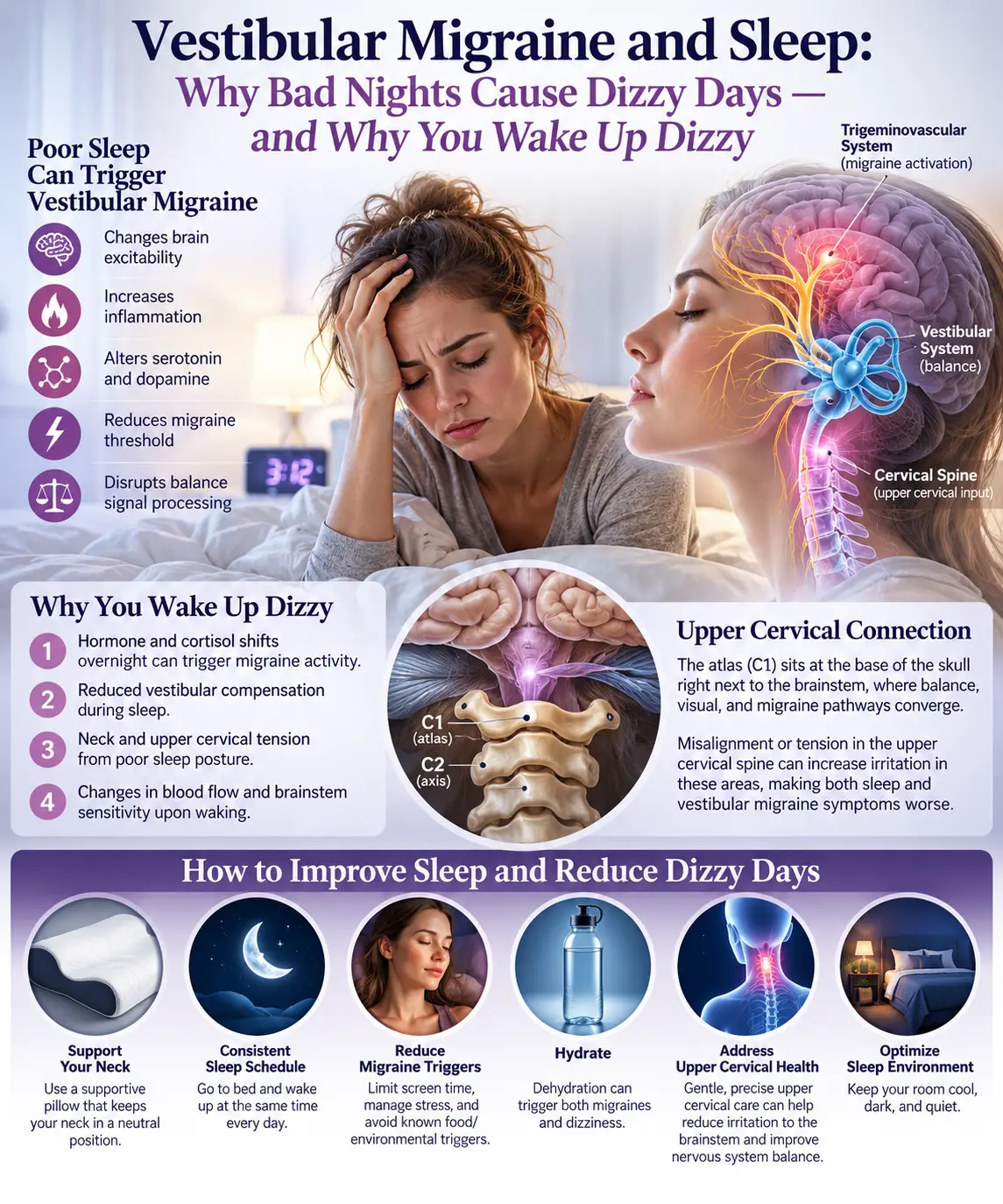
Vestibular Migraine and Sleep: Why Bad Nights Cause Dizzy Days — and Why You Wake Up Dizzy
By Dr. Rusty Lavender, D.C. — upper cervical chiropractor, Lavender Family Chiropractic, Sarasota, FL. Reviewed and updated October 2026.
Two complaints come up in almost every vestibular migraine conversation in our office. The first: “If I sleep badly, the next day is a dizzy day — I can predict it.” The second: “I wake up dizzy. Before I’ve even sat up, the room is already off.” Both are real, both are explained by the research, and both point to the same two things: a migraine brain that depends on sleep more than other brains do, and a neck that spends seven hours a night in whatever position the pillow puts it in.
This article covers how sleep and vestibular migraine feed each other in both directions; what the research says about sleep fragmentation and next-day attacks; why waking up dizzy is different from getting dizzy during the day and what each pattern means; the difference between morning vestibular migraine and BPPV; the role of the pillow and the sleeping position; and why the upper neck is the structural link between a bad night and a dizzy morning.
This is educational content, not medical advice. New dizziness on waking with a severe headache, vision or speech changes, weakness, or numbness is an emergency.
What Vestibular Migraine Is
Vestibular migraine is migraine that affects the balance system — vertigo, unsteadiness, motion sensitivity, and visual sensitivity in episodes lasting minutes to hours, with or without head pain. The criteria by Lempert and colleagues (2012)require a migraine history and migraine features in at least half the episodes. Furman and colleagues (2013) describe it as a brain disorder in which the migraine process destabilizes balance-processing circuits. Our vestibular migraine guidecovers it fully.
A migraine brain is a brain with a low threshold for attacks. Sleep is one of the main things that sets the threshold.
Sleep and Migraine: A Two-Way Street
Sleep and migraine share machinery. The brainstem structures that regulate sleep — the hypothalamus and the clusters of cells that control the sleep-wake cycle — are the same structures involved in starting a migraine. That’s why migraine has a circadian pattern (early-morning attacks are common), why both too little and too much sleep trigger it, and why sleep is also one of the most reliable ways to end an attack.
The research has moved from “sleep matters” to specifics. Bertisch and colleagues (2020), in a prospective study published in Neurology, tracked nearly a hundred people with migraine for six weeks using sleep diaries and wrist monitors. Their finding: fragmented sleep — waking repeatedly through the night — raised the risk of migraine the next day, independent of how many total hours were slept. Short sleep on its own was a weaker predictor than broken sleep. The quality of the night mattered more than its length.
For vestibular migraine, patients describe the same next-day pattern, with the dizziness replacing or joining the headache. The broken night is Tuesday; the dizzy day is Wednesday. In the largest trigger study, Kelman (2007) found sleep disturbance named as a trigger by about half of migraine patients, and Beh and colleagues (2019) found sleep deprivation among the leading triggers reported by vestibular migraine patients specifically.
The street runs the other way too. Vestibular migraine disrupts sleep: attacks in the evening delay it, nighttime vertigo wakes people, the anxiety of anticipating a dizzy day keeps them up, and the motion-sensitive brain can be set off by rolling over. Broken sleep triggers the migraine; the migraine breaks the sleep. That loop is what we’re trying to interrupt.
Why You Wake Up Dizzy
Waking up dizzy is a distinct pattern, and it has three common explanations. Telling them apart matters because each has a different answer.
1. BPPV — the inner ear. If you wake and the room spins the moment you roll over or sit up, for seconds to under a minute, and it’s the same every morning, the most likely cause is loose inner-ear crystals. Lying flat for hours lets them settle into a canal; the first movement sets them off. The AAO-HNS guideline by Bhattacharyya and colleagues (2017)describes this as the classic BPPV presentation, and it’s treated with a repositioning maneuver, not with migraine management. Our articles on vertigo when rolling over in bed and vestibular migraine vs. BPPV sort this out.
2. Morning vestibular migraine — the brain. If you wake already unsteady, foggy, motion-sensitive, light-sensitive, perhaps with a dull head — not a brief spin but a state that lasts hours — that’s a migraine attack that started during sleep. Early-morning onset is one of the most common timings for migraine of every kind, because of the circadian machinery described above. The night before was often short, broken, or unusually long.
3. The neck — the position you slept in. If you wake stiff and unsteady, with pain or pressure at the base of the skull, a head that feels heavy or “not sitting right,” and dizziness that’s worse when you turn your head and eases after you’ve been up and moving for an hour — the pillow and the neck are the likely story. The upper cervical spine carries one of the brain’s main sources of head-position information, and holding it in a bent, extended, or rotated position for seven hours disturbs that input. Kristjansson and Treleaven (2009) reviewed how distorted cervical input produces exactly this: unsteadiness, altered eye control, a sense of the head being off.
In vestibular migraine, patterns 2 and 3 usually coexist — which is the point of the next section.
The Upper Cervical Connection
The upper neck is the structural link between sleep and vestibular migraine, in both directions.
Position at night feeds the migraine. The nerves from the top three cervical segments feed into the same brainstem cells as the trigeminal nerve — the trigeminocervical complex that Bartsch and Goadsby (2003) describe. A neck held in a provocative position for hours sends a sustained stream of input into the migraine generator overnight. That’s the mechanism behind waking with an attack already underway, and it’s why the early-morning timing of migraine isn’t purely a circadian story — the neck has been contributing all night.
Position at night feeds the dizziness. The same hours in the same position disturb the position sensors at the atlas and axis, so the brain starts the day with distorted balance input. In a migraine brain whose balance circuits are already unstable, that’s the recipe for a dizzy morning.
A misaligned upper neck makes every night worse. When the atlas is misaligned, there is no neutral position — the neck is loaded unevenly no matter how the pillow is arranged, the muscles that hold the head stay tense, and sleep itself fragments. That fragmentation is the specific thing Bertisch’s study linked to next-day attacks. So the misaligned neck breaks the sleep, and the broken sleep triggers the migraine, and the migraine breaks the sleep.
Correcting the position of the upper cervical spine addresses the overnight input at its source. In our office, patients with vestibular migraine often report mornings as the first thing that changes — because the night is when the upper neck has the longest, most sustained effect.
The Pillow and the Position
Everything above makes the pillow a medical question rather than a comfort question.
Goal: a neck in a neutral line with the rest of the spine, all night.
Side-sleepers need a pillow that fills the gap between ear and shoulder so the head isn’t tilted down toward the mattress or propped up toward the ceiling. Too thin is the most common error. No arm under the pillow — it hikes the shoulder and rotates the neck.
Back-sleepers need a lower pillow with support under the curve of the neck and the head slightly cradled, not pushed forward. A high, soft pillow flexes the neck forward for hours — the single most provocative position for the upper cervical spine.
Stomach-sleeping rotates the neck to one side all night. For anyone with vestibular migraine, it’s the position to retrain out of. A body pillow helps the transition to side-sleeping.
Fill matters less than shape. Memory foam, latex, and down all work if the height and support match your position. Our guide to the best pillow for migraines goes through the choices.
One caution: a pillow can only put a neck in neutral if the neck has a neutral to be put in. A misaligned atlas has no neutral position. Patients who’ve tried six pillows and nothing works are usually describing that.
Protecting the Night: A Practical Plan
Anchor the wake time. The same wake time every day, including weekends. This is the single most powerful sleep intervention for migraine, because it anchors the circadian machinery that migraine shares. Sleeping in on Saturday is a classic let-down trigger.
Aim for continuity, not just duration. Bertisch’s finding was about fragmentation. Reduce what wakes you: a cooler room, no alcohol in the evening (it fragments sleep in the second half of the night), no large meals late, and treatment of snoring or sleep apnea if present — apnea fragments sleep severely and is a known migraine aggravator.
Wind down the sensory system. Screens off thirty minutes before bed — scrolling is visual motion, and a migraine balance system reads it as movement. Dim light. Quiet. The motion-sensitive brain needs a soft landing.
Hydrate earlier, not later. Dehydration is a trigger; so is waking three times to use the bathroom. Front-load fluids in the day.
Mind the magnesium and caffeine. Keep caffeine consistent and before noon. Magnesium at bedtime is widely used for migraine and sleep; whether it’s right for you is a question for your physician.
Get the neck neutral. The pillow guidance above, and an upper cervical evaluation if mornings are the worst part — because the night is when the neck has the most time to do its work.
Track it. For one month: hours slept, number of wakings, pillow or position changes, morning neck stiffness (1–5), and whether the day was a dizzy day. The pattern between the night and the next day is usually visible within two weeks. Our article on vestibular migraine triggers has the full diary.
Upper Cervical Care at Lavender Family Chiropractic
When someone with vestibular migraine whose nights and mornings are the problem comes to our Sarasota office, the first visit is an evaluation, not an adjustment.
History, including the sleep pattern, the morning pattern, the pillow and position, and the relationship between bad nights and dizzy days.
Examination. Neurological screening; reproduction testing of the upper neck; a head-repositioning test that measures how accurately the neck reports head position; positional screening for BPPV, so a morning spin from loose crystals isn’t mistaken for a neck or migraine problem.
Paraspinal infrared thermography. A non-invasive scan of the heat pattern along the spine, reflecting nervous-system activity — an objective baseline at the upper neck and a way to track change.
3D cone-beam CT (CBCT) imaging of the upper cervical spine. The position of the atlas and axis relative to the skull, in three dimensions and to the degree.
Review of findings before any care.
Correction, if indicated. A precise, low-force procedure specific to your measurements — no twisting, no cracking, no rotation of the neck. Most patients describe it as pressure.
Remeasurement. Thermography after each visit and follow-up imaging when indicated.
Upper cervical care addresses the mechanical source the research points to — the neck — with measurement before and after, so progress is objective rather than guessed at. Results vary from person to person, and we tell you plainly what the findings show. Sleep habits and your neurologist’s care continue alongside; what changes is the input the neck is feeding the brain overnight.
If bad nights are turning into dizzy days, call (941) 243-3729 or request an appointment online for an upper cervical evaluation.
What the Research Says
Fragmented sleep predicts next-day migraine. Bertisch and colleagues (2020).
Sleep disturbance is a leading trigger. Kelman (2007) in migraine broadly; Beh and colleagues (2019) in vestibular migraine specifically.
Vestibular migraine is unstable balance processing in a migraine brain. Furman and colleagues (2013); criteria by Lempert and colleagues (2012).
Morning spinning on rolling over points to BPPV first. Bhattacharyya and colleagues (2017).
The neck’s position input shapes balance and eye control. Kristjansson and Treleaven (2009).
The upper neck feeds the migraine generator. Bartsch and Goadsby (2003).
For the neck-migraine loop in depth, see vestibular migraine and neck pain. Our migraine guide covers the condition broadly.
Serving Sarasota, Bradenton, Lakewood Ranch, and the Suncoast
Our office is on Whitfield Avenue in north Sarasota, minutes from the Manatee County line. We see vestibular migraine patients from Sarasota, Bradenton, Lakewood Ranch, Palmetto, Parrish, Ellenton, Longboat Key, Siesta Key, Osprey, Nokomis, Venice, and North Port. If you wake up dizzy and no pillow has helped, the top of the neck is the piece that hasn’t yet been examined.
Top 15 FAQs About Vestibular Migraine and Sleep
1. Why am I dizzy the day after a bad night’s sleep? Fragmented sleep raises next-day migraine risk — that’s what the research shows — and in vestibular migraine the attack shows up as dizziness. Sleep and migraine share brainstem machinery.
2. Why do I wake up dizzy? Three common reasons: BPPV (brief spinning on rolling over), a vestibular migraine attack that started during sleep (unsteady and foggy for hours), or the neck after a night in a provocative position (stiff, heavy-headed, worse with turning). They often overlap.
3. How do I know if morning dizziness is BPPV or vestibular migraine? Duration. BPPV spins for seconds when you move; vestibular migraine is a state that lasts hours. BPPV is treated with a repositioning maneuver; it’s worth testing for.
4. Does too much sleep trigger vestibular migraine? Yes. Oversleeping, especially a weekend lie-in, is a classic trigger. A fixed wake time seven days a week prevents it.
5. Is sleep quality or quantity more important? Research found fragmentation — waking repeatedly — predicted next-day attacks more than total hours. Continuity matters most.
6. Can my pillow cause vestibular migraine attacks? A pillow that holds the neck bent, extended, or rotated for hours feeds the migraine generator and disturbs balance input overnight. The wrong pillow is a nightly trigger.
7. What’s the best sleeping position? Side or back with the neck neutral and no arm under the pillow. Stomach-sleeping rotates the neck all night and is the one to retrain out of.
8. I’ve tried every pillow and still wake up dizzy. Why? A pillow can only put a neck in neutral if the neck has a neutral position. A misaligned upper neck doesn’t, which is why no pillow works until the position is addressed.
9. Does sleep apnea affect vestibular migraine? Severely fragmented sleep from apnea is a known migraine aggravator. If you snore, wake unrefreshed, or have been told you stop breathing at night, get tested.
10. Why does rolling over in bed make me dizzy? If it’s a brief spin, BPPV. If it’s a sustained lurch in a motion-sensitive migraine brain, the rolling itself is the trigger — moving slowly and keeping the head supported helps.
11. Can the neck really make me wake up dizzy? The upper neck is one of the brain’s three balance inputs, and seven hours in a provocative position distorts it. Waking stiff, heavy-headed, and unsteady with dizziness that eases after an hour of movement is the neck pattern.
12. Will magnesium help me sleep and reduce attacks? It’s widely used for both and reasonably supported; whether it’s right for you is a question for your physician.
13. Should I nap during a dizzy day? Short naps can abort an attack. Long or late naps fragment the next night and feed the loop. Keep naps under thirty minutes and before mid-afternoon.
14. How soon would I notice a difference with upper cervical care? When the upper neck is a factor and it’s corrected, mornings are typically the first thing patients report changing, within the first several weeks. We measure before and after.
15. Do you take insurance? Call the office and we’ll go through costs and coverage before anything begins.
Lavender Family Chiropractic in Sarasota, Florida offers a thorough upper cervical evaluation to find out whether we can help. Call (941) 243-3729 or request an appointment. 5899 Whitfield Avenue, Suite 107, Sarasota, FL 34243.
Related Articles
- Vestibular Migraine: Our Complete Guide
- Best Pillow for Migraines
- Vestibular Migraine Triggers
- Vestibular Migraine and Neck Pain
- Vertigo When Rolling Over in Bed
- Vestibular Migraine vs. BPPV
References
- Lempert T, et al. Vestibular migraine: diagnostic criteria. J Vestib Res. 2012. PMID 23142830
- Furman JM, Marcus DA, Balaban CD. Vestibular migraine: clinical aspects and pathophysiology. Lancet Neurol.2013. PMID 23769597
- Bertisch SM, et al. Nightly sleep duration, fragmentation, and quality and daily risk of migraine. Neurology. 2020. PMID 31843807
- Kelman L. The triggers or precipitants of the acute migraine attack. Cephalalgia. 2007. PMID 17403039
- Beh SC, et al. The Spectrum of Vestibular Migraine: Clinical Features, Triggers, and Examination Findings. Headache. 2019. PMID 30737783
- Bhattacharyya N, et al. Clinical Practice Guideline: Benign Paroxysmal Positional Vertigo (Update). Otolaryngol Head Neck Surg. 2017. PMID 28248609
- Kristjansson E, Treleaven J. Sensorimotor function and dizziness in neck pain: implications for assessment and management. J Orthop Sports Phys Ther. 2009. PMID 19411769
- Bartsch T, Goadsby PJ. The trigeminocervical complex and migraine: current concepts and synthesis. Curr Pain Headache Rep. 2003. PMID 12946290
Related Posts


Get our upper cervical articles first.
Patients Experience