The Stages of Meniere’s Disease: How It Progresses — and the Driver No One Stages
By Dr. Rusty Lavender — Lavender Family Chiropractic, Sarasota, FL
If you’ve been diagnosed with Meniere’s disease, you know the question that sits heaviest: is this going to get worse? Doctors will map the classic stages for you — the fluctuating early years, the active middle phase, the “burned-out” later years where the spinning fades but the imbalance stays. That map is real and useful. But it leaves out something enormous: as your inner ear does less of the balancing over time, your brain leans harder and harder on the one balance input almost nobody ever examines — the upper cervical spine, the atlas (C1) and axis (C2) just beneath your skull. If that structure is misaligned, it can drive the chronic unsteadiness that defines the later stages while everyone keeps staring at the ear. It is the one place your workup never checked, and it is worth evaluating.
In this article we’ll walk through the recognized stages of Meniere’s, from the earliest fluctuating symptoms to the later years, and how vertigo, hearing, tinnitus, and balance each tend to change. And we’ll be direct about where the upper neck fits — because your inner ear is not the only structure feeding your brain information about where your body is in space, and in the later stages it may not even be the main one. We serve patients across Sarasota, Lakewood Ranch, and Bradenton, and this is the piece we see missed constantly.
This article is educational and not a substitute for medical advice. Meniere’s disease should be diagnosed and managed by a qualified physician.
What Is Meniere’s Disease?
Meniere’s is a disorder of the inner ear, which contains two closely related systems: the cochlea (hearing) and the vestibular system (balance and spatial orientation). Both are filled with fluid and rely on precise fluid pressure and chemistry.
In Meniere’s, there appears to be an abnormal buildup of fluid in the endolymphatic system — often called endolymphatic hydrops. The exact reason isn’t fully understood; it may involve fluid production, absorption, immune factors, genetics, vascular factors, or a combination. The effect is what matters: the fluid disturbance disrupts both hearing and balance signals, producing the characteristic cluster of symptoms.
Classic Meniere’s is defined by four hallmark features:
- Episodic vertigo — spinning attacks that typically last from twenty minutes to several hours.
- Fluctuating hearing loss — hearing that comes and goes, especially in the low frequencies early on.
- Tinnitus — ringing, roaring, buzzing, or hissing, usually in the affected ear.
- Aural fullness — pressure or “stuffiness” in the ear, like being on an airplane.
Most people start with one ear involved. Over the years, a subset develop involvement in the second ear, though many remain unilateral for life.
Because Meniere’s shares symptoms with several other conditions — vestibular migraine, BPPV, vestibular neuritis, acoustic neuroma, and neck-related dizziness — an accurate diagnosis matters. A thorough evaluation by an ENT or neurotologist, often including hearing tests and imaging, is essential. And here’s a companion truth that too often gets left off the list: the upper cervical spine, a genuine and frequently overlooked contributor to balance, deserves its own evaluation. We work alongside your medical team, focused on that piece.
Why Doctors Talk About “Stages”
When physicians describe stages of Meniere’s, they’re capturing that the illness evolves. The symptom mix in year one often looks different from year ten.
Be clear about something: staging schemes aren’t perfectly standardized. Some are based on measured hearing loss on an audiogram (a four-stage audiometric system). Others describe the natural history of symptoms over time — how vertigo, hearing, and tinnitus shift across the years. Related, but not identical. One classic question in the literature has been whether we’re staging the patients or merely staging their symptoms.
For this article, we describe the natural-history pattern most patients recognize: an early stage, a middle stage, and a late stage. Think of these as a map, not a timetable. Some people move slowly over decades; some stall in one phase; some have long remissions. Your own experience may not match the textbook sequence, and that’s normal.
With that framing in place, here’s how the progression generally unfolds — and watch how the balance story quietly shifts from the ear toward the rest of the balance system as it goes.
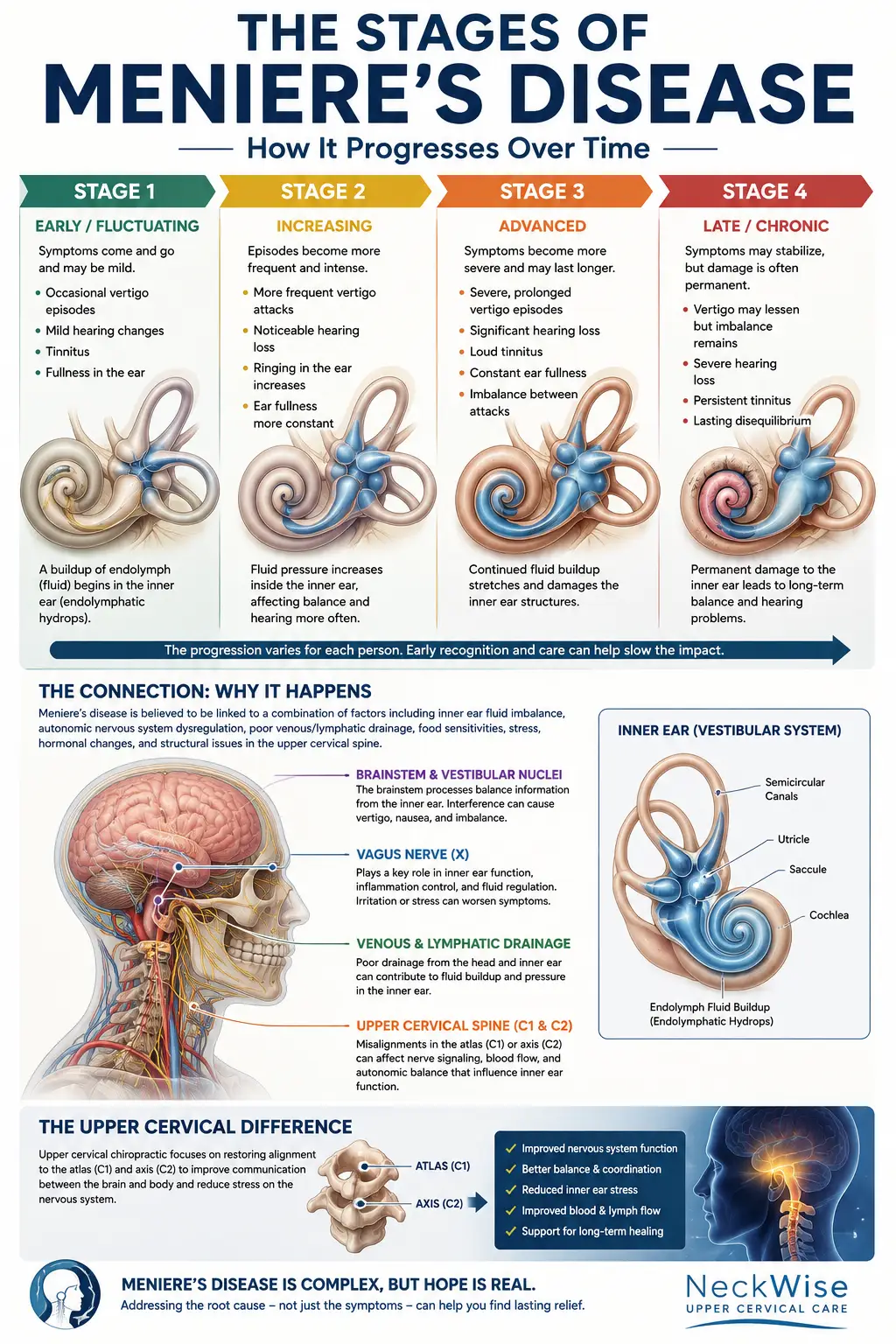
Early Stage (Stage 1): The Fluctuating Beginning
The early stage is often the most confusing, precisely because so much comes and goes.
Vertigo in the Early Stage
In the early phase, vertigo arrives as discrete, dramatic attacks separated by periods of feeling relatively normal. An attack comes on fairly suddenly, sometimes with a warning sense of ear fullness or rising tinnitus. The room spins — severely enough to cause nausea, vomiting, sweating, and a need to lie completely still. Attacks commonly last twenty minutes to a few hours, then subside, leaving the person drained.
Between attacks in the early stage, many people feel genuinely well, and balance returns to near normal. That on-again, off-again quality is a defining feature, and part of what makes the condition frightening.
Hearing in the Early Stage
Hearing loss in early Meniere’s is classically fluctuating and low-frequency — a distinctive fingerprint. Where many other forms of hearing loss hit the high frequencies first, early Meniere’s dampens the low tones. Deeper voices sound muffled, the affected ear feels “off,” and hearing often worsens right before or during an attack, then recovers. In the early years, hearing frequently bounces back between episodes.
Tinnitus and Fullness in the Early Stage
Tinnitus and aural fullness in the early stage are often intermittent and tied to attacks. Many describe a low-pitched roar or rushing sound rather than a high-pitched ring. The fullness may build in the hours before an attack, then ease.
The Emotional Texture of the Early Stage
The early stage is frequently the most anxiety-provoking — not because symptoms are the most severe over a lifetime, but because they’re the most unpredictable. Getting an accurate diagnosis, learning your triggers (salt, stress, caffeine, poor sleep for many), and building a management plan with your ENT are the foundation of coping well. This is also the ideal time to have the upper cervical spine measured, before years of guarding and bracing add a second layer to the problem.
Middle Stage (Stage 2): The Active, Established Phase
As Meniere’s becomes established, many patients enter the active or middle stage — often the period when the disease feels most demanding day to day.
Vertigo in the Middle Stage
Attacks may become more frequent or cluster together — runs of attacks over weeks, followed by quieter spells. The attacks are still the classic spinning episodes lasting minutes to hours, but their rhythm can feel relentless during active clusters. This is often the stage with the greatest impact on work, driving, and social life. Even here, though, the frequency is famously irregular: a stormy few months can be followed by a surprisingly calm stretch. Remissions are real and can be lengthy, which is exactly why it’s so hard to judge whether any single treatment “worked.”
Hearing in the Middle Stage
Here an important shift begins. Hearing loss becomes more persistent and less fully reversible. Fluctuations may continue, but the “floor” your hearing returns to on a good day gradually drops. The loss broadens beyond the low frequencies, flattening across more of the range. Speech gets harder to understand in the affected ear, and sound distortion (diplacusis) can appear.
Tinnitus and Fullness in the Middle Stage
Tinnitus and aural fullness often become more constant rather than purely attack-linked. The roar that once came and went settles in as a near-daily companion, wearing on sleep and concentration even on days without vertigo.
Balance Between Attacks in the Middle Stage
In the early stage, balance between attacks is often normal. In the middle stage, some people notice their balance is not quite as solid between episodes — a lingering unsteadiness, a sense of being slightly off, reduced confidence on uneven ground or in the dark. This reflects the cumulative effect of repeated vestibular disturbances and the growing demand on the rest of the balance system to compensate. And that is precisely where the upper neck moves from bystander to prime suspect.
Late Stage: The “Burnout” Phase and Its Trade-offs
The late stage often surprises people, because in one respect it brings relief — with a trade-off.
Vertigo in the Late Stage
The dramatic spinning attacks frequently lessen in frequency and intensity, and in many people eventually fade substantially — the disease “burning out.” For someone who lived through years of unpredictable vertigo, fewer attacks can feel like a genuine reprieve. But this quieting doesn’t mean the inner ear healed; it often reflects that the affected vestibular system has changed enough that it no longer generates the same violent episodes.
A Note on Drop Attacks
A small subset of people experience otolithic crises of Tumarkin, or “drop attacks” — sudden falls without loss of consciousness, caused by an abrupt vestibular event that makes the person feel pushed or thrown to the ground. They tend to occur in the more advanced course and matter because of injury risk. If you experience sudden, unexplained falls, report them to your physician promptly.
Hearing in the Late Stage
The hearing trade-off is the defining feature of the late stage. Hearing loss in the affected ear is typically more permanent and no longer fluctuating. It tends to stabilize at a reduced level — often moderate, sometimes more significant. The maddening fluctuation often ends, but the remaining loss is generally lasting. Hearing aids and an audiologist frequently become part of life at this stage.
Tinnitus in the Late Stage
Tinnitus commonly persists, and for some remains prominent even after vertigo has calmed. Because the ear has undergone lasting change, the tinnitus often becomes chronic. Sound therapy, hearing aids, and tinnitus-management approaches help many people habituate over time.
Balance in the Late Stage
Here is the crux. As acute vertigo fades, many people are left with chronic imbalance or unsteadiness rather than spinning — a different problem entirely. Instead of dramatic episodes, there’s a persistent sense of being off-balance, a need to move carefully, reduced confidence, especially in the dark, on uneven surfaces, or in busy visual environments.
This chronic imbalance comes from long-term reduction in vestibular function on the affected side. And here is the pivotal fact the standard stage descriptions rush past: to compensate, the brain leans more heavily on the other two balance inputs — vision, and the position sense coming from the body, especially the upper neck. In the late stage, your neck isn’t a minor contributor anymore. It’s doing a larger share of the work of keeping you upright. Which means that if the neck itself is misaligned and sending distorted signals, it can be a primary driver of the very unsteadiness that defines this stage. That is exactly where the conversation about the neck stops being a footnote and becomes central.
The Driver No One Stages: Your Upper Neck
To understand why the upper neck deserves top billing in balance disorders, understand how your body actually keeps you upright.
Your sense of balance is the product of your brain continuously blending three streams of information:
- The vestibular system in the inner ears, sensing head movement and gravity.
- The visual system, telling you where you are relative to your surroundings.
- Proprioception — position sense from muscles and joints, with an especially rich supply from the joints and muscles of the upper neck.
The upper cervical spine — the atlas and axis, where the head meets the neck — is packed with position sensors, feeding a constant stream of information to the brainstem and cerebellum about where your head is relative to your body. Your brain integrates this neck input directly with the vestibular and visual signals. These two vertebrae also carry the full weight of your head, held largely by ligaments rather than interlocking bone, which makes them uniquely mobile and uniquely vulnerable to misalignment.
Now put it together with the natural history above. When the vestibular system on one side is compromised — as it increasingly is in the middle and late stages — the brain depends more on vision and neck proprioception to keep you steady. If the neck is also sending disturbed or inaccurate signals, that added strain doesn’t just make imbalance a little worse; it can become the leading source of the chronic unsteadiness. Cervicogenic dizziness — unsteadiness, disorientation, or “fog” driven by upper-neck dysfunction — is a recognized phenomenon. It is not the same as Meniere’s disease, but the two coexist all the time, and when they do, the neck component can dominate the overall sense of imbalance.
This matters even more given who develops Meniere’s-related unsteadiness. Think about the history so many of these patients carry: years of bracing the head and neck during violent vertigo, old whiplash from a car accident, a past concussion, a hard fall, forward-head posture over screens. Every one of those loads and destabilizes the exact region the balance system leans on most in the later stages. If your unsteadiness followed or worsened after a head or neck injury, the upper cervical spine is a driver worth evaluating — not an afterthought.
Let me be precise and compliant about the boundary: upper cervical chiropractic care does not treat, cure, or alter the stages of Meniere’s disease. It does not drain inner-ear fluid or fix endolymphatic hydrops. What it addresses is the neck’s contribution to your overall balance — a genuine, often overlooked driver that becomes more important, not less, as the vestibular system does less of the work. In other words, we’re not treating the Meniere’s. We’re evaluating and supporting the input your brain is relying on more and more, in the one place almost no one measured.
How Upper Cervical Care Works Across Sarasota, Lakewood Ranch & Bradenton
At Lavender Family Chiropractic (NeckWise North Sarasota), our approach to the upper neck is deliberately precise and low-force. We won’t twist your head, and there’s no cracking or popping. For someone whose balance is already fragile, that gentleness isn’t a marketing point — it’s the whole point.
Our process centers on measuring before we do anything:
- 3D CBCT imaging (cone-beam computed tomography). Rather than guessing at your upper-neck anatomy, we take detailed three-dimensional images to understand your individual structure. Everyone’s atlas and axis are shaped differently.
- Paraspinal infrared thermography. A non-contact way of measuring temperature patterns along the spine, reflecting how the nervous system is functioning — so we adjust only when it’s warranted.
- Low-force Knee Chest Upper Cervical technique. A gentle, specific method — precise and low-force, with no twisting, cracking, or popping. The goal is to help the upper neck move and signal more normally, supporting the proprioceptive side of your balance system.
We work as one part of your team, alongside your medical care. Your ENT or neurotologist should remain the lead on your inner-ear treatment — diet, medications, and any procedures. Our job is to evaluate whether the upper neck is driving your balance difficulties and, if so, to address that piece gently while coordinating with your medical providers. If your evaluation suggests the neck is not a meaningful contributor, we’ll tell you that plainly. Honest assessment protects your time and money.
Living Well Through the Stages
Whatever stage you’re in, some things reliably help. None replace your physician’s advice.
- Track your symptoms. A simple diary of attacks, hearing changes, diet, sleep, stress — and neck pain, stiffness, and headaches — reveals patterns and gives your ENT valuable information.
- Mind the modifiable triggers. Reducing dietary salt, moderating caffeine and alcohol, staying hydrated, and protecting sleep can reduce attack frequency for many.
- Take vestibular rehabilitation seriously. In the middle and late stages, when chronic imbalance dominates, vestibular rehab retrains the brain’s balance processing — and it works precisely by strengthening the brain’s use of vision and proprioception to compensate. That’s the same neck-based input we evaluate, which is why the two approaches complement each other.
- Address fall risk directly. Good lighting, removing trip hazards, sturdy footwear, and grab bars where appropriate — especially in the late stage and if drop attacks occur.
- Care for your mental health. Chronic dizziness and hearing loss take a real emotional toll. Support and counseling matter.
- Protect your remaining hearing and adapt early. Work with an audiologist and consider hearing aids when appropriate.
Red Flags: When to Seek Prompt Medical Attention
Meniere’s itself is not immediately dangerous, but some symptoms that resemble it are serious. Seek prompt medical care — and when in doubt, treat it as an emergency — if you experience any of the following:
- Sudden, significant hearing loss, especially if rapid, since sudden sensorineural hearing loss can be a time-sensitive medical emergency.
- Vertigo with neurological symptoms — double vision, difficulty speaking, facial drooping, weakness or numbness in an arm or leg, or trouble walking — which can signal a stroke.
- A severe, sudden “worst-ever” headache with dizziness.
- New, persistent, or worsening symptoms in only one ear that haven’t been evaluated, since certain tumors (such as acoustic neuroma) can mimic Meniere’s.
- Loss of consciousness, chest pain, or high fever with your dizziness.
- Repeated unexplained falls or drop attacks, because of the injury risk.
These red flags are exactly why we insist on coordinating with your medical providers. Before assuming dizziness is coming from the neck or from Meniere’s, dangerous causes need to be ruled out by a physician.
What the Research Says
The idea that Meniere’s changes over time is documented in the literature, which also underscores how variable the course is.
How best to stage the disease has itself been debated. A foundational discussion asked directly whether clinicians should be staging the patients or their symptoms, highlighting that how we define “stages” shapes what we conclude about progression. A stage based on your audiogram is a different thing from a stage based on your symptom pattern over the years.
Long-term follow-up has helped characterize how the disease behaves across decades. Research on the long-term progression of Meniere’s disease contributed to our understanding that vertigo attacks tend to become less prominent over the long run while hearing loss tends to become more established — the general trade-off pattern described throughout this article, and the very shift that increases the balance system’s reliance on vision and the neck.
Broader overviews have synthesized what’s known about frequency and course. A comprehensive review of the overview, epidemiology, and natural history of Meniere’s places the disorder in context and describes its typical evolution while emphasizing the individual variability that makes prediction difficult. A companion review of the history of Meniere’s disease and its clinical presentation details the classic symptom cluster — episodic vertigo, fluctuating hearing loss, tinnitus, and aural fullness — that clinicians use to recognize the condition.
More recent work continues refining the picture. A 2024 study examining changes in symptom pattern in Meniere’s disease by duration reinforces that the symptom profile earlier in the disease differs from later on, supporting the stage-based way of thinking while reminding us the pattern is a general tendency, not a fixed rule.
Together, these support a few honest conclusions. Meniere’s generally does evolve, and the broad direction — from fluctuating, attack-dominated early disease toward more permanent hearing loss and chronic imbalance later — is well recognized. The pace and path are highly individual. And staging is a useful framework, not a crystal ball. None of this research addresses upper cervical chiropractic care as a treatment for Meniere’s, and we don’t present it as such. We share it so you understand the natural history with clear eyes — including why, as the arc progresses, the balance input in your upper neck becomes something worth measuring.
Top Questions
Does Meniere’s disease always get worse over time? Not in a simple straight line. The classic long-term pattern is that dramatic vertigo attacks tend to lessen over the years, while hearing loss tends to become more permanent and chronic imbalance can develop. Some things often improve (the spinning) even as others become established (hearing and steady-state balance). The course is variable, and long remissions happen.
How long does each stage last? There’s no fixed timetable. Some spend years in the early fluctuating phase; others progress faster or slower. Because the disease waxes and wanes, it’s hard to tell in real time which stage you’re in. Your ENT can use hearing tests over time to track changes.
Will I go completely deaf in the affected ear? Most people don’t lose all hearing. It typically progresses to a moderate — sometimes more significant — level and then stabilizes. An audiologist can help protect and support your remaining hearing.
What are drop attacks, and should I worry? Drop attacks (otolithic crises of Tumarkin) are sudden falls without loss of consciousness, caused by an abrupt inner-ear event. They tend to appear in the more advanced course and matter mainly because of injury risk. If you experience unexplained falls, report them to your physician promptly.
Can upper cervical chiropractic care treat my Meniere’s disease? No. Upper cervical care does not treat, cure, or change the stages of Meniere’s, and it doesn’t affect inner-ear fluid. What it addresses is the neck’s separate contribution to your overall balance — a driver that becomes more important as the vestibular system does less of the work. When an upper cervical dysfunction is present, addressing it may reduce one major source of imbalance layered on top of the inner-ear condition. It complements, and never replaces, your medical care.
How would you know if my neck is driving my dizziness? We evaluate the upper cervical spine using 3D CBCT imaging to understand your anatomy and paraspinal infrared thermography to assess nervous-system patterns. If the neck doesn’t appear to be a meaningful contributor, we’ll tell you honestly rather than recommend care unlikely to help.
Is the technique safe if my balance is already poor? Yes. Our approach is precise, gentle, and low-force, with no twisting, cracking, or popping — especially important for people whose balance is fragile. We coordinate with your ENT and medical team throughout.
Should I still see my ENT? Absolutely. Your ENT or neurotologist should remain the lead on your inner-ear care, including diet, medications, and any procedures. We work alongside your medical team, not in place of them.
A Word to Sarasota, Lakewood Ranch & Bradenton Families
Living with Meniere’s means living with uncertainty, and that’s genuinely hard. Understanding the general stages — the fluctuating early years, the active middle phase, and the later trade-off of fewer attacks but more permanent hearing and balance changes — gives you orientation and helps you plan.
But understand the whole system, not just the ear. As the stages progress, your brain relies more and more on the balance input in your upper neck — and if that structure is misaligned, it can be a primary driver of the chronic unsteadiness the late stage is known for. That’s the one place your workup almost certainly never examined. If chronic imbalance has become part of your daily life, especially after any head or neck trauma, find out whether the neck is adding to it. We’ll evaluate carefully, tell you plainly what we find, and coordinate with your medical providers.
Schedule a Complimentary Consultation
Lavender Family Chiropractic (NeckWise North Sarasota) proudly serves patients throughout Sarasota, Lakewood Ranch, Bradenton, University Park, Palmetto, Ellenton, Venice, Osprey, Nokomis, and the surrounding Manatee and Sarasota County communities.
If you’d like to find out whether upper cervical care might support your balance as part of a broader, medically coordinated plan, patients across Sarasota, Lakewood Ranch, and Bradenton are invited to schedule a complimentary consultation with our doctors. We’ll listen to your history, answer your questions, and give you an honest assessment.
Lavender Family Chiropractic (NeckWise North Sarasota) 5899 Whitfield Avenue, Suite 107 Sarasota, FL 34243(941) 243-3729
This article is for educational purposes only and is not a substitute for professional medical advice, diagnosis, or treatment. Meniere’s disease should be diagnosed and managed by a qualified physician. Upper cervical chiropractic care complements, and does not replace, medical care. If you experience red-flag symptoms such as sudden hearing loss, neurological changes, or a severe sudden headache, seek prompt medical attention.