Meniere’s Drop Attacks (Tumarkin’s Otolithic Crisis): Sudden Falls Explained — and the Balance Input No One Checks
By Dr. Rusty Lavender — Lavender Family Chiropractic, Sarasota, FL
You’re standing at the kitchen counter, feeling perfectly normal, and then — with no warning at all — the floor seems to lurch. An invisible hand shoves you sideways and slams you toward the ground. You’re down before you can react, yet you never lose awareness. Seconds later you’re staring at the ceiling, heart pounding, bruised and bewildered. If that scene is familiar, you may be dealing with one of the most frightening phenomena in all of balance medicine: a Meniere’s drop attack, clinically called Tumarkin’s otolithic crisis. These sudden falls demand prompt, careful medical evaluation — that comes first, always. But there’s also a part of the balance picture that a standard workup almost never examines: the upper cervical spine, the atlas (C1) and axis (C2) just beneath your skull, one of your body’s largest sources of balance information. When you’re coping with a compromised inner ear, that overlooked input is worth evaluating too.
I want to be unmistakably clear from the first paragraph, because this topic is safety-critical: if you are having sudden falls, you need to be evaluated by a physician. An ENT or, better yet, a neuro-otologist — a physician specializing in the connection between the inner ear and the brain — is the right professional to sort out what’s causing these episodes. Some causes of sudden falls are emergencies. This article explains what Tumarkin’s crisis is, why it happens, how to stay safe, and how coordinated care — including the gentle upper cervical work we do at Lavender Family Chiropractic, serving Sarasota, Lakewood Ranch, and Bradenton — fits into a broader, physician-led plan. Nothing here replaces a proper medical work-up.
Let’s walk through it together.
What Is a Meniere’s Drop Attack?
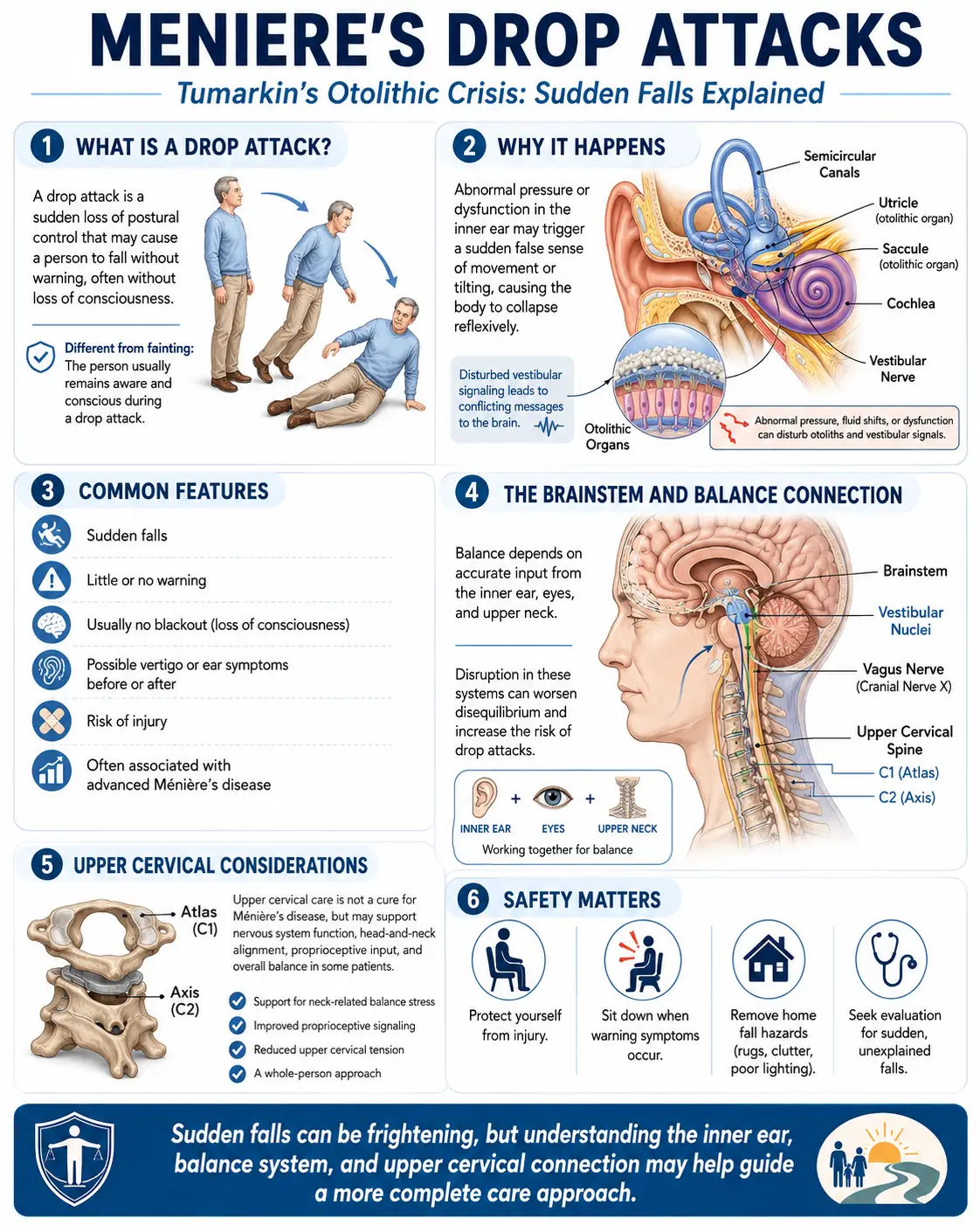
A drop attack, in the context of Meniere’s disease, is a sudden fall to the ground without any loss of consciousness. That last detail is the defining feature. The person remains fully awake and aware throughout. They don’t black out, they don’t have a seizure, and they can usually recount exactly what they felt.
What they felt is described in remarkably consistent language across patients and decades of case reports:
- Pushed, shoved, or thrown — as though an external force acted on them
- A sensation that the ground tilted or dropped away beneath them
- The feeling that the room suddenly accelerated or rotated
- An irresistible pull in one direction, toward the floor
These attacks are abrupt. There’s typically little to no warning — no gradual dizziness that gives you time to sit down, no aura. One moment you’re upright, the next you’re on the floor. Because there’s no time to protect yourself, injuries are common: bruises, lacerations, fractured wrists from catching yourself, facial injuries, and in older adults, hip fractures and head trauma.
The episode itself is brief, usually seconds. Afterward, most people can get up and resume activities, sometimes shaken and unsteady, sometimes near-normal within minutes. There’s no prolonged confusion — no long grogginess of the kind that follows a seizure.
The name Tumarkin’s otolithic crisis comes from the physician Aleksei Tumarkin, who first described these events in 1936. He proposed they were caused by sudden mechanical dysfunction of the otolith organs — the inner-ear parts that sense gravity and linear movement. That mechanism matters, because it explains the strange “pushed” quality patients describe.
The key takeaway: a Meniere’s drop attack is a sudden, unprovoked fall, without loss of consciousness, with a sensation of being pushed or thrown, over in seconds, and without lasting confusion.
A Quick Refresher on Meniere’s Disease
Meniere’s disease is a chronic disorder of the inner ear. The classic picture involves four features:
- Episodes of vertigo — spinning — lasting from twenty minutes to several hours
- Fluctuating hearing loss, especially in the lower frequencies, often in one ear
- Tinnitus — ringing, roaring, or buzzing in the affected ear
- A feeling of fullness or pressure in the ear, as though it needs to “pop”
The underlying problem is thought to involve endolymphatic hydrops — an abnormal buildup of fluid within the delicate membranous compartments of the inner ear. The inner ear contains the cochlea (hearing), the semicircular canals (which sense rotation), and the otolith organs — the utricle and saccule — which sense gravity and straight-line acceleration. When fluid pressure in this closed system fluctuates abnormally, it can disrupt any or all of these functions.
Meniere’s tends to progress through phases over years. Early on, vertigo attacks dominate and hearing may return to normal between episodes. In later stages, hearing loss often becomes more permanent, the violent vertigo spells may actually decrease, and balance becomes more chronically impaired — which, as we’ll see, is exactly when the rest of the balance system, including the upper neck, has to work hardest.
Drop attacks tend to appear in the later stages of Meniere’s disease, though they can occur at various points, and they’re relatively uncommon. When they occur, they can be one of the most disabling features of the condition, precisely because of the injury risk. They can also be a signal to the treating physician that the disease is behaving aggressively and that management may need to escalate.
Why Do Drop Attacks Happen? The Otolith Connection
Here’s where the “pushed or thrown” sensation makes sense.
Your otolith organs — the utricle and saccule — contain tiny calcium carbonate crystals called otoconia, sitting on a bed of sensory hair cells embedded in a gel-like membrane. When your head moves in a straight line or tilts relative to gravity, these crystals shift, bending the hair cells and telling your brain which way is “down” and how you’re accelerating. This system is exquisitely calibrated.
The leading explanation for Tumarkin’s crisis is that sudden fluctuations of fluid pressure in a Meniere’s-affected inner ear cause a sudden, brief mechanical deformation or misfiring of the otolith organs. The otoliths abruptly send the brain a burst of false information — a signal that the body has suddenly tilted or accelerated when it hasn’t.
Your brain trusts this signal. So it does exactly what it’s designed to do: it triggers an immediate, powerful, reflexive postural correction to “catch” you from a fall that isn’t actually happening. This reflex — involving the vestibulospinal pathways connecting the inner ear to the muscles of the trunk and legs — is what actually throws you to the ground. The fall is your own protective reflex firing in response to a false alarm. That’s why people feel pushed: from the brain’s point of view, a push really did occur.
This otolithic mechanism explains several features at once: the suddenness (the false signal is instantaneous), the lack of warning (no build-up, because the trigger is a momentary mechanical event), the directionality (the false tilt has a direction), and the preserved consciousness (the brain and its blood supply are working perfectly — this is a sensory error, not a loss of brain function).
That last point is central. In a true Tumarkin’s crisis, your brain is fine. The problem is a faulty balance signal from the ear, not a failure of the brain itself. That distinction is exactly why other causes of sudden falls — causes that do involve the brain, heart, or blood vessels — must be ruled out first. Those are different, and some are emergencies.
This Is Critical: Sudden Falls Have Many Causes, and Some Are Emergencies
I cannot emphasize this strongly enough. A sudden fall is a symptom, not a diagnosis. Tumarkin’s otolithic crisis is only one of many possible reasons a person might drop to the ground, and it can only be diagnosed by a physician after other, potentially dangerous causes have been carefully excluded.
Some of the other things that cause sudden falls, several of which are medical emergencies:
Cardiac causes. Heart-rhythm problems (arrhythmias), structural heart disease, or sudden drops in blood pressure can cause collapse. A dangerous arrhythmia can cause a fall that looks superficially like a drop attack but is life-threatening. Cardiac syncope often — but not always — involves at least brief loss of consciousness. This must be evaluated.
Seizures. Certain seizure types, including atonic seizures (“drop seizures”), cause sudden falls. They may or may not involve obvious convulsions and often — though not always — involve altered awareness, confusion afterward, tongue-biting, or incontinence.
Vascular and neurological causes. Transient ischemic attacks (TIAs, or “mini-strokes”), vertebrobasilar insufficiency, and other cerebrovascular problems can cause falls. These are emergencies because they can signal an impending stroke.
Orthostatic hypotension. A sudden blood-pressure drop on standing — sometimes tied to medications, dehydration, or nervous-system disorders — can cause falls.
Other inner-ear and neurological conditions. BPPV, vestibular migraine, and other disorders can cause falls or near-falls and are managed differently from Meniere’s.
Because this list includes genuine emergencies, self-diagnosis is not safe here. Please do not assume your sudden falls are “just” Meniere’s drop attacks. That conclusion belongs to a physician, and it’s a diagnosis of the balance system arrived at partly by excluding the dangerous alternatives.
Red Flags: When to Seek Emergency Care
Call 911 or go to the nearest emergency department immediately if a sudden fall is accompanied by any of the following:
- Loss of consciousness or fainting (even briefly)
- Chest pain, palpitations, or the sensation of a racing or irregular heartbeat
- Sudden severe headache unlike any you have had before
- Slurred speech, facial drooping, or weakness or numbness on one side of the body
- Sudden vision loss or double vision
- Difficulty speaking, understanding speech, or confusion
- Convulsions, tongue-biting, or loss of bladder or bowel control
- Shortness of breath
- A serious injury from the fall, especially a head injury, or any head injury in someone taking blood thinners
- Any fall in an older adult that causes injury or that cannot be readily explained
These are not the features of a simple Tumarkin’s crisis; they point toward the heart, brain, or blood vessels, and they demand urgent care. When in doubt, err on the side of an emergency evaluation. It’s always better to be checked and reassured than to miss something serious.
How Doctors Diagnose Tumarkin’s Otolithic Crisis
Because Tumarkin’s crisis is, in part, a diagnosis of exclusion, the work-up is thorough. A neuro-otologist or ENT will typically:
Take a detailed history. When do the falls happen? Is there warning? Do you lose consciousness? What do they feel like — pushed, spun, faint? Is there hearing loss, tinnitus, or ear fullness? Do you have a known Meniere’s diagnosis? A careful history also asks about head and neck trauma — whiplash, concussion, prior falls — because that history is relevant to the whole balance system. The characteristic story (a sudden fall with a sensation of being thrown, no loss of consciousness, no post-event confusion, in someone with Meniere’s) is highly suggestive.
Perform a physical and neurological examination. Including eye movements, coordination, blood pressure in different positions, and a focused neurological exam.
Order hearing tests (audiometry). Documenting the characteristic fluctuating, low-frequency hearing loss supports the diagnosis.
Consider vestibular testing. Videonystagmography (VNG), vestibular evoked myogenic potentials (VEMPs, which specifically assess otolith function), and rotational chair testing help characterize inner-ear function.
Order imaging when indicated. MRI of the brain and inner ear is often used to rule out other conditions, such as a vestibular schwannoma or cerebrovascular disease.
Rule out cardiac and neurological causes. Depending on the story, this may include an ECG, heart-rhythm monitoring, or evaluation by a cardiologist or neurologist.
The point of this careful process is the right diagnosis, because the right diagnosis drives the right treatment — and the treatments for a heart-rhythm problem, a seizure disorder, and Meniere’s disease could not be more different.
Medical Management: What Physicians Can Offer
Once a physician confirms drop attacks are due to Meniere’s, there’s a genuine spectrum of management, and this is an area where medicine has real tools. Management is typically staged, starting with the least invasive and escalating only when needed. Because drop attacks carry such high injury risk, physicians often treat them more aggressively than vertigo alone.
Conservative and medical measures often come first:
- Dietary changes, particularly a low-sodium diet, to reduce fluid-pressure fluctuations in the inner ear
- Diuretics (“water pills”) to help regulate fluid balance
- Limiting caffeine and alcohol and managing other triggers
- Managing associated conditions such as migraine
- Betahistine, used in many countries for Meniere’s symptoms
Escalated and procedural measures, when drop attacks continue despite conservative care:
- Intratympanic injections. Medication delivered through the eardrum into the middle ear — steroids or, in resistant cases, an aminoglycoside antibiotic called gentamicin, which selectively reduces the function of the balance portion of the inner ear. This can reduce the false signals driving the drop attacks.
- Surgical procedures. In severe, treatment-resistant cases, options range from endolymphatic sac surgery to more definitive procedures. As the research section notes, newer approaches such as posterior semicircular canal plugging have been reported to help control Tumarkin’s crisis; older, more destructive procedures such as vestibular nerve section or labyrinthectomy remain options when the goal is to stop the dangerous falls in a non-functional or poorly functional ear.
The reassuring news is that, for the great majority of people, drop attacks can be brought under control with appropriate medical management. They also tend to occur in clusters and may subside on their own over time — but that unpredictability is precisely why they should never be left unmanaged. The plan is highly individual and belongs with your ENT or neuro-otologist. What matters is that you’re in that conversation with a qualified physician, rather than weathering these dangerous falls on your own.
Staying Safe: Practical Steps to Prevent Injury
While you and your physician work on the underlying cause, protecting yourself from injury is a priority in its own right. Drop attacks are dangerous mainly because of what you might hit on the way down.
Around the home:
- Remove trip hazards and clutter from walkways
- Secure or remove loose rugs and cords
- Install grab bars in the bathroom, near the toilet, and in the shower
- Use non-slip mats in the tub and shower
- Improve lighting, including night lights along the path to the bathroom
- Pad sharp corners of countertops and furniture where practical
- Keep frequently used items within easy reach
In daily life:
- Be especially cautious in high-risk settings — near stairs, on hard tile or concrete, near hot surfaces or water, and around pool edges
- Consider your activities carefully. During active periods, avoid situations where a sudden fall could be catastrophic: swimming alone, climbing ladders, working at heights, or operating dangerous machinery
- Talk to your physician about driving. Sudden, unpredictable falls can make driving unsafe for you and others. Your doctor can advise based on your situation and local regulations
- Consider a medical alert system in case you fall and are injured
- Let people know. Family, friends, and coworkers who understand what a drop attack looks like can respond appropriately
Physical stability:
- Ask your physician about vestibular rehabilitation therapy, which can improve balance and reduce fall risk
- Work on general strength and balance as your physician advises
None of these steps addresses the root cause, but every one can mean the difference between a frightening near-miss and a serious injury. Safety planning runs alongside medical care.
Where Upper Cervical Care Fits — the Overlooked Balance Input
You might wonder why a chiropractor is writing about a condition managed by ENTs and neuro-otologists. Fair question, and I’ll answer it carefully, because on a safety-critical topic, overclaiming would be irresponsible.
Let me be direct: upper cervical chiropractic care does not treat or cure Meniere’s disease, and it does not treat or cure Tumarkin’s drop attacks. Drop attacks are driven by inner-ear (otolithic) dysfunction and require medical evaluation and management by the appropriate physicians. If you take one thing from this article, let it be that. Anyone who tells you an adjustment will make your drop attacks disappear is not being straight with you.
So where does upper cervical care fit? The honest answer lies in how the body maintains balance in the first place.
Your sense of balance is not the job of the inner ear alone. It’s the product of three streams your brain constantly blends: vision (what your eyes tell you), the vestibular system (what your inner ears tell you), and proprioception (what your muscles and joints tell you about your body’s position). The upper neck — the region of the atlas and axis — is one of the richest sources of proprioceptive information in the entire body, densely packed with position sensors, with well-mapped neurological connections into the same brainstem centers that process vestibular and visual balance signals. These two vertebrae also carry the full weight of your head, held largely by ligaments rather than interlocking bone, which is why whiplash, concussion, and hard falls can knock them out of alignment and leave them feeding distorted signals.
Here’s why that matters for someone with Meniere’s. In the later stages — exactly when drop attacks tend to appear — the inner ear is doing less of the balancing, and the brain leans harder on vision and neck proprioception to keep you steady. If the upper neck is misaligned, it can become a significant, overlooked driver of the chronic imbalance and unsteadiness that surround this stage. That is not a claim about the drop attacks themselves — those are otolithic. It’s a claim about the broader balance system in which they occur: when someone is already coping with a compromised inner ear, you want every other balance input working as well as it can, and the upper neck is the input almost nobody measures.
That’s the honest framing for our involvement: not as a treatment for the ear or the drop attacks, but as attention to a genuine, overlooked part of the broader balance system, delivered as part of coordinated, physician-led care.
At Lavender Family Chiropractic — NeckWise North Sarasota, serving Sarasota, Lakewood Ranch, and Bradenton — our approach is deliberately gentle and measured. We use:
- 3D CBCT (cone-beam computed tomography) imaging to understand the specific anatomy of your upper cervical spine with precision, rather than guessing
- Paraspinal infrared thermography to assess patterns in the nervous system over time
- The Knee Chest Upper Cervical technique, a low-force method
Our upper cervical work is precise, gentle, and low-force. There is no twisting, no cracking, and no popping. For someone already anxious about their balance and their neck, that gentleness matters.
I want to underscore the coordinated-care piece. We are not a substitute for your ENT, neuro-otologist, neurologist, or cardiologist. If you come to us with a history of sudden falls, our first and most important role is to make sure you’re under the care of the right physicians and have had a proper medical work-up. We see ourselves as one member of a team centered on your physician’s diagnosis and plan — a supportive role focused on the neck’s contribution to overall balance, never a replacement for the medical management your condition requires.
That’s the whole honest picture.
What the Research Says
Drop attacks have been studied for decades. Here’s what a selection of the published research shows.
The concept of a vestibular drop attack as a distinct clinical entity in Meniere’s disease is well established. A 2006 review in Acta Otorrinolaringológica Española examined vestibular drop attacks, or Tumarkin’s otolithic crisis, in patients with Meniere’s disease, reinforcing that these sudden falls are a recognized manifestation of Meniere’s attributed to otolithic dysfunction — consistent with the mechanism described here.
One of the most influential clinical descriptions came from Baloh and colleagues, whose 1990 paper in Annals of Neurology characterized drop attacks with Meniere’s syndrome. Their careful documentation helped define the classic picture: abrupt falls, the sensation of being pushed or thrown, and — critically — the preservation of consciousness.
Earlier still, Black and colleagues addressed the practical clinical challenge in a 1982 paper in Otolaryngology–Head and Neck Surgery on the diagnosis and management of drop attacks of vestibular origin: Tumarkin’s otolithic crisis. This work emphasized that these events are of vestibular (inner-ear) origin and that both accurate diagnosis and active management are important — a message just as true today.
The treatment side continues to evolve. A 2024 study in Audiology Research reported that posterior semicircular canal plugging relieved Tumarkin’s crisis in Meniere’s disease patients — an encouraging example of how surgical options for treatment-resistant, dangerous drop attacks have expanded.
Finally, also in 2024, a separate paper in Audiology Research offered an analysis of the therapeutic response in vestibular drop attack. Studies examining how patients respond to various treatments help physicians counsel patients realistically about their options and outlook.
Together, the research paints a consistent picture. Tumarkin’s drop attacks are a recognized, otolith-related feature of Meniere’s disease; they have a characteristic clinical story that includes preserved consciousness; they need to be properly diagnosed and distinguished from other causes of falls; and a range of treatments, up to newer surgical techniques, can help bring them under control. What the literature does not describe is any shortcut around proper medical care — and neither will we.
Top Questions
Do you lose consciousness during a Meniere’s drop attack? No. The defining feature of a Tumarkin’s otolithic crisis is that you remain fully conscious and aware throughout the fall. If a fall involves loss of consciousness or fainting, that points toward other causes — often cardiac or neurological — and needs urgent medical evaluation. Loss of consciousness is a red flag, not a feature of a simple drop attack.
How long do drop attacks last? The fall itself is brief — usually seconds. There’s little or no warning beforehand and no prolonged confusion afterward, which helps distinguish these events from seizures. Many people can get up and continue their day, though shaken.
Are drop attacks dangerous? The attacks themselves aren’t typically a sign that the brain or heart is failing, but they’re dangerous because of the injuries they cause. Falling suddenly and without warning can lead to fractures, head injuries, and other trauma, especially in older adults. That injury risk is exactly why these events warrant prompt medical attention and active management, and why home safety planning matters.
Can upper cervical chiropractic care cure my drop attacks? No, and we’d never claim otherwise. Drop attacks are caused by inner-ear dysfunction and require medical care from an ENT or neuro-otologist. Upper cervical care focuses on the neck’s role as one input into your overall balance system — a genuine, overlooked input worth evaluating when you’re coping with a compromised inner ear — and is offered only as part of coordinated, physician-led care. It’s gentle and low-force, with no twisting, cracking, or popping, but it is not a treatment for Meniere’s disease or for drop attacks.
When should I go to the emergency room? Immediately if a fall is accompanied by loss of consciousness, chest pain or palpitations, sudden severe headache, slurred speech, facial drooping, one-sided weakness or numbness, vision changes, confusion, convulsions, loss of bladder or bowel control, or a serious injury (especially a head injury). These features suggest causes other than a simple drop attack — some of which are emergencies.
Should I still be driving? This is a conversation to have directly with your physician. Because drop attacks are sudden and unpredictable, they can make driving unsafe for you and others. Please don’t make this decision in isolation.
Will drop attacks last forever? Not usually. They often occur in clusters and may subside over time, and for most people they can be controlled with appropriate medical management — from dietary and medication measures to procedures and, in resistant cases, surgery.
My hearing hasn’t been tested — does that matter? Yes. Because drop attacks are tied to Meniere’s, hearing testing (audiometry) is an important part of the work-up. Documenting the characteristic fluctuating hearing loss helps confirm the diagnosis.
Putting It All Together
Meniere’s drop attacks — Tumarkin’s otolithic crisis — are among the most alarming experiences a person with inner-ear disease can face. Understanding them takes away some of their power to frighten. They’re sudden falls without loss of consciousness, driven by a momentary false signal from the balance organs of the inner ear, which triggers a protective reflex that throws you to the ground. That’s why they feel like a push from nowhere. They’re over in seconds, leave no lasting confusion, and — with the right medical care — can usually be brought under control.
The most important message is also the simplest: sudden falls need medical evaluation. Tumarkin’s crisis is a diagnosis made by physicians after other, potentially dangerous causes — cardiac, neurological, vascular — have been carefully excluded. Please don’t try to sort this out on your own. See an ENT or neuro-otologist, know the red flags, and seek emergency care when they appear.
Alongside that physician-led care, real, practical things help: making your home safer, thinking carefully about high-risk activities, asking about vestibular rehabilitation, and — as one genuine, overlooked input into the broader balance system — evaluating the health of the upper neck. That last piece is where we come in, honestly and in a supporting role, never as a substitute for the medical care your condition requires.
A Gentle, Coordinated Approach in Sarasota, Lakewood Ranch & Bradenton
At Lavender Family Chiropractic — NeckWise North Sarasota, we care for people across the Sarasota–Bradenton region, including Sarasota, Lakewood Ranch, Bradenton, North Sarasota, Whitfield, University Park, Palmetto, Ellenton, and the surrounding Manatee and Sarasota County communities. Many of the people we see are living with balance challenges and want to make sure every part of their balance system is functioning as well as it can, as part of a team that includes their physicians.
Our care is built around precision and gentleness: 3D CBCT imaging to understand your unique upper cervical anatomy, paraspinal infrared thermography to track your nervous system over time, and the low-force Knee Chest Upper Cervical technique. Our work is precise, gentle, and low-force — no twisting, no cracking, and no popping. And if you’re experiencing sudden falls, our first priority will always be to make sure you’re connected with the right medical specialists for a proper evaluation.
If you’d like to learn whether coordinated upper cervical care might have a place alongside your medical treatment, patients across Sarasota, Lakewood Ranch, and Bradenton are welcome to reach out for a complimentary consultation with our doctors. We’ll listen to your story, answer your questions honestly, and help you think through the safest path forward.
Lavender Family Chiropractic (NeckWise North Sarasota) 5899 Whitfield Avenue, Suite 107 Sarasota, FL 34243(941) 243-3729
This article is for general educational purposes only and is not medical advice. It does not replace evaluation, diagnosis, or treatment by a qualified physician. If you are experiencing sudden falls, please seek prompt medical care, and call 911 or go to the nearest emergency department if you notice any of the red-flag symptoms described above.