
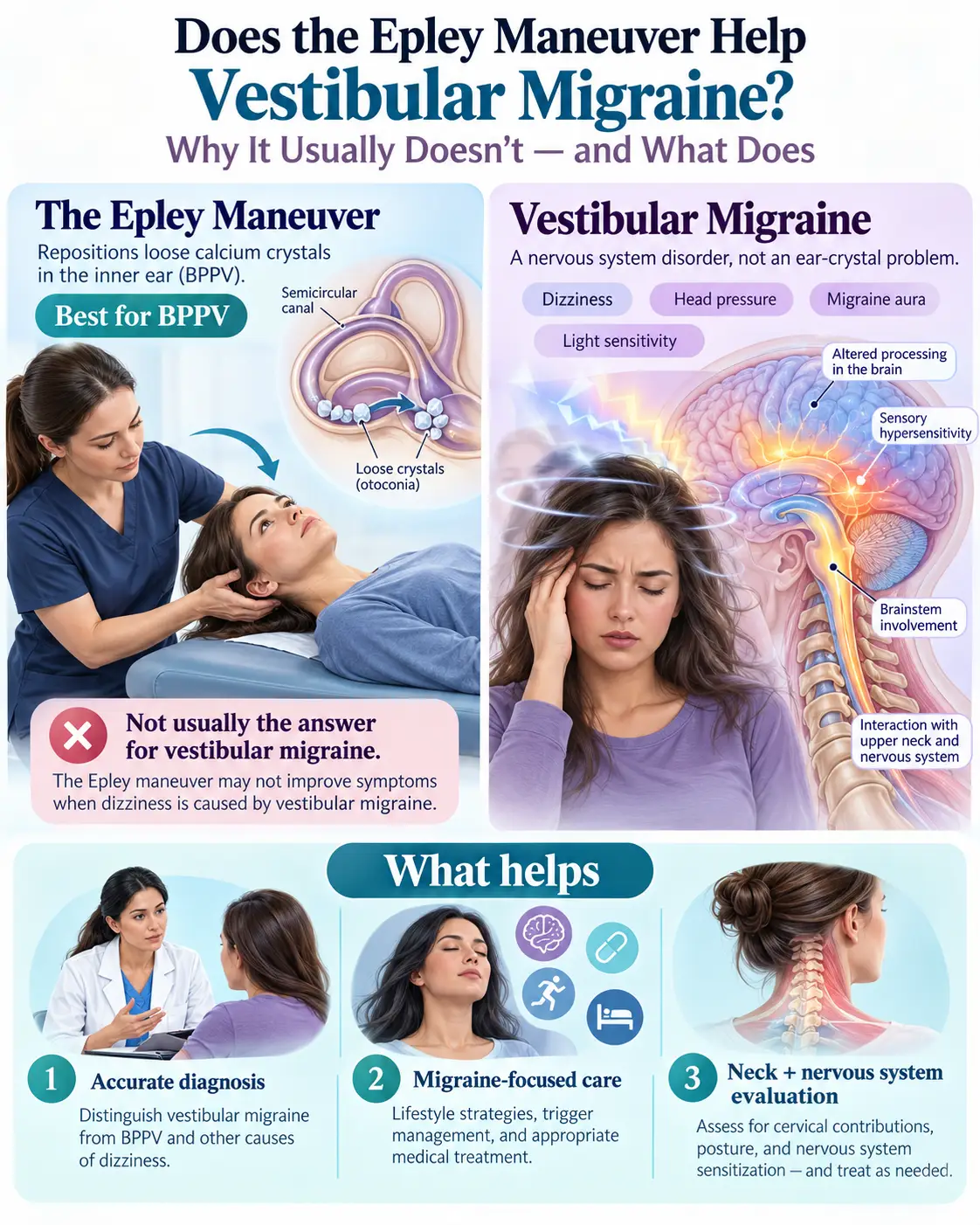
Does the Epley Maneuver Help Vestibular Migraine? Why It Usually Doesn’t — and What Does
By Dr. Rusty Lavender, D.C. — upper cervical chiropractor, Lavender Family Chiropractic, Sarasota, FL. Reviewed and updated October 2026.
You went to the ENT, or the physical therapist, or you found the video online. You lay back with your head turned, waited, rolled, sat up. Maybe it helped for a day. Maybe it did nothing. Maybe it made the spinning worse. And now you’re searching “does the Epley maneuver help vestibular migraine” because somebody finally used those words — vestibular migraine — and you’re wondering whether the thing everyone told you to do was ever the right thing.
The short answer: the Epley maneuver treats one specific problem — loose crystals in the inner ear — and vestibular migraine is not that problem. When the Epley fails, it’s usually not because it was done wrong. It’s because the vertigo wasn’t coming from where the Epley works. This article explains what the Epley actually does, why it can’t reach vestibular migraine, how to tell the two conditions apart, why a surprising number of people have both, and where the upper neck — the piece neither the ENT nor the neurologist typically examines — fits into migraine-driven vertigo.
This is educational content, not medical advice. Vertigo with a sudden severe headache, double vision, trouble speaking, weakness, numbness, or inability to walk is an emergency.
What the Epley Maneuver Actually Does
The Epley maneuver is a treatment for benign paroxysmal positional vertigo (BPPV), and only for BPPV. In BPPV, tiny calcium carbonate crystals that normally sit in one part of the inner ear break loose and drift into one of the semicircular canals — the fluid-filled loops that sense head rotation. When you move your head in certain ways, the crystals slide, the fluid moves when it shouldn’t, and the canal tells your brain you’re spinning when you’re not.
The Epley is a sequence of head positions that uses gravity to walk the crystals back out of the canal to where they belong. The clinical practice guideline from the American Academy of Otolaryngology, by Bhattacharyya and colleagues (2017), is clear: for BPPV of the posterior canal, canalith repositioning is the treatment, and it works well — most people improve in one to three sessions. For the right problem, it’s one of the most effective physical treatments in medicine.
That phrase — the right problem — is the whole point. The Epley moves crystals. If your vertigo isn’t caused by crystals, there’s nothing for it to move. Our article on BPPV treatment covers the maneuver in depth, and why the Epley can be a band-aid covers what it doesn’t address.
What Vestibular Migraine Is
Vestibular migraine is migraine that attacks the balance system instead of — or in addition to — causing head pain. It’s a disorder of the brain’s processing, not of the inner ear’s hardware.
The diagnostic criteria were published by Lempert and colleagues (2012) on behalf of the Bárány Society and the International Headache Society. Simplified: at least five episodes of vestibular symptoms — spinning vertigo, a sense of self-motion, unsteadiness, positional dizziness — lasting from five minutes to seventy-two hours; a current or past history of migraine; and migraine features (headache, light or sound sensitivity, or visual aura) during at least half the episodes. The headache is optional. Many people with vestibular migraine never get a headache with their dizzy spells at all, which is why they’re told they have an ear problem for years.
It’s common. Neuhauser and colleagues (2006) estimated the lifetime prevalence at about one percent of the population — making it one of the most common causes of recurrent vertigo — and found that most people with it had never been diagnosed. Furman and colleagues (2013), reviewing the condition in The Lancet Neurology, describe it as a brain disorder in which the same processes that generate migraine pain spill over into the circuits that process balance and spatial orientation.
Our vestibular migraine guide goes through the condition fully.
Why the Epley Can’t Reach Vestibular Migraine
Put the two side by side and the answer is obvious.
BPPV is a mechanical problem in the inner ear: crystals in the wrong canal. The Epley fixes the mechanics.
Vestibular migraine is a neurological problem in the brain: the balance-processing circuits firing abnormally during a migraine event. The crystals are where they belong. Moving your head through the Epley positions repositions nothing, because nothing is out of position. At best it does nothing. At worst, the head movements provoke the motion-sensitive brain of a migraine patient and make the attack worse — which is exactly what many people report.
von Brevern and colleagues (2005) examined patients during acute vestibular migraine attacks and found abnormal eye movements pointing to both central (brain) and peripheral (ear) involvement — but the pattern was not the pattern of BPPV, and the attacks resolved on their own as the migraine passed, with no repositioning. The vertigo of vestibular migraine comes and goes with the migraine, not with the position of crystals.
So if you were given the Epley, it didn’t help, and nobody mentioned migraine — the problem wasn’t the maneuver. It was the diagnosis.
How to Tell Them Apart
The two conditions are confused constantly, including by clinicians, because both cause positional vertigo. Here is how they differ:
| BPPV (Epley helps) | Vestibular migraine (Epley doesn’t) | |
|---|---|---|
| How long it spins | seconds to under a minute | minutes to hours, up to three days |
| What sets it off | lying down, rolling over, tipping the head back | stress, sleep loss, hormones, weather, screens, certain foods — and sometimes position |
| Between episodes | usually fine | often lingering unsteadiness, motion sensitivity, visual sensitivity |
| Migraine history | not required | present, or family history |
| Light/sound sensitivity, aura | no | often, during episodes |
| Positioning test (Dix-Hallpike) | positive, with a specific eye movement | usually negative or atypical |
| Course | resolves with repositioning | recurs for years without migraine management |
The single most useful question: how long does the spinning last? Seconds means the ear. Minutes to hours means the brain. Our article on vestibular migraine vs. BPPV goes through this distinction in full, and vertigo when rolling over in bed covers the positional overlap.
The Complication: Many People Have Both
Here’s what makes this harder than a simple either/or. Migraine and BPPV travel together. Neuhauser and colleagues (2001) found that migraine was significantly more common in people with vertigo than in the general population, and that migraine patients had higher rates of BPPV. The reason isn’t fully settled; one theory is that migraine’s effects on the inner ear’s blood supply make the crystals more likely to detach.
So the realistic picture for many patients is: a true BPPV episode that the Epley does fix — followed by continued dizziness that the Epley doesn’t fix, because the migraine was underneath all along. The ear problem was real but it was never the whole story. If that’s your experience — the Epley worked once, the spinning stopped, but you’re still off-balance, motion-sick, and foggy — the migraine component is what’s left.
The Upper Cervical Connection
This is the part of the picture that neither the ENT nor the neurologist typically examines, and it bears directly on why migraine-driven vertigo persists.
Migraine and the upper neck share wiring. The nerves from the top three segments of the cervical spine (C1–C3) feed into the same cluster of brainstem cells as the trigeminal nerve, which carries pain from the head and face. Bartsch and Goadsby (2003) describe this trigeminocervical complex and how input from the upper neck can drive the migraine process. That’s why so many migraine patients have neck pain before and during attacks, and why neck input can lower the threshold at which a migraine-prone brain tips into an attack.
The upper neck also feeds the balance system directly. The atlas (C1) and axis (C2) carry one of the body’s densest concentrations of position sensors, and that input converges in the brainstem with the signals from the inner ear and the eyes. Kristjansson and Treleaven (2009) reviewed how disturbed cervical input produces dizziness, unsteadiness, and altered eye-movement control. In a person whose balance-processing circuits are already unstable because of migraine, a neck that’s sending distorted position data is a second source of conflict — and the brainstem, which sits directly against the upper cervical spine, is where both problems meet.
So in vestibular migraine, the upper cervical spine matters twice: as an input that can provoke the migraine process, and as an input that can destabilize balance processing on its own. The Epley addresses neither. Neither, usually, does the neurologist’s medication, which works on the brain’s chemistry but not on the mechanical input feeding it.
Upper Cervical Care at Lavender Family Chiropractic
When someone whose Epley didn’t work comes to our Sarasota office, the first visit is an evaluation, not an adjustment.
History. The pattern of your vertigo — duration, triggers, what accompanies it, migraine history, what’s been tried. This alone usually tells us whether we’re looking at BPPV, vestibular migraine, a neck-driven dizziness, or a combination.
Positional testing for BPPV. We screen for loose crystals ourselves, so an ear problem isn’t mistaken for a neck problem. If the picture is BPPV that hasn’t been repositioned, that’s the first thing to address, and we refer for it.
Neurological examination. Including a head-repositioning test that measures how accurately your neck is reporting head position to your brain.
Paraspinal infrared thermography. A non-invasive scan of the heat pattern along the spine, reflecting nervous-system activity — an objective baseline of irritation at the upper neck and a way to track change visit to visit.
3D cone-beam CT (CBCT) imaging of the upper cervical spine. The position of the atlas and axis relative to the skull, in three dimensions and to the degree.
Review of findings before any care.
Correction, if indicated. If the imaging shows a measurable misalignment of the upper cervical spine, we correct it with a precise, low-force procedure specific to your measurements — no twisting, no cracking, and no rotation of the neck, which matters enormously for someone whose vertigo is provoked by head movement. Most patients describe it as pressure.
Remeasurement. Thermography after each visit and follow-up imaging when indicated.
Upper cervical care addresses the mechanical source the research points to — the neck — with measurement before and after, so progress is objective rather than guessed at. Results vary from person to person, and we tell you plainly what the findings show. Our care works alongside your neurologist’s management of the migraine itself; the two address different inputs.
If the Epley didn’t work and nobody has looked at your neck, call (941) 243-3729 or request an appointment online for an upper cervical evaluation.
What the Research Says
The Epley treats BPPV, specifically. Bhattacharyya and colleagues (2017), in the AAO-HNS clinical practice guideline, establish canalith repositioning as the treatment for posterior-canal BPPV.
Vestibular migraine is a brain disorder with its own criteria. Lempert and colleagues (2012) published the Bárány/IHS diagnostic criteria. Furman and colleagues (2013) reviewed the clinical picture and mechanisms.
It’s common and under-diagnosed. Neuhauser and colleagues (2006) estimated roughly one percent lifetime prevalence and found most cases undiagnosed.
During attacks, the findings are not BPPV findings. von Brevern and colleagues (2005) documented eye-movement patterns during acute vestibular migraine that pointed to central processing, resolving with the attack.
Migraine and BPPV coexist more than chance. Neuhauser and colleagues (2001) found migraine over-represented among vertigo patients and BPPV over-represented among migraine patients.
The upper neck feeds both migraine and balance. Bartsch and Goadsby (2003) described the trigeminocervical complex; Kristjansson and Treleaven (2009) reviewed how cervical input disturbs balance and eye control.
What to Do If the Epley Didn’t Work
Count the seconds. If your spinning lasts seconds and is set off by lying down, ask whether the Epley was done for the correct canal and side — BPPV in a different canal needs a different maneuver.
If it lasts minutes to hours, think migraine. Especially with any migraine history, light or sound sensitivity, visual aura, or a family history. A neurologist who treats headache is the right next stop; bring the Lempert criteria.
Track your triggers. Sleep, stress, dehydration, skipped meals, weather fronts, screens, hormonal timing. Vestibular migraine responds to trigger management the way regular migraine does.
Keep moving. Vestibular rehabilitation helps many people with vestibular migraine — Vitkovic and colleagues (2013)found improvement in people with vestibular migraine who completed rehab — though it addresses the brain’s compensation, not the migraine or the neck. If you’ve done rehab and plateaued, our article on when vestibular rehab isn’t working covers the next step.
Have the upper neck evaluated. If your dizziness travels with neck pain, stiffness, headache at the base of the skull, or began after an accident or fall — or if everything else has been tried — the upper cervical spine is the input nobody has measured.
Our dizziness guide lays out how all the types are told apart.
Serving Sarasota, Bradenton, Lakewood Ranch, and the Suncoast
Our office is on Whitfield Avenue in north Sarasota, minutes from the Manatee County line. We see patients with vestibular migraine, BPPV, and both from Sarasota, Bradenton, Lakewood Ranch, Palmetto, Parrish, Ellenton, Longboat Key, Siesta Key, Osprey, Nokomis, Venice, and North Port. Many arrive having had the Epley two, three, or four times. If that’s you, the question isn’t whether the maneuver was done right — it’s whether anyone has looked at the rest of the picture.
Top 15 FAQs: The Epley Maneuver and Vestibular Migraine
1. Does the Epley maneuver help vestibular migraine? No. The Epley repositions loose inner-ear crystals, which is the cause of BPPV. Vestibular migraine is a brain-processing disorder; the crystals are where they belong, so there’s nothing for the Epley to move.
2. Can the Epley make vestibular migraine worse? It can provoke an attack or worsen one in progress, because the head movements stimulate a motion-sensitive migraine brain. Many patients report feeling worse after.
3. How do I know if I have BPPV or vestibular migraine? Duration is the best clue: BPPV spins for seconds and is set off by lying down or rolling over; vestibular migraine lasts minutes to hours and travels with migraine features. A positioning test (Dix-Hallpike) is positive in BPPV and usually not in vestibular migraine.
4. Can I have both? Yes, and it’s common. Migraine patients have higher rates of BPPV. The Epley fixes the BPPV part; the migraine part remains.
5. The Epley worked once but I’m still dizzy. Why? The most common reason is that BPPV was real but wasn’t the whole problem. Lingering unsteadiness, motion sensitivity, and fog after a successful Epley point toward vestibular migraine or a neck component.
6. Why did my ENT say my ear tests were normal? Because in vestibular migraine, the ear usually is normal. The problem is in how the brain processes balance, which standard ear tests don’t measure.
7. Does vestibular migraine always come with a headache? No. Many people have the dizziness without any headache, which is why it’s so often missed. Light or sound sensitivity during episodes counts as a migraine feature even without pain.
8. What does treat vestibular migraine? Trigger management, migraine preventive medication through a neurologist when needed, vestibular rehabilitation for the brain’s compensation, and evaluation of the upper neck as an input to both the migraine process and the balance system.
9. Can the neck cause vestibular migraine? The upper neck is an input into the migraine process through the trigeminocervical complex, and an input into balance processing through the brainstem. It can provoke attacks and destabilize balance; whether it’s a factor for you is something we measure.
10. Is upper cervical care safe when head movement triggers my vertigo? The procedure we use involves no rotation and no thrust — the head is positioned and a low-force correction is delivered to the atlas. It’s designed for exactly this situation.
11. Should I see a neurologist or a chiropractor first? If you’ve never been diagnosed, a neurologist who treats headache can confirm vestibular migraine. If you’ve been diagnosed and treated and are still dizzy, an upper cervical evaluation looks at the input nobody has examined. Many of our patients see both.
12. How many times should I try the Epley before giving up? If a properly performed Epley hasn’t resolved brief positional spinning in two or three sessions, ask about the other canals. If your spinning was never brief to begin with, the Epley was never the right tool.
13. Can vestibular migraine be positional like BPPV? Yes — positional vertigo is one of the recognized presentations, which is why the two get confused. The difference is that in vestibular migraine the positional vertigo lasts longer and the positioning test doesn’t show the BPPV eye-movement pattern.
14. How soon would I know if the neck is a factor? When the upper neck is involved and corrected, patients typically report changes in attack frequency and baseline unsteadiness within the first several weeks. We measure before and after.
15. Do you take insurance? Call the office and we’ll go through costs and coverage before anything begins.
Lavender Family Chiropractic in Sarasota, Florida offers a thorough upper cervical evaluation to find out whether we can help. Call (941) 243-3729 or request an appointment. 5899 Whitfield Avenue, Suite 107, Sarasota, FL 34243.
Related Articles
- Vestibular Migraine: Our Complete Guide
- Vestibular Migraine vs. BPPV
- Effective BPPV Treatment
- Why the Epley Can Be a Band-Aid
- Vestibular Rehab Isn’t Working: What to Check Next
- Dizziness: Our Complete Guide
References
- Bhattacharyya N, et al. Clinical Practice Guideline: Benign Paroxysmal Positional Vertigo (Update). Otolaryngol Head Neck Surg. 2017. PMID 28248609
- Lempert T, et al. Vestibular migraine: diagnostic criteria. J Vestib Res. 2012. PMID 23142830
- Neuhauser HK, et al. Migrainous vertigo: prevalence and impact on quality of life. Neurology. 2006. PMID 17000973
- Furman JM, Marcus DA, Balaban CD. Vestibular migraine: clinical aspects and pathophysiology. Lancet Neurol.2013. PMID 23769597
- von Brevern M, et al. Acute migrainous vertigo: clinical and oculographic findings. Brain. 2005. PMID 15601663
- Neuhauser H, et al. The interrelations of migraine, vertigo, and migrainous vertigo. Neurology. 2001. PMID 11222783
- Bartsch T, Goadsby PJ. The trigeminocervical complex and migraine: current concepts and synthesis. Curr Pain Headache Rep. 2003. PMID 12946290
- Kristjansson E, Treleaven J. Sensorimotor function and dizziness in neck pain: implications for assessment and management. J Orthop Sports Phys Ther. 2009. PMID 19411769
- Vitkovic J, et al. Vestibular rehabilitation outcomes in patients with and without vestibular migraine. J Neurol.2013. PMID 24061769
Related Posts


Get our upper cervical articles first.