How Vestibular Migraine Is Diagnosed — and Why Your MRI and Ear Tests Came Back Normal
By Dr. Rusty Lavender, D.C. — upper cervical chiropractor, Lavender Family Chiropractic, Sarasota, FL. Reviewed and updated October 2026.
The MRI was normal. The hearing test was normal. The balance test in the dark room with the goggles was normal, or “a little off, nothing significant.” The bloodwork was normal. And you are still, three or four appointments later, getting dizzy for hours at a time with no explanation — and starting to wonder whether anyone believes you.
If that’s where you are, this article is for you. Vestibular migraine has no confirming test. It is diagnosed by criteria — by the story — and the tests exist to rule other things out. That’s not a weakness in the diagnosis; it’s how the condition works. This article explains what the criteria are and how to see whether you meet them, what each test in the workup is actually looking for and why “normal” is the expected result, the conditions that need to be excluded, why so many people wait years for the name, and the one part of the examination that the standard workup leaves out: the upper neck.
This is educational content, not medical advice. New vertigo with severe headache, double vision, trouble speaking, weakness, numbness, or inability to walk is an emergency and needs a scan today, not criteria.
There Is No Test for Vestibular Migraine
Start with the fact that reframes everything: vestibular migraine is a clinical diagnosis. There is no blood marker, no imaging finding, and no vestibular test result that confirms it. Furman and colleagues (2013), reviewing the condition in The Lancet Neurology, describe it as a disorder of how the brain processes balance during a migraine event — a functional problem in circuits that look structurally normal on any scan. The inner ear is usually fine. The brain is usually fine on MRI. The problem is in what the brain does, not what it is.
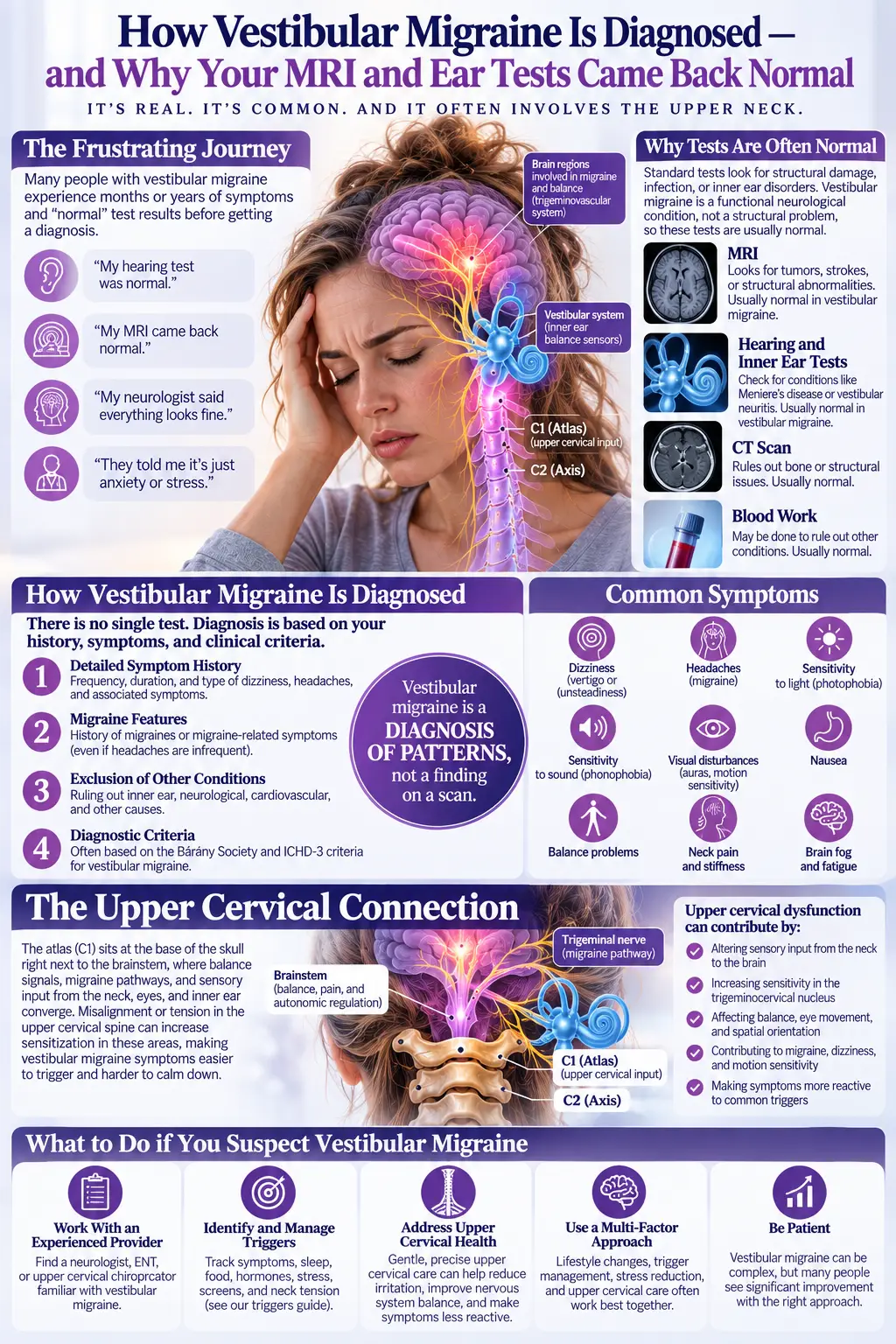
That’s why normal tests are the rule, not the exception. A physician who orders an MRI and a vestibular workup for someone with hours-long dizzy spells is doing exactly the right thing — not to find vestibular migraine, but to make sure it isn’t something else. When those come back clean, the diagnosis is made from the history.
The Criteria
The diagnostic criteria were published by Lempert and colleagues (2012) on behalf of the Bárány Society and the International Headache Society, and they’re the standard worldwide. In plain language, you meet them if all of the following are true:
A. At least five episodes of vestibular symptoms of moderate or severe intensity, lasting five minutes to seventy-two hours. “Vestibular symptoms” is broader than spinning. It includes spinning vertigo; a false sense of self-motion; positional vertigo set off by a change in head position; dizziness provoked by moving visual scenes; and head-motion-induced dizziness with nausea. “Moderate or severe” means it interferes with daily activity or stops it.
B. A current or past history of migraine, with or without aura. Not necessarily now — a history of migraines in your twenties counts. Family history alone doesn’t formally count, though it’s a strong clue.
C. One or more migraine features during at least half the vestibular episodes. The features: a headache with at least two of (one-sided, pulsating, moderate-to-severe, worse with activity); light and sound sensitivity; or visual aura. Note that light-and-sound sensitivity on its own satisfies this — no headache required. That’s the clause that explains the people who’ve been dizzy for years without a single headache and were told “it can’t be migraine.”
D. Not better accounted for by another diagnosis. Which is what the tests are for.
If you meet A, B, and C and the workup has excluded the alternatives, you have vestibular migraine. Count your episodes. Check your history. Think about whether bright light and noise bother you during the dizzy spells. Many people meet the criteria and have never had anyone walk them through it.
Our vestibular migraine guide goes through the condition fully, and silent vestibular migraine covers the no-headache presentation specifically.
What Each Test Is Really For
The workup looks like a search for vestibular migraine. It’s actually a search for everything else. Here’s what each piece is looking for, and why normal is good news.
Brain MRI. Rules out structural causes: tumor, stroke, multiple sclerosis, Chiari malformation, a problem at the base of the skull. In vestibular migraine it’s normal. If you’ve had one and it was clean, that’s the most important box checked. Our article on MRI for dizziness explains what a normal result does and doesn’t tell you.
Hearing test (audiogram). Rules out Meniere’s disease, which causes fluctuating low-frequency hearing loss along with vertigo. In vestibular migraine, hearing is normal — though Radtke and colleagues (2012), following vestibular migraine patients for nearly a decade, found that a minority developed mild hearing changes over time, so a slightly abnormal audiogram doesn’t exclude it. Our article on vestibular migraine vs. Meniere’s sorts the two.
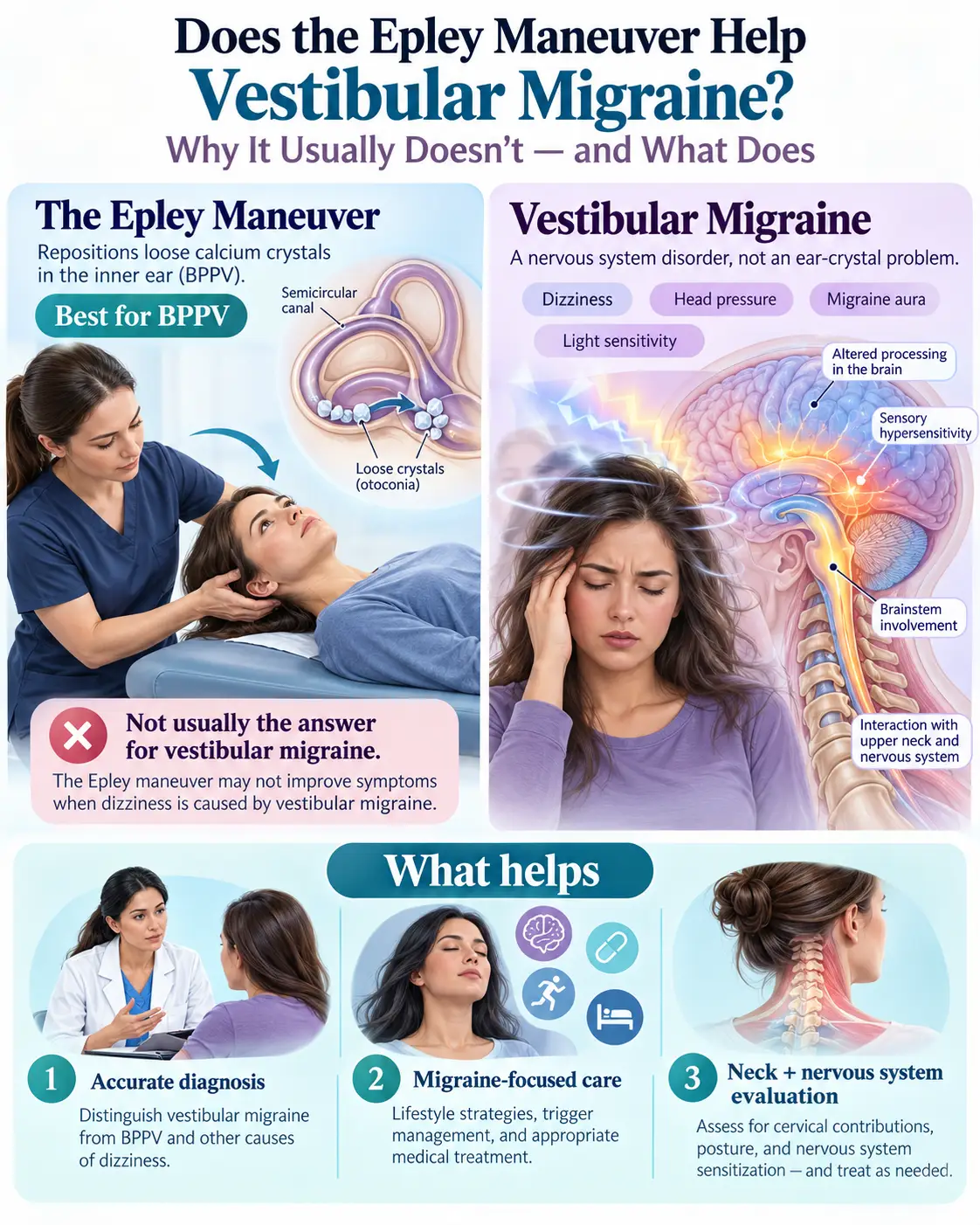
Positional testing (Dix-Hallpike). Rules out BPPV — loose inner-ear crystals. In BPPV the test provokes a specific burst of eye movement; in vestibular migraine it’s usually negative, or produces an atypical pattern. Our article on vestibular migraine vs. BPPV explains the difference.
Vestibular function tests (VNG/ENG, caloric testing, rotary chair, VEMP). Measure how each inner ear and its nerve respond. They rule out a damaged or weak ear — vestibular neuritis, labyrinthitis, a vestibular schwannoma. In vestibular migraine they’re normal or show minor, non-specific findings. von Brevern and colleagues (2005) examined patients during acute attacks and found abnormal eye movements that resolved as the attack passed — so between attacks, when testing usually happens, the ear looks fine.
Bloodwork. Thyroid, blood count, blood sugar, B12 — rules out metabolic causes of dizziness.
Orthostatic vitals or tilt testing. Rules out POTS and orthostatic hypotension, where dizziness comes from blood pressure and heart rate on standing rather than from the balance system.
When all of that is normal and the history fits the criteria, the diagnosis is vestibular migraine — and the physician is confident because the tests are normal, not in spite of it.
Why It Takes So Long to Get the Name
Neuhauser and colleagues (2006) estimated that about one percent of the population has vestibular migraine over a lifetime, and found that most had never been diagnosed. The reasons are predictable:
The headache is often absent, so nobody thinks “migraine.” The dizziness sends people to the ENT, whose tests look at the ear, and the ear is fine. The neurologist, if reached, may focus on headache and not ask about dizziness. The episodes are variable — spinning one week, unsteadiness the next, a bad day on the boat the week after — and don’t sound like one condition. And the criteria are only fourteen years old; many clinicians trained before they existed.
The practical consequence: if you’ve had a clean workup and hours-long dizzy spells, bring the Lempert criteria to your next appointment and ask directly whether you meet them.
What the Standard Workup Leaves Out: The Neck
Here’s the gap. The workup above examines the ear, the brain, the blood, and the blood pressure. It does not examine the neck — and the neck is one of the three inputs the brain uses to build its sense of balance.
Kristjansson and Treleaven (2009) reviewed how the upper cervical spine, with its dense concentration of position sensors, feeds the balance system, and how disturbed input from it produces dizziness, unsteadiness, and altered eye control. The upper neck also feeds the migraine generator directly through the trigeminocervical complex, as Bartsch and Goadsby (2003) describe. So in a condition defined as unstable balance processing in a migraine brain, one of the two inputs most likely to be destabilizing it is the one input the workup never measures.
This doesn’t change the diagnosis. If you meet the criteria, you have vestibular migraine. What it changes is the picture of what’s driving it — and whether there’s a structural contributor that can be measured and addressed.
The Upper Cervical Connection
The atlas (C1) and axis (C2) sit directly against the brainstem, where the inner-ear, visual, and neck inputs converge and where the migraine process is generated. When the atlas is misaligned, the position sensors at that level send distorted data into the balance circuits continuously, the upper cervical nerve roots feed irritation into the trigeminocervical complex continuously, and the migraine threshold stays low. Normal ear tests and a normal MRI don’t see any of this, because it’s a problem of position and function, not of structure the scanner can image.
An upper cervical evaluation measures it. It’s the examination that completes the picture the standard workup starts.
Upper Cervical Care at Lavender Family Chiropractic
When someone with a diagnosis of vestibular migraine — or a clean workup and no diagnosis yet — comes to our Sarasota office, the first visit is an evaluation, not an adjustment.
History, walked through against the Lempert criteria, so you leave knowing whether you meet them.
Examination. Neurological screening; reproduction testing of the upper neck; a head-repositioning test that measures how accurately the neck reports head position to the brain; positional screening for BPPV.
Paraspinal infrared thermography. A non-invasive scan of the heat pattern along the spine, reflecting nervous-system activity — an objective baseline at the upper neck and a way to track change.
3D cone-beam CT (CBCT) imaging of the upper cervical spine. The position of the atlas and axis relative to the skull, in three dimensions and to the degree — the measurement the MRI doesn’t make. Bring your MRI; the two studies answer different questions.
Review of findings before any care.
Correction, if indicated. A precise, low-force procedure specific to your measurements — no twisting, no cracking, no rotation of the neck. Most patients describe it as pressure.
Remeasurement. Thermography after each visit and follow-up imaging when indicated.
Upper cervical care addresses the mechanical source the research points to — the neck — with measurement before and after, so progress is objective rather than guessed at. Results vary from person to person, and we tell you plainly what the findings show. Your neurologist’s management continues alongside.
If your tests were normal and you’re still dizzy, call (941) 243-3729 or request an appointment online for an upper cervical evaluation.
What the Research Says
The criteria. Lempert and colleagues (2012) — the Bárány/IHS diagnostic criteria for vestibular migraine.
It’s a functional brain disorder, so tests are normal. Furman and colleagues (2013).
Attack-time findings resolve between attacks. von Brevern and colleagues (2005) documented eye-movement abnormalities during acute attacks that cleared afterward.
Long-term course and hearing. Radtke and colleagues (2012) followed patients for years: symptoms persisted in most, with mild hearing changes in a minority.
Prevalence and under-diagnosis. Neuhauser and colleagues (2006).
The neck is a balance input the workup doesn’t measure. Kristjansson and Treleaven (2009); Bartsch and Goadsby (2003).
What to Bring to Your Next Appointment
Whether it’s with a neurologist, an ENT, or us, these make the diagnosis faster:
- An episode log: date, duration (minutes vs. hours), what it felt like (spinning, rocking, unsteady, visually triggered), and whether light or sound bothered you during it
- Your migraine history, including childhood motion sickness and any migraines decades ago
- Family history of migraine or unexplained dizziness
- Copies of every test result — MRI report, audiogram, VNG — so nothing is repeated
- A note of any neck symptoms: stiffness, pain at the base of the skull, dizziness with neck movement, prior whiplash or concussion
If your dizziness has become constant rather than episodic, read our article on vestibular migraine vs. PPPD — that’s a separate diagnosis with different criteria. Our dizziness guide lays out how all the types are told apart.
Serving Sarasota, Bradenton, Lakewood Ranch, and the Suncoast
Our office is on Whitfield Avenue in north Sarasota, minutes from the Manatee County line. We see patients from Sarasota, Bradenton, Lakewood Ranch, Palmetto, Parrish, Ellenton, Longboat Key, Siesta Key, Osprey, Nokomis, Venice, and North Port — many of whom arrive with a folder of normal test results and no name for what’s wrong. The top of the neck is the piece of the examination that hasn’t yet been done.
Top 15 FAQs About Diagnosing Vestibular Migraine
1. Is there a test for vestibular migraine? No. It’s diagnosed by criteria — the pattern and history of your episodes — after other causes are excluded. Normal tests are expected.
2. Why was my MRI normal if something is wrong? Vestibular migraine is a problem of how the brain processes balance, not of brain structure. MRI shows structure. A normal MRI rules out the dangerous causes, which is its job.
3. Why were my ear tests normal? Because in vestibular migraine the inner ear is usually normal. The problem is upstream, in the brain’s processing. Attack-time abnormalities resolve between attacks, which is when testing usually happens.
4. Can I have vestibular migraine without headaches? Yes. The criteria accept light-and-sound sensitivity during episodes as a migraine feature; headache is not required. Many patients never have one.
5. What counts as a “vestibular symptom”? Spinning vertigo, a false sense of self-motion, positional vertigo, dizziness triggered by moving visual scenes, and head-motion dizziness with nausea.
6. How many episodes do I need? At least five, each lasting five minutes to seventy-two hours, of moderate or severe intensity.
7. Does a family history of migraine count? Not formally for criterion B, which requires your own history. But it’s a strong clue, and childhood motion sickness often stands in for an early migraine history.
8. Who diagnoses vestibular migraine? Usually a neurologist, sometimes an ENT or neuro-otologist. Bring the criteria and your episode log.
9. What else could it be? BPPV, Meniere’s disease, vestibular neuritis, PPPD, POTS, and rarely a central cause. The workup exists to exclude these.
10. Why does the standard workup skip the neck? Because it’s organized by specialty — ear, brain, blood, heart — and the neck’s role as a balance input falls between them. An upper cervical evaluation fills the gap.
11. Does an upper cervical evaluation diagnose vestibular migraine? No — that’s a medical diagnosis made by criteria. What we evaluate is whether the upper neck is contributing, which is a separate and complementary question.
12. What does CBCT show that MRI doesn’t? The precise position of the atlas and axis relative to the skull in three dimensions. MRI shows soft tissue and structure; it doesn’t measure alignment.
13. My tests were “slightly abnormal.” Does that rule out vestibular migraine? Not necessarily. Minor, non-specific vestibular findings and mild hearing changes have been documented in vestibular migraine over time. Your physician weighs them against the whole picture.
14. How long does it usually take to get diagnosed? Research found most people with vestibular migraine had never been diagnosed. Years is common. Bringing the criteria to your appointment shortens it.
15. Do you take insurance? Call the office and we’ll go through costs and coverage before anything begins.
Lavender Family Chiropractic in Sarasota, Florida offers a thorough upper cervical evaluation to find out whether we can help. Call (941) 243-3729 or request an appointment. 5899 Whitfield Avenue, Suite 107, Sarasota, FL 34243.
Related Articles
- Vestibular Migraine: Our Complete Guide
- When Should You Get an MRI for Dizziness?
- Vestibular Migraine vs. Meniere’s Disease
- Vestibular Migraine vs. BPPV
- Vestibular Migraine vs. PPPD
- Silent Vestibular Migraine
References
- Lempert T, et al. Vestibular migraine: diagnostic criteria. J Vestib Res. 2012. PMID 23142830
- Furman JM, Marcus DA, Balaban CD. Vestibular migraine: clinical aspects and pathophysiology. Lancet Neurol.2013. PMID 23769597
- von Brevern M, et al. Acute migrainous vertigo: clinical and oculographic findings. Brain. 2005. PMID 15601663
- Radtke A, et al. Vestibular migraine: long-term follow-up of clinical symptoms and vestibulo-cochlear findings. Neurology. 2012. PMID 23019266
- Neuhauser HK, et al. Migrainous vertigo: prevalence and impact on quality of life. Neurology. 2006. PMID 17000973
- Kristjansson E, Treleaven J. Sensorimotor function and dizziness in neck pain: implications for assessment and management. J Orthop Sports Phys Ther. 2009. PMID 19411769
- Bartsch T, Goadsby PJ. The trigeminocervical complex and migraine: current concepts and synthesis. Curr Pain Headache Rep. 2003. PMID 12946290
Related Posts


Get our upper cervical articles first.