Vestibular Migraine After a Concussion or Whiplash: When the Dizziness Started With an Injury
By Dr. Rusty Lavender, D.C. — upper cervical chiropractor, Lavender Family Chiropractic, Sarasota, FL. Reviewed and updated October 2026.
There’s a particular version of vestibular migraine that we see constantly in Sarasota, and it has a date attached. “I was rear-ended on Fruitville in March.” “I fell off a ladder two summers ago.” “I took an elbow in a pickup game.” Before that date, no dizziness, or a few migraines a year. After it: spinning spells, unsteadiness, motion sickness in the car, a head that feels full, and a neck that’s never been the same. The ER cleared them. The follow-up said “post-concussion syndrome” or “whiplash,” then “it should resolve.” It didn’t. And somewhere along the way, somebody finally said vestibular migraine— without explaining how an injury turned into a migraine condition.
This article explains it. It covers how head and neck trauma trigger migraine in people who never had it and worsen it in people who did; why the balance system is so often the part that’s affected; what the research says about post-traumatic headache and vestibular dysfunction; why whiplash with no head strike at all can produce the same picture; and why the upper neck — the structure every one of these injuries loads — is the piece that ties it together and the piece most workups skip.
This is educational content, not medical advice. After any head or neck injury, worsening headache, repeated vomiting, confusion, weakness, numbness, trouble speaking, or unequal pupils need emergency evaluation.
What Vestibular Migraine Is
Vestibular migraine is migraine that affects the balance system: vertigo, unsteadiness, motion sensitivity, and visual sensitivity in episodes lasting minutes to hours, with or without head pain. The criteria by Lempert and colleagues (2012)require a migraine history and migraine features in at least half the episodes. Furman and colleagues (2013) describe it as a brain disorder in which the processes that generate migraine destabilize the circuits that process balance. Our vestibular migraine guide covers it fully.
The criteria don’t say anything about how it starts. For many people, it starts with an injury.
Trauma Turns On Migraine
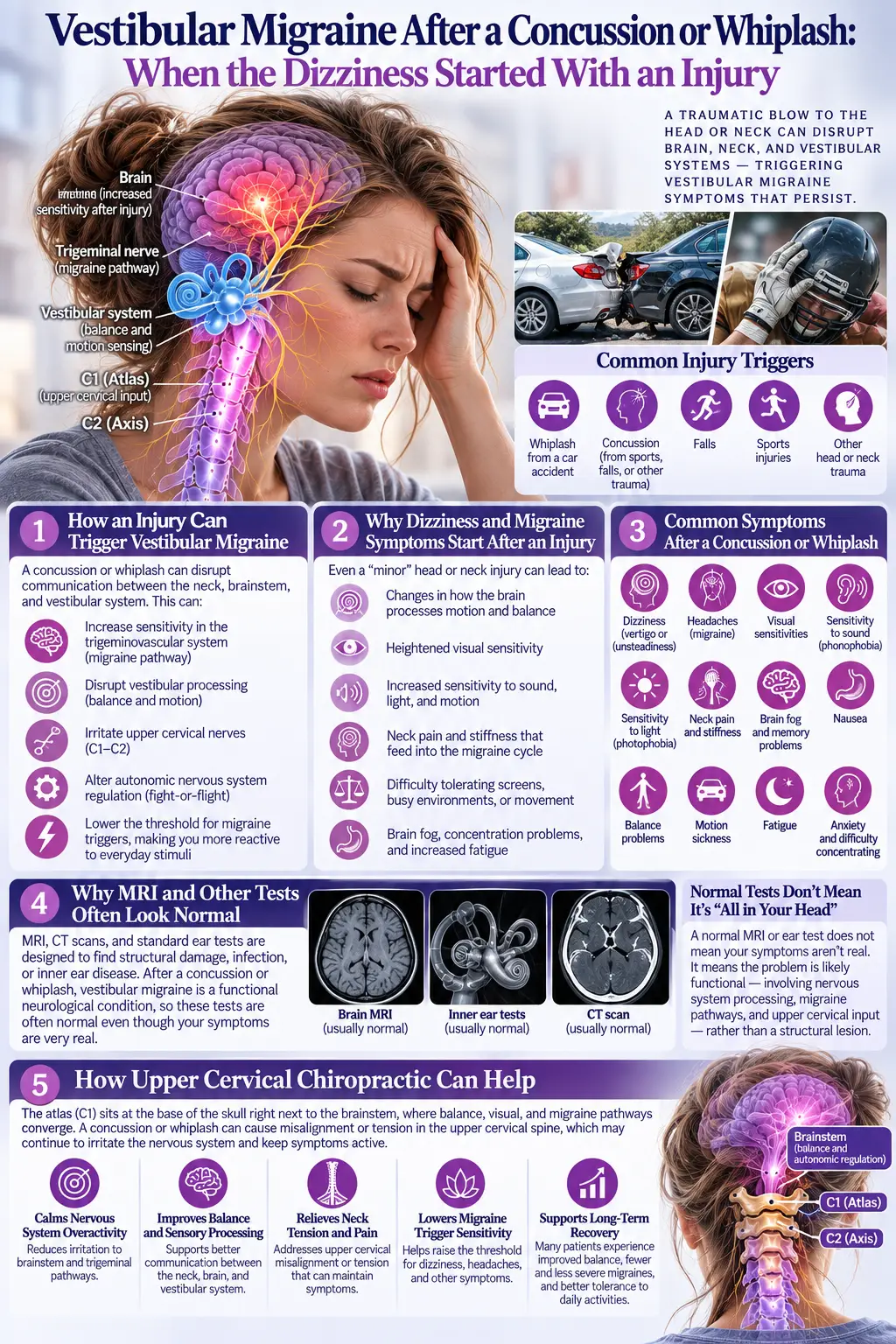
The link between head injury and migraine is one of the best-documented facts in headache medicine. Lucas and colleagues (2014) followed a large group of people after mild traumatic brain injury — concussion — for a year and found that headache was extremely common, and that the most frequent type of post-traumatic headache was migraine-type, not tension-type. Many of those people had no migraine history before the injury. A concussion doesn’t just cause a headache; it can switch on the migraine process in a brain that wasn’t running it before, or turn up the frequency in one that was.
The same injury affects balance. Marcus and colleagues (2019) examined patients soon after traumatic brain injury and found vestibular dysfunction — dizziness, imbalance, abnormal eye-movement findings — in a large proportion, from a mix of inner-ear, central, and cervical sources. The brain’s balance-processing circuits, already vulnerable in a migraine-prone person, take a direct hit.
Put the two together and you have the mechanism: a concussion lowers the migraine threshold and disturbs balance processing at the same time. The result, in a susceptible person, is vestibular migraine — episodes of vertigo and unsteadiness driven by a migraine process the injury switched on.
Our article on post-concussion syndrome covers the broader picture, and post-concussion vertigo covers the dizziness specifically.
Whiplash Without a Head Strike Does the Same Thing
Here’s what surprises people: you don’t need to hit your head. Whiplash — the rapid back-and-forth of the head on the neck in a rear-end collision — produces the same post-traumatic migraine and vestibular picture, and it does it through the neck.
The Quebec Task Force, in the landmark report by Spitzer and colleagues (1995), defined whiplash-associated disorders and recognized dizziness and headache as core features alongside neck pain. Treleaven and colleagues (2003) measured why: whiplash patients with dizziness had significantly worse cervical joint position sense — their necks were sending the brain inaccurate information about where the head was. The upper neck is one of the brain’s three balance inputs, and whiplash corrupts it.
And whiplash reaches the migraine generator directly. The nerves from the upper cervical segments feed into the same brainstem cells as the trigeminal nerve — the trigeminocervical complex that Bartsch and Goadsby (2003) describe — so an injured upper neck sends a continuous stream of input into the migraine process. Sterling and colleagues (2005) found that whiplash patients who went on to do poorly showed early signs of a sensitized nervous system; a sensitized nervous system is a migraine-prone nervous system.
So a rear-end collision at a stoplight, with no head strike and a clean CT, can produce vestibular migraine through the neck alone. Our article on whiplash-associated vertigo covers it, and the post-trauma cascade explains how one injury produces many conditions over time.
Concussion and Whiplash Usually Happen Together
In practice, the distinction is academic. Almost every concussion involves a whiplash of the neck — the forces that rattle the brain also whip the head on the neck — and many whiplash injuries involve enough acceleration to concuss without a strike. The brain injury and the neck injury happen in the same instant, and both feed the same brainstem.
That’s why “post-concussion syndrome” workups that look only at the brain, and “whiplash” workups that look only at the lower neck, both miss the structure in the middle: the upper cervical spine, where the brain’s balance inputs converge, where the migraine generator lives, and where the injury’s mechanical effects concentrate.
How to Tell If Your Vestibular Migraine Is Trauma-Driven
Some clues that point to an injury origin — and to the upper neck as a factor:
- A date. The dizziness and migraines began, or clearly changed, after a specific accident, fall, or hit.
- Neck symptoms travel with it. Stiffness, pain at the base of the skull, limited turning, a heavy-head feeling.
- Position provokes it. Turning the head, looking up, sustained screen or driving posture, sleeping wrong.
- Lingering unsteadiness between attacks. Not just episodes, but a baseline “off” feeling, worse with neck movement — the cervical input problem that Treleaven measured.
- It didn’t resolve on schedule. Most concussions settle in weeks; most whiplash improves in months. If you’re past that and still dizzy, the structural component is still there.
- A normal brain MRI. Which rules out the dangerous causes and leaves the functional ones — migraine and the neck.
Our article on vestibular migraine and neck pain covers the neck-migraine loop in depth.
The Upper Cervical Connection
Every injury described above loads the same structure. The junction between the skull, the atlas (C1), and the axis (C2) is built for motion, not stability — it relies on ligaments rather than bony restraint — and it’s where the whip of a whiplash and the snap of a concussion concentrate their force. It’s also where the brain’s three balance inputs converge in the brainstem, and where the trigeminocervical complex generates migraine.
When the atlas is displaced by an injury, three things follow. The position sensors at that level send distorted input into balance processing — continuously, not just during attacks. The upper cervical nerve roots feed irritation into the migraine generator, keeping the threshold low. And the mechanics of the whole neck below are disturbed, which is the stiffness and pain patients feel. A brain MRI doesn’t show any of this, because it’s a problem of position, not structure. A cervical MRI shows discs and nerve roots at the lower neck, not the alignment of the top.
This is the structural piece that turns a short-term injury into a long-term vestibular migraine, and it’s measurable.
Upper Cervical Care at Lavender Family Chiropractic
When someone whose dizziness started with an injury comes to our Sarasota office, the first visit is an evaluation, not an adjustment.
History, including the injury itself in detail — mechanism, direction of impact, whether there was a head strike, what the ER and follow-up found, the timeline since.
Examination. Neurological screening and red-flag assessment; reproduction testing of the upper neck; a head-repositioning test that measures the cervical position-sense error Treleaven’s research describes; positional screening for BPPV, since trauma can also dislodge inner-ear crystals.
Paraspinal infrared thermography. A non-invasive scan of the heat pattern along the spine, reflecting nervous-system activity — an objective baseline at the upper neck and a way to track change.
3D cone-beam CT (CBCT) imaging of the upper cervical spine. The position of the atlas and axis relative to the skull, in three dimensions and to the degree. Bring any imaging you already have; the CBCT answers the question the others don’t.
Review of findings before any care.
Correction, if indicated. A precise, low-force procedure specific to your measurements — no twisting, no cracking, no rotation of a neck that’s been injured. Most patients describe it as pressure.
Remeasurement. Thermography after each visit and follow-up imaging when indicated.
Upper cervical care addresses the mechanical source the research points to — the neck — with measurement before and after, so progress is objective rather than guessed at. Results vary from person to person, and we tell you plainly what the findings show. Your neurologist’s management of the migraine, and any vestibular therapy you’re doing, continue alongside; we address the structural input the injury created.
If your dizziness has a date, call (941) 243-3729 or request an appointment online for an upper cervical evaluation.
What the Research Says
Concussion switches on migraine. Lucas and colleagues (2014) found migraine-type headache the most common post-traumatic headache after mild TBI, often in people with no prior migraine.
Concussion disturbs balance. Marcus and colleagues (2019) documented vestibular dysfunction in a large proportion of acute TBI patients from inner-ear, central, and cervical sources.
Whiplash corrupts the neck’s balance input. Treleaven and colleagues (2003) measured impaired cervical position sense in dizzy whiplash patients. Spitzer and colleagues (1995) recognized dizziness and headache as core whiplash features.
Whiplash sensitizes the nervous system. Sterling and colleagues (2005) found early sensitization predicted poor outcome.
The upper neck feeds the migraine generator. Bartsch and Goadsby (2003).
Vestibular migraine is unstable balance processing in a migraine brain. Furman and colleagues (2013); criteria by Lempert and colleagues (2012).
Living With It While You Address It
Protect the neck. No rotational neck adjustments, no self-cracking, no aggressive stretching. Neutral head position at screens; a pillow that keeps the neck in line; headrest contact while driving.
Manage the migraine side. Sleep, hydration, regular meals, weather awareness, screen limits — the standard trigger toolkit, which has more room to work once the structural input is addressed.
Keep moving, carefully. Gentle walking and gradual return to activity help both concussion recovery and vestibular compensation. Vestibular rehabilitation helps many people; if you’ve plateaued, the neck is the usual reason.
Document. If there’s a claim, keep records of every symptom and every visit. We document findings and imaging thoroughly.
Watch for PPPD. If the episodic dizziness has become constant, visually triggered unsteadiness, that’s a separate condition that often follows injury. Our dizziness guide explains how the types are told apart.
Serving Sarasota, Bradenton, Lakewood Ranch, and the Suncoast
Our office is on Whitfield Avenue in north Sarasota, minutes from the Manatee County line. We see post-injury vestibular migraine patients from Sarasota, Bradenton, Lakewood Ranch, Palmetto, Parrish, Ellenton, Longboat Key, Siesta Key, Osprey, Nokomis, Venice, and North Port — I-75, 41, and Fruitville produce a steady stream of them. If your dizziness has a date and nobody has measured the top of your neck, that’s the piece that hasn’t yet been examined.
Top 15 FAQs About Vestibular Migraine After Injury
1. Can a concussion cause vestibular migraine? Yes. Migraine-type headache is the most common headache after concussion, often in people with no prior migraine, and concussion disturbs balance processing at the same time.
2. Can whiplash cause vestibular migraine without hitting my head? Yes. Whiplash corrupts the upper neck’s balance input and feeds the migraine generator through the trigeminocervical complex. No head strike is required.
3. I never had migraines before the accident. How can this be migraine? Trauma can switch on the migraine process in a brain that wasn’t running it. The Lucas study documented exactly this.
4. How long after an injury can vestibular migraine start? Often within days or weeks, but it can emerge months later as the nervous system sensitizes and the neck’s position settles into a new, worse pattern.
5. My brain MRI and CT were normal. Doesn’t that mean I’m fine? They rule out bleeding and structural damage, which is critical. They don’t measure how the brain is processing balance or how the top of the neck is positioned.
6. Is it post-concussion syndrome or vestibular migraine? Often both. Post-concussion syndrome is the umbrella; vestibular migraine is one of the specific mechanisms underneath it. The names overlap more than they compete.
7. Why is my neck involved if the problem is a concussion? Almost every concussion whips the neck. The brain injury and the neck injury happen in the same instant and feed the same brainstem.
8. Why does turning my head make me dizzy since the accident? The upper neck’s position sensors were disturbed by the injury and now send inaccurate data when the head moves. That’s the mechanism Treleaven measured in whiplash patients.
9. Will vestibular rehab fix it? It helps the brain compensate and many people improve. If the neck is still sending bad input, rehab plateaus — which is the point at which the upper neck needs evaluation.
10. Is it safe to have my neck adjusted after a concussion or whiplash? Rotational adjustments are not appropriate for an injured upper neck. The low-force, imaging-guided procedure we use involves no rotation and no thrust, and we screen for instability before any care.
11. Could an injury from years ago be the cause? Yes. The structural change from an old whiplash persists, and vestibular migraine can surface years later when other triggers stack on top.
12. Should I see a neurologist first? If you haven’t had a post-injury evaluation, yes — and a neurologist manages the migraine side. We address the structural input. Many patients see both.
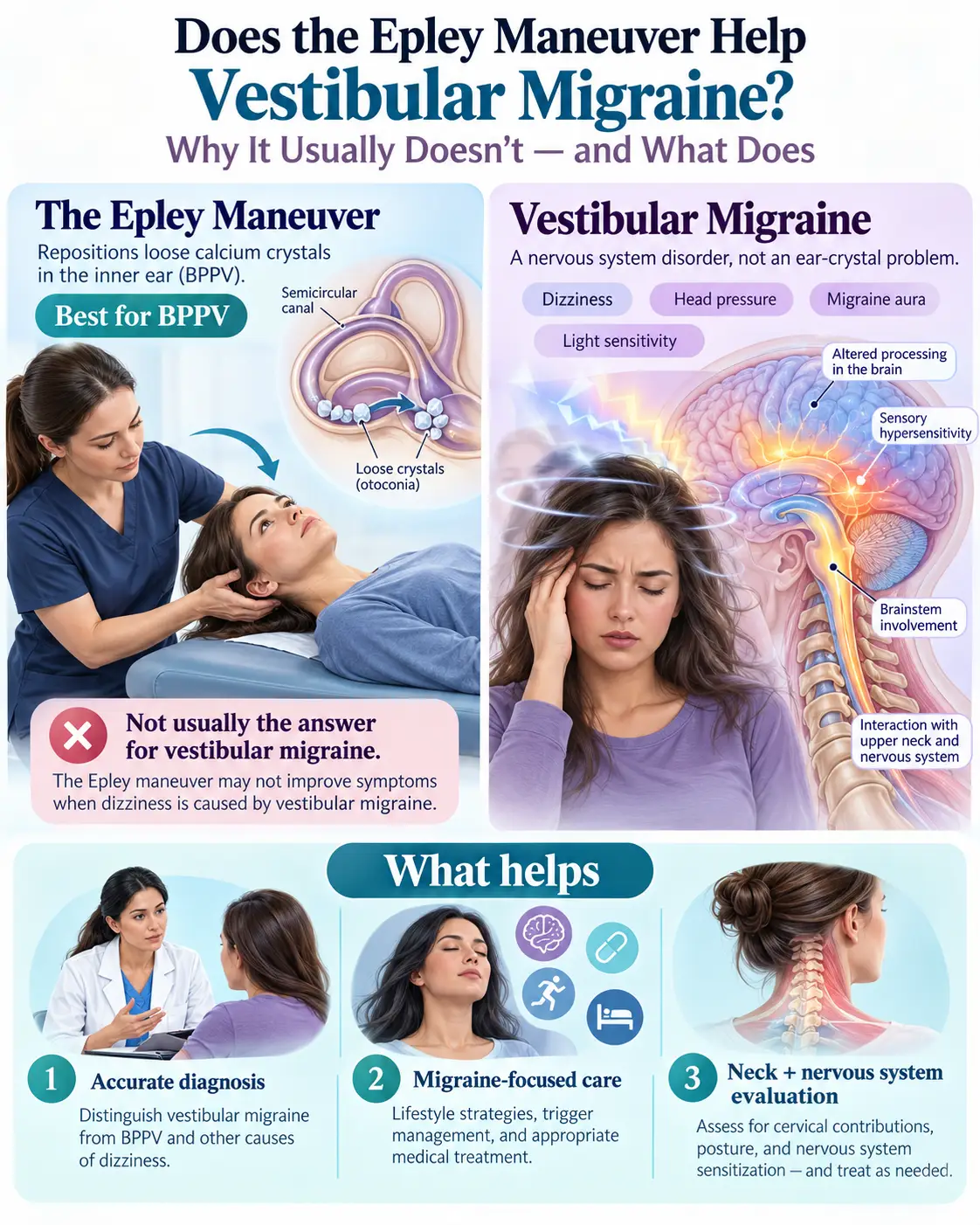
13. Does the Epley maneuver help post-injury dizziness? Only if trauma dislodged inner-ear crystals (BPPV), which does happen. We screen for it. If the dizziness lasts hours and travels with migraine features, it’s not BPPV.
14. How soon would I notice a difference? When the upper neck is a factor and it’s corrected, patients typically report changes in neck symptoms first, then attack frequency and baseline unsteadiness, within the first several weeks.
15. Do you work with attorneys and PIP? We document findings, imaging, and progress thoroughly and provide records on request. Call the office and we’ll go through coverage before anything begins.
Lavender Family Chiropractic in Sarasota, Florida offers a thorough upper cervical evaluation to find out whether we can help. Call (941) 243-3729 or request an appointment. 5899 Whitfield Avenue, Suite 107, Sarasota, FL 34243.
Related Articles
- Vestibular Migraine: Our Complete Guide
- Post-Concussion Syndrome
- Whiplash-Associated Vertigo
- The Post-Trauma Cascade
- Post-Concussion Vertigo in Sarasota
- Vestibular Migraine and Neck Pain
References
- Lempert T, et al. Vestibular migraine: diagnostic criteria. J Vestib Res. 2012. PMID 23142830
- Furman JM, Marcus DA, Balaban CD. Vestibular migraine: clinical aspects and pathophysiology. Lancet Neurol.2013. PMID 23769597
- Lucas S, et al. A prospective study of prevalence and characterization of headache following mild traumatic brain injury. Cephalalgia. 2014. PMID 23921798
- Marcus HJ, et al. Vestibular dysfunction in acute traumatic brain injury. J Neurol. 2019. PMID 31201499
- Spitzer WO, et al. Scientific monograph of the Quebec Task Force on Whiplash-Associated Disorders. Spine. 1995. PMID 7604354
- Treleaven J, et al. Dizziness and unsteadiness following whiplash injury: characteristic features and relationship with cervical joint position error. J Rehabil Med. 2003. PMID 12610847
- Sterling M, et al. Physical and psychological factors predict outcome following whiplash injury. Pain. 2005. PMID 15733639
- Bartsch T, Goadsby PJ. The trigeminocervical complex and migraine: current concepts and synthesis. Curr Pain Headache Rep. 2003. PMID 12946290
Related Posts


Get our upper cervical articles first.
Patients Experience