Eustachian Tube Dysfunction Treatment and Relief in Lakewood Ranch, FL: ENT Options, and When the Neck Is Involved
By Dr. Rusty Lavender, D.C. and Dr. Jacob Temple, D.C. — upper cervical chiropractors, Lavender Family Chiropractic, Sarasota, FL. Published October 2026.
If you live in Lakewood Ranch and your ear has been full, popping, muffled, or under pressure for weeks, you have probably already done the obvious things: the nasal spray, the decongestant, the Valsalva, maybe an ENT visit that ended with “your ear looks fine.” This page is for the Lakewood Ranch resident at that point. It explains what Eustachian tube dysfunction actually is, the three types that get lumped under one name, what the ENT options are and how well they work, why a large share of people have persistent symptoms after a normal exam, and the specific anatomical reason we look at the top of the neck when that happens. Our complete guide to Eustachian tube dysfunction and the upper cervical spine covers the mechanism in depth; this is the Lakewood Ranch decision guide.
Educational content, not medical advice. Sudden hearing loss in one ear, ear pain with fever, drainage from the ear, or ear symptoms with facial weakness or severe vertigo need a physician promptly; sudden hearing loss in particular is time-sensitive.
What the Eustachian Tube Does, and What Goes Wrong
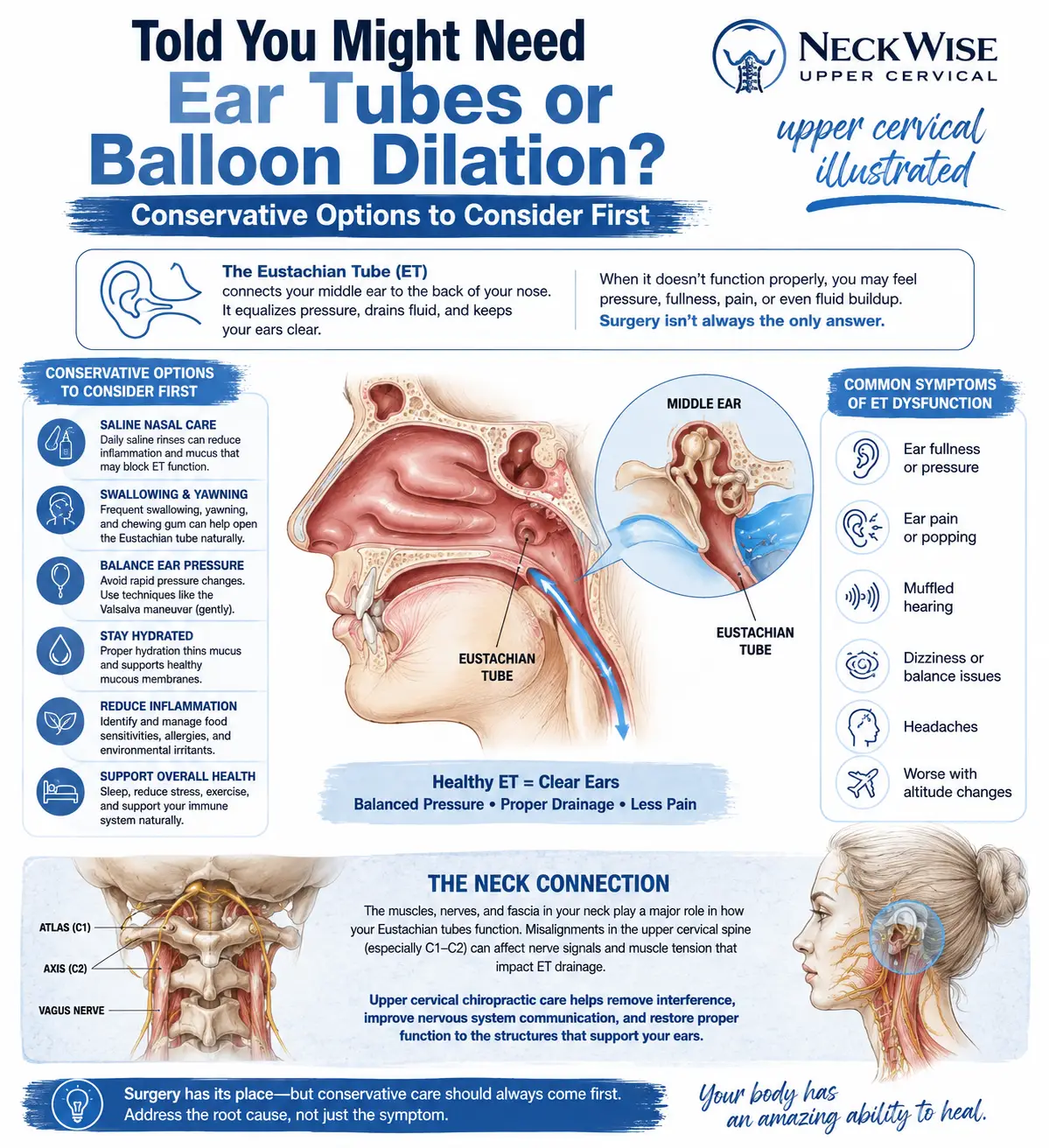
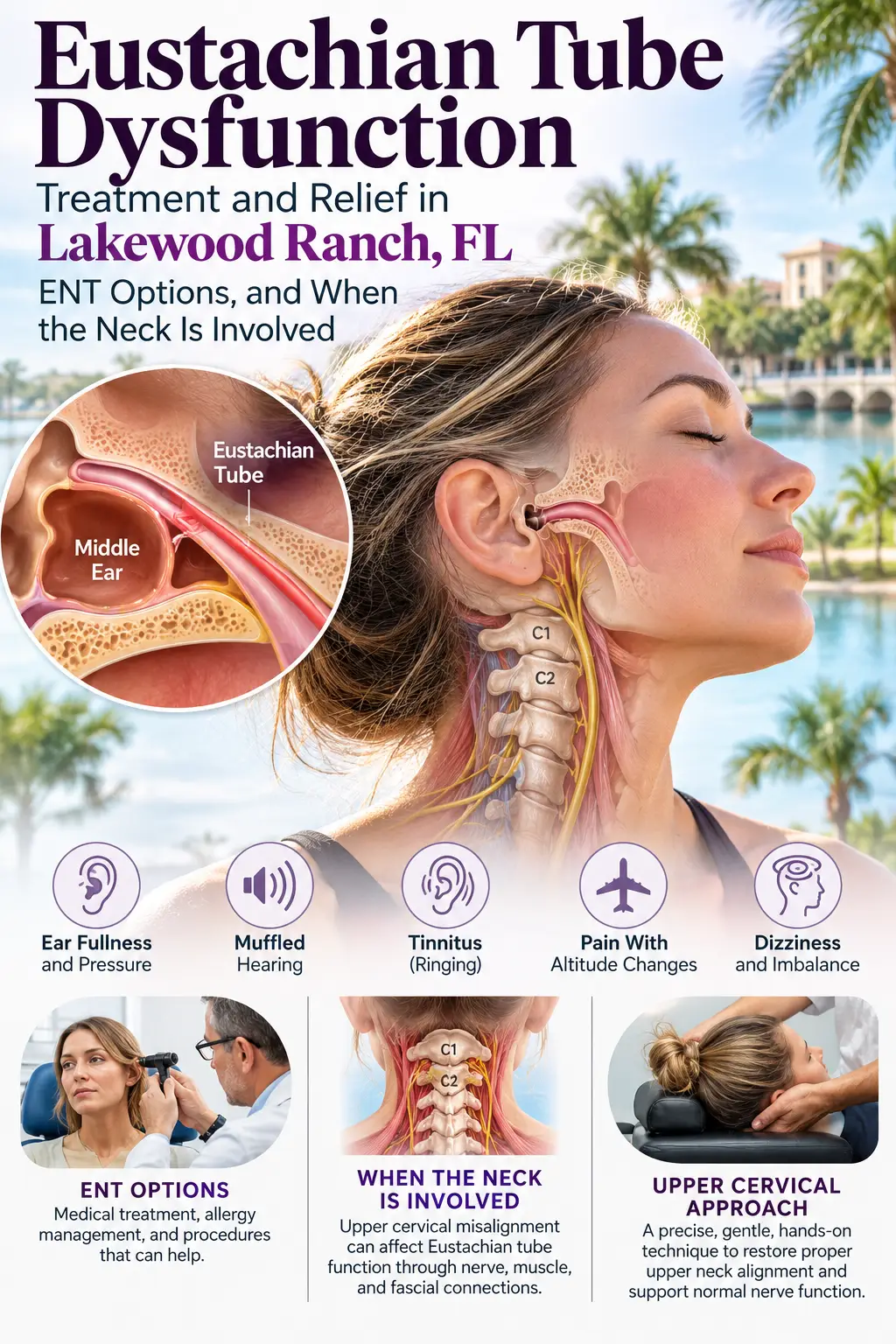
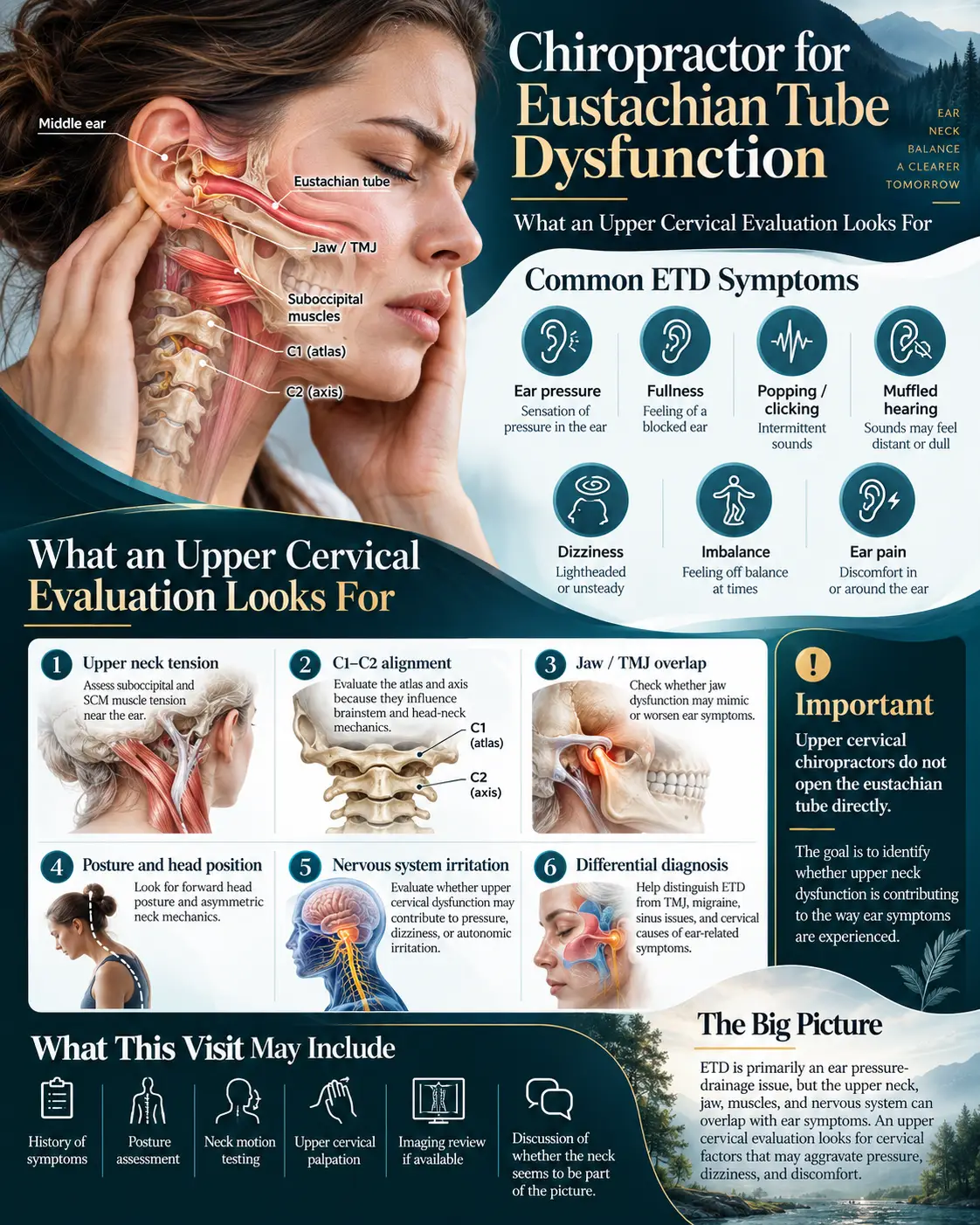
The Eustachian tube is a narrow channel from the middle ear to the back of the nose. It is closed most of the time and opens for a fraction of a second when you swallow or yawn, equalizing the pressure behind the eardrum with the air around you. Eustachian tube dysfunction is a failure of that opening-and-closing cycle. The international consensus statement that defines it describes ear pressure, fullness, popping or crackling, muffled hearing, and sometimes mild ear discomfort or imbalance, with symptoms that commonly worsen with altitude change, flying, colds, or allergies (Schilder et al., Clin Otolaryngol 2015).
The same consensus is useful for a second reason: it insists that ETD is three different problems, and the treatment is different for each.
Obstructive (dilatory) ETD. The tube does not open well enough. This is the common one, the plugged-and-full ear, usually driven by inflammation from allergies, congestion, or reflux, or by the mechanics of the tube itself. Our article on dilatory obstructive ETD goes further.
Patulous ETD. The opposite: the tube stays open when it should be closed, so you hear your own voice and breathing booming inside your head (autophony), often worse after weight loss, dehydration, or hard exercise, and often temporarily relieved by lying down. Decongestants make it worse, which is a common clue that the diagnosis was wrong. See our guide to patulous ETD.
Baro-challenge-induced ETD. The tube works fine at ground level but fails under pressure change: flying, diving, or a fast elevator. Lakewood Ranch has a lot of frequent flyers out of SRQ and a lot of boaters and divers, and this is the type we hear about most from them. See baro-challenge ETD.
Eustachian Tube Dysfunction Treatment Options in Lakewood Ranch: What the ENT Offers
The first stop for ETD in Lakewood Ranch should be a physician, and for persistent symptoms an ENT. Here is what that pathway involves and what the evidence says about each step.
| Option | What it is for | What to expect |
|---|---|---|
| Watchful waiting and equalizing maneuvers | Obstructive ETD after a cold or flight | Most cases settle within weeks; gentle Valsalva or an autoinsufflation device can help the tube open |
| Nasal steroid spray, antihistamines, allergy management | Obstructive ETD with an inflammatory or allergic driver | Trials show modest benefit at best; worth a proper course if allergy is clearly involved, not a cure-all |
| Treating reflux | Obstructive ETD with laryngopharyngeal reflux irritating the tube opening | Helps the subset where reflux is the driver |
| Pressure-equalizing (PE) tubes | Fluid behind the eardrum that will not clear | Immediate relief of the fluid; does not fix the tube itself, and tubes extrude in months to a year or two |
| Eustachian tube balloon dilation | Adult obstructive ETD that has failed medical management | A systematic review and meta-analysis found improvement in symptom scores and tube function in refractory obstructive ETD (Froehlich et al., Otolaryngol Head Neck Surg 2020); a clinical consensus statement sets out who is a candidate (Tucci et al., Otolaryngol Head Neck Surg 2019) |
| Hydration, weight stabilization, saline, occasionally procedures | Patulous ETD | A different problem; decongestants and steroid sprays make it worse |
ENT practices in the Lakewood Ranch and UTC area offer the medical options, and balloon dilation is available in Sarasota. We would never steer a Lakewood Ranch patient away from any of it. For most people, ETD is managed conservatively and improves. The page is really about the people for whom it doesn’t.
Why Your Ear Still Feels Full After a Normal ENT Exam
This is the most common story we hear from Lakewood Ranch ETD patients. The eardrum looks normal. The hearing test is normal. The tympanometry, the pressure test, is normal or borderline. There is no fluid. And yet the ear is full, pops, or aches, every day, sometimes for years. Three things are worth understanding about that situation.
First, the tube does not open on its own. A small muscle in the soft palate, the tensor veli palatini, pulls it open for a fraction of a second every time you swallow. It is the tube’s principal dilator (Leuwer, Otolaryngol Clin North Am 2016), and electromyography shows tube opening tracks its activity directly (Alper et al., Arch Otolaryngol Head Neck Surg2012; Picciotti et al., J Laryngol Otol 2017). A tube that is anatomically normal but whose opening muscle is not firing well will test normal at rest and still fail in daily life.
Second, that muscle is controlled by the trigeminal nerve, and it anchors to the base of the skull. The tensor veli palatini is one of the few palate muscles supplied by the trigeminal nerve’s mandibular branch rather than by the vagus, and an osteological study of the Eustachian tube, tensor veli palatini, and cranial base documents how intimately the tube and its muscle relate to the bony skull base (Doyle et al., Int J Pediatr Otorhinolaryngol 2010). That skull base is where the atlas, the top vertebra, sits.
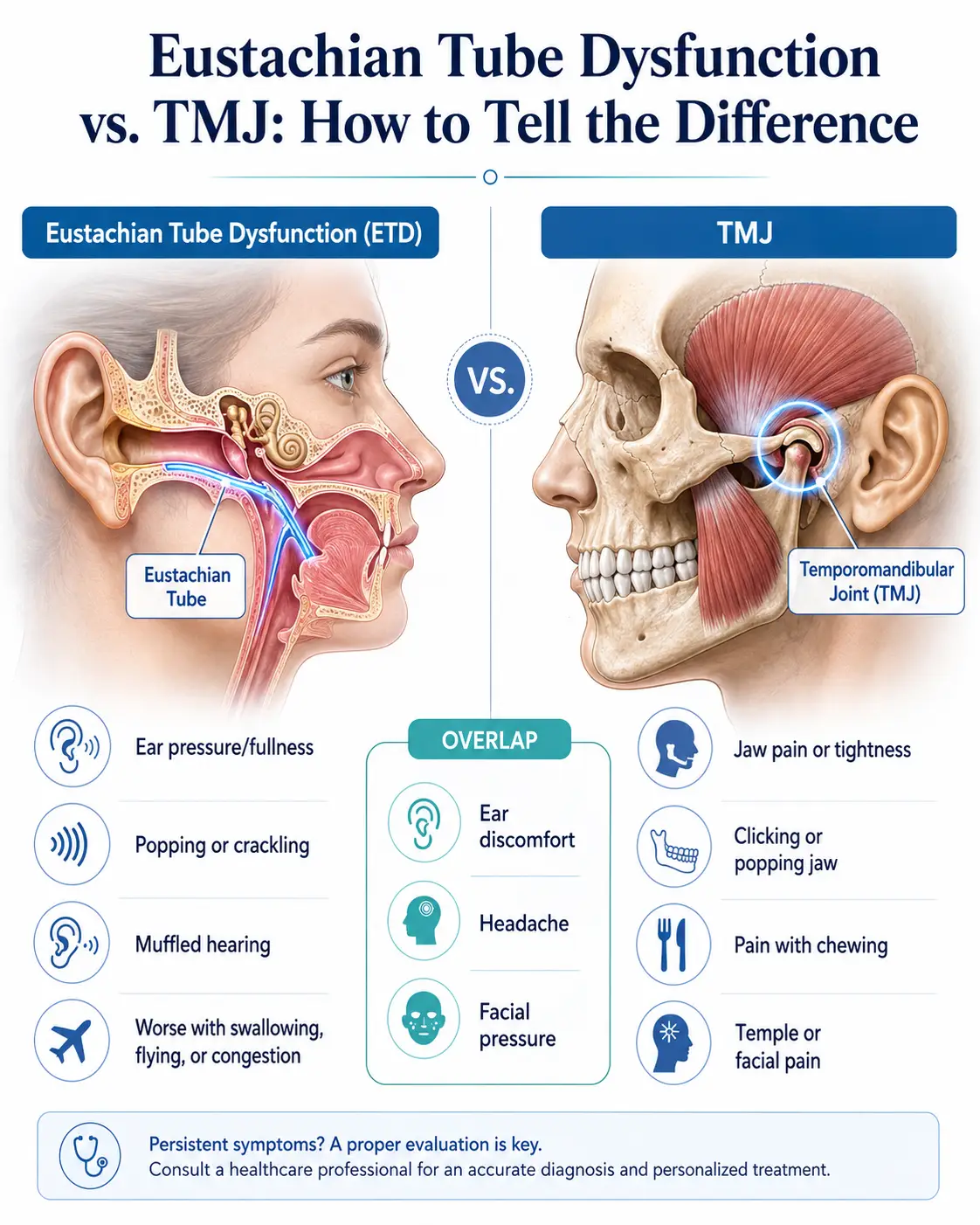
Third, the ear itself receives sensory fibers from the upper cervical nerves, so irritation in the upper neck can be felt in the ear directly as fullness, pressure, or pain with nothing wrong in the ear at all. Radiologists mapping referred ear pain list the cervical spine among its sources (Norris and Chen, AJNR 2020). The same holds for the jaw: the temporomandibular joint sits a finger’s width in front of the ear canal, and TMJ problems produce ear fullness that is routinely mistaken for ETD. Sorting out tube, jaw, and neck is the whole job for the normal-exam patient.
Where the Upper Cervical Spine Fits
Put those three facts together. The tube’s opening muscle runs on trigeminal signal; the trigeminal system shares its brainstem relay with the upper cervical nerves; the muscle anchors to the skull base beside the atlas; and the ear can feel neck irritation directly. When the atlas is shifted, the upper cervical nerves feed distorted input into that relay continuously, the muscles at the base of the skull sit under abnormal tension, and the mechanics around the skull base change. That is a plausible, anatomically grounded reason an ear can feel full with a normal exam, and it is the reason we examine the top of the neck in ETD patients.
Here is the paragraph most chiropractic websites will not write. There are no large, high-quality clinical trials showing that upper cervical chiropractic care treats or reliably improves Eustachian tube dysfunction. The evidence for the connection is anatomical and neurological, which is real, plus our clinical experience, which is not the same as a trial. We tell every Lakewood Ranch ETD patient this on the first visit. What we offer is an evaluation of a region the ENT workup does not examine, with imaging that shows whether there is anything there to correct. If there is not, we say so.
What an Upper Cervical Evaluation for ETD Involves
The first visit is an evaluation, not a sales conversation. We take the full ear history: which ear, how long, what it feels like, what provokes it, whether it changes with lying down or swallowing or altitude, what the ENT found, and what you have tried. We ask about the jaw, the neck, and any injury history back to childhood, because an old whiplash or a fall is often where an upper cervical misalignment began. We check the jaw and the neck for the signs that point toward TMJ or cervical referral rather than the tube.
Then we measure. 3D cone-beam CT of the upper cervical spine shows the position of the atlas and axis in three dimensions, including rotation that a flat X-ray cannot show. Paraspinal thermography reads the nervous system’s pattern along the spine and gives an objective marker to track. We review the findings with you before any care begins. If the imaging shows a misalignment consistent with your picture, the correction is a precise, low-force procedure delivered to the atlas with no twisting and no cracking. If it shows nothing to correct, we say so and help you get back to the ENT with the neck ruled out, which is itself useful information.
Many of our ETD patients keep their nasal steroid or allergy plan going while under our care, and some go on to balloon dilation afterward if the tube itself turns out to be the problem. The two approaches address different parts of the system. Our article on conservative options for ETD lays out the full ladder.
Getting Here from Lakewood Ranch
Our office is at 5899 Whitfield Avenue, Suite 107, right at the corner of University Parkway and Whitfield Avenue, just west of I-75 near UTC and Nathan Benderson Park. From Lakewood Ranch Main Street it is a straight shot west on University Parkway: about 4 miles, under 10 minutes. From Waterside or the Lorraine Road corridor, allow 15 to 20. Free parking at the door. Our Lakewood Ranch page has the full picture of who we see from the Ranch.
Who Should and Shouldn’t Come
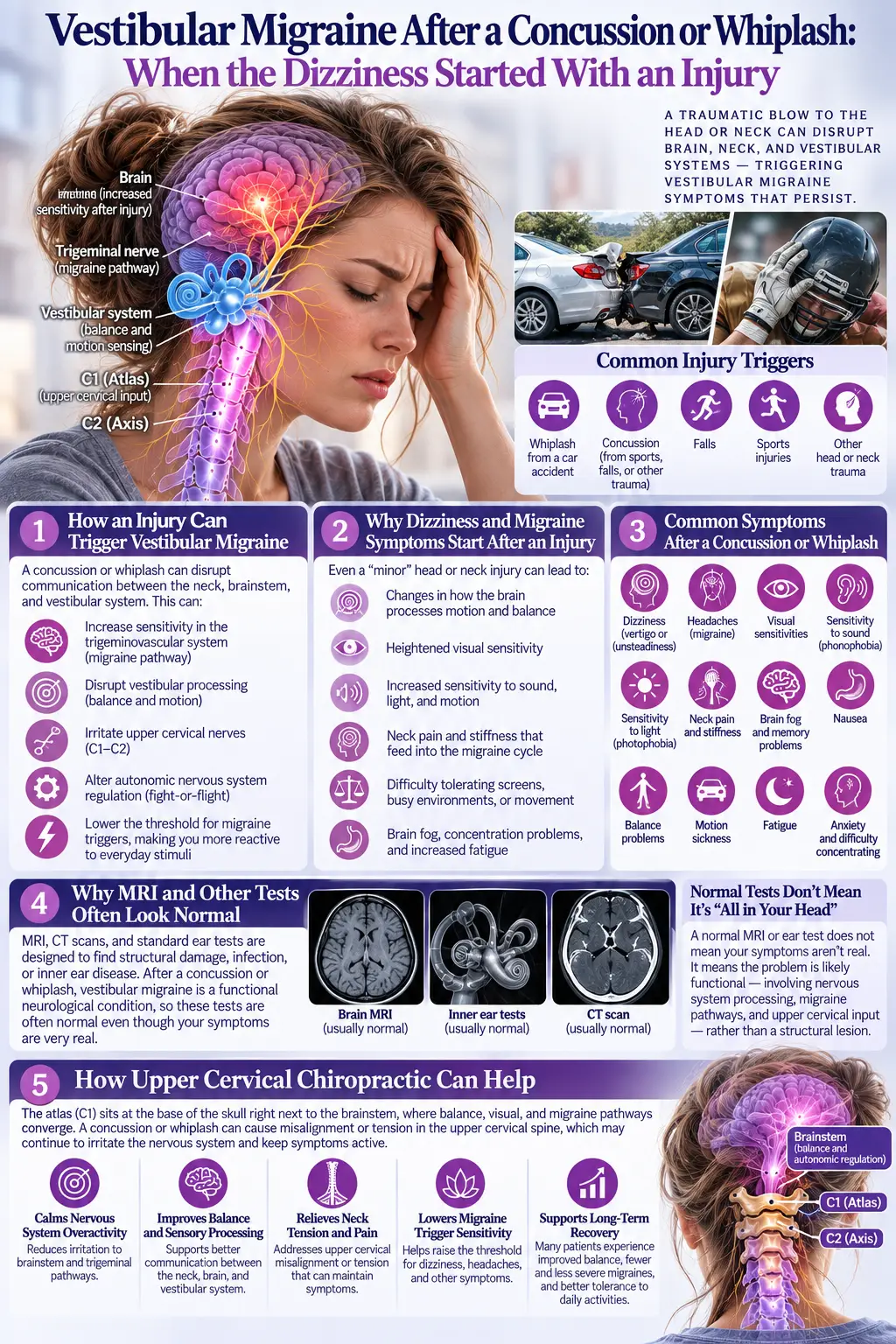
Come for an upper cervical evaluation if: your ear has been full, popping, or under pressure for more than a few weeks; an ENT exam, hearing test, and pressure test were normal or near-normal; the symptoms travel with neck stiffness, headaches at the base of the skull, jaw tension, or dizziness; they began or worsened after a car accident, fall, or concussion; or you have been through sprays, tubes, or even balloon dilation and the fullness is still there.
See someone else first if: you have sudden hearing loss in one ear (urgent: a physician the same day); ear pain with fever or drainage (physician); fluid behind the eardrum or an abnormal pressure test (ENT; the tube itself needs treating); or autophony that fits the patulous pattern (ENT; it is a different problem).
Frequently Asked Questions About ETD Treatment in Lakewood Ranch
Where can I get Eustachian tube dysfunction treatment in Lakewood Ranch, FL? Start with your physician or an ENT in the Lakewood Ranch or UTC area for the medical options: sprays, allergy management, tubes, and a referral for balloon dilation if needed. For the normal-exam patient whose ear is still full, the closest upper cervical office is ours at University Parkway and Whitfield Avenue, under 10 minutes west of Main Street.
Can a chiropractor help with Eustachian tube dysfunction? There are no trials showing that it does. The anatomy connecting the tube’s opening muscle to the trigeminal nerve and the upper neck is real, and we see patients improve, but we do not promise it. What we offer is an evaluation of the one region the ENT workup does not examine, with imaging that shows whether there is anything to correct.
My ENT said my ear is fine but it still feels full. What’s going on? Three common explanations: the tube is anatomically normal but its opening muscle is not working well; the fullness is referred from the jaw; or it is referred from the upper neck. Each is examined differently, and that is what the first visit is for.
Is it ETD or TMJ? If the fullness changes with chewing, clenching, or opening wide, or you have jaw clicking or morning jaw soreness, the jaw is a leading suspect. Our ETD versus TMJ guide walks through the differences.
My ears won’t clear when I fly out of SRQ. Is that ETD? That pattern is baro-challenge-induced ETD, the type that works at ground level and fails under pressure change. It responds to timing of equalizing maneuvers and sometimes to medical treatment; if it comes with neck symptoms, it is worth an evaluation.
Should I get balloon dilation? For adult obstructive ETD that has failed medical management, the pooled evidence supports it, and an ENT can tell you whether you are a candidate. If your tube tests normal, balloon dilation is aimed at the wrong structure, and that is the group we most often see.
My ear fullness started after a car accident on I-75. Is that connected? Often. Whiplash loads the upper cervical spine specifically, and ear fullness is a recognized post-whiplash symptom; our article on ear fullness after a car accidentexplains why.
How many visits will it take? We can’t say until we have evaluated you, and we won’t guess. The first visit is history, exam, thermography, and imaging if indicated, and we review findings before any care begins.
Can I keep seeing my ENT? Yes, and you should. We address the input from the top of the neck; the ENT addresses the tube, the nose, and the inflammation. We will send your ENT our findings if you want us to.
Does insurance cover it? We are out of network. Many patients receive a superbill to submit for reimbursement, and we go over costs and options before you commit to anything.
Lavender Family Chiropractic in Sarasota, Florida offers a thorough upper cervical evaluation to find out whether the top of your neck is part of your ear symptoms. Call (941) 243-3729 or request an appointment. 5899 Whitfield Avenue, Suite 107, Sarasota, FL 34243, under 10 minutes from Lakewood Ranch Main Street.
References
- Schilder AGM, et al. Eustachian tube dysfunction: consensus statement on definition, types, clinical presentation and diagnosis. Clin Otolaryngol. 2015;40(5):407–411. PMID 26347263
- Froehlich MH, et al. Eustachian tube balloon dilation: a systematic review and meta-analysis of treatment outcomes. Otolaryngol Head Neck Surg. 2020;163(5):870–882. PMID 32482125
- Tucci DL, et al. Clinical consensus statement: balloon dilation of the Eustachian tube. Otolaryngol Head Neck Surg.2019;161(1):6–17. PMID 31161864
- Leuwer R. Anatomy of the Eustachian tube. Otolaryngol Clin North Am. 2016;49(5):1097–1106. PMID 27468634
- Alper CM, et al. Relationship between the electromyographic activity of the paratubal muscles and Eustachian tube opening. Arch Otolaryngol Head Neck Surg. 2012;138(8):741–746. PMID 22801708
- Picciotti PM, et al. Tensor veli palatini electromyography for monitoring Eustachian tube rehabilitation in otitis media. J Laryngol Otol. 2017;131(5):411–416. PMID 28294083
- Doyle WJ, et al. Eustachian tube–tensor veli palatini muscle–cranial base relationships in children and adults: an osteological study. Int J Pediatr Otorhinolaryngol. 2010;74(9):986–990. PMID 20580443
- Norris CD, Chen BY. Secondary otalgia: referred pain pathways and pathologies. AJNR Am J Neuroradiol.2020;41(12):2188–2198. PMID 33093134
Related Posts
Get our upper cervical articles first.
Patients Experience